Die-Struck Iron vs Zinc Alloy for Custom Pins in 2026
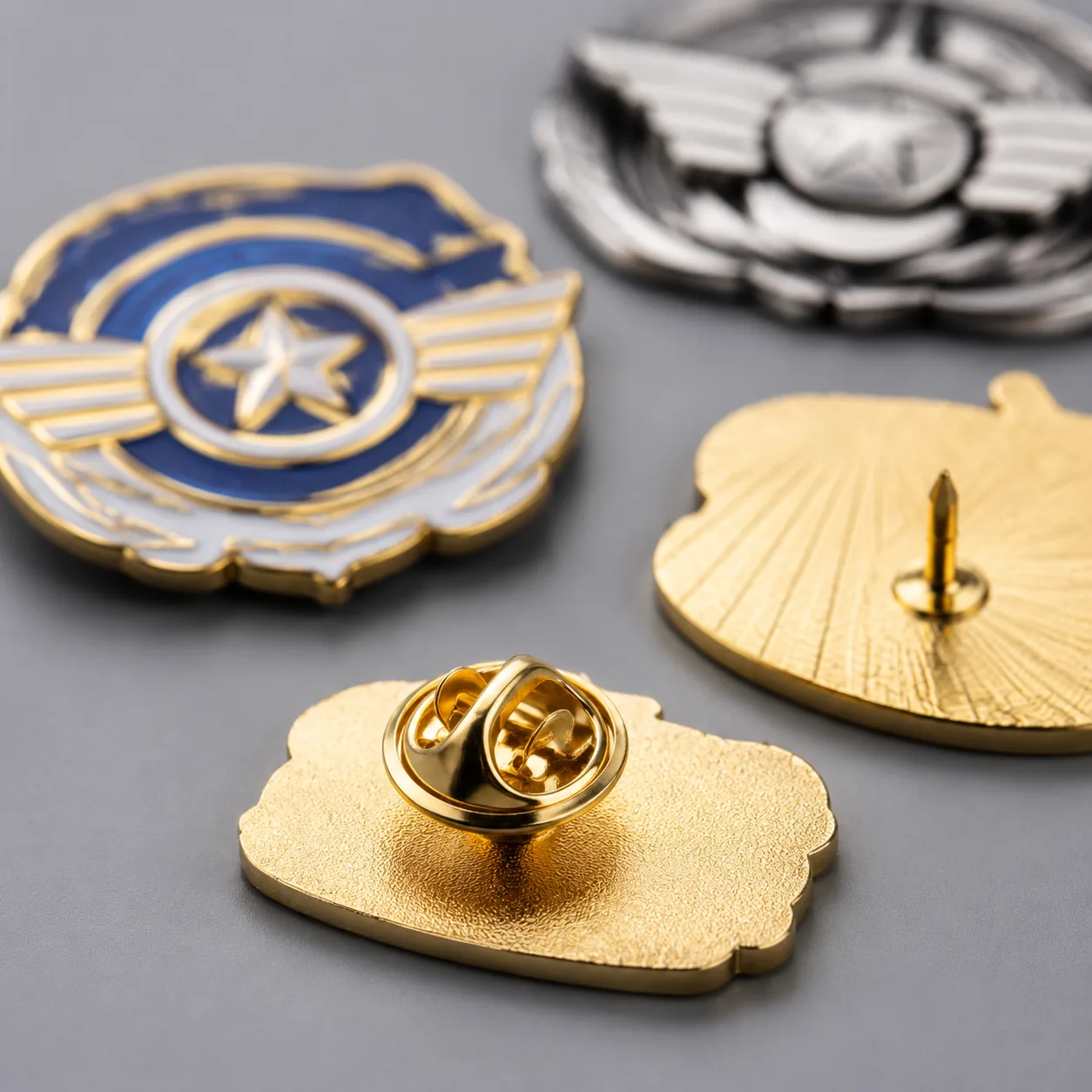
Start with the manufacturing route, not the metal name
The most common quoting mistake on custom pins is treating iron and zinc alloy as direct substitutes when the actual constructions are different. In 2026, one factory may quote a 35 mm die-struck iron pin built from 1.2-1.5 mm low-carbon sheet with one front level and shallow enamel recesses. Another may quote a zinc alloy pin at 2.0-2.5 mm overall thickness with cast relief, larger bridge sections, more polishing allowance, and a heavier back. Both can be called a 35 mm soft enamel pin, but they are not equivalent parts.
That difference changes more than appearance. It affects tooling, unit weight, achievable relief depth, minimum line width, edge sharpness, outline tolerance, plating consistency, and repeat-order stability. Buyers often assume they are comparing raw material cost. In practice, they are comparing stamping versus pressure casting, two processes with different physical limits and different defect patterns.
For simple logo pins, the gap may only be a few cents per piece. For irregular silhouettes, deep cutouts, stepped relief, spinners, danglers, or souvenir pins sold at retail, the process choice decides whether the artwork can be manufactured cleanly at all. The right decision starts with geometry, target FOB, and acceptable process variation, not with a generic preference for one alloy.
This comparison assumes the decoration method is already fixed, usually soft enamel or imitation hard enamel. The practical sourcing question is narrower: for the same artwork intent, when should you specify die-struck iron and when should you move to zinc alloy? The answer depends on relief depth, minimum metal bridge, enamel cell size, finished thickness, MOQ, lead time in production days, and how much visual drift your program can tolerate on repeat orders.
Core spec comparison: where iron and zinc alloy actually diverge
| Buyer Criteria | Die-Struck Iron | Zinc Alloy | What It Means In Practice |
|---|---|---|---|
| Typical process | Stamped from low-carbon steel sheet, formed, plated, enamel-filled, baked, then polished | Pressure cast in steel mold, gates removed, polished, plated, enamel-filled, baked, then finished | Iron favors flatter, graphic builds; zinc supports sculpted and irregular geometry |
| Common material basis | SPCC or equivalent low-carbon iron sheet, typically 0.8-1.5 mm stock | Zamak 3 or similar zinc-aluminum casting alloy | Zinc is easier for complex contours and back relief |
| Recommended finished thickness | 1.2-1.8 mm common; 1.5 mm standard for soft enamel pins | 1.8-3.0 mm common; 2.0-2.2 mm standard for soft enamel pins | Zinc usually has more body and heavier hand feel |
| Efficient size range | 15-45 mm most efficient; simple shapes up to about 50 mm | 20-70 mm common; 75 mm possible with controlled wall sections | Small badges run efficiently in iron; larger irregular pieces favor zinc |
| Minimum raised metal line width | 0.25-0.30 mm possible; 0.35 mm safer for repeat production | 0.30-0.40 mm possible; 0.45 mm safer after polishing | Iron usually holds narrow dividers and small text more crisply |
| Minimum recessed enamel area | 0.40-0.50 mm practical | 0.50-0.70 mm practical | Very small color islands are more reliable in iron |
| Relief depth on front face | Usually shallow, about 0.15-0.30 mm between levels | Commonly 0.30-0.80 mm; deeper relief possible with larger features | Zinc is better when shape, not just graphics, carries the design |
| Outline tolerance | Typically +/-0.10 to +/-0.15 mm | Typically +/-0.15 to +/-0.25 mm | Iron is tighter on geometric outlines; zinc varies more on cast edges |
| Flatness expectation | Better on small to mid-size flat pieces | More warpage risk on large thin castings, especially above 45 mm | Important for magnets, brooches, and two-post pins |
| Typical tooling cost | USD 60-130 for standard 2D die; USD 130-180 for complex cutouts | USD 130-250 for standard mold; USD 250-450 for deep relief, back cavity, or assembly features | Zinc tooling costs more and rises faster with complexity |
| FOB unit price at 100 pcs, 30 mm soft enamel | USD 0.50-0.85 | USD 0.75-1.20 | Iron is usually the lower first quote |
| FOB unit price at 500 pcs, 30 mm soft enamel | USD 0.27-0.46 | USD 0.43-0.78 | The mid-volume gap often remains 20-35% |
| FOB unit price at 1000 pcs, 30 mm soft enamel | USD 0.21-0.37 | USD 0.34-0.64 | Volume helps both, but zinc still carries more process cost |
| Typical MOQ | 100 pcs standard; 50 pcs sometimes possible for repeat simple work | 100 pcs standard; below 100 only works if grouped with other casting runs | Iron is easier to justify on low-volume SKU programs |
| Lead time after artwork approval | 10-14 production days standard; 7-9 days possible on repeat simple orders | 12-18 production days standard; 15-22 days for assemblies or premium packing | Zinc usually needs more finishing and QC time |
| Decorative plating thickness | Typically 0.03-0.08 microns for nickel, gold tone, black nickel, antique copper | Typically 0.03-0.08 microns for the same finishes | Decorative plating is thin unless heavier plating is specified and priced |
| AQL baseline | Major 2.5 / Minor 4.0 | Major 2.5 / Minor 4.0 | The acceptance plan can match even though defect modes differ |
| Best fit | Logo pins, school badges, employee awards, event giveaways, distributor programs | Mascot pins, souvenir retail pieces, sculpted commemoratives, jewelry-leaning brooches | Choose by geometry first, then cost |
Cost, MOQ, and where the real price breaks happen
For a straightforward 25-40 mm pin with one front level, standard soft enamel recesses, and a butterfly clutch, die-struck iron remains the value option. In 2026 sourcing, a 30 mm iron pin at 300-500 pcs is typically 20-40% lower in FOB cost than the same artwork rebuilt in zinc alloy. The savings come from cheaper tooling, faster cycle time, lower polishing labor, and less metal weight per piece.
That gap matters most on programs with many SKUs and modest reorder volume. A buyer carrying 12 event designs at 200 pcs each is more exposed to tooling amortization than a buyer ordering 10,000 pcs of one SKU. An iron die at USD 80-95 versus a zinc mold at USD 180-220 is material when the design may reorder only once per year. Iron also tends to produce cleaner price ladders at 100, 300, 500, and 1000 pcs, which helps when forecast accuracy is weak.
MOQ on both metals is usually 100 pcs, but the economics differ. Iron is easier to run profitably at 100-200 pcs because the setup is simpler and the die cost is lower. Zinc can also run at 100 pcs, but many factories only accept that tier for uncomplicated shapes or when the order can be combined with other casting work in the same production window. For a new zinc SKU below 150 pcs, the quote often looks acceptable only because tolerances, polishing time, or defect screening have been relaxed.
The apparent iron cost advantage disappears when the artwork exceeds what stamping can hold. A low iron quote may stay low only because the supplier silently widened lines from 0.25 mm to 0.40 mm, enlarged enamel cells, flattened relief, reduced cutouts, or moved post positions. At that point you are not comparing metals. You are comparing a simplified iron version against a properly built zinc version.
A practical screening rule is simple. Quote iron first when the design fits within about 1.5 mm finished thickness, uses metal lines of at least 0.30-0.35 mm, keeps enamel cells above 0.50 mm, and does not rely on sculpted transitions. Quote zinc in parallel when the design needs 2.0 mm or more body, organic contours, deep recesses, integrated windows, or a premium retail feel.
Detail, relief, and weight: which process wins on the part itself
Zinc alloy earns its premium when the artwork depends on form rather than only on graphics. Cast construction allows deeper cavities, smoother curves, compound outlines, and clearer height transitions between raised and recessed areas. That makes zinc the better fit for mascot pins, destination souvenirs, layered commemoratives, and jewelry-adjacent designs that should feel sculpted instead of merely stamped.
A concrete example is a 45 mm character pin with two open cutouts, stepped relief on clothing, rounded facial contours, and a recessed back to balance two posts. That concept can be forced into iron, but the factory will usually flatten the front, open the cutouts less cleanly, and accept more edge distortion risk. In zinc alloy at 2.0-2.5 mm, the same design usually holds its silhouette better and needs fewer artwork concessions.
Iron still outperforms zinc on fine graphic separation. Stamping generally creates cleaner walls on straight borders, narrow dividers, and text-heavy insignia. If a design includes 4 mm-high letters, internal counters, serial-style linework, or thin borders around 0.30 mm, iron usually looks sharper. Zinc can reproduce the artwork, but detail softens slightly after casting, deburring, polishing, and plating, especially on pins below 20 mm or with dense text.
Weight affects the decision more than many buyers expect. A 35 mm zinc pin at 2.0 mm thickness often weighs about 10-14 g depending on cutouts and enamel coverage, while a comparable 1.5 mm iron pin is often 6-9 g. Retail buyers often prefer the heavier zinc feel because it reads as premium in hand. For conference giveaways, mailer kits, lightweight garments, or lanyard accessories, that extra mass may add no value and can create rotation or fabric sag unless the attachment hardware is upgraded.
There is also a tooling implication. Iron is efficient for flat badge-style shapes with one clean perimeter. Zinc becomes more attractive once the artwork needs internal windows, large rounded lobes, back relief, nonuniform thickness, or hardware placement that would be difficult to stamp without distortion or secondary forming.
QC and defect risk should match the process
Using one generic inspection checklist for both metals is a mistake. The appearance standard may be the same, but the likely defects are different. On die-struck iron, common watchpoints are burrs on complex outlines, enamel underfill in narrow channels, edge rollover on aggressive shapes, die marks on broad flat fields, and plating skips on sharp corners. On zinc alloy, the risks shift toward casting pits, substrate porosity, softened fine detail after polishing, plating inconsistency caused by uneven surface prep, and over-polished edges that lose definition.
Inspection can still use the same shipment acceptance baseline. AQL Major 2.5 and Minor 4.0 remains common for promotional, school, and distributor programs in 2026. Retail souvenir and licensing programs often keep that numeric AQL but tighten visual criteria on front-face scratches, enamel height consistency, plating tone, and edge smoothness. Antique finishes need explicit approval criteria because darkening in recesses may be intentional on one SKU and a defect on another.
Flatness deserves its own test. For pins above 45 mm, magnets, brooches, or matched two-piece sets, place finished samples on a glass plate and measure lift or rocking. A practical commercial limit is under 0.5 mm visible lift at the highest point for standard pins. Magnets, brooches, and paired sets often need under 0.3 mm to sit correctly. For enamel height, many buyers accept a front-face variation of about +/-0.10 mm on standard soft enamel, while premium imitation hard enamel programs often target tighter surface uniformity after polishing.
Attachment performance matters too. A single butterfly clutch is usually acceptable at 25-30 mm and under about 8 g finished weight. Heavier zinc builds often need two posts spaced roughly 18-22 mm apart, a rubber clutch for anti-spin control, or a locking back for garments with movement. At sample approval, record measurable standards: finished size, total thickness, weight in grams, plating finish, Pantone references, approved minimum line width, post spacing, and backing type. Without those numbers, a repeat PO six months later can drift while still appearing to match the old artwork.
Lead time, repeatability, and 2026 sourcing risk
In 2026, first-order price is rarely the only issue. The harder question is whether the approved look can be repeated without another week of adjustment, plating mismatch, or color drift. On standard shapes, iron usually has the simpler production window. Once the die, Pantone references, and packaging standard are fixed, replenishment orders tend to move faster and with fewer process variables.
A typical repeat order for a standard iron soft enamel pin can ship in 8-12 production days after PO confirmation when the die remains active and the plating is routine. A comparable zinc reorder is more commonly 10-15 production days, and complex pieces with spinners, danglers, chains, hinge parts, or retail card packing often run 15-22 days. Those are normal windows, not delays. They reflect extra casting, deburring, polishing, assembly, and QC steps.
Zinc is also less forgiving of process drift. Surface preparation affects plating tone more visibly, and deeper cavities make enamel fill height harder to keep uniform lot to lot. That does not make zinc unreliable. It means the supplier needs tighter process control and better records. For repeat programs, confirm that the factory retains mold number, Pantone references, plating swatch, approved sample photos, weight record, and packaging specification in the tooling file rather than only in an old sales order.
If the ship date has little slack, iron generally offers more schedule resilience. If the concept requires sculpted geometry or heavier retail feel, zinc is still the better choice, but buyers should budget another 2-4 production days of buffer for sample revision, polishing variation, or assembly correction.
Use-case checklist: when to specify iron and when to move to zinc
- Choose die-struck iron for 20-40 mm logo pins, school emblems, employee recognition badges, conference giveaways, and distributor programs where MOQ is 100-300 pcs and target FOB must stay aggressive.
- Choose zinc alloy for irregular outlines, mascot pins, destination souvenirs, commemoratives with stepped relief, and designs that need 2.0 mm or more apparent body.
- Use iron when the artwork is text-heavy, border-driven, or technical, especially where metal lines fall in the 0.30-0.35 mm range and crisp separation matters.
- Use zinc when the front face depends on curved organic surfaces, deep recesses over about 0.30 mm, integrated cutouts, back cavities, or hardware layouts that are awkward in stamped sheet.
- Avoid iron for heavily sculpted concepts, large rounded shapes with thin bridges, or designs likely to distort during stamping and forming.
- Avoid zinc for very small, highly detailed, budget-sensitive pins where a 20-40% cost premium and slightly softer edges work against the program.
- For wearable pieces, evaluate the full build: size, weight, post spacing, clutch type, and back balance matter as much as the base metal.
How to request a true side-by-side quote
If you ask a supplier to quote a 30 mm custom pin with no construction detail, the responses will describe different products and the comparison will be unreliable. Hold constant the finished size, nominal thickness, decoration type, number of enamel colors, attachment style, plating finish, backing card or polybag, and export carton packing. Also ask whether thickness is measured at the metal body only or at the highest finished point after enamel and plating, because factories do not describe this consistently.
For a usable comparison, request two line items from the same artwork: die-struck iron at 1.5 mm finished thickness and zinc alloy at 2.0 mm finished thickness, both with identical plating, identical attachments, identical packaging, and the same AQL standard. Ask for pricing at 100, 300, 500, and 1000 pcs, plus separate tooling cost, sample charge, and repeat-order pricing. If the design includes cutouts, ask for the minimum bridge width each process can hold without increasing reject rate.
Add one requirement many buyers leave out: the supplier must identify any artwork simplification required for each process, including widened lines, enlarged enamel areas, reduced relief, altered cutouts, changed corner radii, or moved post positions. That single sentence exposes unrealistic low quotes early.
For retail, licensed, or otherwise high-visibility programs, buy one pre-production sample in each metal even if the answer appears obvious. Spending an extra USD 40-120 on comparative sampling is usually cheaper than discovering after mass production that the approved render hid softer edges, unstable attachment spacing, unwanted weight, or a silhouette that reads differently in hand. The decision rule remains straightforward: if the artwork is flat, graphic, and cost-sensitive, iron is usually the correct first specification. If the concept is contoured, irregular, and sold partly on tactile value, zinc alloy usually justifies the added tooling and unit cost.
Have a project? Send your artwork and target quantity and we’ll reply with a detailed quotation within 12 working hours.
Ready to get this made?
Send your sketch, target quantity and ship-date. Detailed quotation in 12 hours.



