Custom Staff Name Badges: From Name List to Sorted Shipment
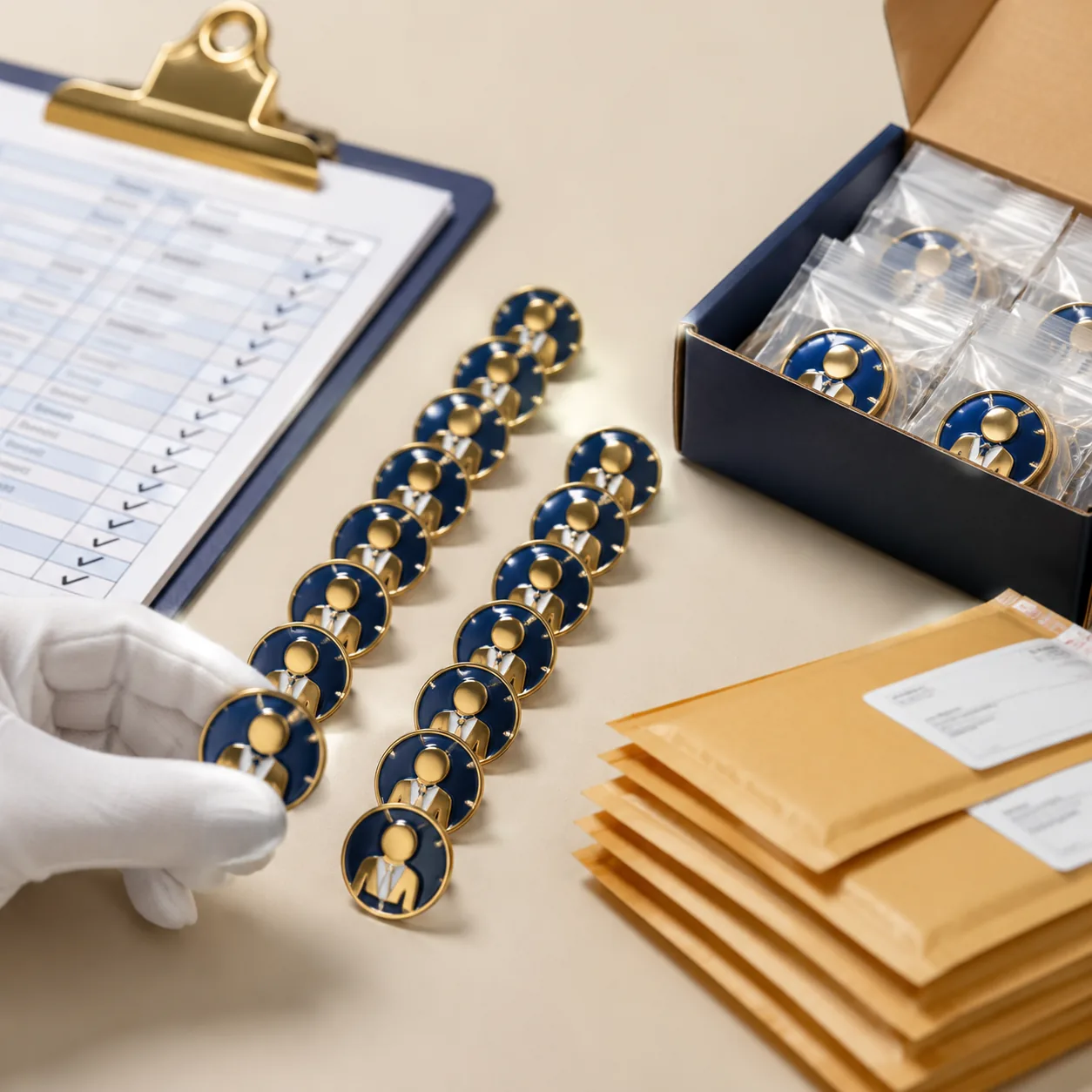
Opening Scenario: 420 Badges, 42 Days, No Room for Rework
A hotel procurement manager needs 420 staff name badges for a property opening in 42 days. The badges must match a champagne-gold brand finish, show individual names, separate front desk, concierge and housekeeping supervisors by department color, and arrive packed by team for onboarding. The buyer has a logo file, an Excel staff list and a uniform fabric swatch, but no factory-ready specification.
Name badges look simple, but the risk is in the variable details. A badge can pass a quick visual check and still fail in use if the magnet rotates on a jacket, a long name is unreadable at guest distance, accents are lost from the staff list, or 420 pieces arrive mixed in bulk bags. For staff programs, the production brief must control construction, finish, variable data, attachment, inspection limits and packing sequence before sampling.
At ZheCraft, these orders are treated as controlled variable-data production, not generic promotional pins. The target is a badge HR can issue directly from the carton: correct name, correct department, correct attachment and correct packing group, without sorting every piece again at the hotel.
Select the Badge Construction Before Quoting
The first purchasing decision is whether each badge carries a permanent name or a replaceable insert. Fixed UV-printed names provide the cleanest front face and are difficult for staff to alter, but every personnel change requires a reorder. Reusable windows reduce replacement cost for high-turnover teams, but they add thickness, expose the insert edge and require the buyer to manage printed inserts consistently.
For hotels, banks, clinics, airline lounges and premium retail stores, fixed names usually suit guest-facing roles. For seasonal staff, training cohorts, back-of-house teams and event crews, a window badge may be more practical. A common hybrid is a fixed plated body with logo and department color, plus a 36 x 10 mm or 40 x 11 mm clear acrylic window for a paper or PET insert.
| Badge Type | Factory Spec | Best Use | Trade-Off |
|---|---|---|---|
| Fixed UV-printed name | 0.8-1.2 mm brass or iron body, UV name print, optional 0.3-0.5 mm epoxy dome | Permanent staff, premium uniforms, guest-facing roles | Reorders needed for staff changes; spelling approval is critical |
| Reusable window badge | Metal body with 0.8-1.0 mm acrylic window, 0.18-0.25 mm paper or PET insert | Seasonal teams, rotating supervisors, reception desks | Thicker profile; insert quality depends on buyer process |
| Laser-engraved name | Brass or stainless plate, 0.03-0.08 mm engraving depth, black fill optional | Security, industrial and long-life corporate use | Limited color; small lettering has lower contrast |
| Printed insert in frame | Stamped or die-cast frame with slide-in insert and shared outer body | Large teams with frequent turnover | Lower reorder cost but less premium appearance |
For the 420-piece hotel order, a sensible split is fixed printed names for front desk and concierge staff, plus reusable window badges for housekeeping supervisors. That split should be written as separate SKUs in the purchase order. Combining different constructions under one line item is a common cause of wrong samples, wrong attachments and mixed packing.
Turn Brand Language Into Measurable Specs
A brand guide may say champagne gold, navy bar, white name and rounded rectangle. Production needs numbers. A strong starting spec for this project is 62 x 22 mm overall size, 2.0 mm corner radius, 1.0 mm brass base, and a flat printable name field of at least 50 x 14 mm. Width and height tolerance should be ±0.3 mm; finished thickness after polishing should be ±0.08 mm.
Material selection affects edge sharpness, weight, corrosion resistance and price. Iron is economical for flat stamped badges but needs reliable plating and clear coat to resist rust at cut edges. Brass gives cleaner edges, better polishing and stronger corrosion resistance for premium uniforms. Zinc alloy suits sculpted 3D frames, but it is heavier; a 65 x 25 mm zinc badge can weigh 28-35 g before attachment and may sag on thin blouses. A 1.0 mm brass badge in this size normally stays under 18 g with a bar magnet.
Plating should be specified by color, layer structure and protection, not by color name alone. A typical champagne-gold badge uses a 3-5 micron nickel barrier under a 0.03-0.05 micron imitation-gold flash, followed by clear electrophoretic coating or lacquer for tarnish resistance. If nickel-free contact surfaces are required, state that at RFQ stage because many economical gold finishes use nickel underplating.
- Overall size: 62 x 22 mm with ±0.3 mm width and height tolerance
- Base metal: 1.0 mm brass with ±0.08 mm finished thickness tolerance
- Corner radius: 2.0 mm with ±0.2 mm tolerance
- Name text: 4.0-4.5 mm cap height for Latin names; minimum stroke 0.25 mm
- Print registration: logo, name and department color held within ±0.2 mm
- Front defect limit: no plating stain, pit or dust mark larger than 0.5 mm in the visible area
- Finish: champagne gold matched to approved physical sample, not screen color only
Control the Name List Like Production Data
Variable data is the highest-risk part of a name badge order. The supplier can reproduce the approved file, but it cannot know whether Jon Smyth should be John Smith, whether María needs the accent, or whether Nguyễn must use a specific font. The buyer should freeze the list before final layout and use one row per badge with columns for full name, title if used, department, badge type, attachment, language, packing group and reorder code.
For 420 badges, send both XLSX and locked PDF files. The XLSX drives variable-data production; the PDF protects the visual reference because spreadsheet fonts, column widths and special characters can shift across systems. Names above 18 Latin characters may need 3.6-3.8 mm cap height, a condensed font or a two-line layout. Names under 10 characters may need increased tracking so the badge face does not look empty.
For Chinese, Arabic, Thai, Cyrillic or accented European names, supply outlined vector text or approve the factory font proof. Do not rely on email body text for diacritics or right-to-left scripts. ZheCraft prepares a variable-data proof sheet showing every name at final size. The buyer approves spelling, line breaks, department assignment, badge construction and attachment before print files, films or engraving files are released.
Duplicate names should be handled before artwork. If two employees share a name, add title, department or a staff code in the packing label rather than changing the badge face without approval. For compliance-sensitive workplaces, keep the badge text limited to approved public-facing information; do not add employee numbers or internal IDs unless the buyer requests them.
Match Attachments to Uniform Fabric and Wearer Risk
Magnetic backing is popular because it avoids pinholes, but it is not always the safest or most stable option. Fabric thickness, badge weight, wearer movement and medical-device restrictions all matter. A magnet that holds well on a blazer can slide on a thin polyester blouse, while a pin that works on an apron may be unacceptable for a luxury front-desk jacket.
For a 62 x 22 mm brass badge under 18 g, two N35 neodymium discs usually hold on 180-260 gsm shirt fabric. For longer badges or staff who move constantly, a 45 x 13 mm N35 or N38 bar magnet reduces rotation. For zinc badges above 25 g, thick wool jackets, aprons or outdoor uniforms, a safety brooch pin or double clutch posts are usually more reliable than magnets.
| Attachment | Typical Spec | Use When | Avoid When |
|---|---|---|---|
| Two-disc magnet | Two N35 magnets, 10-12 mm diameter, steel keeper plate | No pinholes allowed, badge under 20 g, fabric under 260 gsm | Pacemaker risk, thick fabric or rotation complaints |
| Bar magnet | N35/N38 magnet bar, about 45 x 13 mm, plated steel keeper | Long badges, jackets, active service roles, better anti-rotation | Very small badges or lowest-cost programs |
| Safety brooch pin | 25-32 mm steel pin on soldered, riveted or adhesive plate | Aprons, thick uniforms, outdoor staff, fast replacement | Uniform fabric must remain unpierced |
| Double clutch posts | Two 8 mm posts with butterfly or rubber clutches | Heavy badges, industrial uniforms, maximum anti-rotation | Daily removal speed is important |
For the hotel order, front desk and concierge badges use bar magnets so they sit straight on jackets during guest contact. Housekeeping supervisor badges use safety brooch pins because uniforms are thicker and replacement speed matters more than avoiding pinholes. The purchase order should state attachment by department and badge type; the factory should not infer it from artwork.
Sample, Inspect and Define Rejection Limits
A name badge sample should be tested as a working object, not only photographed on a desk. Place it on the actual uniform or swatch, stand one meter away and confirm that the name reads quickly under lobby or service lighting. A 3.0 mm name can look refined in a close-up proof and still fail at normal guest distance.
The pre-production sample should include final metal, final plating, final attachment, one short name, one long name, one department color and the correct finish protection. If the order includes both fixed names and reusable windows, sample both constructions. A photo proof is useful for layout, but it cannot verify magnet strength, edge comfort, badge weight, insert fit or how champagne gold looks against the fabric.
Inspection limits should be agreed before mass production. For staff badges, a practical plan is AQL Critical 0, Major 1.5 and Minor 4.0 under ANSI/ASQ Z1.4 normal inspection, Level II unless the buyer specifies otherwise. Critical defects include wrong names, unsafe sharp edges, detached magnets, failed pins and missing departments. Major defects include wrong color, front plating stains larger than 0.5 mm, name misalignment over 0.5 mm, attachment position deviation over 1.0 mm and unreadable print. Minor defects include non-visible back scratches, slight shade variation within the approved sample range and small handling marks outside the visible face.
- Readability: approved at 1 meter on actual uniform fabric
- Name alignment: within ±0.3 mm against approved layout
- Print registration: within ±0.2 mm for logo, name and color bar
- Magnet hold: no slipping after 30 seconds on specified fabric swatch
- Edge finish: no burrs felt by fingertip along the front perimeter
- Window fit: insert slides smoothly and does not fall out when inverted
- Sorting check: carton count, name list and packing labels match before shipment release
Plan MOQ, FOB Cost and Lead Time by Construction
MOQ depends more on construction than on the number of names. If all departments share one metal body and only print data or department color changes, 100 pieces per construction is usually workable, with 300 pieces preferred for stable unit pricing. If each department needs a different die-cut shape, plated finish or frame design, tooling and setup costs increase quickly.
As a realistic FOB China range, a 62 x 22 mm brass fixed-name badge with plating, UV print, epoxy and bar magnet is commonly USD 1.45-2.60 at 300-500 pieces. A reusable window version is often USD 1.70-3.10 because of acrylic cutting, slot assembly and additional fit checking. Thin iron badges with simple print may fall below USD 1.20, but the buyer should confirm plating protection, magnet grade and edge finish before accepting the quote. Simple stamped badge tooling is usually USD 60-120 per shape; die-cast frames or 3D forms can be USD 120-250.
Lead time should be counted from approved artwork and locked name list, not from first inquiry. A normal schedule is 2-4 days for layout and variable-data proof, 5-7 days for pre-production samples after proof approval, and 12-18 days for mass production after sample approval. For 420 named pieces, add 1-2 days for name verification, individual bagging and department sorting. Air freight to many US or EU destinations commonly adds 4-8 days after export pickup; sea freight is rarely useful for an opening deadline unless the badges are ordered far earlier.
| Order Element | Typical Range | Buyer Note |
|---|---|---|
| MOQ | 100 pcs per shared construction; 300 pcs preferred for best unit cost | Variable names do not require separate MOQ if the body is shared |
| FOB unit price | USD 1.45-3.10 for brass fixed-name or window badges | Very low quotes may assume thin iron, weak magnets or no clear coat |
| Tooling | USD 60-250 per shape | Confirm whether reorder tooling is stored and for how many years |
| Proof and sample time | 2-4 days for proof; 5-7 days for sample after approval | Add time for multiple attachments or window samples |
| Mass production | 12-18 days after sample approval | Variable-data checking and sorting can add 1-2 days |
| Named packing labor | USD 0.03-0.12 per badge | Specify this when HR distributes badges directly |
Pack by Person, Team and Reorder Code
Packing is part of the product for staff badge orders. If 420 badges arrive loose in bulk bags, HR may spend hours sorting them and still issue the wrong badge. The safer method is one badge per OPP bag with a printed or sticker label showing name, department, badge type and SKU code, then grouped by department in inner cartons.
A practical carton plan is 50-100 badges per inner box, depending on badge weight and magnet strength. Strong magnets should not snap together face-to-face because they can scratch plating, mark epoxy or shift keeper plates. Individual bags, tissue separation and carton labels that match the final packing list reduce receiving errors and protect the finish in transit.
Reorder codes matter because staff turnover starts soon after opening. Use codes such as HTL-FD-GD-MAG for front desk gold magnet badges and HTL-HK-GD-PIN for housekeeping pin-back badges. Keep the approved artwork, plating sample reference, font file or outlined name template, attachment spec, AQL criteria and packing rule together. A 20-piece replenishment should be a controlled reorder, not a new development project.
Before requesting prices, convert the badge idea into a controlled order brief: final size, base metal, thickness, plating finish, clear-coat requirement, uniform fabric weight or swatch, XLSX and PDF name lists, attachment by department, AQL level, packing method, tooling ownership and reorder lead time. For the 420-piece hotel opening, ZheCraft can build the shared brass body, prepare variable name proofs, sample magnet and brooch versions, inspect to agreed limits and pack finished badges by department. The buyer still owns final spelling approval and staff-list accuracy; that division of responsibility is the most reliable way to receive badges that look correct, wear properly and arrive ready for handout.
Have a project? Send your artwork and target quantity and we’ll reply with a detailed quotation within 12 working hours.
Ready to get this made?
Send your sketch, target quantity and ship-date. Detailed quotation in 12 hours.



