Custom Promo Orders on a 4-Week Deadline: 2026 Buyer Playbook
Reverse-plan from the in-hand date, not the factory promise
Most late promo programs do not fail in production; they fail in the handoffs around production. Buyers accept a quoted factory lead time, then lose days to artwork cleanup, proof approval, sample review, payment release, freight booking, customs screening, and internal sign-off. If booth move-in, distributor receipt, or kitting date cannot move, that fixed in-hand date is the only real deadline. Every milestone should work backward from it.
On a 28-day schedule, the factory window is only one segment. Typical bulk lead times after final art approval are about `10-14 days` for standard soft enamel pins, `12-18 days` for challenge coins because of die striking, polishing, plating, and edge finishing, `10-16 days` for metal keychains, `7-10 days` for polyester sublimation lanyards, `12-18 days` for woven or jacquard lanyards, and `10-15 days` for `2D` PVC patches. Express courier from China often moves in `3-6 days` door-to-door, but customs review, deconsolidation, and last-mile delivery can still add `2-5 days`.
A realistic four-week path usually looks like this: `1 day` for RFQ release, `1-2 days` for quote closure, `1-2 days` for proofing, `1-3 days` for sample-photo review, `2-4 days` for one physical sample if required, `10-14 days` for bulk production, and `4-7 days` for shipping plus import handoff. That already consumes `20-33 days`. Add one extra day for Pantone approval, one for barcode or carton-mark corrections, and one for payment confirmation, and a nominal 28-day program is already tight.
For 2026 planning, add a rush buffer of `5-7 calendar days` above any quoted production-plus-transit promise. If a supplier quotes `12 days` bulk plus `4 days` courier, plan around `21-23 total days`, not `16`. That buffer is what absorbs one missed approval window, one routine customs hold, one carton-label remake, or one failed sample-photo check without collapsing the program.
Send an RFQ that can be quoted in one pass
Rush RFQs need to be short, exact, and production-ready. Buyers often send polished artwork but omit the details that determine tooling, plating route, assembly time, and packing labor. If you want a same-day or next-day quotation, the supplier needs enough information to cost the job, confirm feasibility, and flag schedule risk without a second clarification round.
At minimum, include finished size in millimeters, thickness, base material, plating, attachment hardware, color count, packaging method, quantity by SKU, destination country or ZIP code, and exact in-hands date. For pins, specify `die-struck`, `soft enamel`, `imitation hard enamel`, or `offset print with epoxy`. For coins, specify single- or double-sided relief, `2D` or `3D`, edge type, and whether sequential numbering is required. For lanyards, state print method, width, folded length, hook style, buckle, breakaway, and whether Pantone matching is mandatory or visual-close only.
- Send vector artwork in `AI`, `EPS`, or editable `PDF`; avoid screenshots, flattened PNGs, or low-resolution JPEGs.
- Quote in tiers such as `300 / 500 / 1,000 / 3,000 pcs` so tooling absorption and unit-price breaks are visible.
- Declare non-negotiables up front: `nickel-free plating`, `individual polybag`, `barcode label`, `Velcro backing`, `REACH`, `CPSIA`, or `Prop 65` testing if relevant.
- State inspection criteria in the RFQ, for example `AQL 2.5 major / 4.0 minor` on finished packed goods.
- Ask the factory to confirm minimum manufacturable detail such as recessed lines under `0.25 mm`, raised borders under `0.30 mm`, or raised text below `0.60 mm` height.
- Request separate line items for tooling, pre-production sample, unit price, packaging add-ons, and freight so cost tradeoffs stay visible.
A good RFQ also states what you will accept, not just what you prefer. If `Pantone 186 C` must be visually close but not spectrophotometer-matched, say so. If quantity cannot short because event kits are pre-counted, write `exactly 1,000 saleable pcs required` rather than assuming the supplier will infer it. Many custom factories default to a quantity variance of roughly `+/-5 percent` unless the PO says otherwise.
As a benchmark, a complete rush RFQ can often be quoted within `12-24 hours`. If thickness, plating, destination, compliance, or pack-out is missing, the quote cycle frequently stretches to `48-72 hours` because the supplier is pricing assumptions instead of a fixed specification.
Choose constructions that fit a four-week clock
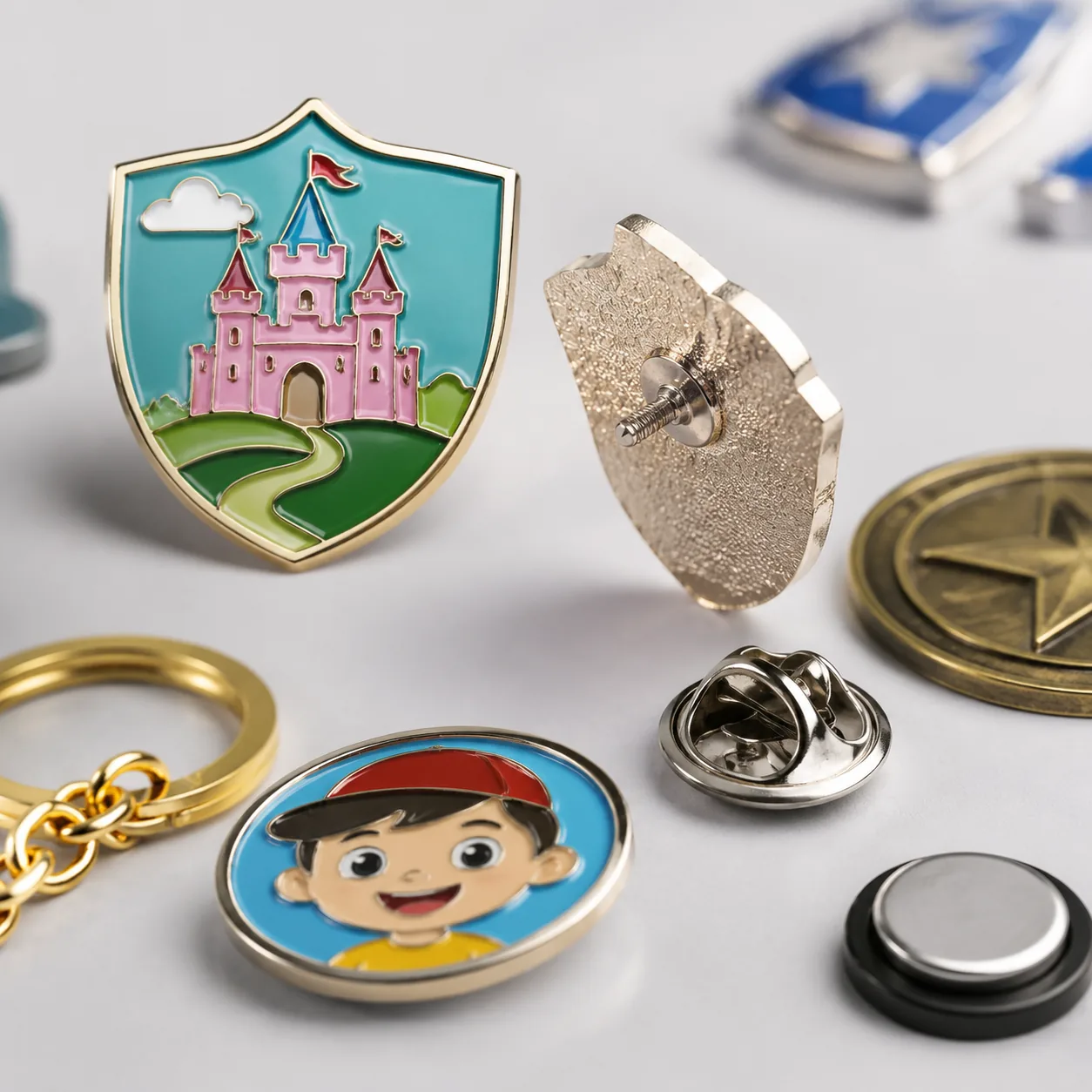
Under schedule pressure, the safest product is usually the one with the fewest unstable steps. A `30 mm` soft enamel pin in iron or zinc alloy, `1.2-1.5 mm` thick, one plating, `4-6` colors, and a butterfly clutch is faster and more predictable than a layered spinner pin with glitter, screen print, epoxy dome, and custom backing-card insertion. The second concept may look stronger in a mockup, but it adds handwork, extra curing or printing steps, more inspection points, and more ways to trigger remake.
The same logic applies across categories. A standard `40 mm` die-struck `2D` coin is safer than a deep `3D` coin with edge numbering. A sublimation lanyard is safer than a woven jacquard lanyard because loom setup and weaving speed are slower. A single-piece keychain with split ring is safer than a spinner or chain-plus-charm assembly. On a four-week program, simplicity is not a compromise in quality; it is how you protect delivery.
| Product Type | Rush-Friendly Spec | Higher-Risk Spec | Typical MOQ / Bulk Lead Time | Indicative FOB Range |
|---|---|---|---|---|
| Enamel pin | `25-35 mm`, iron or zinc alloy, `1.2-1.5 mm`, soft enamel, `4-6` colors, butterfly clutch | Cutouts, glitter, translucent fill, print overlay, epoxy dome, custom backing card | MOQ `100-300 pcs`; `10-14 days` | `USD 0.45-0.95` @ `1,000 pcs`; `USD 0.60-1.20` @ `500 pcs` |
| Challenge coin | `38-45 mm`, `2D` relief, `2.0-3.0 mm`, one plating, standard or rope edge | Deep `3D`, dual-side color fill, edge numbering, capsule packing | MOQ `100-200 pcs`; `12-18 days` | `USD 1.20-2.80` @ `500 pcs`; `USD 2.10-3.80` @ `200 pcs` |
| Metal keychain | Single-piece zinc alloy or iron, one-sided design, split ring | Spinner parts, chain-plus-charm assembly, epoxy dome, retail insert packing | MOQ `100-300 pcs`; `10-16 days` | `USD 0.85-1.80` @ `1,000 pcs`; `USD 1.10-2.20` @ `500 pcs` |
| Lanyard | Polyester sublimation, `15-20 mm` width, standard swivel hook, optional buckle | Woven/jacquard, double attachment, breakaway plus buckle plus card packing | MOQ `100-300 pcs`; `7-10 days` sublimation, `12-18 days` woven | `USD 0.55-1.10` @ `1,000 pcs`; `USD 0.75-1.35` @ `500 pcs` |
| PVC patch | `2D` soft PVC, `2.5-4.0 mm`, sew-on or Velcro backing | Deep `3D` layering, undercuts, custom set packing | MOQ `100-300 pcs`; `10-15 days` | `USD 0.70-1.50` @ `1,000 pcs`; `USD 0.95-1.80` @ `500 pcs` |
Standard finishes are usually the safest. Nickel, black nickel, imitation gold, antique brass, and antique copper are common plating routes with predictable setup and replenishment chemistry. Selective plating, mixed plating on one part, or low-volume custom color plating can add `1-3 days` and increase shade variation risk. If you want a smooth premium look without the longer cycle and higher reject sensitivity of true hard enamel, imitation hard enamel is often the better rush choice.
If the deadline is already inside `21 days`, strip out features that add manual handling: glow powder, magnets, hinges, dangling charms, sequential numbering, gift boxes, decorative capsules, or multi-step card insertion. These options are feasible, but they rarely fit a clean four-week execution unless quantity is low and approvals happen within hours.
Approve artwork like a control sheet, not a design preview
Artwork approval is where rush orders often lose control. Buyers review only the front visual and later find the backstamp is wrong, clutch positions allow the pin to rotate, lanyard logos run in the wrong direction, or the backing-card slot does not align with the product. Once tooling, film output, or print setup begins, even a small geometry change can mean a new mold insert, a revised die line, or a packaging remake.
Treat the proof as a production control sheet. Confirm finished size in millimeters, metal thickness, Pantone references, plating callout, attachment count and location, edge style, reverse layout, packaging orientation, carton marks, barcode data, and destination labeling. For metal items, ask for the reverse-side drawing if you need a custom backstamp, dual-post anti-rotation placement, magnet spacing, or a safety-pin bar position. For lanyards, confirm fold direction, logo repeat length, hook orientation, and whether the buckle sits above or below the print field.
Rush approvals also need realistic tolerances. For small pins, overall size tolerance of about `±0.20 mm` is common. For stamped or die-cast metal thickness, `±0.10-0.15 mm` is more realistic than expecting a perfect nominal. For coins, diameter tolerance of `±0.25 mm` is common on standard struck pieces. For soft PVC patches, thickness can vary around `±0.20 mm` across layered areas. For lanyards, width tolerance is typically `±1 mm`, folded length tolerance around `±5 mm`, and print registration drift of a few millimeters over the full strap length may still be commercially acceptable.
On fine-detail artwork, confirm practical minimums before sign-off. Typical working limits are around `0.25 mm` for recessed metal lines, `0.30-0.35 mm` for raised borders that must hold enamel cleanly, and `0.60-0.80 mm` text height if legibility matters on a small pin or coin. Specs below those ranges may be technically possible, but they are not the right bet on a rush schedule with standard tooling and normal reject rates.
Use one decisive sample round
On a four-week deadline, there is rarely time for both a decorative sample round and a separate production sample round. The sample must answer the real acceptance risks in one pass: color, legibility, hardware placement, plating appearance, edge finish, and packaging fit. That means pass-fail criteria need to exist before the sample is made, not after it arrives.
For a new design, the fastest practical sequence is usually measured sample photos first, then one physical sample by express courier if the item is tactile, finish-critical, or color-sensitive. High-resolution photos with caliper readings can save `1-2 days` by catching wrong dimensions, missing details, incorrect hardware, reversed backs, or misaligned card slots before courier dispatch. Physical samples still matter when approval depends on actual metal tone, polish level, clasp action, magnet pull, edge smoothness, or capsule fit.
- Check dimensions with digital calipers; do not approve size from a printed ruler photo.
- Review plating under neutral light near `5000K-6500K` if black nickel, imitation gold, or antique finish tone matters.
- Test hardware by pull and rotation: pin posts, jump rings, split rings, buckles, and breakaways should feel secure and consistent.
- Verify packaging fit, including backing-card hole alignment, polybag size, insert orientation, and coin capsule closure.
- Compare front and back to approved art for spelling, event dates, logo direction, and reverse orientation.
- Send one consolidated correction list so the factory works from a single revision record.
Be disciplined about remake decisions. A rush program should not stop for a small dust point in enamel, a faint polishing swirl on the reverse, or a slightly warm antique finish if the goods remain saleable and event-ready. Hold the line only on defects that would also justify rejecting bulk: unreadable text, wrong size, wrong plating, unsafe hardware, major color miss, wrong packaging, or a fit issue that cannot be assembled repeatedly.
Control production with two checkpoints and measurable QA
Once the sample or final art is approved, the order needs version control more than daily chat. Too many stakeholder updates create confusion over which file set is final. For urgent promo goods, two formal checkpoints are usually enough: production-start confirmation and pre-shipment verification.
At production start, confirm final quantity, acceptable overrun or underrun, pack-out method, and carton plan. If you need exactly `1,000 saleable pieces`, say so. If `+/-5 percent` is acceptable, write it in the PO. Also confirm whether spare clutches, spare buckles, or replacement backs are required, because those can usually ship separately without slowing the main run. For mixed SKUs, require a carton breakdown such as `Carton 1-4: lanyards`, `Carton 5-6: pins`, `Carton 7: cards and spare parts` so event-site sorting takes minutes instead of hours.
Pre-shipment verification should focus on measurable risk, not on asking whether everything is 'OK.' Request packed-goods photos, carton count summary, outer-carton dimensions, gross and net weights, and random close-up shots of finished goods and packaging. If you use third-party inspection, book it before all cartons are palletized. For rush promo items, common criteria include `AQL 2.5 major / 4.0 minor`, count accuracy, plating consistency, attachment security, packaging correctness, label accuracy, and carton-mark compliance.
As a practical in-house benchmark, inspect at least `80-125 pcs` on a `500-1,200 piece` lot, sampled across cartons rather than pulled from one box. For pins and keychains, check post alignment, clutch fit, split-ring closure, burrs, plating pits, and enamel fill. For lanyards, check print clarity, seam quality, hook assembly, logo direction, and buckle insertion. For coins, check edge finish, color fill, and diameter consistency. For PVC patches, check layer registration, hook-and-loop adhesion, and clean trim along the border.
Book freight by failure mode, not by habit
The wrong freight plan can erase all the discipline upstream. Rush buyers often compare only air versus sea, but the more useful question is what the shipping plan can survive. If customs adds two days, do you still make move-in? If one carton is delayed, do you still have enough units for day one? If the consignee cannot clear airport cargo quickly, is courier actually safer even at a higher per-kilo cost?
For most event orders under about `8-10 cartons`, air is the default. The real choice is usually between express courier, air freight to airport, and split shipment. Express courier is often simplest for consignments under roughly `150-200 kg` chargeable weight. Air freight to airport often becomes more economical above that if the buyer has a broker and reliable pickup. Sea freight is for replenishment, not fixed-date launches, unless the event is far enough out that a delay is still survivable.
| Shipping Method | Best For | Typical Transit | Main Risk | Typical Cost Signal |
|---|---|---|---|---|
| Express courier | Small to mid-size urgent shipments with simple delivery | `3-6 days` door-to-door | High cost per kg; remote-area surcharge or brokerage delay on final handoff | Highest landed cost, lowest coordination |
| Air freight to airport | Heavier urgent shipments with broker support | `3-5 days` flight plus `1-3 days` handling | Customs timing, airport storage, pickup coordination | Usually lower than courier on heavier lots |
| Sea freight | Replenishment or non-urgent launch stock | `25-40 days` depending on lane | Misses fixed event dates if any port or customs delay occurs | Lowest freight cost, highest schedule risk |
| Split shipment | Critical launch quantity first, balance later | First lot `3-6 days` by air; balance by lower-cost mode | More coordination, duplicated paperwork, higher blended freight | Best insurance when one SKU or carton is late |
Split shipment is often the smartest option on mixed event packs. If one slower SKU such as a coin in capsule packing threatens the whole order, ship the minimum launch quantity first—perhaps `300-500 pcs` for opening day—and move the balance on the next flight or a cheaper mode. The freight premium is usually far lower than the cost of an empty booth table, missed sponsor handout, or overnight local reprint of substitute collateral.
Protect margin by paying for speed only where it reduces risk
Rush orders become expensive in predictable places: sample courier, priority scheduling, air freight, and labor-heavy packaging. Buyers often negotiate a few cents off the unit price while ignoring the much larger swings created by remake risk, chargeable weight, and approval delays. On urgent promo orders, the biggest budget damage usually comes from avoidable rework or a weak freight plan, not from the base metal cost.
Use 2026 pricing as a planning range, not as a guaranteed market quote. A standard `30 mm` soft enamel pin at `500 pcs` often prices around `USD 0.60-1.20 FOB`, and at `1,000 pcs` around `USD 0.45-0.95 FOB`, depending on thickness, plating, color count, and packaging. A `40 mm` challenge coin at `500 pcs` is often `USD 1.20-2.80 FOB`, while a standard sublimation lanyard at `1,000 pcs` is commonly `USD 0.55-1.10 FOB`. Sample charges typically run from `USD 35-75` for simple pins or patches and `USD 50-120` for coins or more complex assemblies, often creditable against bulk orders. Tooling can range from `USD 40-90` for standard pins to `USD 60-150` for larger coins or multi-cavity PVC molds.
Spend on features that protect execution: dual pin posts to prevent rotation, clearer carton labels for event-site sorting, one approved physical sample when finish is critical, or a split shipment that guarantees opening-day stock. Cut features that do not change event success: gift boxes for free giveaways, decorative capsules when polybag is acceptable, or complex card insertion that adds hand labor but no functional value.
If the event date is inside `30 days`, freeze the shortlist now, issue one complete RFQ package, and assign one internal approver who can release art and sample comments within hours. If the date is inside `21 days`, reduce SKU count, remove special effects, and treat split shipment as the default backup. If the date is inside `14 days`, focus only on the shortest stable paths—standard soft enamel pins, simple keychains, sublimation lanyards, or basic PVC patches—and assume that multiple sample rounds, selective plating, woven constructions, and sea freight are no longer realistic.
Have a project? Send your artwork and target quantity and we’ll reply with a detailed quotation within 12 working hours.
Ready to get this made?
Send your sketch, target quantity and ship-date. Detailed quotation in 12 hours.



