Custom Pin Spec Sheet: What to Lock Before Quoting
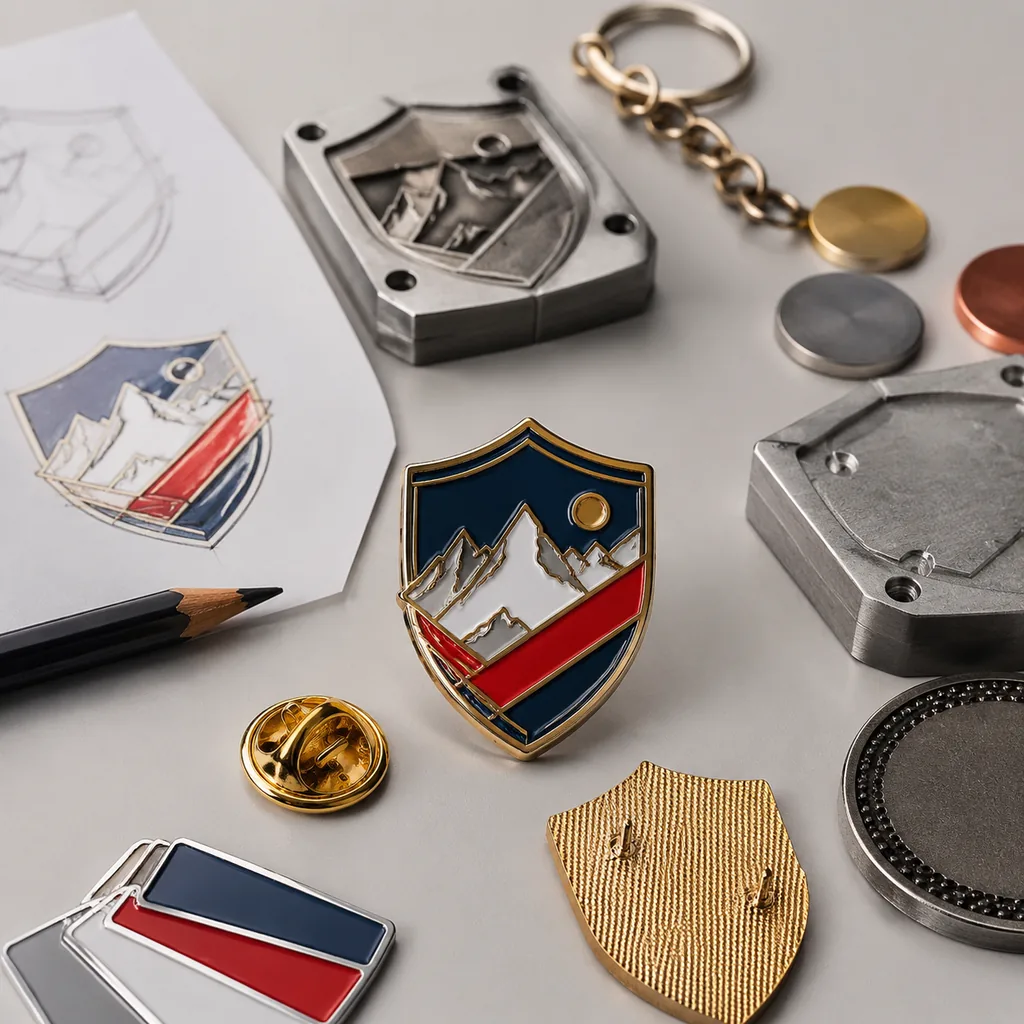
Start With the One Thing Quotes Hide
Most pin RFQs fail because buyers ask for pricing before the spec is stable. A factory can quote a 30 mm soft enamel pin at one cost, then discover the artwork needs a 0.25 mm minimum stroke, a 1.2 mm recess depth, a two-color fill sequence, and a different clutch style. At that point the quote is no longer comparable, because the process, tooling, and labor assumptions have changed.
Treat the design like a technical drawing, not a concept image. Before requesting prices, lock the construction, size, thickness, plating finish, color count, attachment, packaging, and approval method. That is the only way to compare suppliers on the same product instead of on a rough approximation of the product.
A practical custom pin spec sheet should fit on one page and answer six questions: what process is being made, how large it is, how thick it is, what finish it uses, how the colors are controlled, and how it will be attached and packed. If any of those fields are left vague, the factory fills the gap with its own assumptions, which is usually where rework starts.
Define the Product Type Before Anything Else
The first line on the spec sheet should identify the product structure. A pin can be soft enamel, hard enamel, printed, die struck, or a mixed construction with epoxy. Each process changes mold design, polishing time, fill depth, defect risk, and unit cost, so this decision should come before artwork tweaks.
Soft enamel is the most common choice when you want visible metal borders and tactile recesses. Hard enamel suits flatter, more jewelry-like surfaces and usually requires extra polishing to level the fills. Printed pins are better for gradients, tiny logos, and photo-style art, but they sacrifice the raised metal feel. Die struck pins are best when the design should rely on metal relief alone, without color fill.
Concrete example: a 35 mm soft enamel pin with five Pantone colors and black nickel plating is a different product from a 35 mm hard enamel pin with the same artwork. The soft enamel version can tolerate deeper recesses and stronger edge definition; the hard enamel version needs tighter leveling control, more sanding, and more time in finishing. If you do not choose the process first, even a good drawing can be quoted incorrectly.
- Soft enamel: best for visible borders, lower tooling pressure, and moderate cost
- Hard enamel: best for a smooth premium face and tighter surface uniformity
- Printed: best for gradients, small text, or full-color artwork
- Die struck: best for metal-only relief and no-color designs
- Mixed construction: best when epoxy or special inserts are required
Lock Size, Thickness, and Shape
Size drives tooling, legibility, and price more than most buyers expect. A 25 mm pin and a 40 mm pin may look similar on screen, but the larger part uses more metal, takes longer to polish, and usually needs more care to keep the lines readable. For most lapel pins, common MOQ tiers are 100, 300, 500, and 1,000 pcs, with the best per-piece pricing typically appearing at 500 pcs and above.
Thickness should be stated in millimeters, never as thin, medium, or heavy. Common working ranges are 1.0-1.2 mm for lightweight badge-style pieces, 1.5 mm for standard lapel pins, and 2.0 mm or more for a heavier premium feel. Thinner parts can bend or feel cheap; thicker parts can tilt on fabric or increase shipping weight without improving the design.
Shape matters too. A simple circle or rectangle is cheaper than a silhouette with internal cutouts, pointed corners, or narrow bridges. If the artwork includes openwork, state which parts are decorative and which must remain structurally intact, because a bridge that is too narrow may survive sampling but fail in production.
| Spec line | Buyer-safe target | Why it matters |
|---|---|---|
| Overall size | 20-50 mm for most lapel pins | Controls tooling area, readability, and quote comparability |
| Thickness | 1.2-2.0 mm | Affects rigidity, weight, and how the pin sits on fabric |
| Minimum stroke | 0.20-0.30 mm | Prevents fill bleed and lost detail |
| Raised border | 0.15-0.25 mm | Keeps colors separated and improves finish control |
| Text height | 3.0 mm minimum preferred | Improves readability after plating and polishing |
Choose the Plating Finish Like an Engineering Decision
Plating is not just a color choice. It affects perceived value, scratch visibility, and how the pin photographs under retail lighting. Bright nickel is the most common silver-tone finish; gold gives a more premium look; black nickel reduces glare; antique silver and antique brass hide minor surface variation better and suit vintage or military-style designs.
A proper spec should name the exact finish and the surface effect. If you want antique plating, say whether the recesses should be darkened while the high points stay polished, or whether the whole piece should have a muted brushed look. Those are different production paths. For bright finishes, a mirror-polished face usually needs more finishing labor than a satin or matte face.
For decorative plating on custom pins, many factories work with finish thicknesses around 0.1-0.3 microns for the visible outer layer, but surface preparation and polishing quality often matter more than raw deposition thickness. In other words, a cleaner base surface with consistent burnishing usually looks better than a thicker finish over an uneven substrate.
Avoid a bright mirror finish when the artwork has many fine cut lines, when the pin will be handled often, or when the logo needs stronger contrast against the metal. Antique and matte finishes are usually more forgiving in real-world use, even if they look less dramatic in a catalog render.
Set Color Rules Before the Factory Sees Artwork
Enamel issues usually come from vague color language, not bad intent. A factory can match a Pantone reference more consistently than a screenshot, but the buyer still has to specify whether the fill is solid, translucent, glitter, glow-in-the-dark, or a specialty effect. The same blue will look different in a recessed cavity, over silver plating, or under clear epoxy.
If exact brand matching matters, include the Pantone code, the finish type, and the acceptable variance. A practical production tolerance for standard promotional pins is usually one visual shade step under normal daylight, but the final acceptance should always be based on a physical sample. A monitor image is not a control standard.
Use concrete color instructions. For example: "Pantone 186 C solid enamel, no translucency, no glitter, no gradient, white metal borders visible around each segment." That wording tells the factory exactly what to prepare and prevents mid-production interpretation changes.
- State Pantone code instead of only naming a color
- Specify solid, translucent, glitter, glow, or epoxy-filled
- Confirm whether metal borders must remain visible
- Approve one physical golden sample before mass production
- Reject screen-only approvals for brand-critical colors
Treat the Back Side as Part of the Product
Many buyers focus on the front and are surprised by the back. The reverse side should specify the attachment type, backstamp, surface treatment, and whether the pin will contact skin or delicate fabric. If the item will be worn on uniforms, jackets, or lanyards, the back hardware can affect sagging, rotation, and garment damage as much as the artwork affects appearance.
For standard lapel pins, butterfly clutches, rubber clutches, safety pins, and magnets are the main options. Butterfly clutches are inexpensive and common. Rubber clutches are easier to handle and less sharp in use. Safety pins suit brooch-style pieces. Magnets avoid piercing fabric, but holding force drops quickly as the pin gets heavier or wider.
A useful rule of thumb: for a 30-35 mm metal pin weighing about 8-12 g, a single magnet may be adequate on light fabric, but a dual-magnet set or a stronger clutch is safer if the pin is thicker, has a larger silhouette, or will be used on heavier garments. If the product is intended for premium uniforms, note the fabric type so the supplier can recommend a holding method that will not rotate or slip.
| Attachment | Best for | Typical trade-off |
|---|---|---|
| Butterfly clutch | General use, low cost | Can press into thin fabric |
| Rubber clutch | Comfort and easy handling | Slightly less secure than metal |
| Safety pin | Brooch-style pieces | More visible hardware |
| Magnet | Delicate garments | Lower holding force on heavier pins |
Call Out Tolerances and Artwork Limits Line by Line
The fastest way to create rework is to leave tolerances implied. Your spec should state the outer size tolerance, thickness tolerance, cutout tolerance, and minimum line width. For many custom metal products, a size tolerance of plus or minus 0.2-0.5 mm is common depending on shape complexity, but the acceptable range should be agreed before the first sample is made.
If the artwork includes tiny islands, internal text, or interlocking lines, tell the factory what must remain unchanged and what can be simplified. Text under 3 mm in height often needs stronger stroke weight to survive polishing and plating. A design that looks clean at 100 percent zoom may still fail if the thinnest line is below the process limit.
For soft enamel, a practical minimum stroke is often 0.20-0.25 mm; for harder or more detailed constructions, 0.25-0.30 mm is safer. Recess depth is commonly around 1.0-1.5 mm for soft enamel and closer to 0.8-1.2 mm for hard enamel, depending on the visual effect and the amount of polishing required. If the design uses cutouts, define the minimum bridge width so the part does not deform during handling or plating.
- State outer size tolerance in millimeters
- Set thickness tolerance separately
- Specify minimum text height and stroke width
- Mark any simplifications that are forbidden
- Identify decorative cutouts versus load-bearing bridges
Budget by Process, Not by Guesswork
A useful spec sheet should include quantity tiers and FOB pricing expectations, because the supplier needs to know where tooling and labor spread out. For simple custom pins made in China, FOB pricing often starts around USD 0.40-0.90 per piece at 500 pcs, USD 0.30-0.70 at 1,000 pcs, and lower for repeat orders above 3,000 pcs, depending on size, plating, attachment, and packaging. Hard enamel, dual plating, glitter fill, and mixed hardware push pricing upward quickly.
Lead time belongs on the spec sheet too. A straightforward sample usually takes 5-8 days, and mass production is often 12-20 days after sample approval for standard pins. Complex mixed-effect designs, rush orders, or back-to-back plating changes can extend that to 20-30 days. If you need air shipment or an accelerated schedule, say so at the RFQ stage, because the factory has to reserve polishing, plating, and packing capacity early.
The cheapest quote is not always the lowest total cost. A slightly higher unit price can be better if it includes cleaner line work, fewer sample rounds, more stable plating, and packaging that reduces transit damage. For B2B buyers, the real metric is landed cost plus defect risk, not unit price alone.
Use volume tiers that reflect how you actually buy. For example: 100 pcs for development or internal use, 300 pcs for event merchandising, 500 pcs for retail testing, and 1,000 pcs for a campaign run. That structure helps the supplier quote realistic tooling amortization instead of giving a single average price that hides the real breakpoints.
What to Lock Before You Request Quotes
Turn the design into a one-page spec sheet with the process type, size, thickness, plating, color rules, attachment, tolerances, packaging, quantity tiers, and target lead time listed in plain language. If any field is unknown, mark it as open and ask the supplier to quote two controlled options instead of leaving the item ambiguous. That gives you a real comparison instead of a stack of apples-to-oranges prices.
Then ask for a pre-production sample whenever the pin uses special plating, small text, mixed attachments, or a tight brand-color match. Use the first physical sample to lock the golden sample, because that reference is what should govern future reorders. Once it is approved, freeze the final spec sheet so later batches stay consistent.
If you want a simple checklist, use this order: define process, lock size, set thickness, name finish, assign Pantone codes, choose attachment, set tolerances, confirm packaging, request sample, and then release the production order. That sequence prevents the most common cause of rework: a quote built on incomplete assumptions.
- Define the pin process first
- Lock size and thickness in millimeters
- Specify plating, color, and attachment
- State tolerances and minimum stroke limits
- Approve one golden sample before mass run
- Freeze the final spec sheet for reorders
Have a project? Send your artwork and target quantity and we’ll reply with a detailed quotation within 12 working hours.
Ready to get this made?
Send your sketch, target quantity and ship-date. Detailed quotation in 12 hours.



