Custom Pin PO Spec Sheet: 18 Lines That Prevent 2026 Rework
Why approved artwork still turns into bad pin orders
Approved artwork is only a visual target. It does not tell the factory how to tool the mold, what metal line width is manufacturable, how deep recessed areas should be, how thick the plating must be, where posts may drift, or how the goods must be packed and inspected. If a PO only says “30 mm soft enamel pin, gold plating, butterfly clutch,” the workshop still has to make dozens of unpriced decisions. Those decisions become variation, and variation becomes rework, markdowns, or claims.
For custom pins, the purchase order should act as a production control sheet. It needs to state the construction method, measurable tolerances, cosmetic acceptance criteria, inspection plan, and the precedence rule when artwork conflicts with process limits. Example: if the art contains 0.20 mm facial text but the product is quoted as stamped soft enamel, the PO should require redraw approval before tooling. If that rule is missing, the factory may simplify the art on the shop floor or produce a low-yield mold that never matches the approved proof.
The 18 lines below are the ones that most often decide whether a 500-piece order lands usable or claimable. Not every line needs a premium tolerance, but every line should include a number, a decision owner, and an acceptance rule.
Lines 1-5: lock product identity, process and geometry before tooling
Line 1 is product identity. Record item name, customer PO number, internal supplier job number, artwork filename, artwork revision, approval date, mold number if repeating, and whether tooling is “reuse existing mold with no geometry change” or “new mold per revised art.” On repeat orders, also cite the last approved sample date and any approved deviation from the original build. This prevents a frequent failure mode: the factory pulls an older vector file, old backstamp, or previous color map from chat history.
Line 2 is construction method. Write the exact process, not just the appearance: stamped iron soft enamel, stamped brass soft enamel, imitation hard enamel, die-struck brass, zinc alloy die-cast, photo-etched brass, or offset print with epoxy dome. For 20-40 mm lapel pins, stamped iron at 1.2-1.5 mm is the usual low-cost option; stamped brass at 1.2-1.5 mm supports sharper edges and cleaner polishing; zinc alloy die-cast at 2.0-3.0 mm is better for cutouts, deep relief and irregular outlines. As a practical threshold, if raised metal lines are under 0.25 mm, recessed color cells under 0.35 mm, or positive text under 1.0 mm high, stamped soft enamel becomes risky and etched or printed construction is often safer.
Line 3 is finished size, written as maximum width × maximum height in millimeters with tolerance. For standard stamped pins, ±0.20 mm is realistic; for zinc alloy cast parts, ±0.30 mm is more realistic because shrinkage control is less precise. Line 4 is thickness excluding post and clutch. Common stamped standards are 1.2 mm, 1.5 mm and 1.8 mm with ±0.10 mm to ±0.15 mm tolerance. Line 5 is unit weight. A 30 × 28 mm stamped iron pin at 1.5 mm thickness with one post typically weighs about 7-9 g; the same size in zinc alloy can land at 9-13 g. Weight matters for mailers, retail sets, and carton gross-weight limits.
| Spec line | What to write | Typical 2026 range |
|---|---|---|
| Product identity | PO no., revision code, artwork filename, mold no., approved sample date | Required on first runs and repeats |
| Construction | Stamped brass soft enamel, 1.5 mm body | Iron for lowest cost; brass for finer detail; zinc alloy for 3D/cutouts |
| Finished size | 30.0 × 28.0 mm ±0.20 mm | 20-45 mm common for lapel pins |
| Thickness | 1.5 mm ±0.10 mm | 1.2, 1.5, 1.8 mm standard stamped bodies |
| Weight target | 8 g ±1 g per pin | Useful for cards, gift boxes and postal control |
Lines 6-9: define detail limits, color control and plating performance
Line 6 translates artwork into manufacturing limits. State minimum raised metal width, minimum recessed enamel cell width, minimum text height, minimum bridge width for cutouts, and whether isolated micro-islands may be merged. For stamped soft enamel, workable minimums are typically 0.25 mm raised metal, 0.35 mm recessed cells and 1.0 mm text height, but 0.30-0.40 mm metal lines and 1.2 mm text are safer for repeat yield on 1,000+ piece runs. For photo-etched pins, finer lines around 0.15-0.20 mm can be held, but edge sharpness and depth appearance differ. If art violates the chosen process limits, the PO should require redraw approval before die cutting begins.
Line 7 is color specification. List Pantone references for all visible colors and classify each as “critical match” or “visual match.” Critical match should be reserved for brand marks and logo fields that will be compared to a style guide. Background fills, shadows and decorative zones can usually be visual match to reduce unnecessary rejects. On enamel goods, Pantone is a target, not a laboratory guarantee: pigment lot, gloss level, metal wall height and light source shift the perception. If print and enamel appear on the same pin, note that printed Pantone and enamel Pantone may differ even when built from the same reference.
Line 8 defines surface finish by zone. Instead of writing only “polished,” specify front face polished, recessed background matte, antique wash in low areas, or brushed metal on selected planes. Mixed textures are common on premium pins and should be mapped on the art layer or callout sheet. Line 9 is plating and plating thickness. Typical decorative plating for lapel pins is about 0.03-0.08 micron for bright gold, nickel, black nickel or imitation silver. If the product may sit 6-12 months in humid storage, call for anti-tarnish topcoat and a plating minimum such as 0.05 micron, understanding this improves storage resistance but does not make the item jewelry grade. Bright nickel and bright gold show hairline scratches more readily than antique brass or antique nickel, so the cosmetic standard should match the finish.
A practical wording example: “Stamped brass soft enamel, raised metal minimum 0.30 mm, recessed color cell minimum 0.40 mm, Pantone 286 C critical on logo, Pantone Cool Gray 7 C visual on field, bright nickel plating 0.05 micron minimum with anti-tarnish clear coat, front face free of scratches visible at 30 cm under 800 lux white light.” That single sentence eliminates several common disputes.
Lines 10-12: control attachment hardware, post position and wear risk
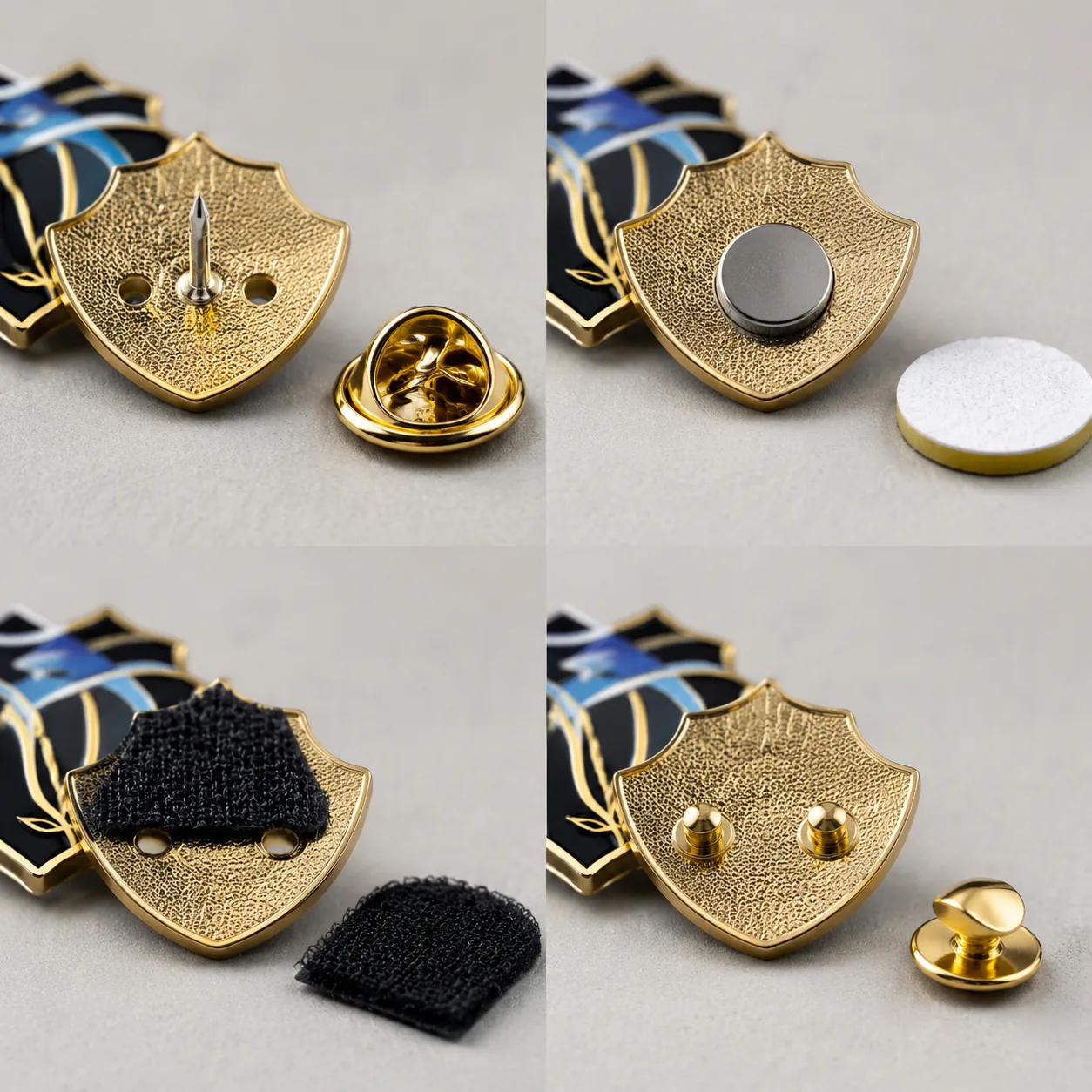
Line 10 is attachment type and material. Specify butterfly clutch, rubber clutch, deluxe locking clutch, safety pin, military clutch, magnet back, or dual-post setup, and state post material if relevant. One post is common under 25 mm. At 30 mm and above, or on long horizontal, asymmetrical or top-heavy shapes, two posts materially reduce rotation. Standard post diameter is often around 0.9-1.1 mm; if fabric damage is a concern, ask for burr-free polished post tips. Magnet backs avoid piercing garments but usually add about USD 0.18-0.45 per unit FOB and require separated packing to reduce transit scratching.
Line 11 is post location with measurable coordinates. “As per artwork” is too vague for production. State distance from the top edge, side edge, and centerline spacing if there are two posts. A practical tolerance is post drift within 1.0 mm of nominal; for premium retail or boxed gift sets, 0.5 mm is more appropriate because crooked posts are immediately visible on cards. Example: for a 35 mm wide badge, two posts on the horizontal centerline, 18.0 mm apart, each post center 8.5 mm from nearest side edge, drift ±0.5 mm max.
Line 12 covers wear risk and weld integrity. Require burr-free perimeter edges, no sharp corners, no exposed plating flakes, and smooth contact surfaces around the clutch seat. For weld strength, many factories rely on informal hand checks, but the PO should state a measurable rule. A common requirement is post pull resistance of 3 kgf for 10 seconds on sample units with no detachment or crack at the weld. For heavier zinc alloy pieces or double-post premium pins, 4 kgf may be justified. A 1.0 m drop test onto a hard surface on 5 sampled units is also useful for exposing weak welds, brittle epoxy domes and loose add-on parts.
- Specify clutch type, post count and post material
- Use two posts for shapes over 30 mm or prone to rotation
- Set post-location drift at 1.0 mm max, or 0.5 mm for premium carded goods
- Require burr-free edges and smooth post tips for apparel contact
- Add weld pull checks during in-line QC, not only at final inspection
Lines 13-15: define back details, retail pack and export carton rules
Line 13 defines the reverse side. State plain sand-texture back, recessed back, stamped backstamp, sequential laser number, serial range, or mixed construction. If a backstamp is required, specify legibility: text height not less than 1.0 mm, logo relief sufficient to remain visible after plating and polish, and major characters readable at 30 cm. If numbering is required, define format and sequence, for example “laser serial 0001-0500, one number per piece, no duplicates.” Without this line, buyers often receive a technically present but unreadable back logo.
Line 14 is unit packaging, one of the most common causes of avoidable claims. Write the exact pack format: each pin in self-seal polybag, glassine sleeve, tissue wrap, mounted on printed card, or inserted in EVA, PU or velvet box. State whether the clutch ships attached, attached behind card, or separately bagged to avoid front-face dents. If carded, specify card dimensions, board stock, print side, finish and pin placement. Example: 90 × 55 mm card, 350 gsm SBS board, CMYK + matte lamination one side, pin centered horizontally, top edge to pin top 12 mm ±2 mm, butterfly clutch attached behind card, no card tear-out around puncture.
Line 15 is shipping configuration. Record units per inner bag, inners per master carton, target gross weight, outer carton grade and moisture controls. For small metal accessories, many importers cap master cartons at 8-12 kg gross to reduce crush damage and simplify receiving counts. A robust export spec is 50 pcs per PE inner bag, 10 inners per master, 500 pcs per 5-ply K=K carton, gross weight 9.5 kg max, one 10 g desiccant sachet per carton, carton count tolerance zero short. If the goods will move by sea and sit in humid storage, PE lining plus desiccant is a low-cost control against tarnish and backing-card warp.
| Packing point | Recommended spec | Why it matters |
|---|---|---|
| Unit pack | 1 pc per self-seal polybag | Reduces rubbing, plating marks and count errors |
| Retail card | 90 × 55 mm, 350 gsm SBS | Controls presentation and fit in polybag or box |
| Inner quantity | 50 pcs per PE bag | Simplifies counting and handling |
| Master carton | 500 pcs, 5-ply K=K, 8-10 kg gross | Limits crush risk and warehouse strain |
| Moisture control | 1 × 10 g desiccant per carton | Helps plated goods during sea transit and humid storage |
Lines 16-18: write the QC plan, defect definitions and commercial triggers
Line 16 is the inspection standard. Do not leave this assumed. For most B2B custom pin programs, ANSI/ASQ Z1.4, single sampling, General Inspection Level II is a practical baseline, with AQL 2.5 for major defects and AQL 4.0 for minor defects. Premium retail, licensed merchandise and museum-store orders often tighten to AQL 1.5 major and 2.5 minor, especially for face cosmetics and card presentation. Critical defects should remain zero acceptance and usually include sharp points, missing attachment, wrong artwork revision, wrong plating, wrong mandatory text, or anything creating a safety or brand-compliance issue.
Line 17 classifies defects by process and location. Major defects typically include size outside stated tolerance, wrong construction method, wrong Pantone on a critical logo area, detached post, missing clutch, unreadable mandatory backstamp, plating peel, deep front scratch visible at 30 cm, enamel underfill greater than 10% of a color cell, contamination across metal lines, or card placement outside stated tolerance. Minor defects typically include slight shade variation on noncritical background areas, light backside polish marks, tiny pinholes in hidden zones, or minor card offset still within a secondary visual tolerance. The more measurable the defect wording, the less likely the shipment dispute turns into subjective photo arguments.
Line 18 sets commercial triggers: sample lead time, production lead time, MOQ, FOB basis, remake threshold and claim window. In 2026, normal timing for standard custom pins is 5-7 calendar days for a pre-production sample after final art approval and 12-18 calendar days for bulk production after sample sign-off. More complex packs, mixed SKUs, dual plating, danglers or gift boxes often extend production to 18-25 days. Typical MOQs start at 100 pcs, but practical price breaks are usually at 300, 500 and 1,000 pcs.
For a 30 mm stamped iron soft enamel pin with one post and butterfly clutch, typical 2026 FOB China price bands are about USD 0.42-0.78 at 500 pcs and USD 0.32-0.60 at 1,000 pcs, depending on color count and plating. The same size in stamped brass is commonly around USD 0.58-1.05 at 500 pcs and USD 0.48-0.88 at 1,000 pcs. Add a second post and clutch for roughly USD 0.03-0.08, printed backing card plus carding for USD 0.06-0.18, and individual polybagging for USD 0.01-0.03 per unit. Zinc alloy die-cast pins of similar footprint usually start higher because of material weight and mold complexity. A practical remake clause is any lot failing agreed AQL for major defects, or any systematic miss such as wrong plating, wrong attachment, wrong backstamp or wrong revision. A reasonable claim window is 7-15 days from receipt unless sealed-distributor allocation is agreed in writing.
Where buyers overspecify, underspecify and waste money
The most common mistake is tightening the wrong variables. Buyers often demand near-perfect Pantone matching on low-cost giveaway pins while leaving post location, edge finishing, weld strength and packaging vague. In actual use, bent posts, spinning pins, scratched plating and torn backing cards generate more complaints than small shade shifts on a noncritical fill color. If the order is for events, employee recognition or broad promotional use, spend control budget first on attachment stability, burr-free edges, reasonable plating protection and packing that prevents face-to-face rubbing.
Another mistake is writing tolerances the process cannot hold at the quoted price. ±0.05 mm on a 35 mm stamped iron pin is generally unrealistic in mass production. Requiring a completely mark-free backside on a low-cost plated iron product is also a mismatch between process and budget. Strong specifications separate must-have requirements from preferred requirements and tie both to process choice and FOB target. If the program needs premium cosmetics, museum-store presentation or long shelf life, the PO should move toward brass, tighter sampling, better packaging and higher price bands rather than forcing low-cost construction to behave like premium jewelry.
How to turn the next PO into a real production control sheet
Before requesting the final quote, send the supplier the artwork together with the 18-line control sheet and require a line-by-line confirmation. If the reply says “standard,” “ok,” or “as per artwork,” ask for the number: minimum line width, plating micron, post coordinates, AQL level, card stock, carton count. That step removes much of the ambiguity that later becomes rework.
For new suppliers, require a pre-production confirmation sheet that mirrors the PO and references the approved sample photo, measured size, plating, backstamp and packaging method. If brand risk is meaningful, add a final factory report or third-party inspection including measured dimensions, pull-test records, count verification and defect photos by category. If only five lines can be upgraded immediately, prioritize construction method, finished size tolerance, plating specification, post location and inspection standard. Those five lines control most of the expensive arguments after shipment.
Have a project? Send your artwork and target quantity and we’ll reply with a detailed quotation within 12 working hours.
Ready to get this made?
Send your sketch, target quantity and ship-date. Detailed quotation in 12 hours.



