Custom Pin Plating Failures: Specs That Prevent Tarnish
Why approved samples still turn into plating claims
The failure pattern is familiar in custom pin programs: the pre-production sample looks bright, the shipment passes a quick inbound check, and 15 to 60 days later the buyer reports dark spots, rainbow staining, edge fade, dulling, or uneven color. In most cases, the root cause is not random oxidation. It is an incomplete specification. The PO says shiny gold, black nickel, or antique silver, but it does not define the base metal, plating stack, target thickness, protective topcoat, visual acceptance standard, or storage packaging.
That gap matters because two factories can quote the same finish name while running very different process windows. One may plate stamped brass with a copper strike, bright nickel undercoat, decorative top layer, and electrophoretic clear coat cured at controlled temperature. Another may run the same color on die-cast zinc alloy with lighter pre-treatment, a thinner undercoat, and no lacquer. Both can look acceptable on approval day. They will not age the same after 28 to 35°C warehouse storage, 65 to 80% RH exposure, wet-season ocean transit, or 90 days inside retail card packs.
Decorative pin finishes are thin by design. Bright gold, nickel, and black nickel top layers are often only 0.03 to 0.10 microns. The visible color comes from that decorative layer, but the real durability comes from surface preparation, undercoats, edge coverage, topcoat cure, and packaging discipline. Buyers need measurable controls rather than vague terms like premium plating or anti-rust finish. For most programs, that means locking the stack, tone window, adhesion method, cosmetic zones, storage limits, and pack-out configuration before bulk production begins.
Specify the plating stack, not just the finish name
The fastest way to reduce tarnish disputes is to replace finish names with finish builds. A usable order sheet for custom lapel pins should lock at least seven items: base metal, forming method, thickness, finish name, undercoat system, decorative top-layer target, and whether a protective clear coat is mandatory. If the goods will sit in stock for 60 to 180 days, the packaging method should be part of the finish spec, not a separate packing note.
A practical spec for a 30 mm soft enamel brass pin can read: stamped brass, 1.2 mm thickness, front polished to mirror grade, copper strike as required, bright nickel undercoat 2 to 5 microns, shiny imitation gold decorative layer target 0.05 to 0.08 microns by process control with spot XRF verification, transparent e-coat or lacquer topcoat 8 to 12 microns, front face to match sealed sample under D65 or 5000K to 6500K light, and individual polybag packing only after full cure and cooling. That gives production a target and QC a measurable acceptance basis.
On zinc alloy, plating stability depends more heavily on porosity control, die-casting density, deburring, and removal of polishing residue trapped in recesses. Sharp relief transitions, recessed cutouts, and textured surfaces are more likely to show thin edge coverage or tone variation. Brass and copper-based substrates usually plate more evenly on flat, high-detail badges, especially below 40 mm where crisp borders and reflective surfaces are critical. If the factory cannot describe the undercoat and topcoat in plain process terms, the finish name alone is not enough to approve.
| Finish option | Typical decorative layer | Common topcoat | Main advantage | Main caution | Best spec to lock |
|---|---|---|---|---|---|
| Shiny gold | 0.05-0.08 microns | Clear lacquer or e-coat 8-12 microns | High-value appearance for awards and corporate pins | Fingerprints, micro-scratches, and storage tarnish if uncoated | Gold thickness target, nickel undercoat, mandatory clear coat |
| Shiny nickel | 0.05-0.10 microns | Optional clear coat | Stable neutral tone with strong cost control | Shows polishing haze on large flat mirror areas | Tone standard, gloss reference, acceptable haze limit |
| Black nickel | 0.03-0.06 microns | Clear coat strongly recommended 8-12 microns | Strong contrast with bright enamel colors | Lot-to-lot tone shift is obvious and sulfur sensitivity is higher | Approved tone window and sealed run sample |
| Antique brass | Chemical antique over plated base | Optional matte clear coat 5-10 microns | Hides handling marks and suits heritage designs | Over-wash can muddy fine lines under 0.25 mm | Reference sample for recess contrast depth |
| Dye black | Conversion finish with protective coating | Matte clear coat strongly recommended | Deep tactical or minimalist look | Raised edges can polish bright during use | Wear expectation at corners, posts, and loops |
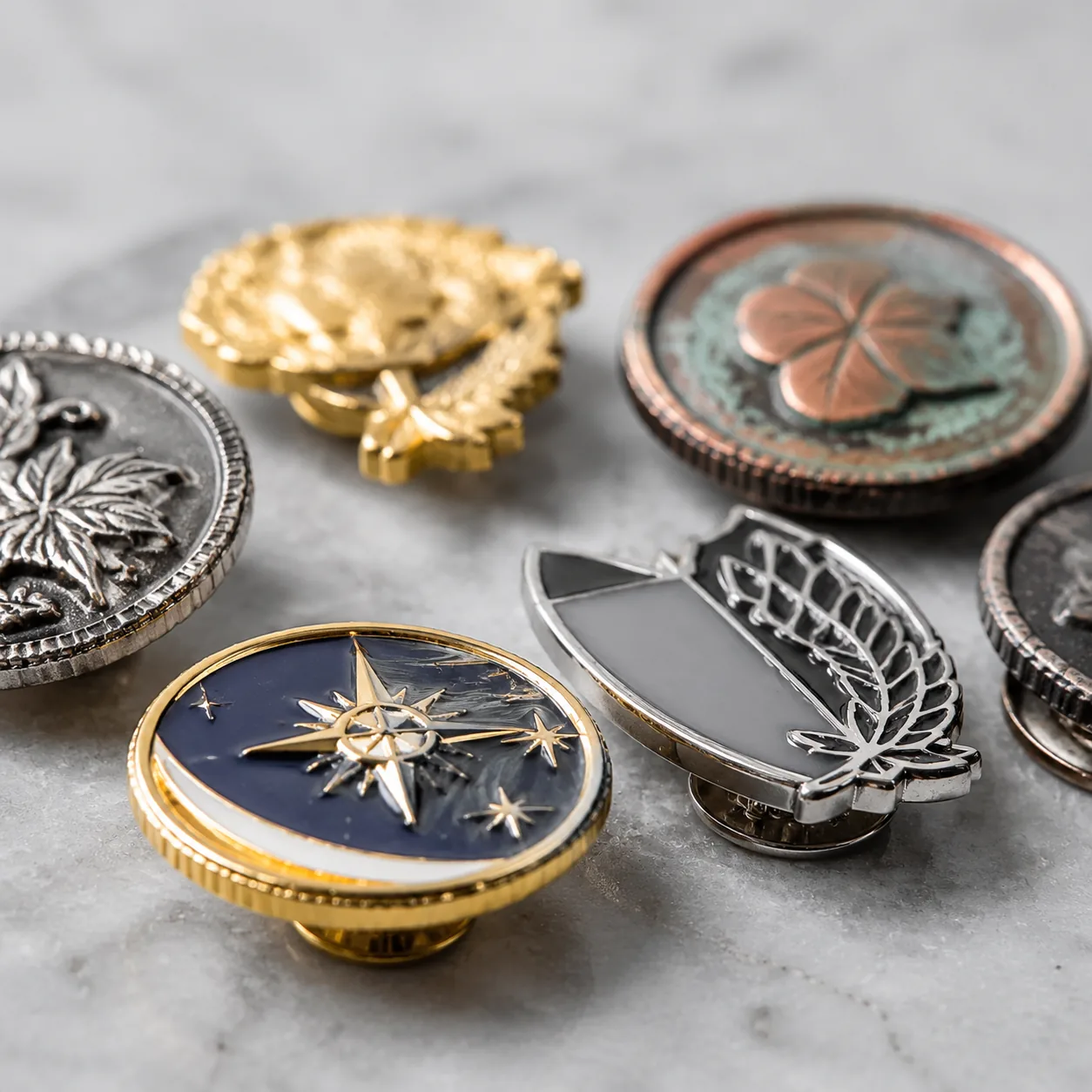
| Antique silver tone | Silver-tone decorative layer with antique wash | Optional clear coat | Good relief definition on medals and commemoratives | Can look flat if recess depth is shallow or polish is uneven | Minimum relief depth and antique contrast sample |
Match finish to metal, geometry, and end use
Many plating complaints start one process earlier with the wrong substrate or geometry. If the design includes line widths below 0.20 to 0.25 mm, text below roughly 1.0 mm cap height, flat mirror borders, or narrow recessed enamel channels, stamped brass is usually safer than die-cast zinc alloy. Stamping gives cleaner edges, more uniform polishing, and better reflectivity on small flat badges. Zinc alloy remains useful for larger parts, 3D sculpted relief, openwork silhouettes, and irregular outlines where die casting reduces tooling complexity.
A practical sourcing rule is this: for flat detailed pins up to about 40 mm, brass usually gives better cosmetic consistency; for sculpted designs above 45 mm, zinc alloy is often more economical and easier to form. In the 35 to 45 mm band, the artwork decides. A 20 mm logo pin with 0.18 mm borders and jewelry-bright gold should generally stay on brass. A 55 mm fantasy pin with layered contours, cutouts, and raised textures can be a good zinc program if the buyer accepts slightly less uniform reflectivity across curved surfaces.
Use conditions matter as much as geometry. The first wear points are usually raised corners, butterfly clutch contact zones, pin posts, jump rings, split rings, and keychain loops. That is abrasion, not necessarily plating failure. If the product is intended for daily handling, bag attachment, or keychain use, antique brass, antique silver, satin nickel, or matte black usually age more gracefully than mirror-bright finishes. The RFQ should state the actual use case so the supplier can recommend a realistic finish stack instead of simply quoting the brightest color at the lowest unit price.
Set inspection criteria before production begins
Many plating disputes are really inspection disputes. The supplier inspects for gross defects at packing, while the buyer expects tighter color control, no exposed base metal, and a cleaner front face. Decorative metal goods need a written QC standard covering sampling, viewing conditions, cosmetic zones, and defect thresholds. For many B2B pin programs, ANSI/ASQ Z1.4 single sampling with AQL 2.5 for major defects and AQL 4.0 for minor defects is a practical starting point, provided the defect definitions are specific.
For the plated front face, major defects commonly include exposed base metal visible at 30 to 40 cm, peeling, blistering, pits larger than 0.20 mm inside a logo area, obvious stains, severe tone mismatch against the sealed sample, or scratches visible without tilting under neutral white light. Minor defects may include faint backside rack marks, slight haze outside the focal area, or controlled tone variation within the approved sample window. A realistic inspection method is 3 to 5 seconds viewing per piece at 30 to 40 cm under 5000K to 6500K light, with illuminance around 800 to 1200 lux.
Cosmetic zoning prevents late arguments. Zone A should be the front logo face, raised borders, and any highly reflective visual area; no visible oxidation, pits over the approved limit, stains, or scratches should be accepted there. Zone B can be side edges and secondary relief surfaces, where light micro-marks not visible at normal distance may be acceptable. Zone C can be the back side, where hanging or rack marks outside a defined radius such as 5 mm around the post or clutch area are acceptable if broad raw-metal exposure is not present.
- Lock sampling before production: AQL 2.5 major and AQL 4.0 minor are common starting points
- Define viewing method: 30-40 cm distance, 5000K-6500K light, 800-1200 lux, 3-5 seconds per piece
- Set cosmetic zones for front face, side edge, and backside
- Approve one sealed sample from the actual plating run, not only a prototype
- State where rack or hanging marks are acceptable and where they are not
- Write measurable limits for pits, scratches, exposed base metal, and tone shift
Separate tarnish, abrasion, and process defects
Not every dark or faded pin has the same root cause. Tarnish is a chemical reaction accelerated by humidity, sulfur compounds, skin oils, residual polishing paste, or reactive packaging materials. Abrasion is mechanical wear at edges, posts, loops, and contact points. A process defect is different again: poor adhesion, contamination, under-built edge coverage, incomplete rinsing, or unstable bath chemistry. Corrective action depends on classifying the issue correctly. Reworking a process defect is different from changing packaging for a tarnish problem or changing finish selection for a wear problem.
Storage conditions are a frequent blind spot. Pins may leave the factory in good condition but then sit in a consolidator warehouse at 28 to 35°C and above 65% RH, travel by ocean freight for 20 to 35 days, or remain in stock for 90 to 180 days before event distribution. For these programs, dry packing is part of finish control. That usually means complete cure before bagging, clean polybags with low-migration additives, desiccant in the inner or master carton where appropriate, and a storage recommendation such as below 30°C and below 60% RH when feasible.
Packaging materials can also trigger finish change. Low-grade foam, acidic card stock, sulfur-bearing paper, aggressive hot-melt adhesives, and some plasticizers can react with black nickel, antique silver, and other sensitive decorative finishes. For carded retail programs, loose-pin approval is not enough. The supplier should approve the complete packed configuration: pin mounted on the retail card, inserted in the final bag, and held for 3 to 7 days under agreed conditions. Many apparent plating failures are actually pack-out compatibility failures discovered too late.
Use realistic tests and measurable limits
Decorative pin plating should be verified with practical tests, not impossible promises such as never tarnishes or permanent anti-rust. Useful controls include adhesion checks after cure, thickness verification where the supplier has capability, moderate salt-spray comparison tests, and packed-storage simulation. For new suppliers or high-visibility programs, it is often more useful to ask how they monitor bath chemistry, rinsing conductivity, drying temperature, and tone drift during the run than to ask for a generic durability guarantee.
Salt-spray testing helps when used correctly. It is a comparative corrosion test, not proof that the display face will remain unchanged in retail storage. For decorative plated pins with clear topcoat, a reasonable benchmark is often 24 to 48 hours neutral salt spray by agreement, with no severe red rust on non-display areas and no major blistering or flaking. Some stacks may perform better, but the result depends on substrate, undercoat thickness, geometry, and exposed edges. If a supplier claims 96 hours, the buyer should ask what substrate, what stack, what test standard, and what evaluation point that claim refers to.
Thickness control is also often misunderstood. A supplier may not measure every piece, but should still control the process through bath records, anode condition, current density, line speed, and periodic XRF checks. If XRF is available, it is the cleanest way to verify a target band such as 0.05 to 0.08 microns for imitation gold or 2 to 5 microns for nickel undercoat. Clear coats should also be quantified where possible. Saying anti-tarnish coating is vague; specifying a transparent cured topcoat target of 8 to 12 microns is more actionable for both production and QC.
| Check | What it detects | Practical benchmark | When to request it |
|---|---|---|---|
| Visual finish inspection | Tone shift, pits, stains, exposed base metal | 100% in-line check plus AQL final inspection | Every plated order |
| Adhesion check | Weak bond after plating or topcoat | Cross-hatch, tape, or controlled scratch check after full cure | New supplier, new finish, or prior complaint history |
| XRF or thickness verification | Under-built decorative layer or stack inconsistency | Target band such as 0.05-0.08 microns for gold where measurable | Premium bright finishes and high-visibility orders |
| Neutral salt-spray reference | Relative corrosion resistance of the stack | 24-48 hours by agreement, read as comparative data | Humid markets or longer storage windows |
| Packed storage simulation | Reaction with card, foam, adhesive, or humidity | 3-7 days in final packed form at agreed temperature and RH | Retail carded pins and event kits |
| Incoming surface prep check | Polishing residue, burrs, porosity before plating | Visual and touch release standard before plating | Complex castings and mirror-bright finishes |
Cost, MOQ, and lead-time trade-offs to expect
Better plating control almost always costs less than a remake, but buyers should know where cost actually moves. For standard custom enamel pins in the 25 to 35 mm range, common MOQ tiers are 100 pieces for sample or pilot runs, 300 pieces for small branded merchandise programs, 500 pieces for more efficient production, and 1,000 pieces or more for stronger FOB pricing. In many China FOB programs, a standard soft enamel iron or zinc alloy pin in that size band is often around USD 0.30 to 0.70 at 1,000 pieces, depending on size, color count, plating, attachment, and packing. A brass-stamped version with brighter cosmetics or an added e-coat is often closer to USD 0.45 to 0.95 FOB at the same volume. Hard enamel, dual posts, custom back stamps, or individual gift boxes can push the price higher.
The key question is not whether tighter QC adds cost, but which controls deliver the highest return. A sealed production sample, written AQL standard, and moisture-conscious packing may add only about USD 0.01 to 0.05 per unit or a modest lot charge. By contrast, large mirror-bright surfaces, multiple attachments, unusually tight tone tolerances, or retail-ready custom packaging can raise cost more sharply because yield drops and labor rises. Buyers usually get the best value by spending first on the basics that prevent claims: the right substrate, the right finish stack, and the right storage packaging.
Lead time also changes once the finish specification becomes more rigorous. Pre-production samples are commonly 5 to 8 calendar days after artwork approval for standard pins, while bulk production is often 10 to 18 days. If the factory must match a prior retained sample, complete packed-storage simulation, wait for 24 to 48 hour salt-spray reference results, or coordinate third-party inspection, adding 3 to 7 more days is normal. For seasonal launches, that buffer is far cheaper than replacing discolored goods after they reach a distributor or event assembler.
What to put on your next RFQ or PO
A strong RFQ removes vague language. Replace premium plating, anti-rust finish, and same as last order with measurable instructions. State the base metal, forming method, finished size, thickness, finish name, undercoat or factory standard stack confirmation, decorative top-layer target, clear coat requirement, packaging method, storage window, and inspection standard. If you have an approved historical sample, send one retained physical unit and current photos. A factory should not be asked to reconstruct finish tone from memory or from a heavily edited marketing image.
Five questions expose risk early. What base metal do you recommend for this geometry and finish? What undercoat and protective topcoat are you planning? Where will rack or hanging marks appear? Which wear points should we expect in normal use? What packing method do you recommend for our climate and storage duration? An experienced supplier answers these directly and will tell you when a requested combination, such as mirror-bright black nickel on a frequently handled keychain, is unrealistic.
For larger, seasonal, or high-visibility orders, approve a pre-production sample from the real plating line and in the final packed configuration. That single step catches more avoidable claims than generic anti-tarnish wording ever will. The goal is not to make decorative pins indestructible. The goal is to make finish performance predictable, with a realistic shelf life, cosmetic standard, MOQ, lead time, and FOB cost structure that match what you promised your customer.
Have a project? Send your artwork and target quantity and we’ll reply with a detailed quotation within 12 working hours.
Ready to get this made?
Send your sketch, target quantity and ship-date. Detailed quotation in 12 hours.



