Custom Pin Inspection Plans: AQL, Defects and Ship Holds
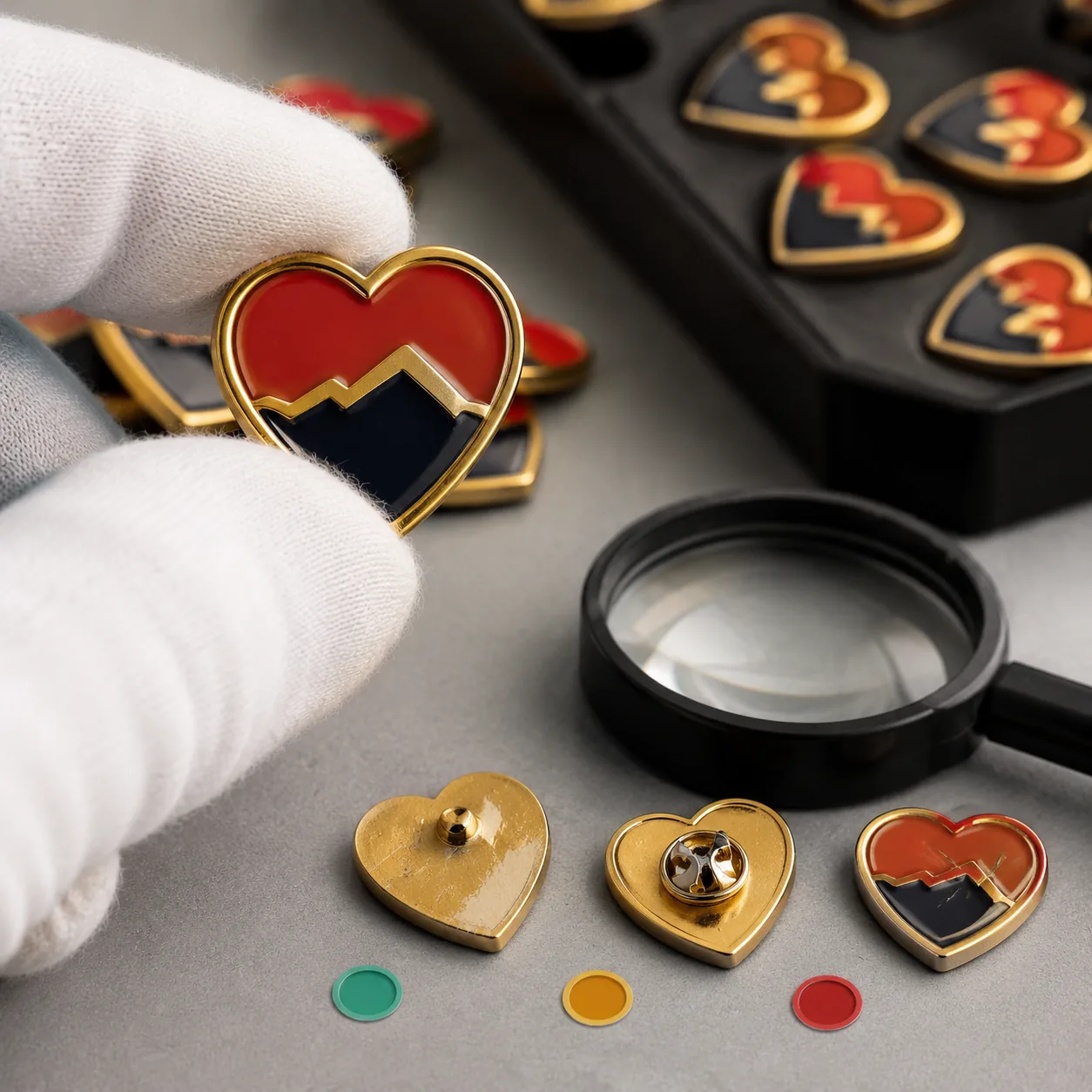
Why “QC Passed” Still Fails at the Distributor Dock
Most rejected custom metal orders are not rejected because nobody inspected them. They fail because the buyer, factory and distributor inspected against different rules. One team accepts “slight enamel variation”; another rejects 2% of pieces with visible dust, 1 mm color overflow, loose clutches, mixed backing cards or incorrect carton labels. Once cartons arrive, the dispute is no longer technical. It becomes a cost argument over sorting, air freight, chargebacks and missed event dates.
A usable inspection plan must be written before mass production. It should define defect classes, AQL levels, inspection timing, functional tests, packaging checks and shipment hold rules. The same pin can need very different limits depending on whether it is a USD 0.48 trade-show giveaway, a USD 1.35 retail enamel pin, or a licensed collectible sold through barcode-controlled distribution.
This guide focuses on in-process and final inspection for lapel pins, brooches, challenge coins, metal keychains, fridge magnets and mixed promotional sets. It does not replace artwork approval or golden sample sign-off. The purpose is narrower: write a QC appendix that a factory inspector, third-party inspector and receiving warehouse can apply without interpretation.
Define Inspection Scope Before Sampling Percentage
Many purchase orders say “100% inspection required” but never state what must be inspected. That is weaker than it sounds. A factory may screen for broken posts and obvious scratches while missing wrong card versions, barcode errors, magnet weakness or carton mix-ups. For custom pins and coins, a better baseline is 100% visual screening during packing for obvious critical and major defects, plus final random inspection under ISO 2859-1 before shipment.
For small lots below 500 pieces, a full final check is realistic and usually adds only USD 0.02–0.06 per piece, depending on backing cards, polybags and retail boxes. For 1,000–10,000 pieces, checking every dimension and every pack component is slow and often unnecessary; use AQL sampling for dimensional, functional and packaging verification. For 10,000+ pieces, staged checks reduce risk: first article approval, mid-production review, pre-packing screen and final packed inspection.
The PO must also define the inspection unit. A pin with clutch, backing card and polybag is one packed unit. A challenge coin in a capsule and velvet box is one packed unit. A keychain with split ring, card and OPP bag is one packed unit. If the unit is undefined, the factory may inspect loose metal pieces but miss missing clutches, wrong card stock, mixed SKUs or weak bag seals.
| Order quantity | Recommended inspection scope | Typical added lead time | Commercial use case |
|---|---|---|---|
| 100–499 pcs | 100% packed-unit check plus 32-piece dimensional sample | 0–1 day | VIP gifts, executive pins, small retail drops |
| 500–2,999 pcs | 100% packing screen plus final AQL inspection | 1 day | Corporate events, distributor orders, club merchandise |
| 3,000–9,999 pcs | First article, 20–50% production check and final AQL | 1–2 days | Retail launches, multi-location campaigns |
| 10,000+ pcs | Tooling article, mid-production audit, pre-pack check and final AQL | 2–4 days | National promotions, franchise programs, replenishment stock |
Classify Defects by Business Risk
A practical QC plan separates critical, major and minor defects. Critical defects create safety, legal or severe functional risk; one confirmed critical defect should normally hold shipment. Major defects make the product unsuitable for normal sale, distribution or event use. Minor defects are small cosmetic imperfections that do not affect function and are not obvious under agreed viewing conditions.
For enamel pins, use a repeatable visual standard: 30 cm viewing distance, 8–10 seconds per face, neutral white light at 600–800 lux, no magnification unless specified. For premium retail, licensed merchandise or museum goods, reduce the distance to 20 cm and tighten the minor limit. For budget giveaways, inspecting under a loupe is usually excessive and creates scrap without improving the customer’s real experience.
Dimensional rules need their own limits. Visual AQL will not catch wrong thickness, oversized posts, weak magnets or an incorrect die line. For stamped brass, iron or zinc alloy pins under 50 mm, a common tolerance is ±0.20 mm on length and width. For pieces from 50–80 mm, ±0.30 mm is more realistic unless CNC finishing is used. Pin body thickness is usually ±0.15 mm for 1.2–2.0 mm pins and ±0.20 mm for thicker coins. Post position should normally stay within ±0.5 mm from the approved drawing, because off-center posts make larger pins rotate.
| Defect class | Concrete examples | Typical acceptance rule |
|---|---|---|
| Critical | Sharp burr over 0.2 mm, exposed needle in packed unit, loose magnet on child-safe order, missing legal warning | 0 allowed in sample; shipment hold |
| Major | Wrong logo color, missing enamel area over 1.0 mm, broken post, plating peel, wrong attachment, mixed design in carton | AQL 1.0 or 1.5 depending on channel |
| Minor | Dust under epoxy under 0.3 mm outside logo center, faint polishing mark, small enamel dimple not exposing metal, light card scuff | AQL 2.5 or 4.0 depending on channel |
Set AQL by Sales Channel, Not Habit
AQL is a sampling acceptance method, not a quality guarantee. A PO that says only “AQL 2.5” is incomplete because it does not say which defects are major, minor or critical. For most promotional pin and keychain orders, a workable final inspection setting is critical 0, major AQL 1.5 and minor AQL 4.0 using ISO 2859-1 general inspection level II.
For retail, licensing, paid membership and museum products, tighten to critical 0, major AQL 1.0 and minor AQL 2.5. For low-cost one-time event giveaways with FOB pricing around USD 0.35–0.80 per piece, major AQL 2.5 and minor AQL 4.0 may be commercially reasonable if function and branding are correct. Avoid writing “AQL 0 for everything” unless the budget includes full sorting, higher scrap allowance and extra lead time.
The cost impact is measurable. A standard final AQL inspection may be included in the factory’s normal process for a 3,000-piece pin order. A strict cosmetic 100% recheck often adds USD 60–180 and 1–3 days. If every piece has a barcode label, backing card, insert, foam tray and retail box, the labor can double because unpacking and repacking take longer than the inspection itself.
- Specify ISO 2859-1, general inspection level II, unless another standard is agreed.
- Set critical, major and minor AQL separately; never rely on one number.
- Define the packed unit: loose pin, pin with clutch, carded pin, boxed coin or full retail set.
- State viewing distance, lighting, inspection time and whether magnification is allowed.
- Define reinspection cost: factory pays for confirmed production defects; buyer pays for late specification changes.
Place Hold Points Where Defects Become Expensive
Final inspection is the most expensive place to discover preventable errors. By then, wrong plating, incorrect backstamps, weak posts or mixed cards may already be packed into thousands of bags. Better plans use production hold points at the stages where defects are still correctable.
For enamel pins, the first hold point is after metal forming and before plating. Check outline, cutouts, rim thickness, post location, backstamp and overall size. For soft enamel, inspect after plating and before enamel fill because plating color, oxidation and surface cleanliness affect the final appearance. For hard enamel, inspect again after polishing; over-polishing can thin raised metal lines below 0.15 mm and blur small text.
For coins and keychains, add functional checks before packing. Standard split rings should withstand an 8–12 kg static pull for promotional use. Swivel hooks and lobster clasps should be tested at the moving joint, which is usually the weak point. Magnetic badges and fridge magnets should be tested on a vertical painted steel plate, not only on a flat bench, because sliding failure is what users notice.
| Checkpoint | What to inspect | Sample size guide | Hold rule |
|---|---|---|---|
| First article after tooling | Overall size, relief, cutouts, post location, backstamp | 5–10 pcs | Hold if any dimension exceeds drawing tolerance |
| After plating | Finish color, tarnish, burns, nickel exposure if nickel-free is specified | 20–32 pcs | Hold if mismatch is visible against approved sample |
| After enamel or printing | Color placement, overflow, bubbles, fill level, curing | 32–80 pcs | Adjust process if repeated major defects appear |
| Before packing | Attachment strength, magnet hold, card match, bag seal | 80–125 pcs | Hold packing if functional defects exceed major AQL |
| Final packed inspection | Carton count, labels, packed unit, visual defects, transit-risk damage | ISO 2859-1 sample | Ship only if AQL acceptance is met |
Use Repeatable Functional Test Numbers
Functional defects create the most expensive complaints because they appear after distribution. A pin can look acceptable but fail on a jacket. A brooch can rotate because the pin back is too high. A keychain can pass visual inspection and still open under normal use.
For lapel pins, specify post solder strength and clutch fit. A practical shop-floor test is a 2 kg pull for 10 seconds on a standard 8–10 mm post, with no detachment, cracking or visible looseness. For oversized pins above 45 mm wide, add a rotation check on fabric or a backing card because one post may not stabilize the item. For brooches, test at least 20 pieces per lot; the hinge should move smoothly, the catch should close fully, and the needle should not require hand bending.
For epoxy-coated pins and keychains, define dome and surface limits. Epoxy dome height commonly varies by ±0.20 mm. It should not overflow the metal edge, remain tacky, show clouding, or trap dust above the agreed defect size in the main logo area. For outdoor use, request 24–48 hours humidity exposure or a limited salt-mist screen. A 96-hour salt spray requirement on a USD 0.60 giveaway is usually unrealistic unless the specification also upgrades plating thickness, sealing and price.
- Pin post pull: 2 kg for 10 seconds on standard lapel pins; increase only if construction supports it.
- Brooch closure: 20-piece sample with no open catch, bent needle, hinge looseness or unsafe point exposure.
- Keychain ring gap: no visible permanent gap over 0.5 mm after assembly and normal manual spread.
- Magnet hold: no sliding for 30 seconds on vertical painted steel using the finished packed product weight.
- Epoxy surface: no edge overflow, tackiness, clouding or dust over the agreed limit in the logo area.
- Plating thickness: 0.03–0.05 microns for decorative flash plating; 0.10 microns or higher for higher-wear use when budget allows.
Treat Packaging as a Shipment-Critical Item
Packaging defects are often mislabeled as minor, but they can stop a shipment as quickly as plating failure. A wrong backing card, missing barcode or mixed SKU can trigger distributor chargebacks. Missing clutches, short cartons or weak master cartons create event-day failures when replacement goods cannot arrive in time.
Pack counts should be exact unless the buyer approves a tolerance. If the packing method is 100 pins per inner bag, 500 per inner carton and 2,000 per master carton, those counts should not be treated as ±2%. Master carton gross weight should be checked against the packing list; for metal products, a practical tolerance is often ±0.5 kg per master carton, adjusted for carton size and packaging weight.
For backing cards, define orientation, print version and placement. A 25 mm pin on a 55 x 85 mm card should sit level within ±2 mm unless angled placement is approved. For retail cards, bent corners over 3 mm, unreadable barcodes, wrong hang holes, scuffed front faces or mismatched artwork versions should be major defects. They affect saleability even if the metal item is correct.
| Packaging item | Common defect | Suggested classification | Practical tolerance |
|---|---|---|---|
| Backing card | Wrong version, wrong barcode, upside-down mounting | Major | Correct SKU, artwork and orientation required |
| Polybag | Open seal, missing suffocation warning where required | Major or critical depending on market | Seal fully closed; warning follows buyer artwork |
| Inner carton | Mixed designs without label separation | Major | Exact SKU separation and exact count |
| Master carton | Wrong shipping mark, weak carton, count mismatch | Major | Exact count; gross weight within agreed range |
| Retail box | Crushed corner, missing insert, coin loose in box | Major for retail; minor for bulk gift | Box closes cleanly; product fixed in insert |
Pre-Approve Shipment Hold and Rework Rules
A failed inspection should not automatically mean the order is scrap. It should trigger a defined action: sort, rework, replace, downgrade or request written buyer concession. The PO should name who can approve release after a failed inspection. Without that rule, a salesperson may release goods that the buyer’s quality team would have held.
For any confirmed critical defect, hold shipment and isolate affected cartons. For major AQL failure, the usual action is 100% sorting for the failed defect type, corrective action, and reinspection using a new random sample. For minor AQL failure, the decision depends on channel. Retail orders often require sorting. Low-cost giveaways may be accepted with a discount, spare quantity or written concession if the defect is not visible at the agreed viewing distance.
Rework has limits. Replacing clutches, relabeling cartons, repacking cards or sorting mixed SKUs is normally safe. Replating finished enamel pins can blur raised detail, discolor enamel and reduce line definition, so remake may be better than chemical stripping. The inspection plan should state when rework is allowed and when remake is mandatory, especially for wrong mold, wrong finish, wrong logo, wrong Pantone-critical color or unsafe construction.
- Hold shipment for any confirmed critical defect in the inspection sample.
- Require carton isolation, defect photos and quantity estimates before sorting starts.
- Use a new random sample after rework; do not inspect only repaired pieces.
- Set remake rules for wrong mold, wrong metal finish, wrong logo and approved-sample mismatch.
- Allow release by written concession only from the buyer’s named approver.
- Keep failed samples until the claim window closes, usually 30–60 days after delivery.
For the next custom pin, coin, keychain or badge order, attach a one-page QC appendix to the RFQ and PO. A strong starting point is critical 0, major AQL 1.5, minor AQL 4.0, ISO 2859-1 general level II, 30 cm viewing distance and 600–800 lux lighting. Tighten only where the sales channel justifies it: licensed retail, child-safe programs, nickel-free claims, outdoor use, premium packaging or barcode-controlled distribution.
Have a project? Send your artwork and target quantity and we’ll reply with a detailed quotation within 12 working hours.
Ready to get this made?
Send your sketch, target quantity and ship-date. Detailed quotation in 12 hours.



