Custom Pin Defect Limits: AQL Questions Buyers Should Ask
Q: Why agree defect limits before tooling?
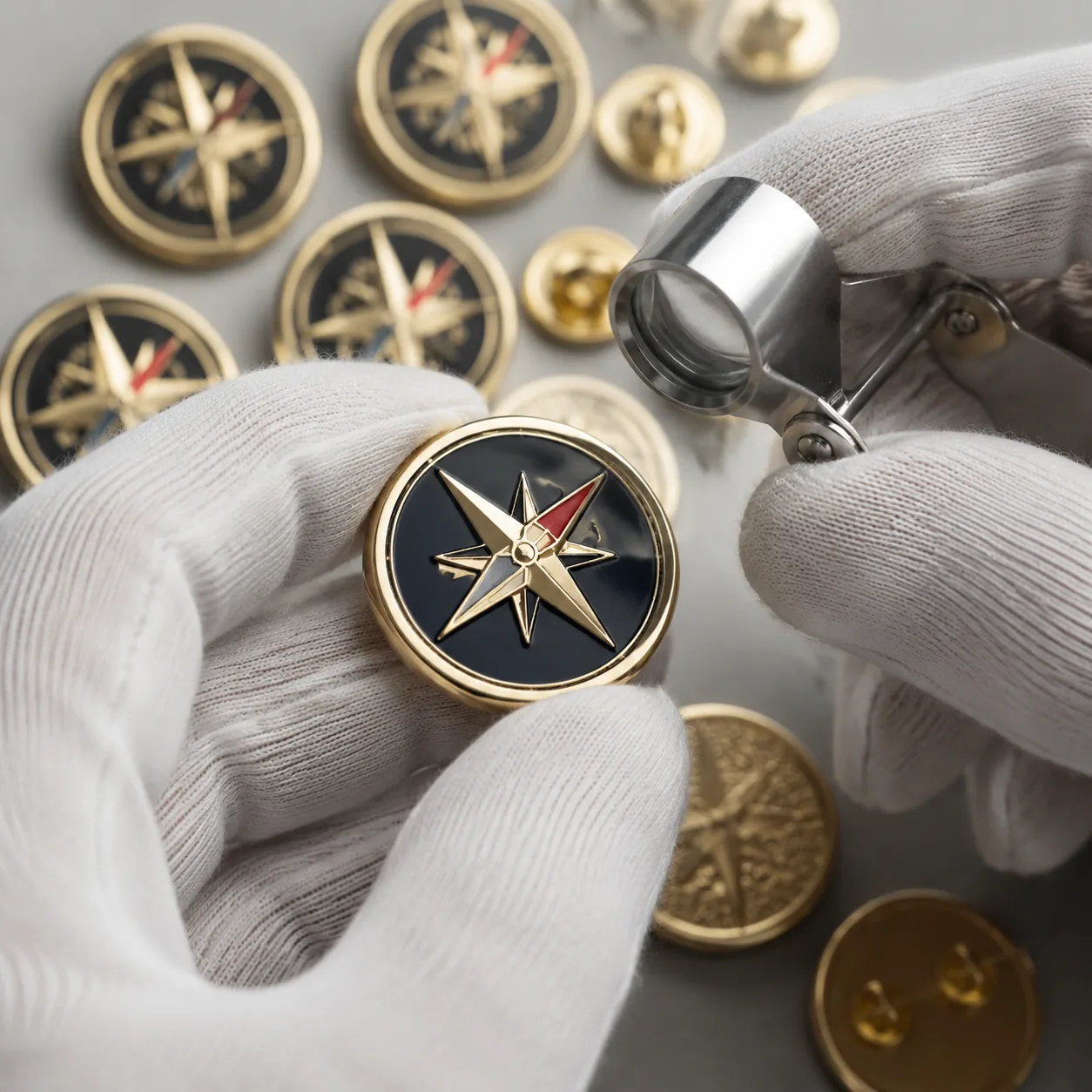
Most AQL disputes start too late. A final report may show 14 front-side plating stains, 9 enamel pits over 0.4 mm, 3 loose clutches and one short carton. By then the goods are packed, the ship date is near and both sides are debating what “acceptable” means. For custom enamel pins, coins, medals and keychains, the practical control is to define defect classes, AQL levels, inspection zones, viewing conditions and functional tests before the mold is cut or mass production starts.
AQL is not a promise that every unit is perfect. It is a lot-acceptance sampling method, usually based on ANSI/ASQ Z1.4 or ISO 2859-1, that decides whether a shipment passes by counting defects in a random sample. For many B2B promotional metal orders, a workable baseline is Critical 0.0, Major 2.5 and Minor 4.0 at general inspection level II. Retail collectibles, licensed merchandise, museum-shop badges and paid fan products often need Major 1.5 and Minor 2.5 because buyers inspect them more closely and complaint costs are higher.
The defect standard should separate safety, function and appearance. A sharp burr, loose post, lead-risk coating or detached magnet is not comparable to a 2 mm polishing hairline on the back. If the purchase order only says “no defects,” the inspector must make subjective calls. If it says “Zone A plating stain over 0.5 mm is major; back-side hairline under 3 mm is minor,” the buyer, factory and third-party inspector can apply the same rule.
Q: Which AQL levels fit each order?
For orders from 500 to 20,000 pieces, Critical 0.0, Major 2.5 and Minor 4.0 is the common commercial setting. It protects the brand without forcing retail-grade yields on giveaway merchandise. Moving to Major 1.5 and Minor 2.5 is appropriate for paid retail packs, VIP gifts and complex hard enamel pins, but buyers should expect more sorting, higher scrap allowance and usually a 3% to 8% FOB price increase. For free event giveaways, Major 4.0 and Minor 6.5 may be acceptable if all safety and functional defects remain controlled at Critical 0.0 or Major 2.5.
Order size affects the inspection method. A 100-piece order may be checked 100% because formal sampling is not efficient. For 300 to 2,999 pieces, many factories combine line checks with final AQL sampling. Above 3,000 pieces, AQL sampling plus in-process inspection is more stable than final sorting alone. Typical custom metal product MOQs are 100 pieces for simple soft enamel pins, 300 pieces for shaped keychains, 500 pieces for challenge coins with custom edges and 1,000 pieces for multi-piece, spinner, slider or shaker designs.
| Order Type | Typical MOQ | Critical AQL | Major AQL | Minor AQL | Best Use |
|---|---|---|---|---|---|
| Retail collectible pins | 300-1,000 pcs | 0.0 | 1.5 | 2.5 | Paid merchandise, licensed art, fan drops |
| Corporate lapel pins | 100-500 pcs | 0.0 | 2.5 | 4.0 | Uniform pins, awards, brand gifts |
| Event giveaway keychains | 500-1,000 pcs | 0.0 | 4.0 | 6.5 | Free distribution with controlled cosmetic risk |
| Challenge coins | 300-500 pcs | 0.0 | 2.5 | 4.0 | Military, association and presentation coins |
| Children-related metal items | 500+ pcs | 0.0 | 1.5 | 2.5 | Only with added material, small-parts and labeling controls |
For context, under ANSI/ASQ Z1.4 general inspection level II, a 1,000-piece lot commonly uses a sample size of 80 pieces. At Major AQL 2.5, the lot typically passes with 5 or fewer major defects and fails at 6. At Minor AQL 4.0, it typically passes with 7 or fewer minor defects and fails at 8. The exact acceptance number depends on the selected standard, inspection level and switching rules, so the PO should state the plan instead of only naming AQL values.
Q: What counts as critical?
Critical defects create safety risk, legal exposure or complete product failure. For lapel pins and brooches, examples include accessible sharp burrs, exposed pin needles without secure caps, pin posts that detach under light pull, magnets that separate from the badge body and coatings that fail restricted-substance requirements. For keychains, broken split rings, open jump rings, detached charms and sharp cut edges can be critical or major depending on the end user, age grade and sales channel.
Use measurable thresholds where possible. Common production limits include accessible burr height over 0.10 mm as critical, pin post pull strength below 5 kgf as major or critical, magnet detachment below 1.5 kgf as major or critical, jump ring opening over 0.30 mm after assembly as major, and brooch hinge failure after 10 open-close cycles as major. A cotton-snag test is more repeatable than a visual burr check: the item should not tear or catch cotton when lightly wiped across edges, posts and cutouts.
If the item is intended for children, schools, toy-like promotions or regulated retail markets, normal promotional-product QC is not enough. Buyers may need EN 71, ASTM F963, CPSIA, REACH, California Proposition 65 or destination-specific heavy-metal screening. Nickel release, soluble heavy metals, small-parts risk, torque, tension, magnet hazards and packaging warnings should be reviewed by a qualified compliance provider. The factory can build to the requested specification, but the importer or brand owner remains responsible for confirming legal requirements.
Q: How should cosmetic defects be zoned?
Major defects are visible problems that a normal recipient would notice and judge as poor workmanship. On a front-facing enamel pin, major defects usually include missing enamel, wrong plating color, Pantone mismatch beyond the approved tolerance, plating stain over 0.5 mm in the logo area, offset printing over 0.30 mm, exposed base metal, epoxy bubble over 0.8 mm or a scratch crossing the main artwork. On a challenge coin, weak 3D relief, enamel overflow into recessed letters, plating burn on the rim or off-center dual plating should usually be major.
Minor defects are small appearance issues that do not affect function and are not obvious at normal viewing distance. Examples include a 2 to 3 mm polishing hairline on the back, an enamel dimple under 0.3 mm outside the logo, a small plating shadow on a side wall, or color variation within Delta E 2.0 to 3.0 when Pantone matching is requested. Minor defects still count; they simply have a higher acceptance limit because they do not materially reduce the product’s use or brand value.
The cleanest method is zoning. Zone A is the front logo or primary display surface, inspected at 30 cm under 600 to 800 lux light for 5 to 10 seconds per side with the naked eye. Zone B is the edge, side wall and secondary decoration. Zone C is the back face, attachment area and hidden surfaces. The same 0.4 mm enamel speck may be major in Zone A, minor in Zone B and acceptable in Zone C if it is not sharp, loose or contaminating the packaging.
| Defect Example | Zone A Front Logo | Zone B Edge or Side | Zone C Back Face |
|---|---|---|---|
| Enamel pit 0.2-0.3 mm | Minor if isolated | Acceptable to minor | Acceptable |
| Enamel pit over 0.5 mm | Major | Minor to major | Minor |
| Plating stain over 0.5 mm | Major | Minor to major | Minor |
| Scratch 3-5 mm | Major if visible at 30 cm | Minor | Acceptable to minor |
| Print or epoxy offset over 0.30 mm | Major | Major if visible | Minor if non-functional |
| Wrong attachment installed | Major | Major | Major |
| Accessible burr over 0.10 mm | Critical | Critical | Critical |
Q: Which process checks prevent failures?
Final inspection should confirm quality, not discover a systemic process failure. A stronger control plan uses first-article approval, in-process inspection at 20% to 30% completion and final AQL inspection when at least 80% of goods are packed. This matters most for orders with multiple plating colors, translucent enamel, glitter enamel, epoxy domes, laser engraving, backstamps, mixed attachments, barcodes or retail packaging.
For enamel pins, check die-struck or cast blanks before plating, enamel fill before polishing and final color after curing. Practical dimensional tolerances are ±0.20 mm for pins under 40 mm, ±0.30 mm for larger coins and keychains, metal thickness ±0.15 mm, attachment position ±0.50 mm and soft enamel recess of 0.05 to 0.15 mm below metal lines. Hard enamel should polish close to flush, with surface variation generally within 0.05 to 0.08 mm where the design allows it.
Plating thickness should be specified, not assumed. Cost-sensitive flash plating is often 0.05 to 0.10 microns for nickel-color, gold-color or black nickel finishes. Better promotional plating is commonly 0.10 to 0.30 microns. Precious-metal plating above 0.30 microns costs more and still needs anti-tarnish handling. If long shelf life matters, request dry inner bags, anti-tarnish paper for silver-tone finishes, silica gel for humid routes and individual OPP bags or paper sleeves to prevent abrasion during sea freight.
Q: What do tighter standards cost?
Stricter AQL changes production economics because it increases sorting time, rework, scrap allowance and documentation. A standard 1,000-piece soft enamel pin order normally takes 12 to 18 calendar days after artwork approval, excluding international freight. A pre-production sample adds 5 to 8 days. Retail-grade 100% cosmetic sorting can add 1 to 3 days for simple pins and 3 to 6 days for complex coins, brooches, sliders or multi-piece keychains.
FOB pricing depends on size, metal, colors, plating, attachment and packaging. As a practical 2025 reference, a 25 to 30 mm iron soft enamel pin at 1,000 pieces may fall around USD 0.45 to 1.20 FOB each. A 35 to 45 mm zinc alloy hard enamel pin with two posts, polished plating and backing card may run USD 1.10 to 2.80 FOB. A 45 to 60 mm challenge coin with two-sided enamel and antique plating often falls around USD 2.00 to 5.50 FOB. Custom keychains with chain, split ring and enamel charm commonly range from USD 0.80 to 2.50 FOB at 1,000 pieces.
| Specification Choice | Lead-Time Impact | FOB Cost Impact | When It Is Worth Paying For |
|---|---|---|---|
| Pre-production sample | Adds 5-8 days | Usually USD 30-100 sample or tooling-related cost | New artwork, new plating, retail approval |
| Major AQL 1.5 instead of 2.5 | Adds 0-2 days | Adds 0%-5% on simple designs | Paid merchandise and brand-sensitive orders |
| 100% final cosmetic sorting | Adds 1-6 days | Adds 3%-8% depending on complexity | Retail packs, VIP gifts, licensed products |
| Individual photo or video packing proof | Adds 1-3 days | Adds inspection or admin cost | High-value small batches or remote approvals |
| Upgraded plating 0.10-0.30 microns | No major delay if planned | Adds finish-dependent cost | Longer shelf life and better visual consistency |
Tighter standards are worthwhile when the sales channel requires them. A free conference insert usually does not need retail collectible tolerance. A paid pin drop, museum shop badge or executive coin does. The right standard is not the strictest possible standard; it is the strictest standard that matches the end use, selling price, complaint risk, delivery date and budget.
Q: What should the checklist include?
A useful checklist should be short enough for factory staff to use on the line and specific enough for a third-party inspector to enforce. It should match the approved sample, artwork revision, purchase order, packing instruction and destination compliance requirement. If the checklist is written only after defects appear, it becomes a negotiation tool instead of a production control tool.
- Confirm approved golden sample, artwork revision, Pantone codes, plating finish, attachment type and packaging layout before mass production.
- Set AQL by class: Critical 0.0, Major 1.5 or 2.5, Minor 2.5 to 4.0 for most branded orders.
- Define viewing conditions: 30 cm distance, 600 to 800 lux light, naked eye, 5 to 10 seconds per side.
- State tolerances: size ±0.20 mm for small pins, thickness ±0.15 mm, attachment position ±0.50 mm unless otherwise approved.
- List functional tests: post pull, clutch fit, magnet pull, split-ring gap, brooch hinge movement, swivel rotation and clasp operation.
- Separate Zone A, Zone B and Zone C defect limits so the back face is not judged like the logo face.
- Check unit count, backing card orientation, barcode, polybag seal, carton marks, carton weight and export carton strength.
- Record approved deviations with photos so reorders use the same quality reference.
For larger or repeat orders, add defect photos to the checklist. A line such as “minor plating shadow acceptable on side wall” is much clearer when paired with an approved reference image. Buyers should also keep their own copy of production approvals because distributors, brands and end clients may all be involved in later reorder decisions.
Q: What should the RFQ state?
Before requesting a final quote, send the factory the defect standard together with the artwork. Include product type, size, base metal, plating, enamel type, attachment, packaging, order quantity, destination country, required ship date and any restricted-substance requirement. Ask whether the quoted FOB price includes the requested AQL level, in-process checks, final inspection records and any added sorting.
Do not compare supplier prices unless the inspection standards match. One quote may assume ordinary giveaway tolerance with Minor AQL 6.5, while another includes retail sorting at Minor AQL 2.5, individual bagging and photo records during packing. The lower price may still be valid, but only if that quality level fits the end use and complaint risk.
A practical RFQ line is: “Final inspection to ANSI/ASQ Z1.4 general inspection level II, Critical 0.0, Major 2.5, Minor 4.0. Zone A front logo inspected at 30 cm under 600 to 800 lux light. Front plating stain over 0.5 mm, print offset over 0.30 mm or missing enamel is major. Any sharp burr over 0.10 mm, loose post, detached magnet or wrong attachment is critical or major as applicable.” For premium retail orders, change Major to 1.5 and Minor to 2.5, then ask for the added FOB cost and lead time before the mold is made.
Have a project? Send your artwork and target quantity and we’ll reply with a detailed quotation within 12 working hours.
Ready to get this made?
Send your sketch, target quantity and ship-date. Detailed quotation in 12 hours.



