Custom Metal vs Acrylic Keychains: Which Spec Wins?
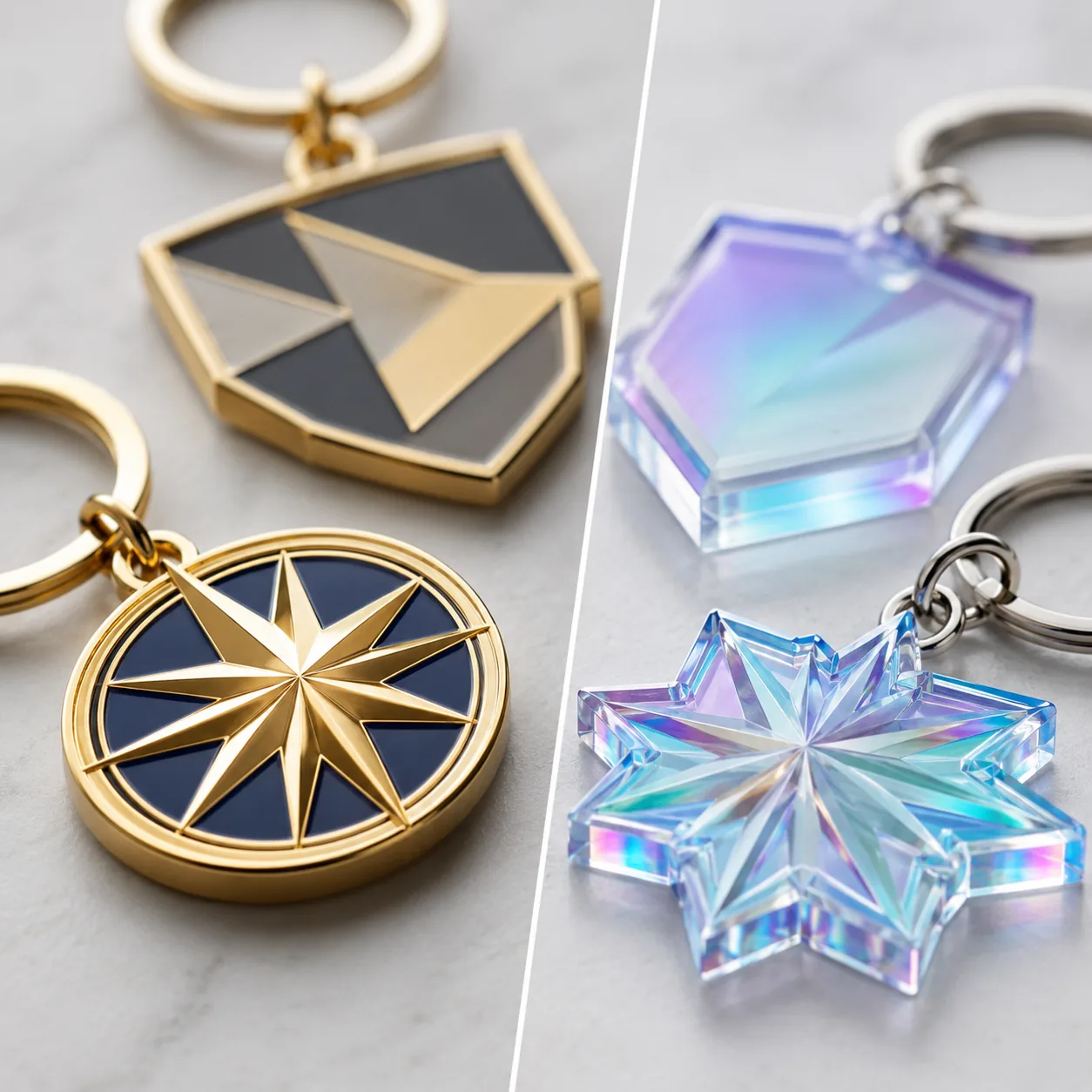
Two Keychains, Two Different Buying Risks
When a buyer asks for custom keychains, the decision is rarely about shape alone. It is about whether the item needs the durability and premium feel of metal or the low cost and full-color flexibility of acrylic. Choose the wrong material and you either overspend on a giveaway that gets tossed, or save money on a product that chips, scratches, or looks weak in hand. The safest comparison is not visual preference; it is spec discipline.
Metal and acrylic solve different jobs. Metal fits longer-life gifts, retail merch, membership items, and souvenir programs where weight, plating, and edge durability matter. Acrylic fits bright campaign pieces, fast-turn event handouts, and short-run designs where print fidelity matters more than tactile heft. The best quote starts with the use case, then locks thickness, finish, artwork method, and attachment hardware around that use case.
Spec Table: Metal vs Acrylic at a Glance
Use this as a first-pass screen before you request samples or lock a purchase order.
| Spec item | Metal keychain | Acrylic keychain |
|---|---|---|
| Typical material | Zinc alloy, iron, or stainless steel; zinc alloy is most common for cast shapes | Cast or laser-cut acrylic sheet; clear, white, black, and custom colors are common |
| Typical thickness | 1.5 to 2.5 mm for standard promo pieces; 3.0 mm for heavier premium pieces | 2.0 to 4.0 mm sheet; 3.0 mm is the most common balance of stiffness and cost |
| Typical size | 40 to 60 mm long for standard promo shapes | 40 to 70 mm long; larger shapes need stronger hole reinforcement |
| Perceived weight | About 18 to 35 g with ring and chain | About 5 to 15 g with ring and chain |
| Decoration method | Die casting, stamping, soft enamel, hard enamel, laser engraving, epoxy dome | UV print, screen print, layered print, lamination, or double-sided graphics |
| Edge durability | High when plated and polished correctly; scuffs show on mirror finishes | Moderate; corner chips and drilled-hole stress are the main risks |
| MOQ reality | Usually 100 to 300 pcs for standard tooling; 300 to 500 pcs for complex shapes | Usually 100 to 200 pcs for print-only; 200 to 500 pcs for layered builds |
| Lead time | 12 to 20 days after sample approval | 8 to 15 days after sample approval |
| FOB price range | USD 0.35 to 1.80 per piece | USD 0.18 to 0.85 per piece |
| Best use case | Premium promo, retail merch, corporate gifts, souvenirs | Mass events, youth brands, bright campaigns, low-cost giveaways |
Where Metal Wins on Durability and Perceived Value
Metal wins when the keychain must survive repeated pocket friction, desk drops, and long distribution cycles. A die-cast zinc alloy body with nickel, black nickel, antique brass, or matte silver plating usually outlasts printed surfaces because the decoration is built into the part rather than sitting on top of a fragile film. If the design needs cutouts, debossed text, raised borders, or a two-tone finish, metal gives much more control over visual hierarchy.
The trade-off is artwork discipline. Fine gradients do not reproduce directly in stamping or casting, and interior text below about 0.8 mm stroke width can fill in during polishing or plating. For premium designs that still need color, the common solution is soft enamel on a metal base, epoxy dome over enamel, or laser engraving on a flat face. On retail programs, buyers usually accept the higher unit price because the object feels substantial and survives longer in circulation.
A practical metal spec for promotional use is 1.5 to 2.0 mm zinc alloy, polished and plated to a decorative finish with enamel fill if needed. For decorative plating, most buyers will see around 0.03 to 0.08 micron for flash-style gold effects and roughly 0.1 to 0.3 micron for nickel or black nickel decorative finishes, depending on the process and target cost. Nickel and black nickel are common budget-to-mid-tier choices; antique brass and matte black are often used when the goal is a more restrained, collectible look. If the design will ride in a pocket or bag every day, avoid high-gloss mirror plating unless you are comfortable with visible micro-scratching.
- Choose metal if the keychain should last 6 months or longer.
- Choose metal if you need plated finishes, debossing, or raised lines.
- Choose metal if the design must still look good after heavy handling.
- Avoid metal if the artwork depends on gradients or photo-style color.
- Avoid polished mirror plating when scuff resistance matters more than shine.
Where Acrylic Wins on Color and Speed
Acrylic wins when the design is graphics-first and the buyer wants vivid color at a lower unit cost. UV print on clear, white-backed, or double-layer acrylic can carry small fonts, gradients, shadows, and brand illustrations far better than a stamped metal body. For event teams, acrylic is also easier to scale because simple custom shapes can be cut from sheet stock without expensive metal dies.
The main risk is mechanical, not visual. Acrylic can crack at narrow necks, chip at corners, and show stress whitening around drilled holes if the cutter feed or hole diameter is wrong. In production, a safe rule is to keep internal cutouts larger than 1.5 mm and avoid thin bridges under 2.0 mm unless the part is small and the attachment point is reinforced. For a standard giveaway piece, 3.0 mm acrylic is often the best balance of stiffness and cost; 2.0 mm is lighter but less forgiving.
Acrylic is especially useful for mascot merch, seasonal campaigns, school events, and social-media-driven promotions where the visual pop matters more than long-term wear. It also makes multi-version campaigns easier because artwork changes do not require new metal tooling in the same way as cast dies. If you need a fast SKU family for different brands, markets, or colors, acrylic is usually the simpler route.
A practical acrylic spec for promo work is 3.0 mm sheet, UV print on one or both sides, laser cut to shape, and edge polishing if the design is visible from the side. For print registration, buyers should ask for roughly ±0.2 mm on small parts and ±0.3 mm on larger shapes, with hole placement held tight enough that the split ring hangs centered. For display value, you can add a double-layer build: printed top layer plus a white backing layer that increases opacity and prevents the image from looking washed out against light.
Production Methods and Tolerance Control
The build method determines what the factory can hold consistently. Metal keychains usually start with die casting, stamping, or etching, followed by polishing, plating, color fill, and assembly. Acrylic keychains are usually laser cut or CNC cut from printed sheet, then edge-finished, drilled, assembled, and packed with protective film if the surface is glossy. Different routes create different failure modes, so the spec has to match the process, not the other way around.
For metal, the key controls are die detail, plating thickness, burr removal, and ring clearance. A good buyer spec should call out minimum line width, recessed depth, and hole diameter, because those details affect both appearance and function. For example, if text is smaller than about 0.8 mm stroke width or the recess is too shallow, polishing can blur the design; if the ring hole is too tight, assembly slows and the chain twists. For acrylic, the key controls are print registration, cut-edge smoothness, and hole position; a practical hole tolerance is about ±0.2 mm on small parts and ±0.3 mm on larger shapes. If the hole wanders outside that range, the split ring sits crooked or the print clips the edge.
For buyers writing a spec sheet, that means one simple rule: define the decoration method before the quote. A stamped metal piece with soft enamel should not be quoted like a laser-engraved plaque, and a printed acrylic charm should not be quoted like a molded cast part. The more clearly you state the surface process, the fewer surprises you get in sample approval.
| Process control | Metal keychain | Acrylic keychain |
|---|---|---|
| Surface decoration | Plating, enamel, epoxy, engraving | UV print, screen print, lamination, layered print |
| Dimensional risk | Burrs, plating build-up, slight warping after casting | Chipping, hole crack-out, edge burn, print misalignment |
| Best tolerance focus | Hole diameter, ring clearance, plating uniformity | Drill position, outline accuracy, edge finish |
| Inspection priority | Plating color, coating defects, sharp edges | Print registration, bubbles, edge cracks |
| Typical defect to watch | Tarnish, scratch lines, rough edges | Corner breakage, peel, cloudy print |
Pricing, MOQ, and Lead Time in Real Terms
Metal and acrylic do not follow the same cost curve. Metal carries tooling, polishing, and plating burden, so the first batch costs more but the unit price becomes reasonable once quantity rises and the design is stable. Acrylic has a lower barrier to entry, especially for printed pieces, but complex shapes with many colors can narrow the price gap faster than buyers expect because each extra print pass and assembly step adds labor.
For common promo sizes around 40 to 60 mm, FOB pricing for metal keychains typically lands around USD 0.35 to 1.80 per piece. Simple zinc alloy shapes with basic plating are at the low end; multi-color enamel, antique finishes, epoxy dome, thicker 2.5 to 3.0 mm bodies, or premium hardware can push pricing higher. Acrylic usually sits around USD 0.18 to 0.85 per piece for similar sizes, especially when the shape is simple and the print is one-sided. If you add double-sided print, layered construction, white backing, or special packaging, the gap narrows.
MOQ is commonly 100 to 300 pieces for metal and 100 to 200 pieces for acrylic. The lowest MOQ is not always the best choice if you need repeat orders, because tooling reuse, color consistency, and sample approval matter more than the first carton. For recurring programs, ask whether the mold or cut file can be reused and whether the approved sample will be the master reference for follow-up lots.
Lead time usually favors acrylic. Simple acrylic can ship in 8 to 15 days after sample approval, while metal usually needs 12 to 20 days, and longer if the item uses multi-step plating, hand polishing, or epoxy curing. If the campaign date is fixed, freeze artwork at least 25 to 30 days before ship date for metal and 18 to 22 days before ship date for acrylic so there is room for sample correction and packing.
A quick procurement rule: when the design is stable and the quantity is above 500 pcs, metal becomes more attractive for premium programs; when the quantity is small, the art is color-heavy, or the delivery window is tight, acrylic is usually the safer choice. Buyers should compare FOB price only after confirming the same size, same hardware, same packing, and same defect standard.
Quality Checks Buyers Should Not Skip
The right material still fails if the inspection standard is vague. For metal, check plating adhesion, burrs, color fill depth, ring strength, and whether the finish stays even around recessed areas and cut edges. For acrylic, the common problems are edge cracking, cloudy lamination, scratch sensitivity, and print alignment that shifts when the part is clipped or drilled. In both cases, the sample has to be checked in real light and in hand, not just in photos.
A useful buyer rule is to define one appearance acceptance point and one functional acceptance point. Appearance includes color match, finish, polish, and print sharpness; function includes ring retention, hole strength, and whether the keychain sits flat instead of twisting. If you use AQL, a common starting point for promotional metal or acrylic accessories is AQL 2.5 for major defects and 4.0 for minor defects, with critical defects at zero tolerance. For higher-risk retail programs, many buyers tighten the major-defect limit to AQL 1.5.
If you want a stronger buyer checklist, use the following as your pre-shipment gate:
- Check edge quality under angled light, not only front-on.
- Confirm the split ring opens and closes cleanly without deformation.
- Compare sample weight against the approved reference piece.
- Inspect print or plating against the same Pantone or visual master every time.
- Reject any part with visible crack lines, peel, burrs, or exposed metal near the hole.
Which Spec Fits Which Buyer Type?
Distributors serving corporate promo buyers usually do better with metal when the item is part of a broader brand package, because the perceived value is easier to justify. Event organizers and marketing teams often prefer acrylic when they need fast turn, low cost, and bright graphics for large attendance volumes. Retail brands can go either way, but the decision should follow the product story: premium, durable, and collectible points toward metal; colorful, lightweight, and campaign-driven points toward acrylic.
If you are buying for a mixed program, do not force one material across every audience. A sponsor gift for executives may need a heavy metal body with plated finish, while the same campaign’s giveaway pack can use acrylic to stretch budget. That split is usually more efficient than compromising both products into a middle spec that satisfies nobody. For many buyers, the best sourcing move is to quote both versions side by side so landed cost, not just factory price, drives the choice.
A simple decision rule works well in practice: if the keychain will be kept, handled often, or used as part of premium merchandising, choose metal; if it is meant to spread widely, look bright, and ship quickly, choose acrylic. The material should match the expected life of the item, not the aspirational value of the brand.
What To Do Next
Start by narrowing the job: premium keepsake, mass giveaway, or retail merch. Then compare one metal build and one acrylic build using the same artwork, same size, same hardware, and same packing style so the comparison is honest. Ask for FOB quotes, MOQ, lead time, and a pre-production sample for each version, then inspect weight, print clarity, edge quality, and ring fit side by side before you place the order.
If you want the cleanest RFQ, lock these points before you send it: final dimensions, thickness, target quantity, finish, decoration method, attachment type, packing method, and acceptable defect level. That gives the factory enough detail to quote accurately and reduces the risk of a later spec dispute. In most sourcing projects, the real question is not simply metal or acrylic; it is which material matches the campaign life, handling conditions, and budget ceiling.
Have a project? Send your artwork and target quantity and we’ll reply with a detailed quotation within 12 working hours.
Ready to get this made?
Send your sketch, target quantity and ship-date. Detailed quotation in 12 hours.



