Custom Metal Promo Tooling: Ownership, Lifespan and Reorder Risk
Why Reorders Fail When Tooling Is Uncontrolled
A distributor approves 5,000 enamel pins for a conference, keeps the PDF artwork, and assumes the same pin can be reordered next year. Twelve months later the factory says the mold is missing, corroded, discarded, or owned by the trading company that placed the original order. A new die is made from the old artwork, but the outer profile shifts by 0.15 mm, the raised border is wider, the enamel cavities are shallower, and the polished gold flash looks warmer than the first batch. The buyer now has a technical mismatch, not just a service problem.
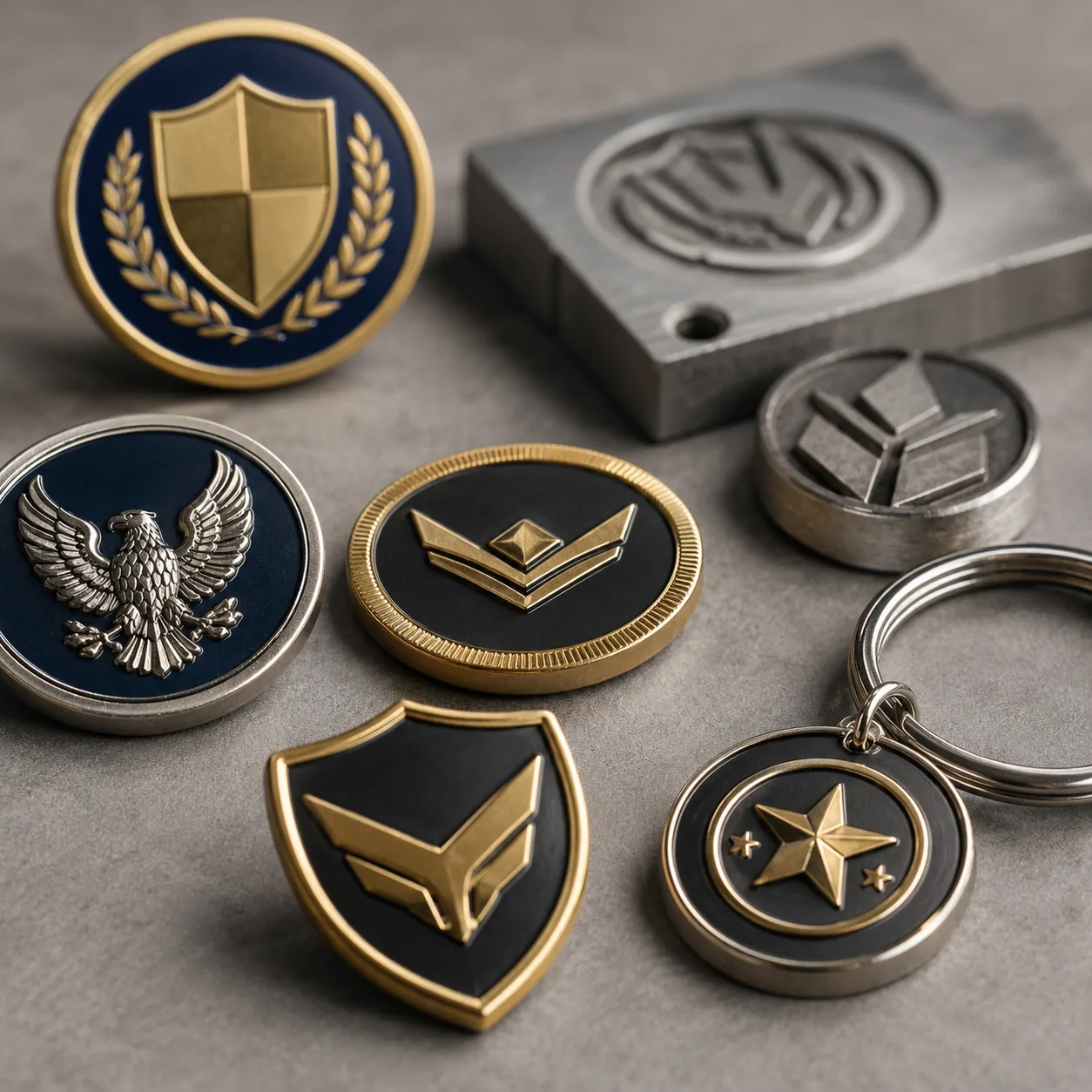
For custom metal promotional products, tooling is the physical memory of the item. It controls outline, relief height, raised metal width, recessed enamel areas, cutouts, coin edge detail, magnet recesses, ring holes, and sometimes post or clutch location. A vector file is necessary, but it does not reproduce every production decision made during die cutting, polishing, plating, and enamel filling.
The commercial risk is usually larger than the mold fee. A 30 mm pin die may cost only USD 40 to 90 FOB equivalent, but an unmatched reorder can delay an event, trigger chargebacks, or force the buyer to remake stock. The safest approach is to treat tooling as a controlled production asset. Before paying for a sample, define ownership, storage period, exclusivity, wear limits, and what happens if the tool must be repaired, remade, or transferred.
Tooling Types by Product and Process
For soft enamel and hard enamel pins, the main tool is normally a hardened steel stamping die used to press the design into iron, brass, or copper blanks. Common thicknesses are 0.8 to 1.2 mm for budget iron pins, 1.2 to 1.8 mm for brass pins with cleaner detail, and 1.5 to 2.0 mm for heavier retail or membership pins. For stable enamel filling, raised metal lines should normally be at least 0.20 to 0.25 mm wide; finer lines may stamp, but they often polish away or allow enamel bleed.
Challenge coins and heavier keychains usually need more tooling. A coin may require a front die, back die, trimming die, and a separate edge tool for rope, reeded, oblique, wave, or diamond-cut edges. A 40 to 45 mm coin is commonly 3.0 to 4.0 mm thick, while 50 to 60 mm coins are often 4.0 to 5.0 mm thick. If the edge is part of the visual specification, list it as a separate controlled tool rather than assuming it is included.
Die-cast zinc alloy items, such as 3D badges, bottle opener keychains, sculpted fridge magnets, and openwork products, use casting molds rather than flat stamping dies. These molds cost more, are less portable, and include shrinkage and parting-line decisions. A remade casting mold can change surface draft, wall thickness, and fit of magnets or hardware even when the artwork is unchanged.
| Product type | Common tooling | Typical tooling cost, FOB China | Useful life target | Main reorder risk |
|---|---|---|---|---|
| Soft enamel pin, 25 to 35 mm | Single stamping die plus trimming | USD 40 to 80 | 20,000 to 50,000 strikes | Raised lines below 0.25 mm soften after polishing |
| Hard enamel pin, 25 to 35 mm | Stamping die plus polishing fixture | USD 50 to 110 | 20,000 to 50,000 strikes | Over-polishing narrows borders and changes enamel level |
| Challenge coin, 40 to 60 mm | Front die, back die, trimming die, optional edge tool | USD 90 to 240 | 30,000 to 80,000 strikes | Relief depth, rim height, or edge pattern changes |
| Zinc alloy keychain, 50 to 80 mm | Die-casting mold and trimming fixture | USD 120 to 380 | 50,000 to 100,000 shots | Shrinkage, parting line, and hardware fit differ if remade |
| Metal fridge magnet, 40 to 70 mm | Stamping die or casting mold plus magnet recess fixture | USD 60 to 220 | 20,000 to 80,000 cycles | Magnet position or recess depth changes |
Ownership Is Not the Same as Paying a Mold Charge
Many buyers assume that paying a mold fee means they own the mold. In practice, the fee may only cover tool creation for use at that factory. Unless ownership and transfer rights are written into the RFQ and purchase order, the supplier may refuse release, charge an unexpected handling fee, or say the tool is part of its internal production process.
There are three practical models. Factory-retained tooling is simple and often acceptable for one-off event orders: the factory keeps the tool and agrees not to use the artwork for other customers, but the buyer cannot move it. Buyer-owned tooling gives stronger control for repeat programs, provided the PO defines labeling, storage, exclusivity, maintenance, and release terms. Stock tooling is suitable only for generic shapes such as round coin blanks, standard bottle opener bodies, or rectangular keychains where the outline is not proprietary.
For promotional-product distributors, buyer-owned tooling is usually worth specifying for corporate identity pins, annual event badges, membership coins, retail souvenir ranges, and licensed merchandise. For a one-time 300 piece giveaway pin, factory-retained tooling may be reasonable if it reduces setup cost. The important point is not which model is chosen; it is that the model is documented before sampling.
- State whether tooling is factory-retained, buyer-owned, or stock tooling before the sample invoice is paid.
- List each tool separately: front die, back die, trimming die, edge tool, casting mold, magnet recess fixture, or packaging knife.
- Require the mold ID to match the artwork revision, PO number, and final approved sample.
- State whether the tool may be used only for the buyer and its authorized reorder agents.
- Define whether transfer is allowed and who pays packing, inspection, and freight if the mold is moved.
- Ask for mold photos as supporting evidence, but do not treat photos as a substitute for written ownership terms.
Storage, Maintenance, and Retirement Limits
A metal tool is not usable forever. Even a correctly hardened die can rust, chip, deform, or lose crisp detail after repeated strikes. After production, a competent factory should clean the tool, remove residue, apply anti-rust oil, pack it in a labeled bag or box, and store it away from humidity. In Zhejiang and Guangdong summer conditions, unprotected steel can show visible rust within months; pitting on a die can later appear as texture defects on polished metal.
A reasonable free storage period is usually 24 to 36 months after the last shipment. For long-running brand programs, ask for 60 months, but allow the factory to inspect tool condition before each reorder. Be cautious when a supplier promises permanent free storage for every low-value order; unless it is written into the order terms, it is a sales statement.
Retirement limits should be measurable. For stamped pins, require notice if the outer profile drifts beyond ±0.15 mm from the approved sample, if thickness varies beyond ±0.10 mm, or if recessed enamel depth is reduced by more than 0.10 mm. Raised metal lines under 0.25 mm should be checked carefully because they are the first areas to round off. For challenge coins, review the rim and edge tool if rope or reeded edge height varies by more than 0.15 mm around the circumference.
| Tooling term | Buyer-friendly specification | Why it matters |
|---|---|---|
| Free storage period | Minimum 36 months after latest shipment | Covers annual and biennial reorders without surprise remold fees |
| Rust prevention | Clean, oil, pack, label, and store in dry conditions | Reduces pitting on raised metal and textured backgrounds |
| Condition review | Factory checks stored tool before reorder sampling | Finds wear before mass production starts |
| Repair threshold | Notify buyer if profile drift exceeds ±0.15 mm or relief loss exceeds 0.10 mm | Prevents silent dimensional changes |
| Retirement notice | No repair, remake, disposal, or transfer without written buyer approval | Avoids unexpected new tooling and mismatched batches |
When Remaking the Mold Is the Correct Choice
Reusing old tooling is not always the lowest-risk option. Buyers often try to avoid a USD 60 to 240 mold charge, but a weak die can reproduce the same defects for years. If the original artwork was bitmap-traced, small text was not legible, raised metal lines were below 0.20 mm, or enamel bleed appeared in the first run, the reorder is a good opportunity to correct the engineering rather than repeat it.
A new tool is also necessary when the product changes more than the buyer expects. Increasing a pin from 30 mm to 35 mm changes enamel cavity size, border width, and attachment balance. Switching from iron to brass changes stamping behavior and polishing allowance. Moving from soft enamel to hard enamel can require a revised die because hard enamel is filled, baked, and polished flush; raised metal that looked acceptable in soft enamel may become too narrow after polishing.
Do not rely on old tooling when the approved standard is missing. A proper reorder file should include vector artwork, material, thickness, Pantone references, plating finish, enamel type, attachment, packaging, final approved sample, and photos showing ruler, order number, and mold ID. If only a product photo remains, remake and resample instead of treating the old mold as a controlled specification.
- Remake the mold if the original artwork came from low-resolution bitmap tracing or small text is unclear.
- Remake the mold if raised metal lines are below 0.20 mm and enamel fill was unstable.
- Remake the mold if the brand guide, Pantone references, size, or attachment has changed.
- Remake the mold when switching process, such as stamped brass to zinc alloy die casting.
- Remake the mold if the first batch showed burrs, weak cutouts, uneven relief, or poor plating coverage.
- Reuse the mold only when approved sample, process, material, size, finish, and attachment remain unchanged.
Price, MOQ, and Lead-Time Impact
Tooling cost is normally quoted separately from unit price because it is incurred before production. For enamel pins, economic MOQs often start around 100 pieces, but the mold fee has a large effect on landed unit cost at low volume. A USD 60 die adds USD 0.60 per piece at 100 pieces, USD 0.12 at 500 pieces, and USD 0.06 at 1,000 pieces. This is why a repeat order using stored tooling can be materially cheaper even when the metal and plating costs are unchanged.
FOB unit prices vary by size, thickness, plating, colors, packaging, and inspection requirements. As a working range, a 30 mm soft enamel iron pin with one butterfly clutch is often USD 0.45 to 0.95 at 500 pieces. A 32 mm brass hard enamel pin with polished nickel plating and rubber clutch may run USD 0.80 to 1.60 at 500 pieces. A 45 mm dual-sided challenge coin may be USD 2.20 to 4.80 at 300 pieces depending on 3.0 to 4.0 mm thickness, edge tool, enamel, antique finish, and epoxy. A zinc alloy keychain with enamel and split ring is commonly USD 1.00 to 2.80 at 500 pieces.
New tooling also affects schedule. For pins, die making and pre-production sampling usually add 5 to 9 calendar days before mass production approval. Coins and zinc alloy castings commonly need 7 to 12 days because of dual-sided tooling, edge tools, polishing, and plating setup. After approval, mass production is typically 10 to 18 days for pins, 14 to 24 days for coins, and 12 to 22 days for zinc alloy keychains, assuming standard plating capacity and no public-holiday interruption.
| Scenario | Typical MOQ | Tooling impact | Sampling time | Mass production time |
|---|---|---|---|---|
| New 30 mm enamel pin | 100 to 300 pcs | USD 40 to 90 mold | 5 to 9 days | 10 to 18 days |
| Repeat pin, same approved mold | 100 to 300 pcs | Usually no new mold fee | 2 to 5 days first article | 8 to 16 days |
| New 50 mm coin with custom edge | 100 to 300 pcs | USD 90 to 240 tooling | 7 to 12 days | 14 to 24 days |
| Repeat coin, same dies and edge tool | 100 to 300 pcs | No new die unless worn | 3 to 6 days first article | 12 to 22 days |
| Zinc alloy 3D keychain | 300 to 500 pcs | USD 120 to 380 mold | 7 to 12 days | 12 to 22 days |
Inspection Standards That Confirm the Tool Still Works
A reorder should not move directly from purchase order to mass production just because a mold exists. Ask for a first-article sample from the stored tool and compare it with the archived approved sample, not only the digital artwork. The review should cover dimensions, relief, plating color, enamel color, attachment position, magnet fit, ring-hole diameter, and packaging fit.
Use calipers for width, height, thickness, and hardware position. For many 25 to 40 mm pins, practical tolerances are ±0.20 mm on outer dimensions, ±0.10 mm on thickness, and ±0.50 mm on post position unless a tighter drawing is agreed. For 40 to 60 mm coins, ±0.20 mm on diameter and ±0.15 mm on thickness is usually realistic; weight can vary ±5% due to plating, enamel coverage, and polishing. Magnet recess depth should normally be held within ±0.15 mm so the magnet sits flush and does not rock.
For decorative plating, define the finish rather than using only color words. Gold flash may be only 0.03 to 0.08 microns, which is common for promotional items but not high-wear jewelry. Nickel or copper underlayers may be thicker depending on process, and antique finishes require consistent oxidation removal on raised areas. If abrasion resistance matters, specify a higher plating requirement or protective epoxy, then price it accordingly.
For final inspection, many B2B orders use ANSI/ASQ Z1.4 or ISO 2859-1 sampling with General Inspection Level II, AQL 2.5 for major defects, AQL 4.0 for minor defects, and zero tolerance for critical safety defects. Critical defects include sharp broken posts, detachable magnets on items intended for children, lead or cadmium non-compliance where regulated, and hardware failure that creates an unsafe product.
- Compare first-article samples with the signed approval sample and specification sheet.
- Measure outer size, thickness, post location, magnet recess, ring hole, and coin edge detail.
- Check raised metal sharpness at small text, borders, logo corners, and recessed enamel cavities.
- Confirm plating finish, enamel colors, and any epoxy thickness or surface dome.
- Test attachments: butterfly clutch grip, rubber clutch fit, magnet adhesion, split ring closure, brooch pin tension, or chain pull strength.
- Record defects against agreed AQL levels before releasing full production.
RFQ and Purchase Order Wording That Prevents Disputes
Tooling terms do not need to be long, but they must answer the commercial questions that cause disputes. The RFQ should require tooling to be quoted separately from unit price and should identify every included tool. The purchase order should then confirm ownership, storage period, exclusivity, reorder standard, maintenance responsibility, and transfer conditions.
Avoid vague phrases such as mold included, free mold, or supplier keeps mold safely. They do not say whether another distributor can reorder from that tool, whether the factory can discard it after one year, or whether the buyer can transfer it if quality drops. A balanced clause protects both sides: the factory is not expected to store unused tooling forever, and the buyer does not lose control of a design it paid to develop.
A practical PO clause can be short: buyer-paid tooling is exclusive to the buyer and authorized agents; supplier stores it for 36 months after the latest shipment; supplier may not use, repair, remake, discard, or transfer it without written approval; reorders are judged against the approved sample and specification sheet; if transfer is requested, buyer pays reasonable packing and freight after invoices are settled.
- Quote tooling as a separate line item and identify all dies, molds, edge tools, trimming tools, and fixtures.
- State that buyer-paid tooling is exclusive to the buyer and its authorized purchasing agents.
- Store tooling for at least 36 months after the latest shipment unless otherwise agreed in writing.
- Notify the buyer before repair, remake, disposal, transfer, or substitution of any buyer-paid tooling.
- Use the approved sample, specification sheet, and mold ID as the reorder standard, not the mold alone.
- For accurate quoting, send vector artwork, target size, material, finish, quantity, expected reorder frequency, MOQ target, lead-time target, and tooling ownership requirement in the first RFQ.
Have a project? Send your artwork and target quantity and we’ll reply with a detailed quotation within 12 working hours.
Ready to get this made?
Send your sketch, target quantity and ship-date. Detailed quotation in 12 hours.



