Custom Metal Promo Product Costs and Lead Times, Broken Down
Why unit price alone is a weak buying signal
When buyers compare custom metal promo products, the common mistake is to focus on FOB unit price and ignore tooling, setup, packaging, and schedule risk. Two quotes can both show USD 0.85 FOB, but one may require a 5,000-piece MOQ, a 15-day mold cycle, and custom retail cards, while the other is ready in 10 to 12 days with existing tooling. For launches, dealer programs, membership kits, and event giveaways, that difference often matters more than a few cents on the invoice.
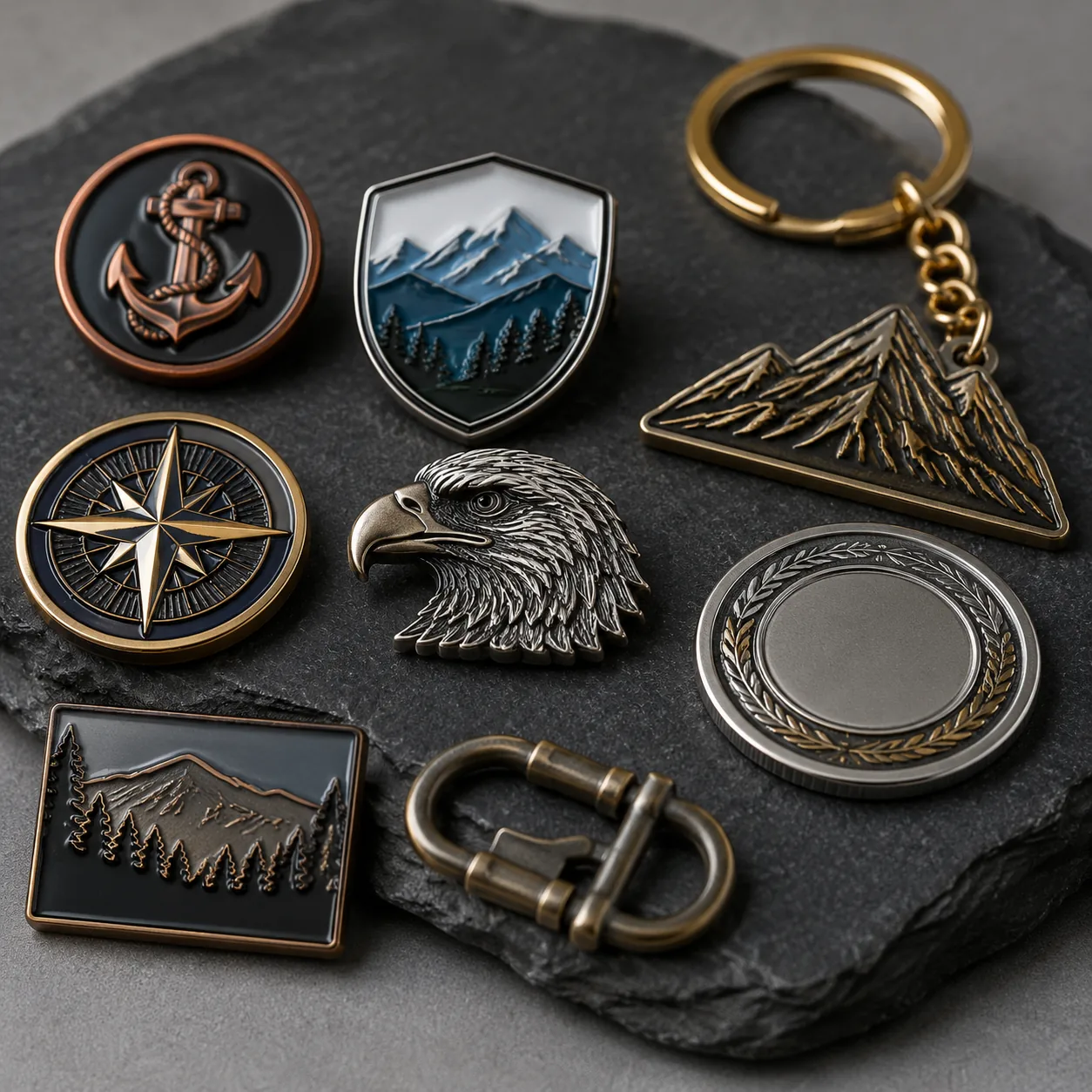
Custom metal promo items include enamel pins, challenge coins, keychains, badges, magnets, lapel pins, and small brooches. Their cost is usually driven by five variables: tooling, base material, plating, decoration, and packaging. Lead time is driven by the same variables plus artwork approval speed, sample rounds, and whether the factory must source special hardware or color-matched enamel. The right question is not “what is the cheapest quote?” but “what spec gives the best value for the intended use and reorder plan?”
A practical sourcing rule: if the item will be worn, handed out, or shipped in volume, keep the structure simple and the finish consistent. If it will be gifted, collected, or resold, prioritize plating quality, polish, and packaging before chasing the lowest FOB.
What actually moves FOB price
FOB pricing for metal promo products is not linear. The biggest cost jumps usually come from tooling complexity, metal weight, surface finish, and the amount of manual inspection required. A 30 mm hard enamel pin with two colors and a butterfly clutch might land around USD 0.55 to 1.10 FOB at 300 to 1,000 pieces, while a thicker die-cast soft enamel version with epoxy, screen print, and a custom backstamp can move into USD 1.20 to 2.40 FOB at the same quantity. If the design uses cutouts, raised text, or multiple finishes, unit cost rises faster than size alone would suggest.
Tooling is the first fixed cost buyers should understand. Simple stamped shapes may use a die fee of roughly USD 40 to 120 per design, while multi-level cast items or designs with several cavities often run USD 80 to 250 or more, depending on size, depth, and polishing requirements. Very small parts can sometimes be made with simpler tooling, but tiny text, thin borders, and sharp internal corners increase reject risk and inspection time.
Plating and finishing matter more than many buyers expect. Standard nickel, silver, gold, and black nickel are usually the most economical options. Antique finishes, dual plating, and specialty coatings add cost because they require extra line setup or additional handling. A heavier premium finish does not always change the base metal cost much, but it can add labor, rework, and rejection risk when the spec asks for tighter appearance consistency.
- Simple shapes with fewer cavities cost less because the die is faster to cut and polish.
- Thin parts use less alloy, but very thin bases can bend during packing and raise scrap rates.
- Soft enamel is usually cheaper than hard enamel when the design uses visible recessed color fills.
- Epoxy, glitter, glow, and printed details add labor and inspection time.
- Custom backcards, polybags, and gift boxes can add more to landed cost than buyers expect.
How MOQ tiers change the price curve
MOQ is where many buyers misread the economics. The first price tier often looks expensive because the factory must recover setup, plating line changeover, and hand inspection across a small run. Once volume increases, those fixed costs are spread across more pieces, so the unit price can fall quickly. A quote that looks high at 200 pieces may become competitive at 1,000 pieces or more.
For most custom metal promo items, the practical buying ladder looks like this: 100 to 299 pieces for samples or micro-events, 300 to 999 pieces for standard campaigns, 1,000 to 3,000 pieces for distributor replenishment, and 5,000+ pieces for retail or annual program work. Below 300 pieces, unit price is commonly 20% to 60% higher than the 1,000-piece tier, especially when the order includes premium plating or packaging. If you expect a reorder within 6 to 12 months, it is often smarter to place the first run at a slightly higher quantity and lock the spec now.
| MOQ tier | Typical FOB range | Best use case | Main trade-off |
|---|---|---|---|
| 100–299 pcs | USD 0.90–3.20 | Samples, pilots, short events | Highest unit cost, setup-heavy |
| 300–999 pcs | USD 0.55–2.40 | Standard campaigns, distributor orders | Moderate price, manageable inventory |
| 1,000–3,000 pcs | USD 0.35–1.80 | Reorders, seasonal programs | Lower unit cost, more cash tied up |
| 5,000+ pcs | USD 0.22–1.20 | Retail, national promotions, annual programs | Lowest unit cost, larger planning burden |
Do not compare MOQs without comparing the spec behind them. One supplier may quote 500 pieces with plain polybags and standard nickel, while another quotes 300 pieces with backcards, double-sided print, and custom box inserts. The lower MOQ is not always the lower total cost if the spec is heavier.
Lead time from artwork approval to shipment
Lead time is usually more sensitive than buyers think, especially when a campaign date is fixed. A straightforward metal pin or keychain can move from approved artwork to shipment in 10 to 18 days when tooling already exists or the design is simple. If new tooling is required, add about 5 to 10 days for mold making and first sample approval, plus more if the buyer changes art after proofing.
A realistic new-order timeline is: 1 to 2 days for quotation, 2 to 4 days for artwork confirmation, 5 to 10 days for tooling and sample, 2 to 5 days for sample approval, 5 to 12 days for mass production, and 2 to 7 days for packing and export booking. Rush orders are possible, but only when the factory has open plating capacity, available alloy stock, and a buyer who approves proofs quickly. If the order includes multiple SKUs or retail packaging, the packing stage is usually the bottleneck.
The fastest schedules happen when three things are already fixed: size, decoration method, and hardware. The slowest schedules happen when buyers keep changing text, color match, or backing style after sample approval.
- Existing tooling shortens lead time more than almost any other factor.
- Late color changes usually delay more than late text edits.
- Retail packaging can add 3 to 7 days if printed inserts are required.
- Multi-item promo sets should be scheduled by the slowest component, not the fastest.
- Peak season before major holidays can extend queues by 5 to 15 days.
Cost and lead time by product type
Not every custom metal product behaves the same way in production. Pins are usually the fastest and cheapest because they are small, flat, and easy to inspect. Coins and heavy badges cost more because they use more alloy, require more polishing, and often need sharper edge finishing. Keychains and magnets can add assembly labor and hardware sourcing, which lengthens lead time if the attachment is not standard.
For the lowest cost with short lead time, soft enamel pins and simple stamped keychains are usually the safest starting point. For premium perceived value, challenge coins and thick die-cast badges justify the extra spend because they feel more substantial in hand and present better in gift packaging. For giveaway use, keep decoration simple; for resale or gifting, focus more on plating consistency, weight, and packaging fit.
| Product | Typical FOB range | Typical MOQ | Typical lead time |
|---|---|---|---|
| Soft enamel pin | USD 0.35–1.50 | 100–500 pcs | 10–18 days |
| Hard enamel pin | USD 0.55–2.20 | 100–500 pcs | 12–20 days |
| Keychain | USD 0.45–2.80 | 100–300 pcs | 10–22 days |
| Fridge magnet | USD 0.40–2.00 | 200–500 pcs | 10–18 days |
| Challenge coin | USD 1.20–4.50 | 100–300 pcs | 12–25 days |
| Woven patch | USD 0.18–1.20 | 100–500 pcs | 8–15 days |
| Lanyard | USD 0.25–1.10 | 100–500 pcs | 7–14 days |
These ranges assume common OEM specs, standard packaging, and no special compliance work. If the job needs retail blister packs, serialized numbering, custom inserts, or mixed hardware, the quote can move meaningfully even if the product itself looks simple.
Hidden costs, tolerances, and quality limits
The quote is rarely the full cost. Buyers often forget plating thickness upgrades, secondary polish, epoxy doming, retail backing cards, oversize carton charges, and inspection rework. A design that looks cheap on paper can become expensive if it needs tight color matching, tiny text, or multiple attachment types because each requirement adds inspection time and reject risk.
Change control is another hidden cost. If the factory has already cut the die and the buyer then changes thickness from 1.2 mm to 1.8 mm, shifts the outer shape, or revises the clasp, the project may need a new mold or a partial remake. That is why the artwork, size, and hardware should be locked before pre-production sample approval, especially for orders above 1,000 pieces.
Tolerance also matters. For flat metal promo items, a practical manufacturing tolerance is often ±0.2 mm to ±0.3 mm on overall dimensions for small parts, with slightly wider tolerance on thicker cast items. If the design depends on precise fit with a box insert, card slot, or accessory, buyers should specify the critical dimension explicitly in the RFQ rather than assuming the factory will treat it as critical.
Surface standards should be stated in measurable terms whenever possible. If a buyer wants a smooth finish, define whether the item must be free of visible burrs under normal inspection, or whether minor polishing marks are acceptable. If the order uses enamel, request Pantone references and clarify whether a Delta E target is required. For plating, ask whether the factory is quoting standard decorative plating or a heavier custom spec, and whether the finish is suitable for indoor handling only or for longer wear.
For quality checks, a normal production target for decorative promo items is often AQL 2.5 for major defects and AQL 4.0 for minor defects, with tighter inspection on color fills, logos, and moving parts. If the item has layered enamel, hinges, or rotating components, ask the supplier to separate cosmetic defects from functional defects in the inspection report. For the FOB quote itself, ask whether plating thickness is standard decorative grade or a heavier spec in the roughly 0.03 to 0.05 micron range for light decorative finishes; if the buyer expects more wear resistance, that requirement should be written into the RFQ because not every factory quotes the same build standard.
- Ask whether the quote includes one tool, one sample round, and standard packing.
- Confirm whether plating thickness, epoxy, and backstamp are included or optional.
- Check whether edge polishing and deburring are included in the base price.
- Verify carton inner count and master carton count before booking freight.
- Ask whether rework for minor art corrections is free or billable.
How to write a sharper RFQ and control spend
The best way to control spend is to match the spec to the use case. A sales kickoff pin does not need retail packaging or heavy plating, while a corporate gift coin may need both. Buyers who define the purpose early usually get better factory advice and fewer surprises when the sample arrives.
A better RFQ should include exact size in millimeters, quantity by tier, desired plating, decoration method, backing or attachment type, packaging level, delivery country, and target deadline. If possible, also specify whether you want the cheapest workable version or the most premium finish within budget. That single instruction helps suppliers quote the right material and process mix the first time.
A useful sourcing habit is to ask for three prices on the same design: sample cost, 500-piece cost, and 1,000-piece cost. That exposes the real unit-cost curve and shows whether it is cheaper to order once or split into two runs. If the supplier cannot explain the delta between tiers, the quote is probably incomplete.
| Spec choice | Cost effect | Lead-time effect | When to use |
|---|---|---|---|
| Standard plating and no epoxy | Lowest | Shortest | Internal giveaways, price-sensitive promos |
| Thicker plating and polished edges | Medium | Slightly longer | Executive gifts, retail-facing items |
| Epoxy dome or screen print | Medium to high | Adds 1–3 days | Designs needing surface protection or fine text |
| Custom packaging | Medium to high | Adds 3–7 days | Retail, gifting, premium campaigns |
| Multiple hardware options | Medium | Adds 1–4 days | When comfort, security, or branding matters |
What to do next
Start by choosing your target tier: test run, standard campaign, or bulk reorder. Then lock three things before requesting quotes: exact size, decoration method, and packing level. If you do that, most suppliers can give you a usable FOB range and a credible schedule without multiple revisions.
For the fastest response, send one RFQ with artwork, target quantity, delivery country, and deadline, then ask for sample cost, MOQ pricing, and mass-production lead time. At ZheCraft, we can usually quote faster when buyers state whether they want the lowest workable spec or the most premium finish within budget. That simple instruction reduces back-and-forth and helps the factory price the job accurately the first time.
Have a project? Send your artwork and target quantity and we’ll reply with a detailed quotation within 12 working hours.
Ready to get this made?
Send your sketch, target quantity and ship-date. Detailed quotation in 12 hours.



