Custom Metal Promo Product Cost and Lead-Time Breakdown
What Actually Drives the Quote
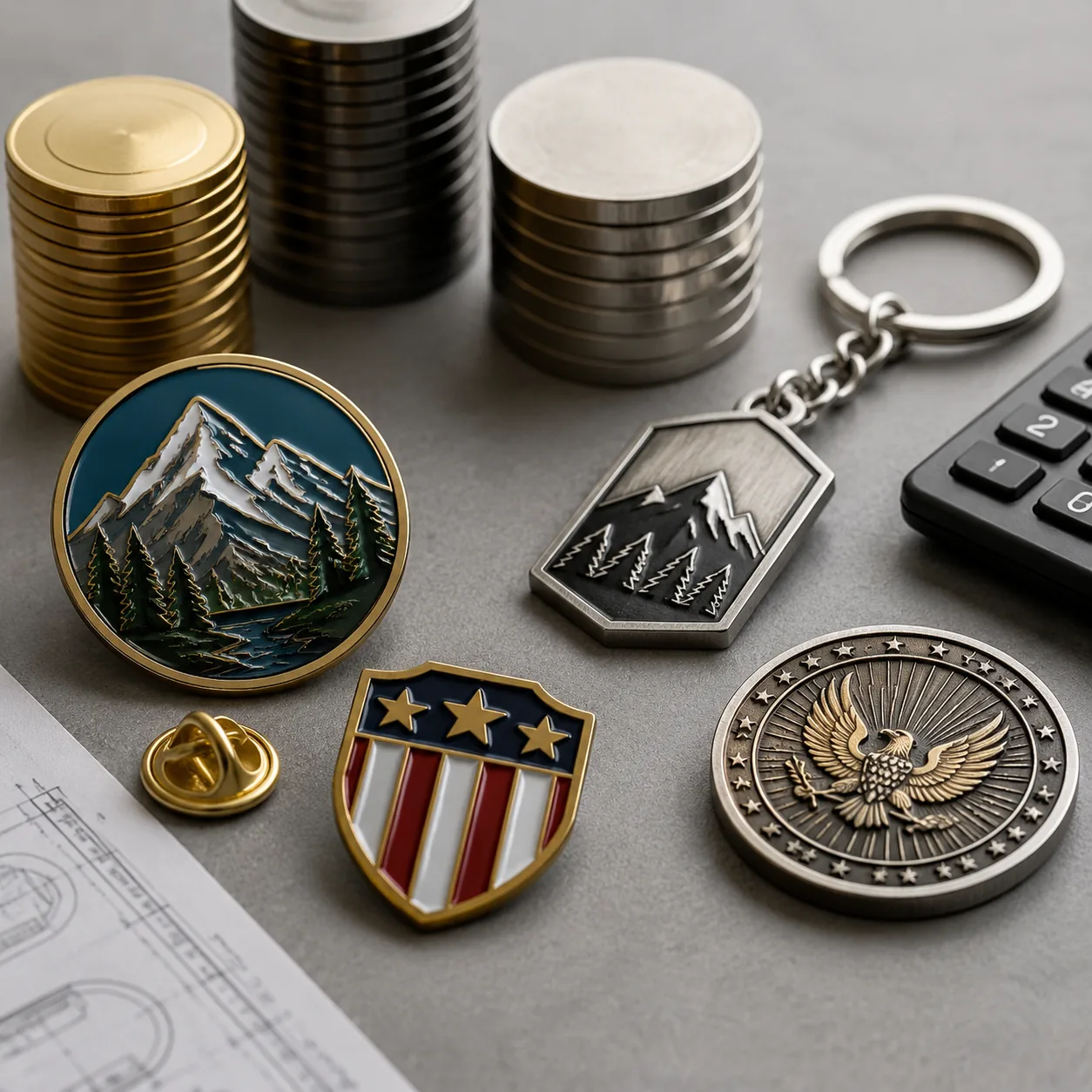
Two products can look identical in a mockup and still land at very different FOB prices. For custom pins, coins, badges, keychains, magnets, patches, and lanyards, the quote is driven by measurable inputs: outer size, thickness, material stack, plating finish, color count, attachment hardware, packaging, and how much hand-finishing the design requires. If a buyer only sends artwork and quantity, the supplier has to guess the process route, and that is where most budget surprises begin.
The cleanest RFQs specify dimensions in millimeters, target thickness, construction type, plating finish, color method, backing or attachment, packaging, and whether the item must pass retail-ready presentation checks. That does more than reduce back-and-forth. It lets the factory estimate die work, press time, polishing load, plating queue, and inspection effort with far less guesswork. A flat 2D soft-enamel pin, for example, is a very different job from a 3D cast coin or a printed PVC badge, even when the visible artwork is similar.
- Size: a 20 mm lapel pin and a 45 mm lapel pin may share artwork, but the larger piece uses more alloy, more polishing time, and more plating area.
- Construction: soft enamel, hard enamel, stamped metal, die-cast metal, embroidered, woven, printed PVC, and laser-etched metal each follow a different process route.
- Finish: nickel, black nickel, gold, antique brass, matte black, and dual plating add masking, cleaning, or rework steps.
- Extras: epoxy dome, glitter fill, glow pigment, moving parts, serial numbering, and custom backing cards add labor and inspection time.
MOQ Tiers And Unit Cost
MOQ is not just a sales policy. It is the point where setup cost spreads enough to make the unit price workable. Below about 100 pieces, per-unit cost is usually dominated by tooling, setup, and manual handling. Between 100 and 300 pieces, the curve starts to normalize. Around 500 to 1,000 pieces, many buyers reach the best balance of unit cost, flexibility, and factory priority.
A useful factory-side rule is that the same design can price 2x to 4x higher at 50 pieces than it does at 500 pieces, especially when the order includes custom packaging or multi-step finishing. For very simple stock-form builds, some factories will accept lower counts, but the quoted price is still usually anchored to the same setup burden. Buyers should also expect a higher tool amortization charge on one-off shapes, deep relief, or designs that need multiple molds.
| Order Tier | Typical Use | FOB Unit Price Behavior | Typical Production Lead Time |
|---|---|---|---|
| 50-99 pcs | Samples, pilot runs, internal gifts | Highest unit cost; setup dominates | 10-18 days |
| 100-299 pcs | Small campaigns, event handouts | Moderate setup burden; pricing begins to soften | 12-20 days |
| 300-999 pcs | Distributor orders, merch drops | Best balance of unit cost and efficiency | 15-25 days |
| 1,000+ pcs | Large promotions, retail programs | Lowest per-unit pricing; queue time may extend schedule | 18-30 days |
For reference, many factories quote a minimum tooling-friendly order at 100 pcs for simple pins and keychains, 200 pcs for coins with more than one finish, and 300 pcs for packaging-heavy programs. On mixed-SKU programs, each variant should be priced separately; otherwise the average unit price hides the true low-volume cost of each shape or finish.
Typical FOB Price Ranges
The product family matters more than many buyers expect. A 30 mm soft-enamel pin does not price like a 30 mm challenge coin, and neither behaves like a woven patch or printed lanyard. The ranges below are practical FOB guides for mid-volume orders with standard specs, not premium retail packaging or unusually complex geometry. Pricing assumes a repeatable design, one or two plating finishes, and no unusual compliance testing.
As a rough reference, simple custom metal pins often land around USD 0.35 to 0.85 per piece; challenge coins commonly range from USD 1.20 to 3.50; basic metal keychains from USD 0.60 to 1.80; fridge magnets from USD 0.30 to 1.40; embroidered patches from USD 0.25 to 1.10; and printed lanyards from USD 0.20 to 0.75. Add 10% to 35% for heavier thickness, 3D relief, dual plating, epoxy, custom carding, or premium boxes. Orders under 100 pieces can run materially higher, often by 30% to 100%, because setup cost is not yet absorbed.
| Product | Common Spec Baseline | Typical FOB Range (USD) | Cost Upside Trigger |
|---|---|---|---|
| Soft-enamel pin | 25-30 mm, 1.2-1.5 mm thick | 0.35-0.85 | Epoxy, dual plating, 3D cutout |
| Challenge coin | 40-45 mm, 2.5-3.0 mm thick | 1.20-3.50 | Deep relief, antique finish, edge text |
| Metal keychain | 35-50 mm, 1.5-2.0 mm thick | 0.60-1.80 | Double-sided logo, swivel ring, bottle opener |
| Fridge magnet | 40-60 mm, 1.0-2.0 mm thick | 0.30-1.40 | Domed epoxy, full-color print, layered build |
| Embroidered patch | 70-90 mm wide | 0.25-1.10 | Merrow edge, iron-on backing, dense stitch count |
| Printed lanyard | 900-920 mm long, 15-20 mm wide | 0.20-0.75 | Safety breakaway, metal hook, double-sided print |
What Changes Cost Most
The biggest savings usually come from design restraint, not from asking the factory to make it cheaper. Cutting plating breaks, simplifying cutouts, and avoiding mixed finishes often saves more than shaving a few cents from the quote. A buyer who freezes artwork early also avoids hidden cost from revision handling, re-polishing, or remaking tooling. The cheapest-looking design is not always the cheapest to produce if it creates extra setup or reject risk.
Thickness is a major lever. A 1.2 mm pin body is easier and cheaper to process than a 2.0 mm version. A coin at 2.5 mm feels more substantial than a 1.8 mm coin, but it also uses more metal and press time. In practice, the best design is rarely the thickest one; it is the thickest one that still meets the use case and budget. On plated pieces, a wide flat field also reduces polishing time and makes color fill more consistent than a heavily segmented surface.
| Spec Choice | Cost Impact | Lead-Time Impact |
|---|---|---|
| Single plating finish | Lowest process complexity | Shortest |
| Dual plating or masked plating | Adds finishing steps and rework risk | Adds 2-5 days |
| Soft enamel with clear epoxy | Adds coating and cure time | Adds 1-3 days |
| 3D relief or moving parts | Higher tooling and inspection load | Adds 3-7 days |
| Custom backing card or box | Extra printing and packing labor | Adds 2-6 days |
A practical example: a 30 mm nickel pin with four enamel colors and a butterfly clutch often quotes far lower than the same design in antique brass with a printed backing card, numbered back stamp, and epoxy dome. The artwork is unchanged, but the process route is not.
How Lead Time Breaks Down
Lead time is a chain, not a single number. Artwork confirmation, die or mold making, forming, polishing, plating, color fill or printing, curing, assembly, inspection, and packing each consume calendar days. If one step stalls for a revised file or color approval, the full order slips even if the production floor is otherwise on schedule. This is why “10 business days” can mean very different things across suppliers: some count only factory processing, while others include pre-production approval.
For standard custom metal promo products, a realistic factory timeline is often 1-3 days for artwork and proof approval, 3-7 days for tooling, 2-6 days for production and finishing on small to mid-size orders, and 1-4 days for inspection and packing. Larger orders or complex builds can extend to 18-30 days total, especially when plating queues are busy or the item includes multiple assemblies. Buyers planning for a fixed event date should treat the quoted production time as factory time only, then add freight and buffer. Ocean freight, customs, and domestic delivery can add 14-40 days depending on route and season.
- Artwork and proof: 1-3 days if the buyer responds quickly; longer if colors, sizing, or copy are still changing.
- Tooling: 3-7 days for most simple metal items; 7-10 days for 3D or multi-part builds.
- Finishing: 2-6 days depending on plating, paint fill, epoxy, and cure time.
- Packing and QC: 1-4 days depending on AQL level and packaging complexity.
If a launch date is fixed, the safe planning window is usually quote approval plus 2-3 days, proof approval plus 1-3 days, production plus 10-20 days, and freight buffer. Rush jobs are possible, but they usually compress inspection or pre-production review rather than the core manufacturing steps.
Specs Buyers Should Lock
A quote becomes unreliable when the factory has to guess the spec. The most common re-quote triggers are missing dimensions, unclear thickness, no finish selection, no attachment definition, and artwork that does not state whether small text and fine lines must be preserved. The second most common trigger is a mixed-SKU order described with one generic sentence instead of separate line-item specs. Buyers who standardize the RFQ usually get faster and more comparable pricing.
For dependable pricing, buyers should specify outer dimensions, thickness, metal type if relevant, finish, color method, tolerance, inspection level, and packaging format. For plated metal goods, a practical decorative target is often 0.03-0.05 microns for very light flash plating, while heavier decorative builds commonly use 0.1-0.3 microns depending on appearance and wear expectations. For retail-facing orders, AQL 2.5 for major defects and AQL 4.0 for minor defects is a common starting point, though some buyers tighten the standard for client gifts or premium channels. Typical dimensional tolerance for stamped or cast promo metal is around ±0.2 mm to ±0.3 mm on overall size, with tighter control only where the part geometry supports it. For enamel fill, color placement tolerance is usually controlled visually rather than by micron measurement, so the approved sample matters as much as the drawing.
| Spec Item | Recommended Entry | Why It Matters |
|---|---|---|
| Overall size | Length and width in mm | Controls mold size, polish time, and freight cube |
| Thickness | 1.2 mm, 1.5 mm, 2.0 mm, or 2.5 mm | Affects weight, rigidity, and press time |
| Plating | Nickel, black nickel, gold, antique brass, matte black | Changes masking, cleanup, and visual value |
| Inspection | AQL 2.5 major / 4.0 minor | Sets reject threshold and packing effort |
| Tolerance | ±0.2 mm to ±0.3 mm | Defines acceptable dimensional drift |
| Packaging | Bulk, polybag, backing card, gift box | Affects labor, damage rate, and lead time |
- Give outer dimensions, thickness, and any keyhole, cutout, or hole measurements.
- State the exact attachment or hardware, not just “standard backing.”
- Define finish, color method, and whether epoxy is allowed or prohibited.
- Confirm packaging: bulk, individual polybag, backing card, or gift box.
- Set the approval rule for pre-production samples and golden sample retention.
When Lower Price Is The Wrong Buy
The cheapest quote is not always the lowest-risk option. When a supplier underprices a complex design, the risk usually appears later as rushed production, rough polishing, thin plating, weak hardware, or color that drifts from the approved sample. This is especially true on small orders, where the factory has little margin to absorb hidden labor. A quote that is 15% lower but misses hardware or packaging can cost more after rework or replacement than a cleaner, complete quotation.
There are also cases where a higher-cost build is the better commercial decision. If the item will be handled daily, shipped through retail channels, or worn outdoors, stronger plating, better attachment, and tighter inspection can reduce returns and replacements. For short-life giveaways, a simpler construction can be the right call; for client gifts and retail programs, the quality threshold should be higher. For example, a coin intended for desk display can accept a more decorative antique finish, while a keychain intended for daily pocket use may need a stronger split ring and thicker body.
One useful rule: if the design has more than two process risks, such as dual plating plus epoxy plus moving parts, do not compare quotes only on unit price. Compare them on defect allowance, inspection method, and lead-time confidence. Those factors usually determine whether the order lands on time and within acceptable quality.
What To Send For A Fast Quote
Start by locking the commercial spec, not just the artwork. Send one RFQ with exact dimensions, quantity tiers, finish choice, hardware, packaging, target delivery date, and any must-pass requirements such as child safety, corrosion resistance, or retail presentation. If you are comparing pins, coins, keychains, magnets, patches, and lanyards in one program, ask for separate unit pricing plus a combined packing and freight view so landed cost is visible. When possible, include one reference image, one vector file, and one target sample photo so the factory can align the intended finish and detail level.
A good brief usually answers three questions: what is the cheapest acceptable construction, what lead-time window is acceptable, and what is the maximum landed cost per piece. At ZheCraft, that is usually enough to quote the correct process route on the first pass instead of revising after sampling. The result is fewer surprises, fewer reworks, and a schedule that matches the event date instead of hoping for one. If the buyer can also state whether the order is for internal use, corporate gifting, retail resale, or trade-show distribution, the factory can tune the inspection level and packing method more accurately.
Have a project? Send your artwork and target quantity and we’ll reply with a detailed quotation within 12 working hours.
Ready to get this made?
Send your sketch, target quantity and ship-date. Detailed quotation in 12 hours.



