Custom Metal Promo Failures: 8 QC Breakpoints to Spec Out
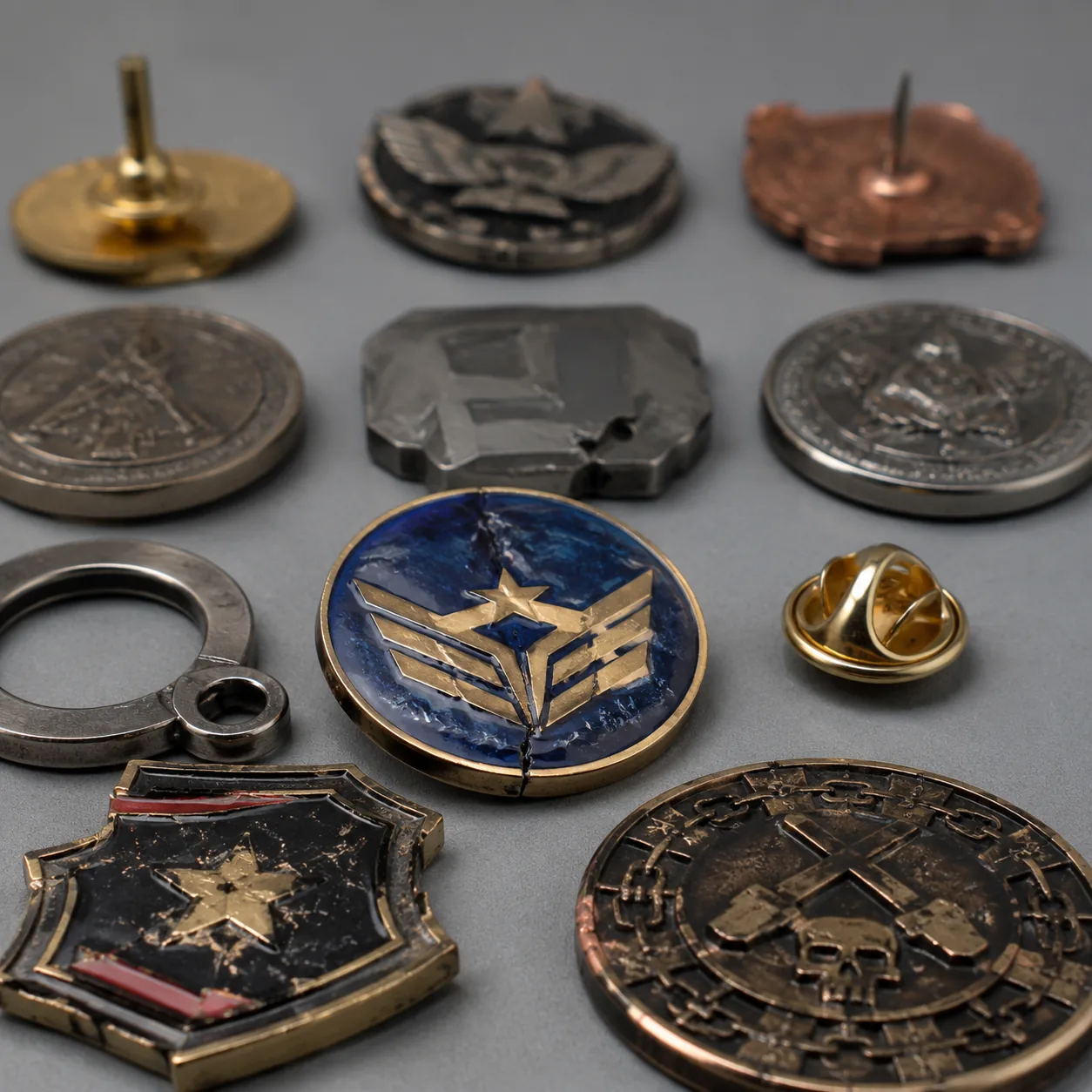
Why metal promo orders fail after approval
The part that fails is rarely the one that looked bad in the proof. In custom metal promo products, the real risk appears after artwork signoff: during tooling, plating, filling, assembly, packing, and carton-out. A pin, coin, keychain, medal, or badge can look simple on screen yet still fail on minimum line width, plating build, enamel registration, or hardware retention once it reaches production. The right way to buy these items is to spec the failure points, not just the finished appearance.
For most programs, the best control stack is an approved artwork file, a dimensioned drawing with tolerances, a plated master sample, a Pantone or physical color reference, and a packed sample. For repeat orders, keep the same reference package and lock the revision number. That matters because a 0.2 mm change in edge geometry, a different plating sequence, or a new clutch supplier can create rework across a 3,000-piece run even when the render still looks identical.
A practical sourcing baseline for this category is simple: simple stamped or die-struck items often run MOQ 100-300 pcs with 10-14 days for samples and 15-25 days for production after approval; custom soft enamel, hard enamel, or multi-component pieces are more often MOQ 300-1000 pcs with 12-18 days for samples and 20-35 days for production. FOB pricing usually starts around USD 0.35-0.90 for basic stamped zinc alloy or iron pieces, USD 0.90-2.50 for soft enamel or plated multi-color pieces, and USD 2.50-6.00+ for hard enamel, epoxy dome, or complex assembled items, depending on size, finish, and packaging.
1. Artwork that survives design review but dies in tooling
Tooling failures usually trace back to artwork that is too fine for the process. Die-struck and stamped items need more clearance than flat-vector art suggests. If a line is too thin, the factory may thicken it, merge it, or convert it into a shallow ridge. For hard enamel, tiny islands can trap air or overflow during polishing. For cast parts, undercuts and deep pockets can create fill and release problems. A good RFQ should ask for redraw feedback before tooling so the factory can tell you what it can actually make without distortion.
Use production limits, not only visual intent. For small metal promo items, a practical minimum is often 0.20-0.25 mm line width for simple stamped relief, 0.30 mm for safer enamel walls, and 0.25-0.40 mm spacing between separate color areas depending on process and size. Text below about 4 pt on a 25-35 mm part is usually risky unless it is engraved rather than raised. If the design depends on micro-detail, increasing the overall size by 1-2 mm is often cheaper than accepting a blurry first run.
Concrete example: a 28 mm lapel pin with a 3.5 pt URL and a 0.15 mm internal cutout is likely to need redraw or simplification. At that size, many factories will recommend at least 0.30 mm wall thickness, 0.35 mm color separation, and lettering no smaller than 4.5-5 pt if it must remain raised. If the linework is critical, ask the supplier to confirm the smallest feature size in writing before tooling starts.
- Specify minimum line width and gap in millimeters, not just overall size.
- State whether tiny text may be removed, simplified, or engraved.
- Approve a redraw before tooling when cutouts, bridges, or openwork are involved.
- Provide separate artwork layers for outline, metal relief, and color fills.
- Set a minimum readable text size, especially for serials, slogans, and URLs.
2. Dimensions that drift after plating and assembly
Finished dimensions are not the same as CAD dimensions. Plating adds thickness, polishing removes material, and assembly introduces stack-up. Decorative nickel, black nickel, gold, or antique finishes often build roughly 0.05-0.15 μm per side in a visual-decorative context, but the more important number for buyers is the finished-size tolerance after all processing. On small items, even a 0.10 mm change can affect pin alignment, hinge fit, or how a clasp sits against the substrate.
For flat promo metal parts, a sensible starting tolerance is ±0.20 mm on general outline dimensions under 50 mm, and ±0.30 mm on larger parts or multi-component assemblies. For critical holes, posts, or tabs, call out the fit separately; do not let them fall under the general tolerance. If the item is riveted, hinged, or magnetized, ask the factory to confirm the dimension after polishing and plating, because the processing order changes the final geometry. Sharp corners also soften during polishing, so a part that looks crisp in render can arrive with visibly rounded edges if that sequence is not controlled.
For example, if a 32 mm badge needs to fit a backing card with a die-cut window, specify the badge at 32.00 mm ±0.15 mm, the window at 32.40 mm ±0.20 mm, and the measurement method at the widest point after final plating. If the pin post must align with a butterfly clutch, define post diameter, straightness, and insertion force separately instead of relying on the outline tolerance.
| Risk area | Typical failure | What to specify |
|---|---|---|
| Outer size | Piece matches the drawing before finish but feels oversized after plating | Finished-size tolerance and measurement point |
| Hole/post fit | Accessory assembles crooked or binds | Critical diameter, pin size, and mating tolerance |
| Edge detail | Polishing rounds off corners and fine relief | Minimum edge definition and polishing sequence |
| Layered parts | Stacked components shift during riveting | Assembly alignment tolerance and pull requirement |
3. Surface finish that looks right in one light and wrong in every other light
Surface finish is not just a color choice. It controls perceived quality, scratch visibility, and how much polishing the part can tolerate. A brushed field can hide minor tooling marks better than a mirror finish. Antique silver with selective high-polish edges usually gives stronger contrast and better handling durability than a fully polished surface. Matte or sandblasted textures are also more forgiving on low-cost promotional runs because they reduce the visual penalty from minor plating variation.
The spec should say exactly where the finish belongs. For example: brushed background, polished raised logo, matte recessed field, and bright nickel border. If the back side will ever be visible, approve it too. Many buyers overlook backside scratches, drag marks, or uneven cleaning, then discover the defect only after the item is bagged or assembled. Inspect glossy finishes under neutral light, ideally 5000-6500K, because warm retail lighting can hide unevenness that a warehouse will show immediately.
A useful commercial distinction is this: mirror finishes need tighter visual control and often a more conservative acceptance standard, while brushed or antique finishes are more forgiving on surface micro-defects. If you want a polished logo on a matte base, define the contrast boundary in the drawing. For example, specify a 0.20 mm masked edge between brushed recess and polished relief so the factory does not blur the transition during buffing.
- Choose finish by viewing distance and handling frequency.
- Call out where polish, matte, brushed, or antique texture should appear.
- Require backside finish approval if the item will be visible in use.
- Reject photos alone for mirror finishes; inspect under neutral light.
- Use one approved master sample for both color and sheen comparison.
4. Color fill that shrinks, sinks, or bleeds at the edge
Enamel failures are usually control failures, not art failures. The buyer needs to define fill level, edge condition, and acceptable variation before the job starts. On soft enamel, the color should usually sit slightly below the metal walls; on hard enamel, it is often ground flush after curing and polishing. If the spec does not say which result is required, the factory may deliver either and still consider the part acceptable.
For small color islands, simplify. A design with six tiny enamel zones is much more likely to show pinholes, overflow, or uneven curing than a design with three larger zones and clearer borders. A good production spec should include the Pantone reference, finish type, allowed color delta, and whether exposed base metal at the edge is acceptable. For repeatability, ask for a pre-production color chip and a first-article sample rather than relying on a digital mockup.
Typical color acceptance on promo metal is practical rather than laboratory-grade. For many campaigns, a Pantone delta within about ΔE 2-3 is acceptable if all pieces in the lot match each other and the approved reference. More important is uniformity across the run, no exposed base metal in the fill area, no overflow onto plated walls, and no pinholes larger than about 0.20 mm in visible fields. If the design is miniature, a thicker wall or larger open area will usually outperform a more detailed but fragile layout.
If the item is soft enamel, specify whether the fill should be 0.10-0.20 mm below the metal wall. If it is hard enamel, specify that the final surface should be flush within about ±0.05 mm after polishing. That single sentence eliminates a lot of back-and-forth when the sample arrives looking “too flat” or “not flat enough.”
5. Plating that tarnishes, freckles, or wears through early
Plating should be specified as a system, not a color name. A correct spec names the base metal, the finish, the appearance target, and the expected use environment. Decorative finishes on common promo items are usually thin by design, so buyers should not describe them as wear-proof unless the factory has a heavier protective stack or a clear anti-tarnish process. High-touch items need more than a nice initial look; they need stable surface performance through packing, transit, and customer handling.
If the item is for retail, gifting, or long shelf life, ask whether anti-tarnish oil, protective film, individual polybags, or desiccant is part of the process. On nickel and brass-based products, freckling often comes from incomplete cleaning before plating or from poor post-plating drying. Wear-through at the edges usually means the finish was too thin for the handling profile or the base polish was too aggressive. Define the expected life in plain terms, such as display-only, occasional wear, or daily use, and make the factory match the process to that use case.
Useful commercial targets for plated promo pieces often sit in these ranges: MOQ 100-300 pcs for simple stock-style builds, 500-1000 pcs for custom logo runs, and 3000+ pcs for fully custom multi-part items. FOB pricing can vary widely by size and finish, but simple zinc alloy or iron promo items often land around USD 0.35-1.20 per piece, while more complex hard enamel, epoxy dome, or multi-process items may run USD 1.20-4.50+ FOB depending on size, plating, and packaging. Lead time is usually 10-15 days for samples and 15-30 days for production after approval, longer if the design needs 3D tooling or special plating.
If you need a more durable finish, ask for the coating stack in plain language: base metal, copper or nickel underplate if used, final decorative plating, and any sealant or lacquer. A buyer who requests “gold finish” without this stack is usually buying appearance only, not a defined wear profile.
6. Attachment hardware that loosens in the field
Hardware should be selected by function, not habit. A butterfly clutch is fine for a light lapel pin, but it can rotate or loosen if the piece is large or worn on thick fabric. A rubber clutch is more forgiving for daily use but can still fatigue over time. Magnet backs avoid piercing garments, yet they must be sized for the real substrate, not a lab test plate. Key rings, lobster clasps, split rings, and safety pins each have different failure modes and should be chosen for load, motion, and pull direction.
For critical programs, specify the retention requirement. If the item will be worn on a jacket, bag, or lanyard, state a minimum pull resistance or cycle expectation. A practical spec might require a 1.5-2.0 kg pull test for a medium badge, or a minimum 1000 open-close cycles for a clasped accessory, depending on size and use. Anti-rotation features matter for pins with wide footprints. For magnets, state the actual surface condition, such as painted steel, coated garment, or curved metal, because holding force drops fast when the contact surface is imperfect.
Example: a 40 mm souvenir pin with a wide logo bar should not rely on a single clutch if it will be worn on denim or a jacket lapel. Two posts, a locking clutch, or a wider magnetic backing may be the right answer. For keychains, specify split ring wire diameter, usually around 1.0-1.5 mm for light promotional use, and ask for spring recovery after repeated opening.
| Hardware choice | Best use | Common failure | Spec to add |
|---|---|---|---|
| Butterfly clutch | Light lapel pins | Rotation and loss under motion | Anti-rotation design and pull test |
| Rubber clutch | Moderate daily wear | Gradual loosening | Retention check after vibration |
| Magnetic back | Clothing without piercing | Sliding on smooth or coated surfaces | Surface type and holding target |
| Split ring | Keychains | Opening under repeated load | Wire diameter and spring recovery |
| Lobster clasp | Lanyards and attachments | Snagging or weak spring | Cycle count and opening force |
7. Packing that creates defects after QC has already passed
A finished part can pass inspection and still arrive damaged if packing is weak. The packing method should match the surface finish, hardware, and carton handling risk. High-polish parts need individual protection. Mixed sets need component separation. Soft goods and hard metal parts should not rub directly inside the same bag. If the project is export-bound, carton labeling and count control matter as much as the parts themselves, because destination warehouses often reject cartons that cannot be audited cleanly.
Ask for the packed sample, not only the loose finished sample. A good packing spec may require individual polybags for glossy items, divider cards for stacked parts, bubble sleeves for boxed sets, or blister trays for retail presentation. Add carton limits too: master carton weight, stackability, and acceptable count variance. For most projects, a count tolerance of 0 is preferred on final packed units, while carton-level variance should stay within the factory’s documented process control. If a product uses plated finishes, specify whether anti-scratch film, silica gel, or anti-tarnish paper is required before sealing.
A common failure is scuffing from bulk bagging. If 200 polished badges are dropped into one PE bag, the scratch rate can be higher than the rejection rate at inspection. A better standard is individual polybagging for mirror or high-gloss surfaces, then separation by dividers or trays inside the master carton. For export, also specify carton marks, gross and net weight, quantity per inner box, and whether the carton must survive 1.2-1.5 m drop handling without opening.
- Require individual protection for glossy or high-polish faces.
- Separate hard and soft components inside mixed sets.
- Define carton count tolerance, carton weight, and label format.
- Ask how the factory prevents moisture, scuffing, and compression.
- Approve packed samples, not just loose finished samples.
8. The QC checklist that prevents repeat failures
The most reliable orders are the ones that close every ambiguity before tooling. Start with one approved drawing, one physical reference for finish, one color standard, one hardware spec, and one packed sample standard. Then lock the acceptance order: artwork proof first, pre-production sample second, first article third, mass production fourth, and packed-out audit last. That sequence keeps suppliers from changing details between approval stages.
A practical pre-production checklist should force the buyer to answer the questions the factory will not answer on its own. If the item is a pin, badge, coin, medal, keychain, magnet, patch, or lanyard, define the process, the target tolerance, the surface, the hardware, and the pack-out. For mixed campaigns, make sure every product type shares the same color standard and plating intent so the range looks like one collection rather than five unrelated buys.
Use measurable acceptance terms. A useful spec set might include: general dimensional tolerance ±0.20 mm on parts under 50 mm, hole or post fit tolerance called out separately, enamel pinholes not exceeding 0.20 mm in visible zones, finish reference approved under 5000-6500K light, hardware retention tested to 1.5 kg minimum where relevant, and packed-unit count tolerance of zero. Those numbers are not universal, but they are specific enough to stop vague sampling decisions.
- Confirm process type: stamped, die-struck, cast, etched, soft enamel, hard enamel, or epoxy dome.
- Lock finished dimensions, not just artwork dimensions.
- Approve one physical master for color, sheen, and edge detail.
- Define MOQ, lead time, and FOB range before tooling starts.
- Require packed-sample approval for the exact carton-out configuration.
If you want fewer surprises, do not ask only whether a supplier can make the item. Ask where it can fail, what the measurable limit is, and which sample proves the limit was met. That is the difference between a clean promo run and a batch of avoidable rework.
Have a project? Send your artwork and target quantity and we’ll reply with a detailed quotation within 12 working hours.
Ready to get this made?
Send your sketch, target quantity and ship-date. Detailed quotation in 12 hours.



