Custom Metal Giveaway Spec Sheet: What to Lock Before Quote
Start With the Item Class, Not the Artwork
Most quote errors start because the buyer describes the graphic, not the product. A supplier can build the same logo as a lapel pin, badge, coin, keychain, magnet, cufflink, or bottle opener, and each class changes tooling, thickness, backing, plating area, and acceptable tolerance. Before you send art, lock the item class, use case, and success criteria. Otherwise, one factory prices a 1.2 mm soft enamel pin while another quotes a 2.5 mm cast badge, and both are answering a vague brief correctly.
A useful first line for any RFQ is: product type, size, thickness, base metal, plating, color system, attachment, and packing. That is enough to anchor the quote and expose conflicts early. A 25 mm pin for apparel is not the same as a 25 mm fridge magnet once you account for steel backing, magnet grade, and total thickness. For B2B buyers, the goal is not just a pretty proof; it is a repeatable build with a written approval standard.
Typical MOQ tiers for custom metal giveaways are 100 to 200 pcs for very simple stock-base work, 300 to 500 pcs for most standard custom shapes, and 1,000 pcs plus for lower unit pricing on multi-color or multi-part builds. Standard sample lead time is often 7 to 12 days, while full production usually lands around 12 to 20 days after sample approval. Freight, plating, and packing choices can move the delivered cost more than the artwork itself, so those variables need to be fixed before pricing starts.
- State the product class: pin, badge, coin, keychain, magnet, cufflink, or opener.
- Define the use case: apparel, desktop, event giveaway, retail, or commemorative.
- Lock the production route expectation: stamped, cast, etched, printed, or hybrid.
- Set the approval basis: visual match, dimensional match, or both.
Dimension Line: Size, Thickness, and Tolerance
Size drives tooling cost, perceived value, attachment stress, and shipping density. For lapel pins and badges, common working sizes are 20 to 30 mm for simple logos, 35 to 45 mm for detail-heavy badges, and 50 mm plus when text needs to remain readable at arm’s length. Challenge coins are usually 40 to 50 mm in diameter and 2.5 to 3.5 mm thick. Keychains and magnets need extra stiffness because bending loads increase once the product is handled daily or hung from a ring.
Tolerance should be written, not assumed. For flat metal products, a practical tolerance is +/-0.3 mm to +/-0.5 mm on small parts, and +/-0.5 mm to +/-1.0 mm on larger forms. Thickness tolerance is commonly +/-0.1 mm to +/-0.2 mm depending on process and alloy. If your logo has a tight outer contour, specify whether the tolerance applies to the metal edge or the visible enamel edge. Those are not always the same, and that distinction matters when the artwork sits close to the limit.
A good spec sheet also states what happens when the design includes multiple components. For example, a badge with a separate butterfly clasp, a printed insert, and an epoxy dome can be within tolerance on each part while still looking misaligned as an assembly. Ask the factory to confirm both part-level and assembled-level checks if the item includes layered elements. For mixed sets, the usual quality target is a clear fit-up with no visible rocking, no exposed raw edge beyond the design, and no sharp burrs on the back.
| Spec line | Typical buyer choice | Why it matters |
|---|---|---|
| Small lapel pin | 25-30 mm, 1.2-1.5 mm thick | Keeps unit weight low and fits most apparel |
| Badge or brooch | 35-45 mm, 1.5-2.0 mm thick | Improves visibility and stability on fabric |
| Challenge coin | 40-50 mm, 2.5-3.5 mm thick | Supports relief, edge text, and premium hand feel |
| Keychain body | 30-50 mm, 1.8-3.0 mm thick | Needs stiffness for ring pull and daily use |
Metal Body Spec: Base Alloy and Build Route
The base metal determines feel, durability, and how much detail survives tooling. Iron is usually the cost leader for stamped items, brass gives cleaner edge definition and a more premium look, zinc alloy is better for deep 3D casting and complex contours, and stainless steel is preferred when corrosion resistance or a sharper industrial appearance matters. If the piece is too thin for the chosen alloy, it can warp during plating or bend in packing, which often costs more than upgrading the base material would have.
Use stamped metal when you want crisp flat relief and predictable pricing on moderate to high quantities. Typical MOQ for stamped pins is 300 to 500 pcs, with FOB pricing often around USD 0.25 to 1.20 per piece depending on size, plating, and packaging. Use cast metal when the design needs deep relief, curved surfaces, or irregular outer shapes; MOQ is often 300 pcs, with FOB pricing commonly around USD 0.60 to 2.80 per piece for standard custom work. Etching suits line-based graphics and fine text, but it is not the right route if the logo needs strong tactile depth.
For a simple guide, choose iron for price-sensitive flat items, brass when edge quality matters, and zinc alloy for sculpted or heavy-feel products. If the artwork includes both flat fields and sculpted sections, ask the supplier where the process transitions, because that junction is a common source of tooling compromise. For small parts under 20 mm, avoid over-specifying 3D relief; detail collapse is common, especially when the minimum feature size falls below the tool maker’s practical cut width.
- Choose iron for simple stamped items with tight unit cost targets.
- Choose brass when sharp edge definition and finish quality matter.
- Choose zinc alloy for 3D shapes, thick sections, and complex contours.
- Avoid deep relief on very small items; fine detail will collapse in production.
Plating and Finish: Match the Look to the Use Case
Plating is where buyers often overbuy or underbuy. Common finishes include bright nickel, black nickel, antique brass, antique copper, gold, silver, and matte black. Decorative plating thickness is often in the 0.1 to 0.3 micron range for standard promotional work, while wear-focused jobs may request higher build or an added protective coat. If the item will live in a gift box, visual consistency matters more than abrasion resistance; if it will be worn daily, you need a tougher finish and cleaner edge polish.
Finish choice should follow the artwork and audience, not the supplier’s default catalog. Bright nickel fits corporate branding and cool color palettes. Antique finishes hide minor tooling marks and suit heritage or commemorative themes, but they soften contrast on fine text. Matte black reduces glare in photography and stage lighting, which helps event merch and fashion drops. For any finish-sensitive project, ask for a plated sample or at least a directional photo proof before mass production. That single step prevents most “the color looked different” disputes.
A workable FOB range for common plated pin and badge programs is USD 0.30 to 1.80 per piece at 500 to 1,000 pcs, depending on size, plating, enamel, and packing. Premium multi-layer or hard-enamel builds can run USD 1.50 to 4.50 FOB per piece. If a quote is far below those ranges, check whether the supplier omitted back stamp, polishing, black lines, or individual packing. Low quotes are often incomplete quotes.
| Finish | Best for | Trade-off |
|---|---|---|
| Bright nickel | Corporate branding, clean logos | Shows fingerprints and edge flaws more easily |
| Antique brass | Heritage and commemorative looks | Reduces contrast on fine details |
| Black nickel | Modern premium styling | Harder to judge color in low light |
| Matte black | Event merch and fashion drops | Can show scuffs on high-contact areas |
Color and Fill: What the Enamel Spec Must Say
Color problems usually come from vague naming, not from carelessness. A reliable spec should state the color standard, fill method, line width, and whether the buyer accepts small visual variance under daylight. For soft enamel, the fill sits below the metal edge and the recessed area creates texture. For hard enamel, the surface is polished flatter and feels smoother. If your artwork includes gradients, transparency, or shadows, standard enamel is the wrong build and the spec should say so clearly.
Pantone references are still the cleanest way to control expectation, but the buyer needs a written acceptance rule. For most promotional items, a practical target is “match the approved sample under daylight” rather than an abstract promise of exact color. For linework, a minimum visible line width of about 0.2 to 0.3 mm is safer on most metal giveaway builds, though smaller parts may need wider separations to survive filling and polishing. If the design uses multiple brand colors, ask the factory to confirm compartment count, fill sequence, and whether any areas require manual touch-up.
For quality control, a useful AQL target is often AQL 2.5 for major defects and AQL 4.0 for minor defects on standard promotional lots, unless the client requires tighter screening. Major defects include wrong color, missing attachment, gross plating mismatch, or broken pieces. Minor defects include tiny surface pits, slight color shift, or small polishing haze that does not affect use. State the approval sample as the master reference so inspection criteria do not drift later.
- Specify Pantone or another named reference, not just red or blue.
- State whether the sample or render is the color authority.
- Confirm soft enamel, hard enamel, or printed color.
- Define the smallest acceptable line and gap width.
Attachment, Hardware, and Functional Limits
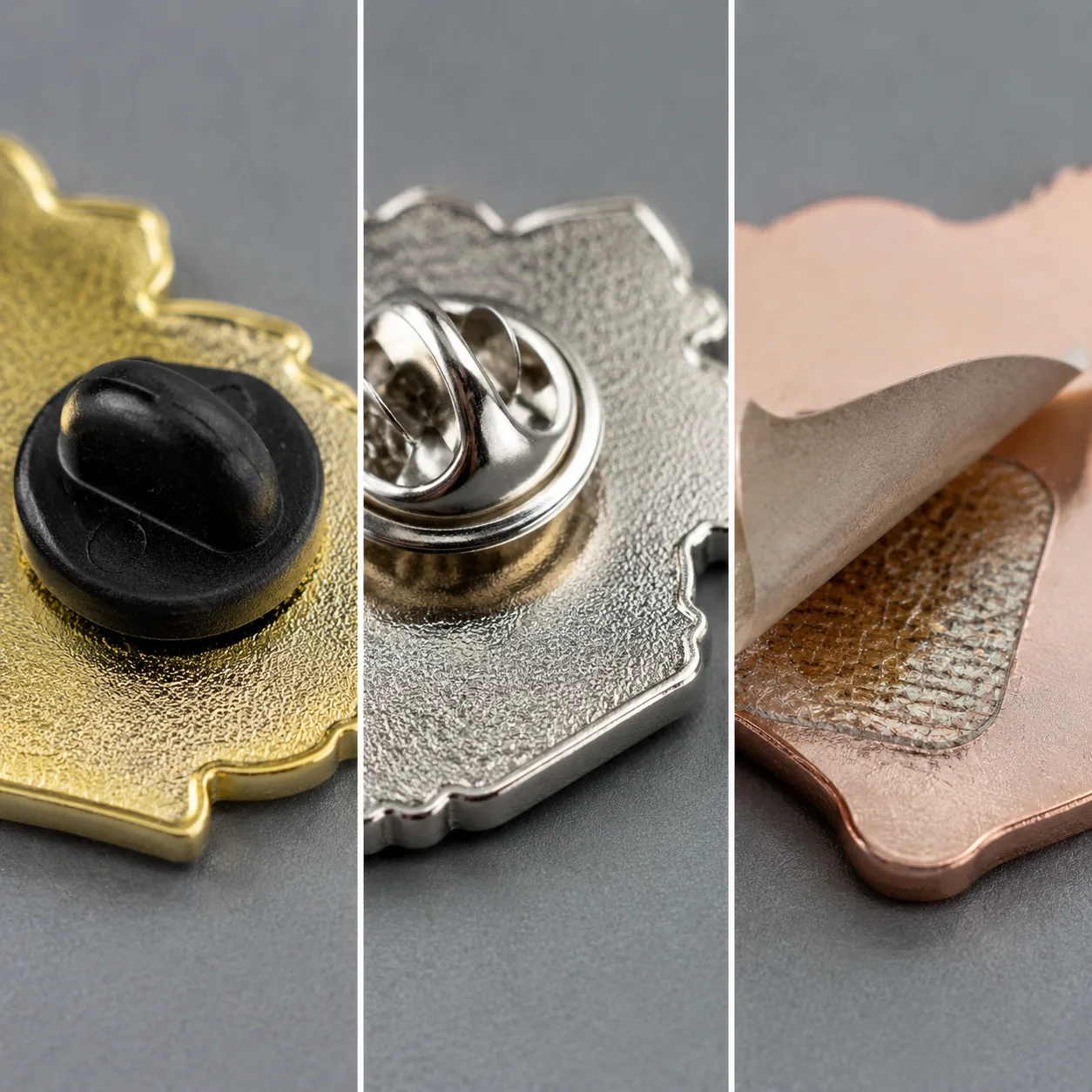
Hardware failures cost more than cosmetic issues because they create returns after distribution. For pins and badges, attachment choices include butterfly clutch, rubber clutch, safety pin, magnetic backing, brooch clasp, and tie tack styles. For keychains and charms, the weak points are usually split rings, jump rings, connectors, and swivel clasps. If the item is meant for garments, bags, or event badges, the attachment must match fabric thickness and movement, not just the product shape.
Standard butterfly clutches are economical for light pins, typically up to about 8 to 12 grams depending on geometry, but they can rotate or loosen on wider badges. Rubber clutches are easier to use and reduce snagging, while magnetic backs avoid piercing fine fabrics but need enough holding force for the final weight. A practical target for a magnetic badge is a combined hold that comfortably exceeds the finished item weight by at least 3x, especially if the wearer will move frequently. Brooch clasps work better on larger pieces because they distribute load across the garment.
For functional hardware, ask the supplier for the material grade and any pull or cycle expectation. A keychain ring should not open under normal handling, and a clasp should survive repeated tugging without deformation. If the item is intended for uniform use or retail wear, specify that the back hardware must be free of burrs and sharp points. It is easier to prevent a back-side failure in the spec than to sort it out after thousands of units have shipped.
| Hardware | Best use | When not to choose it |
|---|---|---|
| Butterfly clutch | Light lapel pins | Heavy or wide badges that rotate |
| Rubber clutch | General promotional pins | High-temperature or long-life wear |
| Magnetic back | Fine garments and uniforms | Very heavy items or thick clothing |
| Brooch clasp | Large badges and brooches | Tiny logos where the clasp dominates the back |
Packaging, Packing Count, and Sign-Off
Packaging is not an afterthought when the item ships overseas or arrives pre-packed for events. The spec should define individual bagging, backing card size, insert type, carton quantity, and whether the carton is retail-ready or bulk-only. A simple OPP bag may be acceptable for trade-show giveaways, while a printed backing card and polybag may be required for retail or corporate gifting. If the buyer wants barcodes, QR labels, or mixed-SKU cartons, that must be written before production starts.
Packing density affects damage risk and freight cost. Loose-packed metal products can rub and scratch plating, while overpacked cartons can deform softer attachments. For pins and coins, individual polybags plus inner dividers are common when finish quality matters. For magnet and keychain programs, carton load should be checked against the weight of the hardware, because small dimensional changes can produce large freight swings across thousands of units. Ask for both net weight and gross weight per carton, and make sure the factory states carton count per master carton in writing.
Before approval, require the supplier to restate the critical lines: size, thickness, material, plating, color reference, attachment, packing, lead time, and inspection standard. A common production timeline is 2 to 4 days for artwork confirmation, 5 to 8 days for tooling and sample preparation, and 12 to 20 days for mass production after sample approval. If the order is urgent, some factories can compress the cycle, but the buyer should expect either a higher FOB price or a narrower finish choice. Good spec control saves more time than rushing a weak brief.
What to Do Next Before You Request Quotes
Turn the product into a one-page spec sheet before you send RFQs. Include product class, size, thickness, material, plating, color references, attachment, packing, artwork files, tolerance limits, inspection level, and approval standard. Then send the same sheet to every supplier so you can compare process and pricing on equal terms. That approach usually exposes hidden assumptions within one reply cycle instead of after the first sample.
A strong RFQ also asks the factory to confirm exclusions. Have them state whether the quote includes mold charge, setup fee, back stamp, epoxy, card insert, or export carton. For small runs, mold or die charges often add USD 40 to 150 for simple items and USD 80 to 300 plus for more complex 3D builds, depending on size and tooling depth. If you need a tight landed-cost view, ask for FOB and carton details separately so freight and packaging do not get blended into the unit price.
ZheCraft uses this kind of spec locking on pins, badges, coins, magnets, keychains, patches, and lanyards because it prevents the most common production disputes. The best order is usually the one with the clearest spec, the narrowest acceptable tolerance, and the fewest assumptions left for the factory to guess.
- Build a one-page spec sheet with all controllable variables.
- Send identical specs to every supplier for a clean comparison.
- Require written confirmation of the critical lines before sampling.
- Approve the first sample against the written spec, not memory.
Have a project? Send your artwork and target quantity and we’ll reply with a detailed quotation within 12 working hours.
Ready to get this made?
Send your sketch, target quantity and ship-date. Detailed quotation in 12 hours.



