Custom Metal Giveaway Spec Sheet: A Line-by-Line Buyer's Guide
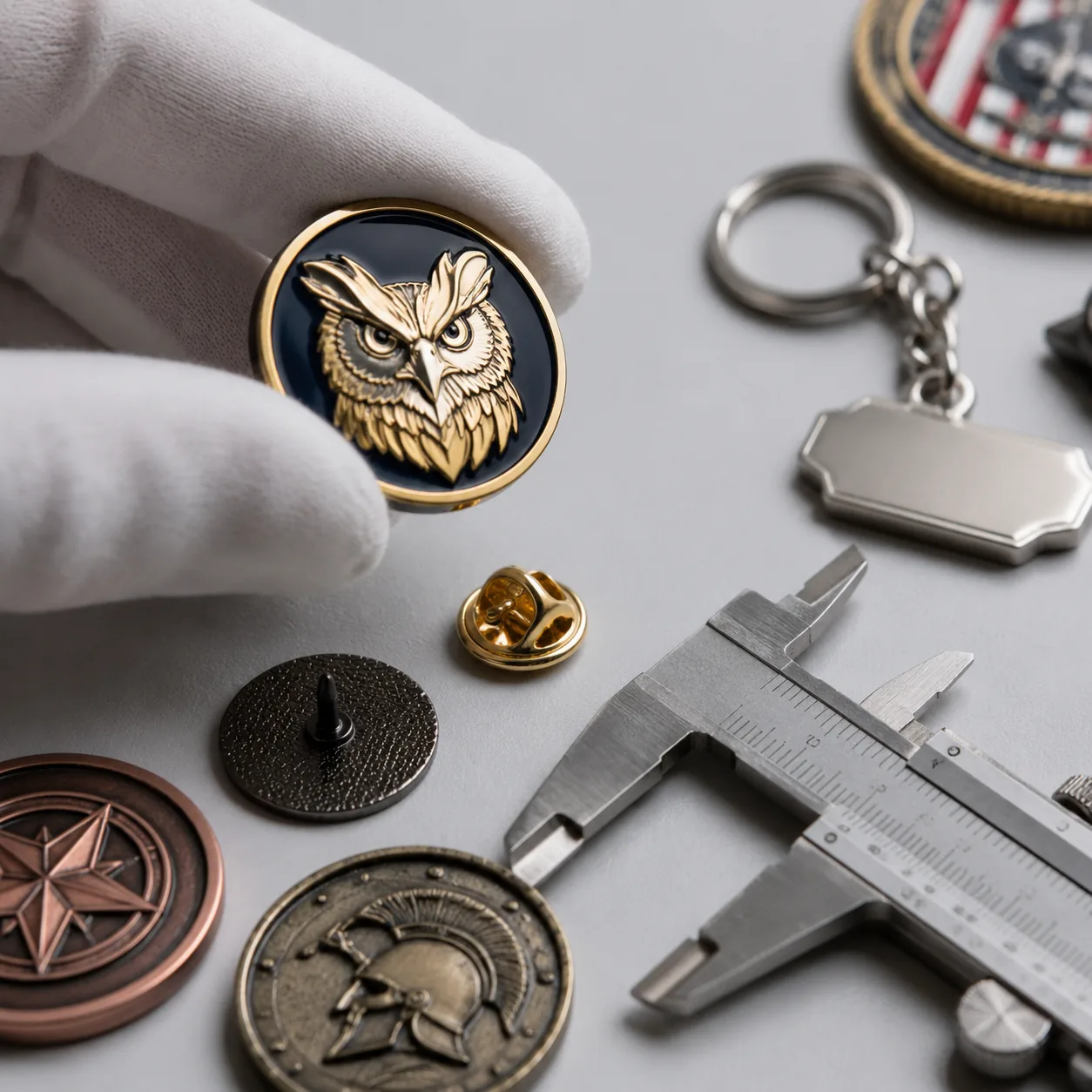
Why a spec sheet cuts rework
Most custom metal giveaway failures start at the RFQ stage, not on the press line. A vague request such as “make it premium” leaves the supplier to choose thickness, plating build, edge finish, backing type, and pack method based on cost rather than intent. For pins, badges, coins, keychains, magnets, and other small branded metal items, the safest buying method is to write the order like a manufacturing spec, not a mood board.
A good spec sheet shortens quoting, stabilizes samples, and reduces tool changes. It also makes supplier quotes comparable because everyone is pricing the same build, not a different interpretation of the same artwork. On typical promotional metal items, that can cut sample revisions from two or three rounds to one and avoid a 5% to 15% cost swing caused by hidden assumptions in metal choice, plating, or packaging.
Lock the variables that affect function, appearance, and landed cost: dimensions, thickness, base metal, build method, plating, decoration, attachment, tolerance, and packaging. Leave low-impact details flexible only when they do not change wear risk, presentation, or freight. The more specific the spec, the fewer surprises in plating color, edge feel, and back-end assembly.
- Name the exact product type: pin, badge, coin, keychain, magnet, or charm
- State the use case: wear, gifting, resale, mailing, or event handout
- Separate visual requirements from structural requirements
- Approve a golden sample before mass production when color or finish matters
- Define what may vary and what may not, especially size, weight, and attachment
Line 1: Product form and intended use
The first line on the spec sheet should identify the product form in precise terms. “Metal giveaway” is too broad; a 25 mm lapel pin, a 45 mm challenge coin, and a 60 mm keychain blank are built differently and quoted differently. A worn item needs comfort and edge control, while a coin for desk display can prioritize thickness and weight. A keychain for daily pocket use needs stronger hardware than a one-time event handout.
Write the intended use on the same line. If the item will be worn, the factory should optimize for low snag risk and moderate weight. If it will be mailed, thickness and carton protection matter more. If it will be handed out at an event, the supplier may be able to optimize for assembly speed and unit cost. That one sentence changes engineering choices more than many buyers expect.
Concrete examples help avoid ambiguity. “30 mm soft enamel lapel pin for apparel, single backing, retail presentation card” is useful. “Premium gift for customers” is not. “40 mm double-sided coin for desk display, gift box included” is useful. “Nice souvenir” is not. Add the channel if it matters: retail shelf, trade-show giveaway, subscription box, or VIP mailer.
If the item has a strict safety or compliance expectation, say so early. Garments should avoid sharp burrs; children’s promotions may need nickel and small-part restrictions; mailers should not include loose accessories that puncture packaging. The supplier cannot quote the right process if the use case is vague.
Line 2: Size, thickness, and weight
Always specify finished dimensions in millimeters with a tolerance. For most custom metal giveaways, ±0.5 mm is practical for smaller stamped or cast items, while ±1.0 mm is more realistic for larger pieces, layered builds, or products with hand-finishing. If mating parts, edge-to-edge alignment, or print placement matter, tighten the callout on the critical feature rather than the whole part.
Thickness drives rigidity, perceived value, and postage. For many pins and badges, 1.0 to 1.2 mm is a common low-cost range, 1.5 to 2.0 mm is typical for a more substantial feel, and 2.5 mm or more is often used for coins or premium pieces. Zinc alloy cast items can be thicker because the geometry carries more mass without excessive machining, while thin brass or iron parts are better for flat stamped products.
Weight should be specified as a target band, not a guess. A 30 mm pin may weigh about 5 to 8 g in a light build and 10 to 15 g in a heavier premium build. A 1.75-inch coin commonly lands around 25 to 35 g depending on thickness and edge treatment. Weight matters because it changes comfort, shipping cost, and how the product feels in hand.
Use the size and weight targets to force apples-to-apples quotes. Two factories can both promise a 30 mm pin, but one may quote a thinner iron body at 5 g while the other quotes a brass body at 8 g with cleaner edges. Without a weight band, that difference may only surface after sampling.
| Spec line | Practical guidance | Typical range |
|---|---|---|
| Diameter / width | Measure the finished item at the widest point | 20–50 mm for most pins/badges; 38–45 mm for coins |
| Thickness | Controls rigidity and perceived quality | 1.0–2.0 mm for pins/badges; 2.0–3.0 mm for coins |
| Weight | Impacts comfort and freight | 5–15 g for pins; 20–40 g for coins |
| Tolerance | Define acceptable variation | ±0.5 mm small items; ±1.0 mm larger items |
Line 3: Base metal, build method, and plating
Base metal affects detail sharpness, finishing, and price. Brass is a strong premium choice for enamel pins and badges because it holds crisp detail and polishes cleanly. Iron is often used when the budget matters and the design is relatively flat. Zinc alloy works well for 3D relief, deeper cast shapes, and thicker builds that need more sculptural volume.
Build method should be stated alongside the metal: stamped, die-struck, cast, etched, or printed-on-metal. Stamping and die-striking are usually better for sharp outlines and flatter forms; casting is better for raised 3D detail; etching suits finer line work on thinner faces. If the artwork has deep undercuts, very small text, or layered relief, write that into the RFQ so the supplier does not quote the wrong process.
Plating should be specified as both finish and expected thickness when possible. Decorative nickel plating in promotional metal goods is often around 0.1 to 0.3 microns of visible deposit in very light cosmetic work, while more durable decorative builds may be thicker depending on the factory process and base metal. Popular finishes include bright nickel, gold, silver, antique brass, antique copper, and black nickel. For handling-heavy products, ask whether the finish is decorative only or intended to improve abrasion and corrosion resistance.
Typical FOB pricing depends on quantity, size, and complexity, but useful buyer ranges exist. For a 30 mm soft enamel pin, budget about USD 0.45 to 1.20 FOB at 1,000 to 5,000 pcs, with a mold fee often in the USD 40 to 120 range. For a 1.75-inch challenge coin, a common FOB range is USD 1.80 to 4.50 at 500 to 3,000 pcs, depending on plating, edge detail, and packaging. Low-MOQ runs usually sit at the top of the range.
Ask the supplier whether quoted price includes tooling, plating, and packaging or only the bare metal part. A quote that excludes one-time mold charges can look cheap until the first invoice. If a part needs multiple finishes or enamel colors, confirm whether each extra color or side is priced separately.
| Build choice | Best for | Typical FOB range |
|---|---|---|
| Brass stamped pin | Sharp detail, premium enamel | USD 0.45–1.20 at 1,000–5,000 pcs |
| Iron stamped badge | Cost-sensitive flat designs | USD 0.35–0.95 at 2,000–10,000 pcs |
| Zinc alloy cast keychain | 3D relief and thicker profiles | USD 0.90–2.80 at 1,000–5,000 pcs |
| Challenge coin | Gift, recognition, resale | USD 1.80–4.50 at 500–3,000 pcs |
Line 4: Decoration, color, and surface detail
Decoration should follow the artwork geometry. Flat fields with bold separations suit soft enamel. Fine recessed detail can work better with hard enamel or antique plating. Very small text, thin reverse spaces, and gradient art often require simplification before tooling, because the production method has hard limits on line width and fill behavior.
For color, state the system and the acceptance rule. Pantone is still the cleanest reference for enamel or paint fill, but the spec should say whether matching is judged under daylight or under a production light box. A reasonable production tolerance for enamel color is a close visual match against the approved sample, not a lab-perfect numerical match. If the item includes printed art, note whether UV print, pad print, or laser marking is required.
A practical decoration spec should include minimum detail sizes. On small metal giveaways, minimum line widths around 0.2 to 0.3 mm are common for reliable reproduction, while tiny knocked-out gaps below 0.25 mm can disappear or clog. If you need crisp logos, ask for a revised artwork proof that shows the line weight the factory will actually hold.
For hard enamel, define whether the surface should be polished flush or left slightly domed. For antique finishes, specify whether the recesses should be darkened for contrast or kept subtle. If a protective epoxy dome is allowed, say so explicitly; if you want the metal surface exposed, prohibit it.
- State whether decoration is soft enamel, hard enamel, printed, or laser-engraved
- List all Pantone references or approved artwork values
- Set minimum line width and minimum gap width for readability
- Specify whether epoxy dome coating is allowed or prohibited
- Call out matte, glossy, brushed, or textured surface requirements
Line 5: Attachment, function, and wear risk
Attachment is where many field failures begin. A lapel pin backing, badge pin, keychain ring, clip, magnet assembly, or coin edge is not just an accessory; it is the component that determines whether the item stays usable. Butterfly clutches are common for low-cost pins, but rubber clutches reduce sharpness risk. Magnetic backs protect delicate garments, though they are usually better for lighter pieces.
Write the attachment spec like a use test. For apparel, ask whether the back must resist rotation. For keychains, specify whether the ring should survive daily pocket abrasion. For magnets, specify the minimum pull force if the item must hold through paper or thin fabric. If the product is heavier than about 15 g, do not assume a single standard backing will be sufficient.
For reference, a typical split ring for a keychain should use enough wire gauge to resist deformation in normal use, while a lobster clasp is better for bag charms and removable accessories but adds labor and cost. Magnet backs are often chosen when garment protection matters more than retention force, but they should not be used as a blanket answer for all wearable items.
Concrete callouts improve quoting. Example: “Two-pin butterfly back, anti-rotation nubs, suitable for woven jacket lapel” or “25 mm rare-earth magnet back, minimum 1.2 kg pull on 0.8 mm steel under controlled test conditions.” Even if the factory does not test exactly that way, the request defines the intent.
| Attachment type | Best for | Watch-outs |
|---|---|---|
| Butterfly clutch | Low-cost lapel pins and badges | Can rotate and stress thin fabric |
| Rubber clutch | Safer wear on apparel | Can loosen if undersized |
| Magnetic back | Delicate garments and premium presentation | Not suitable for heavier pieces |
| Split ring | Keychains and multi-tool items | Can deform if wire gauge is too light |
| Lobster clasp | Bag charms and removable items | Adds cost and assembly time |
Line 6: Tolerances, edges, and approval points
Tolerance is the language that keeps the factory from guessing. If a cutout must align with printed art, state the allowable offset. If a pin post must sit near center, write the positional tolerance. If an edge must not be sharp, say so directly. Buyers often omit these details and then reject a sample that technically matches the artwork but fails the functional requirement.
A practical spec sheet should separate general dimensional tolerance from critical-feature tolerance. For example: outer dimensions ±0.5 mm, post location ±0.3 mm, and no sharp burrs visible under normal inspection. On layered or openwork designs, also specify minimum bridge width and minimum wall thickness. For many cast items, a bridge below about 0.8 to 1.0 mm is risky; for stamped details, thin unsupported sections can deform during polishing or shipping.
Add an inspection standard when the finish is sensitive. If the product is retail-facing, state the acceptable surface condition in plain terms: no visible scratches at arm’s length, no pits larger than 0.2 mm on the front face, and no exposed base metal on the show surface. If you work to AQL, a common starting point for promotional metal goods is AQL 2.5 for major defects and AQL 4.0 for minor defects, with tighter limits for premium retail packs.
Approval should be staged. First review the artwork proof, then confirm the metal sample or first article, then approve the golden sample before bulk production. If the item includes plating, color, or texture that is hard to judge from screen proofs, the golden sample is the control document. Without it, later disputes usually become expensive rework rather than simple corrections.
- Set outer-dimension tolerance and critical-feature tolerance separately
- Define edge condition: deburred, rounded, or no sharp burrs
- Specify bridge width and wall thickness for openwork or layered pieces
- State the inspection level or AQL target for finished goods
- Approve artwork proof before tooling
- Approve a golden sample before mass production
Line 7: Packaging, labeling, MOQ, and lead time
Packaging changes both labor cost and damage risk, so it belongs on the spec sheet. A bare bulk pack is cheapest but risky for plated surfaces and delicate attachments. An individual polybag reduces scuffing and contamination. A backing card or gift box improves retail value, but it can raise pack-out labor and freight volume fast. If your buyer uses retail shelves, gifting, or resale channels, packaging is part of the product, not a last-minute extra.
State unit pack, inner pack, master carton, and label requirement. If you need barcode, SKU, or lot marking for warehouse intake, say so before quoting. For plated items, separate pieces with tissue, sleeve, or bagging when scratching is a concern. Common MOQ tiers for standard promo metal goods are 100 to 300 pcs for sample or VIP runs, 500 to 1,000 pcs for small custom orders, and 2,000 pcs or more for better unit pricing.
Lead time should also be written in days. A typical sample lead time is 7 to 12 days after artwork approval. Production is often 12 to 20 days for straightforward pins or badges and 18 to 30 days for more complex coins, cast keychains, or boxed sets. Freight time is separate. If the date matters, write the in-hands date and ask the supplier to confirm whether the calendar includes tooling, plating queue time, and packing.
A useful packaging spec is as concrete as the part spec. Example: “Each piece in an individual OPP bag, 50 pieces per inner box, 500 pieces per export carton, carton labeled with SKU and lot code, no mixed-SKU cartons.” That level of detail removes a lot of assumption from the factory and warehouse sides.
- Specify unit packaging: OPP bag, backing card, box, or tray
- State carton pack quantity and any inner box requirement
- Require barcode, SKU, or lot marking when warehouse intake needs it
- Ask for surface protection between pieces if plating is delicate
- Confirm whether mixed-SKU packing is allowed or forbidden
Turn the RFQ into a workable order
The fastest way to make this usable is to copy the line items into one page: product form, size, thickness, base metal, build method, plating, decoration, attachment, tolerances, packaging, MOQ, and approval rule. Pair that sheet with a marked-up reference image that shows what must match exactly and what can flex. If you do not know which build method is best, ask the factory to quote two options side by side so you can compare price, weight, and durability before sampling.
For a first order, keep the spec strict on the few variables that matter most: dimensions, color, attachment, and packaging. Leave low-impact features flexible only when they do not affect wear, safety, or shelf presentation. That balance usually gets you the best result: fewer revisions, cleaner samples, and a production run that stays close to the approved piece.
A well-written RFQ does more than reduce risk. It improves sourcing leverage because each supplier is quoting the same measurable target. That is the difference between buying a vague giveaway and buying a controlled manufactured product.
Have a project? Send your artwork and target quantity and we’ll reply with a detailed quotation within 12 working hours.
Ready to get this made?
Send your sketch, target quantity and ship-date. Detailed quotation in 12 hours.



