Custom Enamel Pin Cost and Lead-Time Breakdown
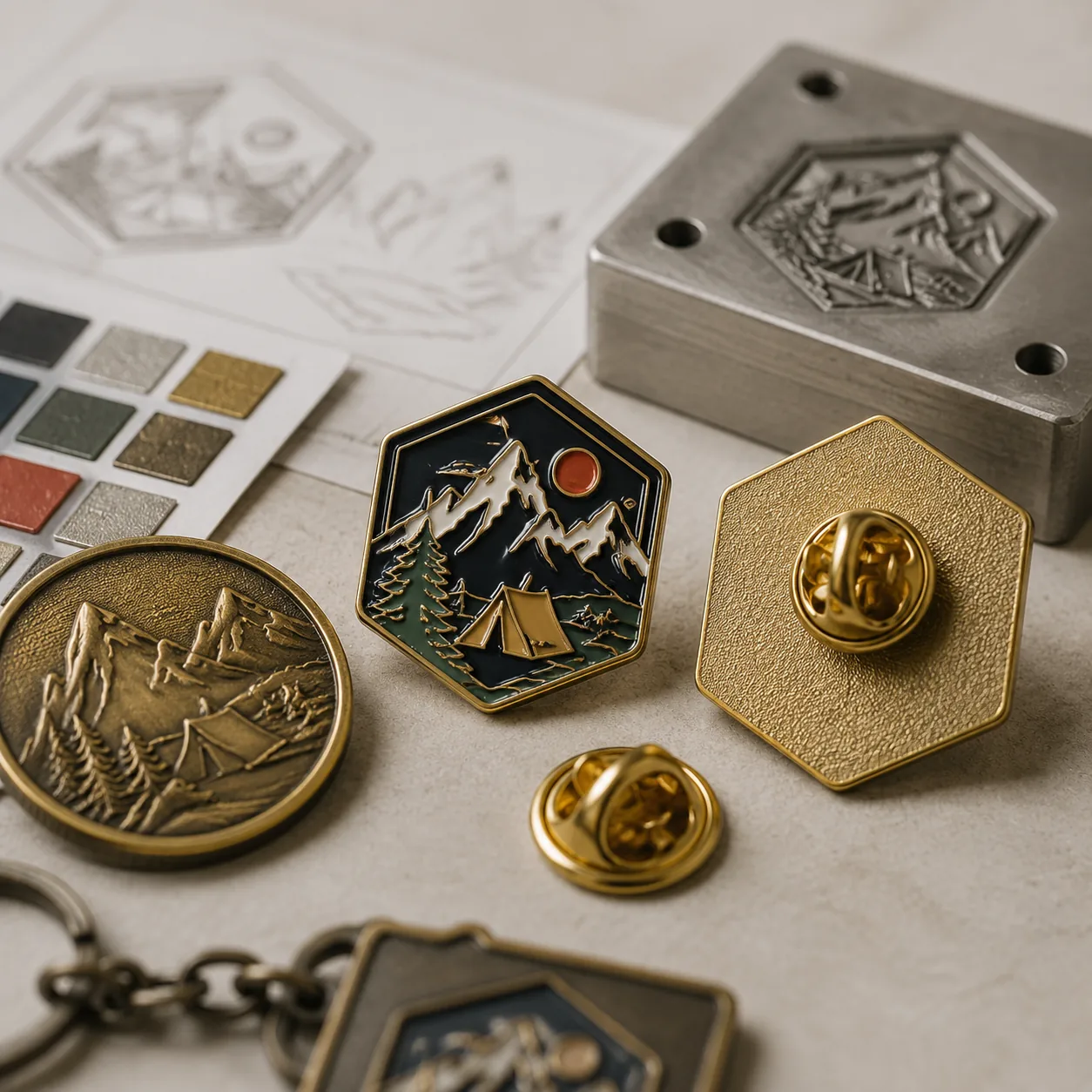
Why two nearly identical pin quotes can differ by 40%
Buyers often compare only the headline unit price, but enamel pin pricing is built from several separate steps: artwork cleanup, tooling, die striking or casting, polishing, plating, color fill, accessory assembly, inspection, and packing. Two 30 mm pins can look nearly identical and still differ sharply in cost if one has cutouts, soft-enamel texture, dual plating, epoxy coating, or a tighter inspection standard. The most common mistake is treating pins as a simple size-by-quantity purchase when the real drivers are process complexity, reject risk, and setup recovery.
In factory terms, the delta usually comes from labor hours and process risk rather than raw material alone. A 1.2 mm iron soft-enamel pin with one Pantone color and a butterfly clutch may sit near the low end, while a 1.5 mm brass pin with sandblasted recesses, black nickel plating, custom backing card, and a 3D border can cost multiples more at the same size. Lead time follows the same pattern: stable artwork and standard specs move quickly, while vague specs trigger revisions and rework.
The main cost drivers, in factory order
A factory prices pins in the order they are made. First comes artwork cleanup and tooling, then die making and stamping or casting, then polishing, plating, color filling or printing, accessory assembly, and final packing. Every extra process adds labor and another inspection point. If a supplier cannot explain which step changes the price, the quote is too vague to compare fairly.
| Cost driver | Typical FOB impact | Typical lead-time impact |
|---|---|---|
| Tooling / die setup | USD 25-150 per design | Adds 2-5 days before sample or production |
| Base metal and thickness | About 8-30% difference | Usually none if stock is available |
| Plating finish | About 5-18% difference | Adds 1-3 days for dual or antique plating |
| Enamel type / print method | About 10-25% difference | Adds 1-3 days for fill, curing, or print control |
| Backstamp, numbering, cutouts, moving parts | About 10-40% difference | Adds 2-7 days depending on complexity |
| Packaging choice | USD 0.03-0.80 per piece | Adds 1-4 days for custom cards or boxes |
A useful rule is simple: if a quote is unusually low, check whether tooling, plating surcharges, packing, or domestic freight to port have been excluded. If a quote is unusually high, check whether it includes premium inspection, individual OPP bags, or a mold fee spread across a small MOQ. A reliable supplier should separate the quote into line items so you can compare like for like and manage reorders later without guesswork.
MOQ tiers and how they change unit economics
MOQ is not just a sales policy; it is how factories recover setup time. For custom enamel pins, common tiers are 50-100 pieces for samples or ultra-small runs, 100-300 pieces for pilot orders, 500 pieces for standard production, and 1,000+ pieces for better unit pricing. The smaller the order, the more your unit price carries tooling amortization, labor setup, and inspection time. That is why a 100-piece run can look expensive beside a 1,000-piece run even when the pin design is identical.
For distributors testing a new design, 100-200 pieces is usually the safest pilot tier. For a brand launching a retail or event program, 500 pieces often gives the best balance between landed cost and risk. For repeat replenishment with no artwork change, 1,000 pieces or more can reduce the per-unit cost materially, especially on simple soft-enamel builds. Low-MOQ development is still workable, but the buyer should expect a higher FOB unit price because setup labor has to be recovered somewhere.
| MOQ tier | Best use case | Typical FOB price per piece | Notes |
|---|---|---|---|
| 50-100 pcs | Prototype, internal review, urgent small event | USD 1.25-3.80 | Highest setup share; best for design validation |
| 100-300 pcs | Pilot launch, distributor test order | USD 0.88-2.90 | Common entry point for first commercial runs |
| 500 pcs | Standard B2B production | USD 0.58-1.95 | Usually the best balance of price and control |
| 1,000+ pcs | Recurring program, retail, mass gifting | USD 0.38-1.25 | Best unit economics if specs stay stable |
Lead time from artwork to shipment
A realistic schedule starts before production. For a standard enamel pin with approved vector artwork, expect 1-3 days for quoting and order confirmation, 3-7 days for sample or pre-production proof if needed, 7-14 days for mass production, and 2-5 days for packing and export handoff. Air freight may shorten transit, but it does not shorten manufacturing. Most schedule failures happen when buyers forget to include approval time for plating, color matching, or backing card design.
Simple orders move faster than complicated ones. A clean 30 mm soft-enamel pin with one plating and standard butterfly clutch can be completed much faster than a 3D relief design with multiple colors, epoxy dome, numbered backstamp, and custom packaging. If the supplier asks for multiple approval rounds, that is usually not delay for its own sake; it is the factory avoiding rework, scrap, and a much longer correction later.
- Artwork in vector format can save 1-3 days.
- Pantone-confirmed colors reduce sample loops.
- Single plating and standard accessories keep scheduling predictable.
- Custom backing cards often add 2-4 days.
- Rush orders usually increase cost and defect risk together.
What a quote should include, and what it often excludes
A clean quote should say whether the FOB unit price includes mold fee, plating, enamel filling, polishing, accessory assembly, individual bagging, and carton packing. In many factory quotes, the headline unit price excludes tooling, shipping, and custom packaging inserts. That is not necessarily a problem, but it becomes one when buyers compare quotes built on different assumptions. If one supplier includes OPP bags and another does not, the cheaper quote is not actually cheaper.
The most common hidden cost is revision time. Every change to outline, color count, attachment, or card layout can trigger a new proof round or a tooling adjustment. Another common surprise is plating complexity: antique nickel, black nickel, dual plating, and matte finishes usually cost more than standard bright nickel or gold because they require tighter process control and more inspection. Buyers should ask for an itemized quote before asking for a discount.
| Item | Often included in FOB | Often excluded from FOB |
|---|---|---|
| Mold / tooling | Sometimes on larger orders | Often separate on small orders |
| Metal forming and polishing | Usually yes | Rarely excluded |
| Standard plating | Usually yes | Rarely excluded |
| Custom Pantone color fill | Usually yes | Rarely excluded |
| Epoxy dome | Sometimes | Often a separate line item |
| Custom backing card or printed box | Sometimes | Frequently excluded |
| International freight and duties | No | Almost always excluded |
Specs that move cost the most
If you need to reduce cost without weakening the design, start with the specs that are expensive to process but not essential to the buyer experience. Large open cutouts, double-sided details, multiple plating colors, and tiny text increase labor and reject rates. Thickness matters too: 1.2 mm zinc alloy is often suitable for cast styles, while 1.5-2.0 mm iron or brass usually performs better for stamped enamel work. The key is to remove complexity where it does not add value.
A practical sourcing rule is to trade unnecessary visual complexity for cleaner manufacturing. For example, a simple outline with one main fill color, one plating finish, and a standard clutch often produces a more premium result than a crowded design with five thin sections and micro text. If you need more perceived value, packaging is often a better spend than extra process steps on the pin itself, especially for event giveaways where presentation matters more than microscopic detail.
Concrete tolerances also matter. Typical edge tolerance on a stamped pin is about ±0.2 mm, while enamel fill can vary by roughly ±0.1-0.2 mm depending on cavity size and line width. For color, factories commonly aim to match Pantone within a practical production tolerance, not lab-perfect colorimetry; a visible but acceptable deviation can still occur on small surfaces or textured areas. For buyers, that means fine lines below about 0.25 mm and text under 4 pt are where quality risk rises fastest.
How to plan the budget without overbuying
Budgeting should start with the business objective, not the piece price. For a one-time event, a 500-piece order with a slightly higher unit cost may still be cheaper than a rush reorder after the show. For a recurring campaign, 1,000 pieces can be a better buy if the design is stable and reorder risk is low. The right quantity depends on how quickly the design may change, how many recipients need it, and whether leftover stock can still be used later.
A practical budgeting model is to split spend into three buckets: development, production, and delivery. Development covers artwork cleanup, tooling, and proofs; production covers the pins and accessories; delivery covers packing, freight, and customs exposure. If your budget only covers production, you are underestimating the project. A disciplined buyer should also hold 10-20% budget slack for revision, packing upgrades, freight changes, or a second proof round if the first sample reveals a sizing issue.
- Use 100-300 pcs for design validation or distributor testing.
- Use 500 pcs when you need a balanced commercial run.
- Use 1,000+ pcs when the art is fixed and repeatable.
- Keep 10-20% budget slack for revision, packing, or freight changes.
- Ask for landed-cost clarity before approving the mold.
A practical quote checklist before you place the order
Before approving any pin order, lock the specs so every supplier quotes the same basis. One final artwork file, one target size, one plating choice, one attachment choice, and one MOQ target is enough to get a clean comparison. Ask each factory to show tooling, unit price, packing, sample lead time, mass-production lead time, and excluded charges. If the response is vague, the order will probably be vague too.
- Confirm final vector artwork and size in millimeters.
- State the exact plating finish, including antique or dual plating if used.
- Specify enamel type, epoxy dome, or print method if relevant.
- Request separate pricing at 100, 300, and 1,000 pieces.
- Ask for sample lead time, production lead time, and excluded charges in writing.
- Confirm packing standard: bulk, OPP bag, backing card, or gift box.
For most buyers, tiered pricing exposes the real cost curve immediately and prevents the common mistake of choosing a quote that looks cheap only because it assumes a larger quantity or a lower finish standard. ZheCraft can work from that format and return a quote that separates tooling, production, packing, and timing so you can compare suppliers on equal terms. The next move is simple: lock the spec, request tiered pricing, and decide where the business case is strongest before sampling starts.
Have a project? Send your artwork and target quantity and we’ll reply with a detailed quotation within 12 working hours.
Ready to get this made?
Send your sketch, target quantity and ship-date. Detailed quotation in 12 hours.



