Custom Bag Charms for Retail Launches: Buyer Walkthrough
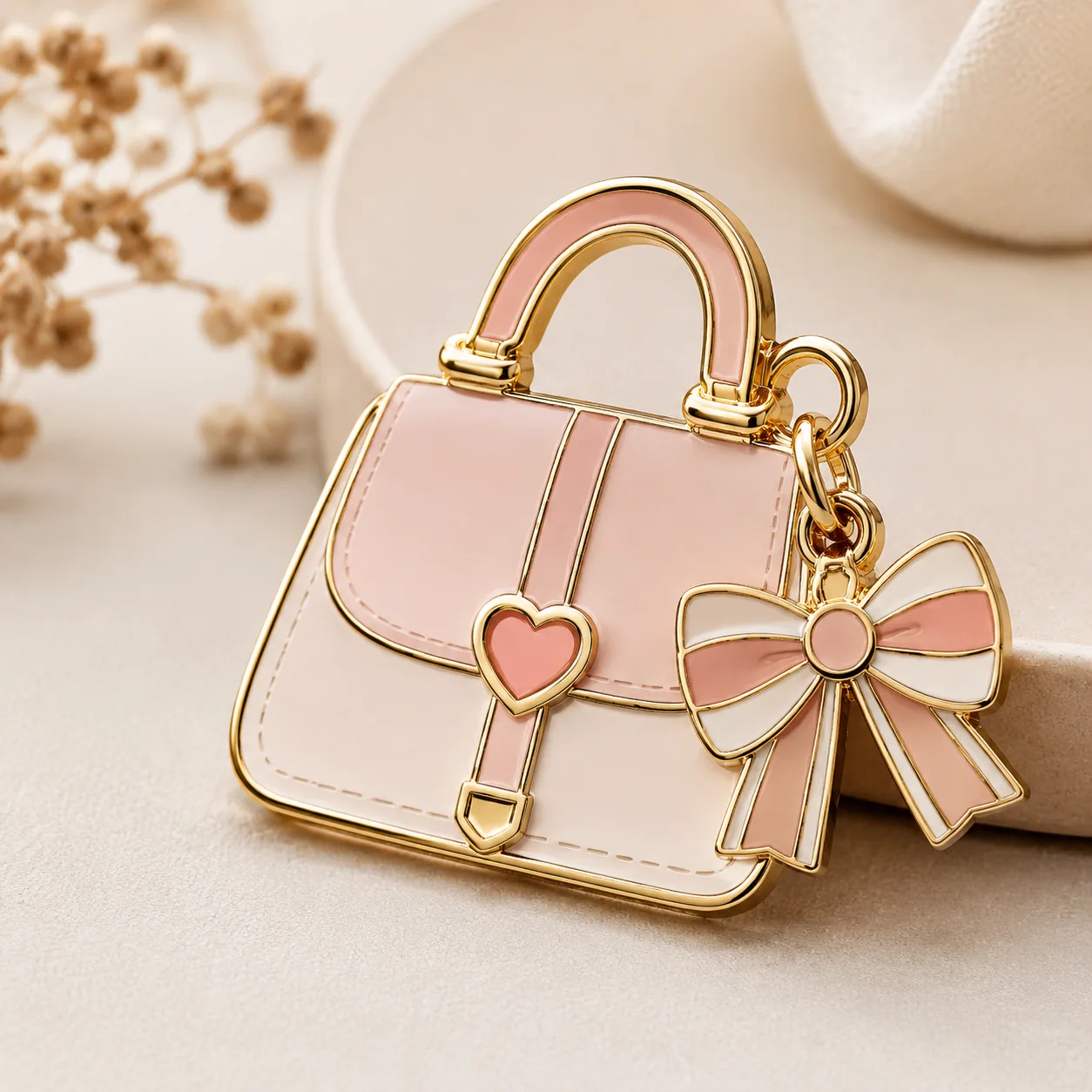
The buyer problem: 5,000 charms, 3 bag styles, zero scratches
A retail marketing team usually arrives with the creative already approved: a 38 mm logo charm, antique gold finish, a small enamel accent, and a clip that has to work on three handbag styles without damaging the leather. The challenge is not making the charm look attractive in a render. The challenge is making 5,000 pieces that hang straight, survive handling, do not open on a busy sales floor, and arrive sorted by store or bag set without delaying the launch.
For this walkthrough, assume a 5,000-piece custom metal bag charm program for a fashion, beauty, or luxury gifting launch. A realistic split might be 3,000 pieces for in-store gifting, 1,500 pre-attached to VIP tote bags, and 500 kept as sales-team samples and replacements. At this scale, a workable FOB target is usually USD 1.10 to 2.80 per piece for zinc alloy, USD 1.55 to 3.40 for brass, and USD 0.85 to 2.10 for flat stainless or iron constructions, depending on size, finish, plating thickness, and packing.
We treat this as a hardware-controlled project, not a simple promotional keychain. The important variables are body weight, clip clearance, plating wear, edge radius, swing length, and the packing method. If those are not defined before sampling, the buyer often loses 7 to 12 days to revisions that should have been resolved in the first drawing.
Day 1: turn the creative mockup into a production drawing
The first factory drawing should define more than the front logo. It should lock the outer dimensions, metal thickness, loop position, attachment length, clip type, finish, enamel areas, back logo, packing format, and inspection standard. For a 38 mm charm, a practical production tolerance is ±0.3 mm on outer dimensions, ±0.15 mm on raised or recessed logo placement, and ±0.2 mm on key alignment features such as the clip hole or chain connection.
If the logo includes fine text, set a minimum raised line width of 0.25 mm and a minimum recessed enamel channel width of 0.35 mm. Anything finer tends to fill poorly after polishing or plating. For 3D relief, keep the shallowest visible relief at 0.20 mm and the main relief at 0.40 to 0.80 mm so the shape still reads after coating.
The top hole matters more than many buyers expect. A 2.0 mm hole can look neat on artwork but bind after plating when connected to a 1.4 mm jump ring. For small charms, specify a 2.5 to 3.0 mm internal hole. For heavier charms above 18 g, 3.5 to 4.0 mm is safer. The metal bridge around the hole should be at least 1.2 mm thick after polishing to avoid ovalization during pull testing.
Drop length also affects how the charm behaves on the bag. For retail handbags, 35 to 55 mm total drop usually looks controlled. Longer than 70 mm often swings into hardware and corners. If the charm hangs from a zipper pull, keep finished weight under 18 g. If it hangs from a handle loop or D-ring, 20 to 32 g is acceptable, but only when the ring and clasp are upgraded accordingly.
Day 2: choose the metal build before discussing price
Most bag charms are made from zinc alloy die casting, brass stamping or casting, stainless steel cutting, or iron stamping. Zinc alloy is the most flexible for rounded edges and medium-weight 3D forms, but it needs disciplined polishing and plating. Brass gives a cleaner premium feel and better corrosion resistance, but the FOB cost usually rises by USD 0.35 to 0.90 per piece versus zinc alloy at 5,000 pieces. Stainless steel is strong and tarnish resistant, but it is less suitable for deep enamel recesses and warm gold tones. Iron is the cheapest, but it is the least forgiving when the charm will touch coated leather or polished hardware.
The buyer should decide whether the charm is a brand keepsake or a disposable event accessory. For a one-week promotion, zinc alloy with standard plating may be enough. For retail gifting that customers will keep on a bag for months, brass or a higher-grade zinc alloy process with thicker plating is safer. Thin iron stamping is usually the wrong choice for a luxury bag charm because stamped edges and low-cost plating create higher scratch and corrosion risk.
| Build choice | Best use case | Typical specs | MOQ tier | FOB range at 5,000 pcs | When not to choose it |
|---|---|---|---|---|---|
| Zinc alloy die cast | Rounded logo charms, 2D or soft 3D shapes | 2.5 to 4.0 mm body thickness, 15 to 35 g finished weight, die tolerance ±0.2 to ±0.3 mm | 300 to 500 pcs per design | USD 1.10 to 2.10 | Avoid for ultra-thin luxury tags or severe salt-spray requirements |
| Brass stamped or cast | Premium retail gifts and long-life accessories | 1.8 to 3.0 mm thickness, cleaner polishing, stable gold tone, tighter edge control | 300 to 500 pcs per design | USD 1.55 to 3.40 | Avoid if budget is tight or the shape needs very deep sculpted volume |
| Stainless steel cut | Flat modern tags, mirror or brushed silver finishes | 1.2 to 2.0 mm thickness, laser or etched detail, rust-resistant finish | 500 to 1,000 pcs per design | USD 0.95 to 2.40 | Avoid for complex enamel fill or antique gold appearance |
| Iron stamped | Low-cost event giveaways | 1.2 to 1.8 mm thickness, simple flat shape, basic plated finish | 1,000 pcs per design | USD 0.65 to 1.30 | Avoid for handbag use where edges may rub leather or coating |
For most retail launches, a zinc alloy body is the best starting point because it balances sculpted appearance, tooling cost, and acceptable weight. If the charm has a polished logo face and a painted rear side, brass can justify its higher price. If the design is flat, minimal, and silver-toned, stainless steel often gives better scratch resistance than soft-plated zinc.
Day 4: specify hardware like it will be pulled by a customer
The clip is the failure point on most bag charm complaints. A small split ring and thin lobster clasp may pass a desk review, but fail when a customer pulls the charm from a tote handle or when store staff pre-attach 1,500 pieces in a rush. For a 20 g charm, we usually specify a 12 to 15 mm lobster clasp with 1.2 to 1.4 mm wire thickness, a 1.2 mm jump ring, and a pull strength target of 5 kg for 10 seconds. For a 30 g charm, move to a 16 to 18 mm clasp with 1.4 to 1.6 mm wire and a 6 to 8 kg pull target.
Clip opening must match the real bag part, not just the drawing. If the charm clips to a 5 mm zipper pull, a 6 mm opening is enough. If it clips around a tote handle loop or a metal D-ring, you may need 8 to 10 mm clearance. Oversized clips look cheap on a small charm, so ask the factory to photograph the sample on the actual bag or on a gauge with the same diameter.
Ring closure should be checked under magnification after plating. A normal jump-ring gap should stay below 0.2 mm. Welded rings are preferable for retail programs because they remove the open seam risk; they add roughly USD 0.03 to 0.08 per piece, which is usually worth it once the charm weighs more than 25 g or the order is sold at retail rather than used for a single event.
If the charm includes a chain between the clip and the logo body, the chain length should be fixed in the drawing and not left to the assembler. A 25 to 35 mm chain is usually enough for a neat hanging angle. Longer chains increase swing and create more contact with the bag surface. For a premium look, specify nickel-free hardware, 360-degree swivel clips only where needed, and no exposed sharp hook ends.
Day 7: sampling decisions that prevent leather damage
A useful pre-production review includes a touch test, not just a color check. The buyer should run the charm edge across a piece of similar leather, PU coating, or fabric under light pressure. Edges should have a radius of at least 0.2 mm on small charms and 0.3 mm on heavier charms. Any burr near the loop, jump ring, or clasp should be treated as a functional defect, not a cosmetic note.
Plating thickness is another area where bag charms differ from ordinary pins. For standard promotional use, 0.03 to 0.05 microns of gold flash over 3 to 5 microns of nickel may be acceptable. For a charm that will rub against bag hardware, specify 0.08 to 0.15 microns of gold or imitation gold over 5 to 8 microns of nickel, then seal with a clear topcoat if the finish allows it. Black nickel, antique silver, and antique gold should be approved on the front, side, and recessed areas, because polished edges often show tone differences.
If enamel is used, hard enamel gives a flatter surface and lower snag risk. Soft enamel is cheaper and can look more dimensional, but the recessed areas collect dirt more easily on a handled accessory. Epoxy dome can protect printed art or soft enamel, but it can yellow under strong UV and usually looks less premium on a luxury bag charm. For retail bag programs, hard enamel or a fully metal design is usually the safest choice unless color is the core of the concept.
Sampling should also include a fit check on the actual bag style, not only a loose sample on the desk. A charm that looks balanced on a tote may hang awkwardly on a mini shoulder bag or sit too low on a structured top handle. If the order covers multiple bag models, test the largest and smallest attachment points before approving the final chain length and clip opening.
Day 10: packing plan for store teams, not only freight cost
Packing is often where a clean bag charm project becomes slow at destination. Bulk packing lowers unit cost, but store staff must then attach every piece by hand and the chance of scratches rises. Pre-attached packing improves speed at store level, but carton volume increases and the packaging spec becomes part of the product cost. The right answer depends on who pays for the final labor.
For a 5,000-piece launch, common packing choices are individual OPP bag at USD 0.02 to 0.04 per piece, backing card plus OPP bag at USD 0.08 to 0.18, microfiber pouch at USD 0.18 to 0.45, and retail box at USD 0.35 to 0.90. A protective tissue wrap around the charm body adds about USD 0.01 to 0.03 and is useful for mirror gold, rose gold, and polished silver. If the charm is attached to VIP bags before shipment, add a scratch barrier between the charm and the bag surface.
Carton specs should be written into the PO. For metal charms, keep gross carton weight under 12 kg if cartons will be hand-carried by store teams, or under 15 kg for normal export handling. Use 5-ply export cartons for heavier metal orders, with inner cartons of 100 to 250 pieces depending on whether each piece is individually packed. Carton drop risk increases when buyers request oversized mixed cartons just to reduce freight labels.
If the launch requires store-ready sorting, ask for country, store, SKU, or bag-style separation before the factory begins packing. Repacking in the warehouse is slower and introduces count errors. For a 5,000-piece order, the factory should be able to maintain a packing accuracy target of 99.5% or better when each inner carton is labeled and sealed by count.
Day 15 to 28: mass production controls worth paying for
A normal 5,000-piece zinc alloy or brass bag charm order takes 18 to 28 days after sample approval, excluding international freight. Tooling and first samples usually take 7 to 10 days for zinc alloy, 8 to 12 days for brass, and 5 to 8 days for flat stainless designs. Rush orders are possible, but polishing and plating are the two stages where compressed schedules create visible risk.
For inspection, use AQL 2.5 for major defects and AQL 4.0 for minor cosmetic defects unless the product is sold under a premium brand with stricter requirements. Major defects should include a broken clip, open ring above 0.2 mm, sharp burr, wrong plating tone, wrong enamel color, unreadable logo at normal viewing distance, or any stain that cannot be wiped off. Minor defects can include light polishing marks, slight enamel low spots within the approved master sample, or color variation within the approved range.
A practical control point is to inspect hardware after plating and again after assembly. A clasp that works before plating may feel sticky after plating buildup, especially on small spring parts. Approved samples should be kept separately for the body, plating, and final packed assembly, because a charm can match the metal sample but still fail after the wrong ring, chain, or card is used.
For premium retail orders, request in-process photos after polishing, after plating, and after final packing. That gives the buyer a chance to stop a bad lot before all 5,000 pieces are finished. If the design includes multiple finishes, such as antique gold with polished highlights, require the factory to keep one physical master for each finish so the line does not improvise color targets.
- Approve a physical sample on the actual bag, not only loose on a desk.
- Confirm finished weight and maximum allowed weight before tooling.
- Specify clip opening, ring wire diameter, and pull-test requirement in the PO.
- Set plating thickness and topcoat expectations before price is finalized.
- Define sharp edges and burrs as major defects, not minor cosmetic issues.
- Require photos of bulk pieces on the packing card or bag before shipment.
- Use AQL 2.5 for major defects and AQL 4.0 for minor defects on normal launches.
What to do next before you release the purchase order
Before sending the PO, collect three physical references: the bag or handle part where the charm attaches, the approved metal color reference, and the packaging reference. Send the supplier a measurement photo of the attachment point with calipers, especially if the charm clips to a zipper pull, D-ring, or narrow handle loop. If the launch has multiple bag styles, test the largest and smallest attachment points, not only the hero sample.
Ask for two quotes instead of one: a cost-controlled version and a safer premium version with upgraded plating, welded rings, or a heavier clasp. The difference is often only USD 0.15 to 0.50 per piece, but that extra cost can eliminate the most common retail complaints. In many cases, spending more on hardware and packing produces better results than upgrading the body metal.
If you send artwork, target quantity, delivery country, bag attachment photo, and preferred packing method, we can return a production-ready spec sheet with recommended body thickness, clip size, plating route, MOQ tier, sample lead time, and FOB price range. The goal is not to overbuild the charm. The goal is to make the first sample close enough that mass production starts without another round of preventable changes.
Have a project? Send your artwork and target quantity and we’ll reply with a detailed quotation within 12 working hours.
Ready to get this made?
Send your sketch, target quantity and ship-date. Detailed quotation in 12 hours.



