Confidential Launch Pins: Factory Controls That Prevent Leaks
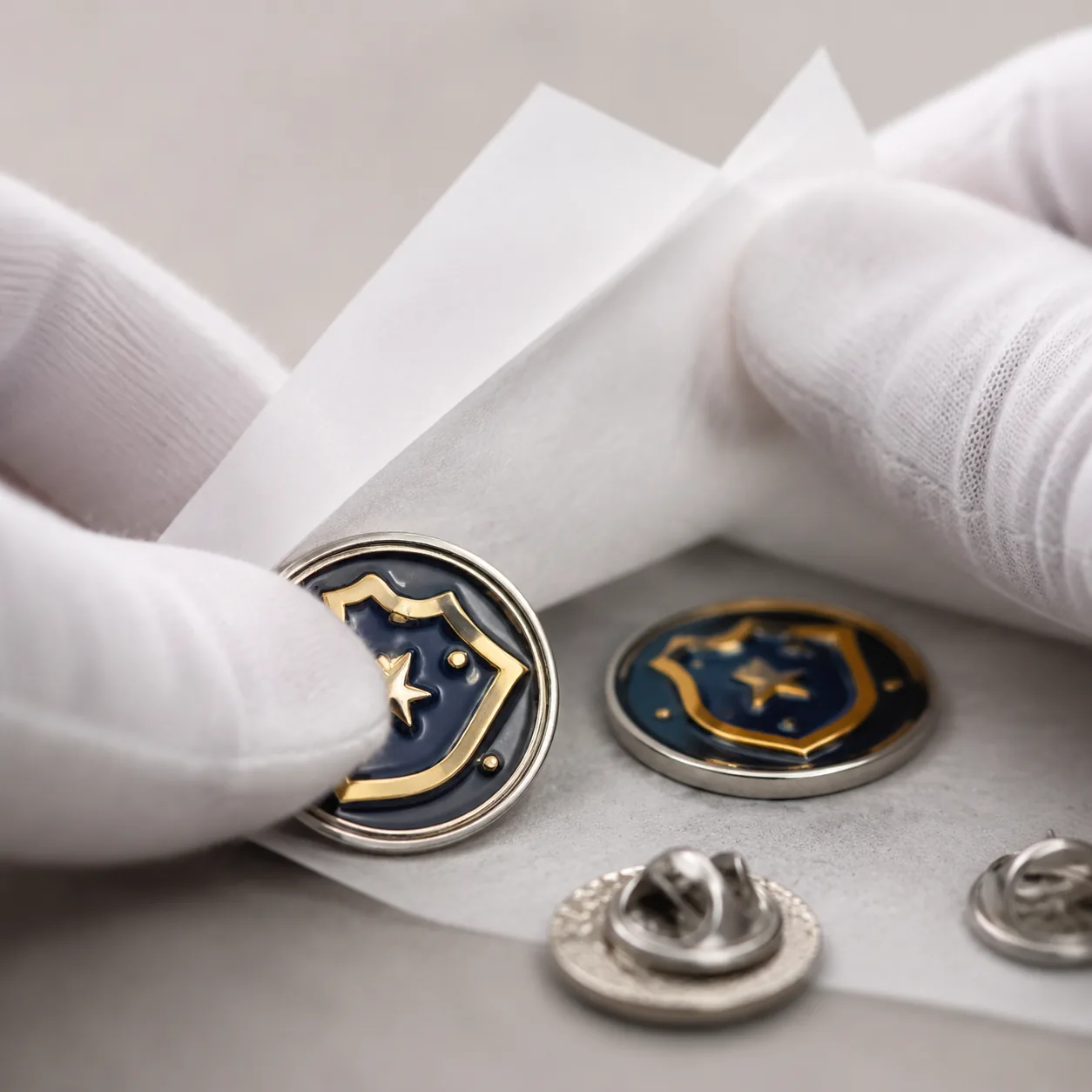
Leak Risk Starts Before Tooling
A brand team needs 5,000 custom enamel pins for a game launch, 2,000 zinc alloy keychains for press kits, and 800 challenge coins for VIP partners. The artwork shows unreleased characters, taglines, colorways, and event timing. The launch date is 52 days away. The schedule is workable, but one factory photo, sample video, rejected piece, or overrun lot appearing online can damage the reveal before the goods ship.
Confidentiality has to be treated as a production specification, not only as an NDA. An NDA helps with enforcement after a breach. It does not tell the factory who may open the artwork, whether sample photos can show the full design, how rejects are counted, or what may be printed on cartons. Those controls must be attached to the RFQ, sample approval, purchase order, inspection checklist, and packing instruction.
The same model applies to entertainment merchandise, sports finals products, corporate rebrands, retail collaborations, limited-edition coins, event badges, and influencer kits. Whether the item is a 30 mm soft enamel pin, a 45 mm keychain, a 50 mm antique coin, or a woven patch, the buyer should control artwork exposure, outsourced processes, retained samples, scrap disposal, overrun stock, and shipment labeling from the first supplier contact.
RFQ: Quote the Item, Not the Campaign
The first preventable mistake is sending a full campaign deck to five factories. A supplier does not need celebrity names, launch calendars, retail strategy, or unreleased copy to quote a metal accessory. It needs product type, size, quantity, material, decoration method, plating finish, attachment, packaging, inspection level, delivery term, and target ship date.
Use neutral file names and reduced artwork during the first quote round. Replace embargoed wording with placeholders if it does not affect mold structure. Instead of “Project Phoenix Final Character Reveal Pin,” send “badge_A_30mm_v1.pdf.” Release final artwork only after the supplier is shortlisted, the sample rules are agreed, and the PO control sheet is ready.
- Use neutral file names such as badge_A_30mm_v1.pdf, keychain_B_45mm.ai, or coin_C_50mm.svg.
- Send AI, PDF, SVG, EPS, or CDR files with fonts outlined, Pantone references listed, and cut lines separated from artwork.
- Quote MOQ tiers at 100, 300, 500, 1,000, 3,000, and 5,000 pieces to show where tooling, plating, and labor efficiency change the unit cost.
- Ask for tooling, sample, mass production, packaging, inspection, and freight as separate line items.
- Set dimensional tolerances before sampling: ±0.2 mm outer size for die-struck pins and ±0.3 mm for cast zinc keychains or coins.
- Prohibit use of the artwork in showroom boards, catalogs, sales decks, short videos, social posts, or spare sales samples.
As a FOB China reference, a 30 mm iron soft enamel pin at 3,000 pieces commonly runs $0.46 to $0.82 each, depending on color count, plating, backing, and packing. Hard enamel is often $0.68 to $1.15. A 45 mm zinc alloy keychain with enamel and split ring is usually $0.75 to $1.45. A 50 mm die-cast or stamped challenge coin with antique plating can run $1.20 to $2.80, depending on thickness, edge text, dual plating, 3D relief, and packing. Tooling is commonly $35 to $90 per pin design and $60 to $180 for heavier keychains or coins.
Control Sheet: Lock Specs Before Mold Cutting
Before tooling starts, issue a one-page product and confidentiality control sheet. It should identify the approved artwork version, size, base metal, thickness, plating, enamel type, attachment, packaging, carton mark rules, inspection standard, overrun rule, retained sample limit, and scrap-handling method. This prevents the factory from filling gaps with normal shop-floor habits that may be acceptable for open merchandise but risky for an embargoed launch.
For confidential launch pins, a practical base specification is iron or zinc alloy at 1.2 to 1.5 mm thickness for 25 to 35 mm designs. Soft enamel is normally filled to about 70 to 85 percent of raised metal height, leaving a recessed texture. Hard enamel is filled and polished flush, which gives a smoother surface but adds cost and production time. Common finishes include nickel, black nickel, imitation gold, brass, copper, and antique silver.
If nickel plating is specified, a 3 to 5 micron target is reasonable for promotional-grade pins and keychains. Decorative gold flash over nickel may be only 0.03 to 0.10 microns, so it should not be described as heavy-wear plating. For keychains that will rub against keys, specify thicker base plating, epoxy protection, or accept faster abrasion on raised corners.
For press-kit keychains, zinc alloy at 2.0 to 3.0 mm thickness is usually better than thin iron because it supports molded relief, thicker shapes, and heavier attachments. Clear epoxy adds about 0.3 to 0.5 mm surface height and improves scratch resistance, but it can soften fine recessed detail and may yellow after long UV exposure. For collector coins where relief matters, antique plating, recessed enamel, or no enamel may look sharper than epoxy.
| Control point | Recommended buyer spec | Why it matters |
|---|---|---|
| Artwork access | Final artwork released only after supplier selection | Limits exposure across multiple quoting factories |
| Sample photos | Plain background, no staff, no order boards, cropped when required | Prevents accidental disclosure outside the product |
| Overrun rule | 0 percent commercial overrun unless approved in writing | Blocks extra stock from entering grey channels |
| Retained samples | Maximum 2 factory-retained samples, logged by PO and design | Controls reference pieces without loose inventory |
| Scrap handling | Rejects, test strikes, misprints, and color trials destroyed or returned | Reduces leak risk from defective units |
| Carton marks | Neutral SKU, PO number, carton number, quantity, weight, and origin only | Avoids revealing launch names during transit |
| Inspection standard | AQL General II, 2.5 major, 4.0 minor | Creates objective release criteria before shipment |
Sampling: Verify Without Broadcasting
Confidential orders still need physical samples. Photos cannot reliably confirm plating tone, enamel level, clutch grip, edge smoothness, magnet strength, coin relief, or epoxy clarity. Normal sample timing is 5 to 7 calendar days after artwork approval for enamel pins, 7 to 10 days for zinc alloy keychains, and 8 to 12 days for challenge coins with 3D relief or antique plating. Tooling revision usually adds 2 to 4 days; a full mold remake can add 5 to 8 days.
The sample request should define both technical and confidentiality rules. Photos should be taken on a plain background with no visible staff, posters, customer designs, order boards, computer screens, or chat windows. For highly sensitive art, ask for cropped images showing plating, enamel fill, attachment, thickness, and edge quality without showing every character or slogan in one frame. Full images should go only to named approvers through the agreed channel.
Courier paperwork should stay neutral but accurate. Use descriptions such as “metal badge sample,” “zinc alloy keychain sample,” or “commemorative coin sample.” Do not put the campaign name, character name, or event slogan on the commercial invoice or outer label. Declared sample values of $5 to $20 are common, depending on destination rules. False descriptions or zero-value declarations can trigger customs delays and create more exposure than a neutral invoice.
Approve the sample against measurable criteria. Check outer size with calipers, confirm thickness, test attachment strength, compare enamel colors to Pantone targets or a signed master sample, and inspect plating under consistent light. For pins, a post pull target of 5 to 8 kgf is practical for promotional use. For split rings, check recovery after manual flexing. For magnets, test on the intended surface, not on thick steel that overstates holding force.
Mass Production: Limit Access and Outsourcing
After sample approval, mass production for 3,000 to 5,000 enamel pins usually takes 12 to 18 days. Keychains with epoxy, multi-part assembly, or custom backing cards often need 15 to 22 days. Challenge coins with antique plating, edge numbering, dual plating, or 3D relief commonly need 18 to 25 days. These estimates assume the buyer does not reopen artwork, Pantone, plating, or packaging decisions after approving the sample.
The control sheet should state who can access the order. In a small or mid-sized metal gift factory, normal access may include the sales owner, artwork technician, tooling operator, production supervisor, plating coordinator, QC inspector, and packing lead. It is not realistic to demand that only one person sees the order. It is realistic to ban unauthorized photography, open storage, showroom display, subcontractor sharing, and unlogged retained samples.
Some steps may be outsourced depending on factory capacity and technique. Electroplating, specialty epoxy, offset printing, laser engraving, woven labels, paper cards, magnetic assemblies, and velvet boxes may be handled by partner workshops. Ask which steps are in-house, which are outsourced, and whether the outside shop receives full artwork or only the component file needed for its work. A backing-card printer may need the card barcode and SKU, but not the unreleased pin art if the card is neutral.
MOQ affects exposure. At 100 to 300 pieces, the order may stay near a sample line with manual handling. At 1,000 to 5,000 pieces, it moves through more workstations and operators. At 10,000 pieces or more, plating racks, packing tables, and carton staging become more visible. Larger quantities are manageable, but they require batch counting, covered WIP trays, sealed storage, and documented scrap disposal.
Inspection: Check Quality, Counts, and Leak Points
Inspection for an embargoed launch should cover product defects and disclosure risk. The PO should require the factory to report finished quantity, rejected quantity, rework quantity, overrun quantity, retained sample quantity, and destroyed scrap quantity before shipment. If the PO is for 5,000 pins, the factory should not ship 5,180 pieces unless the buyer approves the excess in writing.
For promotional pins and small metal accessories, AQL General Inspection Level II with 2.5 major and 4.0 minor is a practical baseline. Major defects include wrong artwork, wrong plating, incorrect Pantone color outside the approved range, missing enamel, broken posts, loose split rings, sharp burrs, incorrect backing, mixed designs, short quantity, and carton labels that reveal the campaign. Minor defects include slight plating shade variation within the signed sample range, small dust in enamel, or tiny marks visible only under close inspection.
Dimensional checks should use calipers on the sampled units. For die-struck pins, hold outer size to ±0.2 mm and post position to ±0.5 mm unless the design requires tighter placement. For cast keychains and coins, ±0.3 mm outer size and ±0.2 mm thickness are reasonable. Check enamel for voids, overflow, and underfill. Check plating for exposed base metal, blistering, dark spots, and inconsistent antique wiping.
- Count approved pieces, rejects, rework pieces, overruns, retained samples, and destroyed scrap before release.
- Confirm no product photos appear in factory catalogs, social feeds, showroom boards, or sales messaging groups.
- Check that backing cards, polybags, inner boxes, and cartons use neutral SKU codes only.
- Verify specified plating targets, such as 3 to 5 microns for nickel base plating where required.
- Test attachments: pin post pull at 5 to 8 kgf, split ring recovery after flexing, and magnet hold on the intended surface.
- Seal master cartons with tamper-evident tape if goods pass through multiple warehouses before launch.
Packing and Shipment: Neutral but Traceable
Neutral packing should not be vague. The receiving warehouse still needs to identify the shipment and reconcile it against the PO. Use PO number, neutral SKU, carton number, quantity, gross weight, net weight, and country of origin where required. Do not print the launch title, character name, final retail name, event slogan, or embargo date on master cartons.
For 30 mm pins on backing cards, a common method is one pin per OPP bag, 100 pieces per inner box, and 500 to 1,000 pieces per export carton. Keep cartons under about 12 to 18 kg to reduce crushing and handling damage. For metal keychains, 10 to 15 kg per carton is safer because concentrated weight can deform inner boxes or mark epoxy surfaces. Challenge coins should use capsules, dividers, trays, or individual pouches if antique finish or polished plating is prone to rubbing.
If the order has multiple designs, avoid mixed cartons unless the warehouse specifically needs them for kitting. Mixed cartons can help press-kit assembly, but they increase counting errors and expose the design mix to more handlers. For confidential launches, single-design cartons with neutral SKU codes are cleaner. Keep the SKU-to-design map in the buyer’s internal file and share it only with the receiving team.
Shipment choice should balance speed, cost, and disclosure risk. Express courier is fast but creates more scans, labels, and handling points. Air freight is suitable for launch orders under roughly 200 to 500 kg when the event date is close. Sea freight lowers unit freight cost but may require production to finish 25 to 40 days earlier, depending on destination and sailing schedule. For the scenario order, a practical split is 300 approval-ready sets by express courier and the balance by air freight if the launch window is fixed. Express transit is often 3 to 6 days after pickup. Air freight is commonly 5 to 10 days airport to airport, plus clearance and local delivery.
PO Attachment: Make Confidentiality Auditable
Before issuing the PO, convert confidentiality into written operating instructions. Do not rely on a chat message buried in a long sales thread. The attachment should be short enough for the factory team to follow and specific enough for QC to verify.
At minimum, state that final artwork is released only for the named order, public photography and showroom display are prohibited, commercial overruns are not allowed, retained samples are capped and logged, rejected pieces must be destroyed with evidence or returned, carton labels must use neutral codes, and any outsourced process requires buyer notice. These rules are easier to enforce before tooling starts than after finished goods are packed.
For a buyer working with ZheCraft, the efficient first step is to send a reduced RFQ: product type, size, quantity, target delivery date, material preference, attachment, packaging, inspection requirement, and confidentiality level. We can then advise which steps can stay in-house, which outside processes may be involved, what MOQ and FOB range is realistic, and whether the 52-day launch window is safe before the buyer exposes final unreleased artwork.
Have a project? Send your artwork and target quantity and we’ll reply with a detailed quotation within 12 working hours.
Ready to get this made?
Send your sketch, target quantity and ship-date. Detailed quotation in 12 hours.



