Choosing the Right Metal Finish for Promo Giveaways
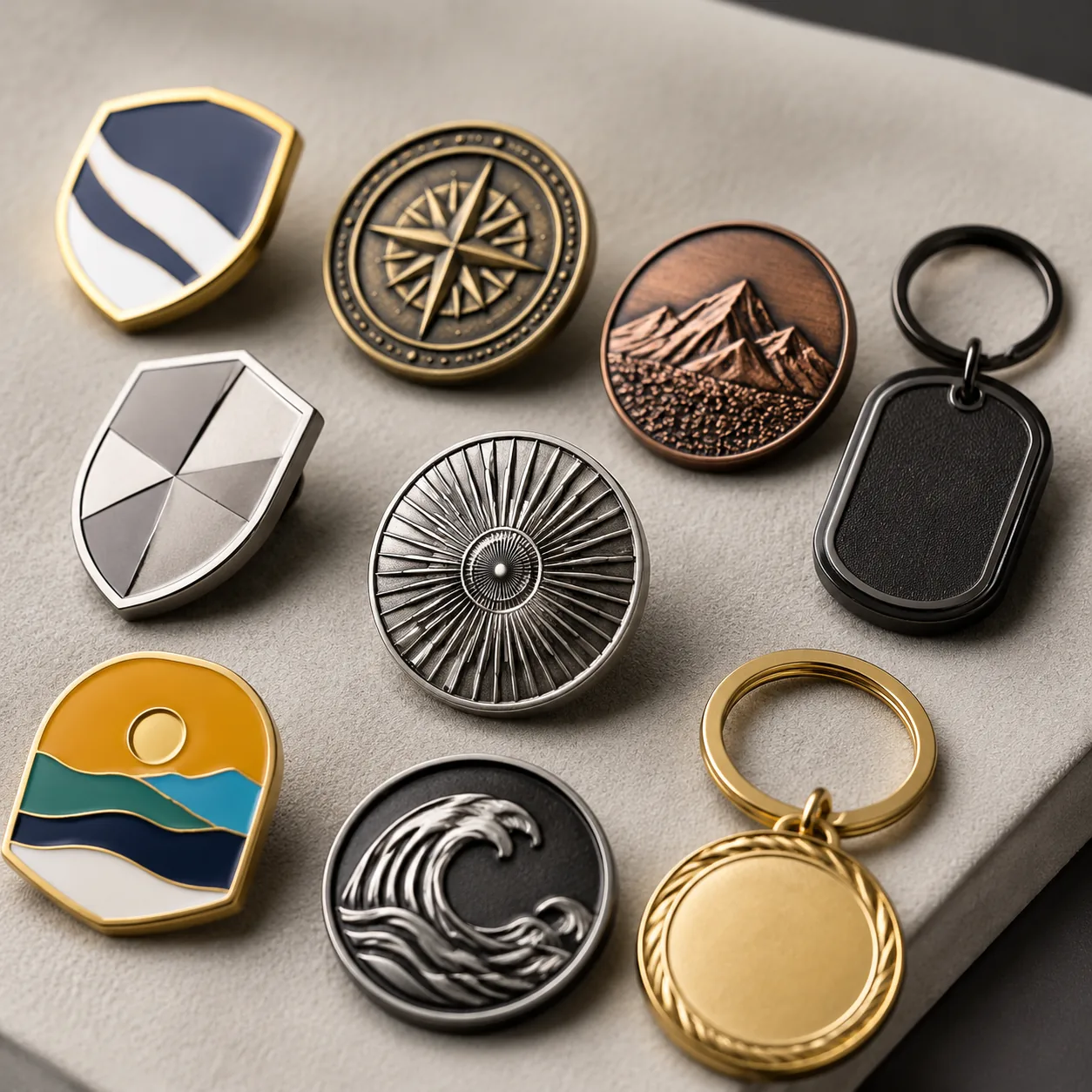
Decide the finish before final artwork approval
For metal pins, coins, badges, medals and keychains, the finish is not a final cosmetic choice. It changes contrast, perceived value, scratch visibility, corrosion resistance and the way enamel or printed color reads under light. A clean vector file can still become a poor product if the finish makes fine lines disappear, exposes edge wear too quickly, or shifts the apparent brand color after plating.
The most common sourcing error is approving artwork in isolation, then asking the factory to “make it gold” or “use black nickel” after the design is locked. That can force line-weight changes, enamel color changes, extra polishing, or a new sample. On a 1,000-piece pin order, a late finish change can add 3–7 working days and USD 40–120 in sample or setup costs. On coins or cast keychains, it can also require revised mold polish because high-gloss finishes reveal surface texture that antique finishes would hide.
Finish terminology is also a quote-comparison risk. Two suppliers may both quote “nickel plating,” but one may be using a 0.03 micron flash layer while another targets 0.10–0.20 micron decorative plating with better polishing and inspection. The price difference may be only USD 0.02–0.08 per piece, but the wear difference is visible after shipping abrasion or several weeks of daily handling.
For reliable buying, treat the finish as a controlled specification: base metal, polishing level, plating color, plating thickness, gloss, antique wash, clear coat, packaging and inspection standard. Those details are more useful than broad words like shiny, premium or vintage.
Match finish to use case and design style
Bright nickel is the safest default for many corporate giveaways. It is neutral, modern and compatible with hard enamel, soft enamel, offset printing and epoxy doming. It gives crisp contrast around strong brand colors and normally has the lowest tone-matching risk across repeat orders. For 25–35 mm lapel pins, bright nickel is often the most predictable option at 500–5,000 pieces.
Gold works best for awards, anniversaries, ceremonial gifts and premium membership items. It should be specified by tone, because pale champagne gold, bright yellow gold and deeper brass-gold can look very different under the same office lighting. Rose gold is more fashion-oriented and can be effective for lifestyle, cosmetics, wellness and retail gift sets, but it has higher bath-to-bath tone drift. If rose gold must match across pins, coins and keychains, require a physical master sample.
Antique brass, antique copper and antique silver are good for heritage, outdoor, military-inspired, museum, brewery and club merchandise. The darkened recesses add contrast and hide minor scuffs better than mirror finishes. They also work well when the design has raised relief, large numerals, borders or emblems. They are less suitable for tiny recessed copy below about 0.35 mm stroke width because antique wash can reduce legibility.
Black nickel is useful for gaming, music, streetwear, tactical and premium-black programs. It creates strong mood and good contrast with white, red, neon and metallic colors. Its weakness is detail loss: thin outlines, dark enamel and shallow relief can merge visually. For black nickel, keep raised metal dividers at least 0.30–0.35 mm wide for soft enamel pins and preferably 0.40 mm or wider for high-wear keychains.
Matte silver, satin nickel and brushed finishes reduce glare and can look technical or industrial. They are not automatically more durable. Matte surfaces can show fingerprints, oil marks and uneven preparation more clearly than polished nickel. Use them when the program values low reflection, not as a substitute for better plating or packaging.
Compare finish cost, thickness and risk
The ranges below reflect common China export production for custom pins, badges, challenge coins and keychains. Actual pricing depends on size, metal, mold complexity, enamel count, packing and order quantity. The FOB ranges assume a typical 25–35 mm soft enamel pin or badge at 1,000 pieces, excluding freight and complex retail packaging.
| Finish | Best use case | Typical decorative plating | Typical MOQ and lead time | FOB price effect / risk |
|---|---|---|---|---|
| Bright nickel | Corporate pins, color-heavy badges, clean retail look | 0.05–0.15 micron; 24–72 hour neutral salt spray if specified | MOQ 100–300 pcs; 10–16 days after sample approval | Baseline cost; low tone drift; scratches visible on high polish |
| Gold | Awards, anniversaries, formal gift sets | 0.05–0.15 micron decorative gold-color layer; clear coat recommended | MOQ 300–500 pcs; 12–18 days after approval | Adds about USD 0.03–0.10/pc; tone must be controlled |
| Antique brass | Vintage, clubs, breweries, museums, heritage campaigns | 0.03–0.10 micron plus dark antique wash and hand wiping | MOQ 100–300 pcs; 10–17 days after approval | Low to medium cost; hides wear well; wash depth varies |
| Antique copper | Outdoor, rugged, craft, retro branding | 0.03–0.10 micron plus dark antique wash | MOQ 300 pcs typical; 12–18 days after approval | Adds USD 0.02–0.08/pc; oxidation look must be sampled |
| Black nickel | Gaming, music, fashion, tactical or dark premium designs | 0.03–0.10 micron; clear coat recommended for handled items | MOQ 300–500 pcs; 12–20 days after approval | Adds USD 0.03–0.12/pc; small details can darken |
| Rose gold | Lifestyle, cosmetics, wellness, boutique merchandise | 0.03–0.10 micron; physical tone reference strongly advised | MOQ 500 pcs typical; 14–22 days after approval | Adds USD 0.05–0.15/pc; highest tone-drift risk |
| Matte or satin silver | Technical, outdoor, minimalist and glare-sensitive items | 0.05–0.15 micron over polished or bead-blasted surface | MOQ 300–500 pcs; 12–20 days after approval | Adds USD 0.03–0.12/pc; surface prep defects show quickly |
These are decorative finishes, not heavy industrial coatings. If the item will be worn daily, rubbed on keys, exposed outdoors or used as resale merchandise, specify testing rather than relying on color names. A reasonable promo-grade standard is no exposed base metal, no visible staining at 30 cm viewing distance, no major plating burn on edges, and no more than 1.5% combined major defects under AQL 2.5 for major defects and AQL 4.0 for minor cosmetic defects.
For keychains and coins, buyers should be more conservative than for lapel pins. Keychains face metal-to-metal abrasion at the split ring and connector, while coins are handled across the rim and high points. A finish that survives a pin card may still wear quickly on a daily-use keyring unless ring contact, clear coat and packing are specified.
Control thickness, tolerances and inspection criteria
A useful RFQ does not need to read like an aerospace drawing, but it should remove the most expensive ambiguity. State the finish name, appearance, target plating thickness, acceptance criteria and how the approved sample will control reorders. For decorative promo metalwork, 0.05–0.10 micron may be acceptable for short campaign giveaways, while 0.10–0.20 micron is a better target for resale items, coins, bottle openers and keychains. Very low flash plating below 0.03 micron should be treated as cost-driven and higher risk.
Dimensional tolerances matter because finish performance is tied to edges. Typical custom pins and badges can hold about ±0.2 mm on outer size, ±0.1–0.2 mm on enamel cavities and ±0.2–0.3 mm on overall thickness, depending on stamping or casting. Challenge coins and cast keychains often use ±0.3 mm on outer dimensions and ±0.2 mm on raised relief. If fine text, QR-like marks or small logos are involved, confirm the minimum raised line width and recessed gap before sampling.
Inspection language should be practical and visual. Define major defects as exposed base metal, peeling, blistering, severe stains, plating burn, wrong finish, loose attachment, sharp burrs and incorrect artwork. Define minor defects as tiny pinholes, light hairline scratches, minor color specks or slight uneven gloss that are not obvious at 30 cm under normal daylight. For standard promotional orders, AQL 2.5 major and AQL 4.0 minor is common; premium retail programs may require AQL 1.5 major and tighter packaging inspection.
If the supplier can provide test data, ask for the exact test instead of a generic durability claim. Useful checks include tape adhesion after plating, 24–72 hour neutral salt spray for corrosion-sensitive programs, rub testing at 200–500 cycles on raised areas, and ring-pull checks for keychain connectors. These tests are not always included in the base quote, but they are cheaper than replacing a failed reorder.
Design artwork around the selected finish
Metal finish changes the way a design reads. High-polish nickel and gold reflect light strongly, emphasizing bevels and raised edges, but also making scratches and uneven polishing easier to see. Antique finishes reduce glare and hide scuffs, but they can soften fine engraving and darken small recessed areas. Black nickel creates premium contrast in photos, yet it can turn dark enamel, small type and narrow outlines into a low-contrast mass.
Before sampling, review the artwork against manufacturing limits. For soft enamel pins, raised metal lines should usually be at least 0.25–0.30 mm, with 0.35 mm safer for black nickel or antique wash. Recessed enamel areas should be at least 0.3–0.4 mm wide to fill cleanly. For hard enamel, avoid very shallow cavities and extremely thin dividers because polishing can reduce raised metal detail.
Color approval should also account for metal reflection. A white enamel fill next to black nickel looks brighter and more graphic than the same white next to gold. Pastel enamel can appear warmer beside brass or rose gold. Dark blue or black enamel may lose separation on black nickel unless there is a bright metal border or enough line width. If Pantone matching is critical, approve a physical sample under daylight and office light, not only a screen image.
Packaging is part of the finish decision. Bright nickel, gold and rose gold should not be bulk packed loose unless low cosmetic expectations are acceptable. Individual polybags add about USD 0.01–0.03 per piece and reduce transit abrasion. Backing cards, foam inserts, blister cards or divided trays cost more, often USD 0.05–0.30 per piece, but they can protect a premium finish and improve retail presentation.
Specify the RFQ so quotes are comparable
A vague RFQ invites mismatched quotations. “Gold pin, 30 mm, soft enamel” is not enough to compare factories. A stronger version is: “30 mm stamped iron soft enamel lapel pin, bright yellow-gold decorative plating, target 0.10 micron, polished raised metal, no antique wash, black rubber clutch, individual polybag, AQL 2.5 major / 4.0 minor, pre-production sample required before mass production.”
- Name the exact finish: bright nickel, satin nickel, black nickel, antique brass, antique copper, bright gold, rose gold or dual plating.
- State plating target: 0.05–0.10 micron for standard giveaways or 0.10–0.20 micron for higher-wear retail and keychain programs.
- Define surface effect: high polish, satin, matte, brushed, antique wash, dark recess fill, clear coat or no clear coat.
- Confirm base metal and process: stamped iron, brass, zinc alloy die casting, soft enamel, hard enamel, die-struck, printed or epoxy-coated.
- Set inspection terms: AQL level, major and minor defect definitions, viewing distance, scratch allowance and exposed-metal rejection.
- Control packing: individual polybag, backing card, tray, tissue wrap, blister card or bulk pack by counted inner bags.
- Lock approval method: physical pre-production sample, plated color chip, golden sample or approved production sample for repeat orders.
For multi-item campaigns, request the same finish specification across all SKUs but allow process-specific adjustment. A bright nickel pin, zinc alloy keychain and die-struck coin may need different polishing steps to achieve the same visual tone. The master sample should define the target appearance, while the technical spec should define acceptable variation.
Plan MOQ, lead time and reorder control
Standard finishes such as bright nickel, antique brass and antique silver usually carry the lowest MOQ and fastest production. Many factories will accept 100–300 pieces for pins, 300 pieces for keychains and 100–500 pieces for coins, depending on size and mold cost. Normal production after sample approval is often 10–18 working days, with sample making at 5–8 working days for stamped pins and 7–12 working days for cast or 3D items.
Special finishes add time because they may require separate plating baths, masking, hand wiping, extra clear coat, or a minimum rack quantity. Black nickel, rose gold, dual plating, brushed effects and heavy antique treatments commonly add 3–7 working days. If the order is below the plating line’s efficient batch size, the factory may either raise the MOQ, charge a small plating setup fee of USD 30–100, or wait to combine the job with another batch.
Dual plating should be used carefully. A two-tone coin with antique brass recesses and bright nickel raised elements can look excellent, but masking and secondary plating increase reject risk. Expect higher MOQ, usually 500 pieces or more, and a longer mass-production window of 18–28 working days after sample approval. For urgent event giveaways, a single finish with good contrast is usually safer.
Reorders should be controlled by a physical golden sample, not only the original invoice wording. Store one approved sample with the buyer and one with the factory. Record finish name, base metal, plating target, enamel system, packaging and approval photos. Without this, a reorder placed six months later may match the shape but miss the tone, gloss or antique-wash depth.
Choose the lowest-risk finish for the campaign
The best finish is the one that fits the product’s use, expected life and approval risk. For broad corporate distribution, bright nickel or satin nickel gives the cleanest balance of cost, consistency and color compatibility. For rugged or heritage themes, antique brass and antique copper hide wear and make relief look deeper. For premium awards, gold can work well if the tone is sampled and controlled. For lifestyle and dark-brand programs, rose gold and black nickel are effective but should not be approved from renderings alone.
If durability is more important than day-one shine, prioritize polishing quality, plating thickness, clear coat, edge design and packaging. If visual consistency is more important, prioritize a physical master sample, tone notes and AQL-based inspection. For most promotional buyers, the safest process is simple: choose the finish before final artwork, specify it in measurable terms, approve a plated sample, and keep that sample for reorder control.
ZheCraft can align finish selection with base metal, relief depth, enamel type, MOQ and packing method for pins, coins, badges and keychains. That early alignment prevents the common failure pattern: an attractive rendering, a rushed sample, and a bulk order that looks acceptable in photos but wears poorly in real use.
Have a project? Send your artwork and target quantity and we’ll reply with a detailed quotation within 12 working hours.
Ready to get this made?
Send your sketch, target quantity and ship-date. Detailed quotation in 12 hours.



