Choose the Right Custom Giveaway Product by Use Case
Start With The Job, Not The Product
Most rework starts when buyers name the item before they define the job. A trade-show handout, employee award, retail add-on, donor thank-you, and internal ID accessory each fail differently: one needs low cost and fast replenishment, another needs perceived value, and another must survive daily handling. The right choice is usually the one that holds up to the intended handling pattern at the lowest acceptable unit cost, not the one that looks best in a catalog.
For example, a lapel pin meant to be worn for six months needs secure backing, smooth edge finishing, and a design that reads at arm’s length. A fridge magnet for an office campaign needs strong visual contrast and enough magnetic pull to stay flat on steel, not deep enamel relief. At ZheCraft, the best orders usually start with the use case, then move into construction, plating, thickness, and packing. Skipping that step leads to either over-specifying decoration or under-specifying durability.
- Define where the item will live: on clothing, on a desk, in a mailer, or in a pocket.
- Define handling: one-time handout, daily wear, shipping impact, or outdoor exposure.
- Define what must survive: scratching, bending, tarnish, fading, or magnet loss.
- Define success by one primary outcome: visibility, keepsake value, function, or unit cost.
- Define your tolerance for rework: cosmetic variation, attachment failure, or color drift.
Match The Product To The Real Use Case
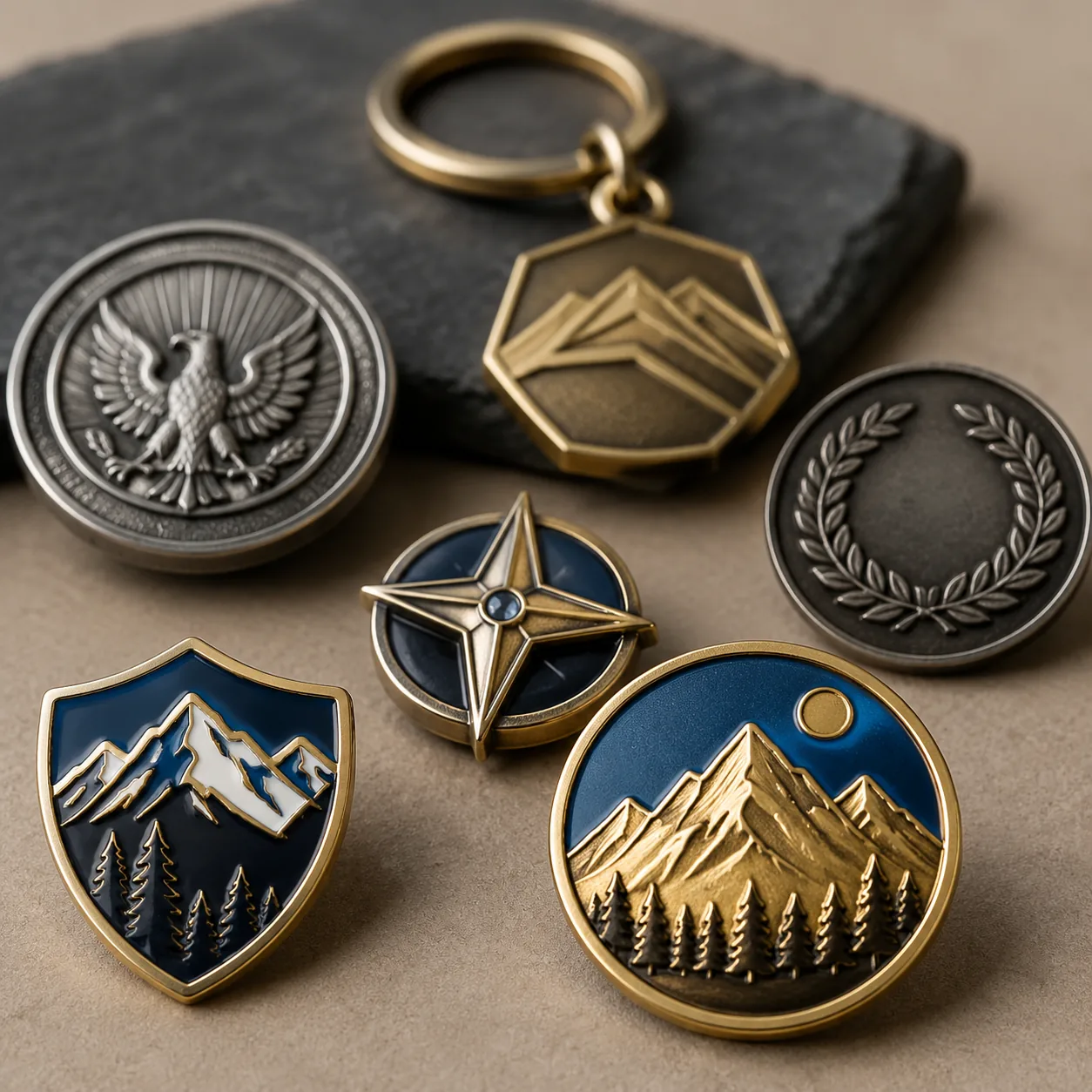
Custom enamel pins fit best when the item must be worn, collected, and recognized quickly. Common production ranges are 20 to 35 mm for lapel use, 1.2 to 1.5 mm base thickness, and 0.2 to 0.25 micron decorative plating for standard nickel, brass, or black nickel finishes. Soft enamel is usually preferred for lower tooling complexity; hard enamel is better when the buyer wants a flatter, more jewelry-like surface. Pins are weak choices when the audience wants utility first, because the value comes from design and wearability rather than function.
Keychains are better when the item must travel with the user and tolerate pocket abrasion. Metal keychains often use 1.5 to 2.0 mm thickness, with split rings around 20 to 25 mm diameter and lobster clasps or key rings selected by load and style. Practical MOQs commonly start at 100 to 300 pcs for simple die-struck or printed builds. They work well for retail add-ons, hotel gifting, auto clubs, and membership programs, but hardware quality matters more than in most other giveaway items.
Fridge magnets are strongest when the message must stay visible on a steel surface for weeks or months. A flat printed magnet is often best for office campaigns, home promotions, and tourism giveaways because it gives the largest readable area at the lowest cost. Magnets are a poor fit when the customer needs fabric compatibility, premium weight, or a tactile award feel.
Patches are the best fit when you need a larger logo area and lower unit cost at scale, especially for uniforms, jackets, hats, and bags. Woven patches typically support fine text better than embroidery, while embroidered patches deliver a thicker, more traditional texture. Most workable sizes start around 50 to 80 mm for clear branding. Lanyards are the most rational option when the item must carry an ID, badge, or access card, because the function is obvious and the print area is long and continuous.
Challenge coins suit recognition programs, executive gifting, military-style awards, and collector-style branding. They carry more weight, both physically and symbolically, than most giveaway products. They are not efficient for broad exposure, but they are effective when the objective is retention, ceremony, or a premium unboxing experience.
Compare The Trade-Offs Before You Quote
The fastest way to avoid a bad quote is to compare products by the variables that actually move cost and risk. Decoration method, tooling style, surface area, attachment hardware, and packing format often matter more than the headline item name. A simple stamped keychain can be cheaper than a detailed enamel pin at the same size, but the pin may still win if the buyer values collectability and daily visibility.
| Product | Best For | Typical MOQ | Typical FOB Range USD | Typical Lead Time (Days) | Main Risk |
|---|---|---|---|---|---|
| Enamel pin | Wearable branding, collecting | 100-300 pcs | 0.35-1.80 | 12-20 | Color/detail overreach |
| Keychain | Portable utility, repeat handling | 100-300 pcs | 0.45-2.50 | 12-22 | Hardware failure |
| Fridge magnet | Desk, home, office visibility | 100-500 pcs | 0.25-1.20 | 10-18 | Weak perceived value |
| Patch | Uniforms, apparel, bags | 50-100 pcs | 0.30-1.60 | 10-18 | Application mismatch |
| Lanyard | Events, IDs, access control | 100-500 pcs | 0.20-1.10 | 8-15 | Print wear and twist |
| Challenge coin | Awards, recognition, premium gifting | 100-300 pcs | 1.20-6.00 | 15-28 | Cost creep from relief/detail |
Use the table as a screening tool, not a final answer. If the campaign is mail-heavy, carton size and shipping weight may matter more than unit cost. If the audience is executive-level, a coin or heavy metal keychain usually carries more perceived value than a thin printed magnet. ZheCraft often advises buyers to compare price against failure risk, because the cheapest unit is not cheap if 8 percent arrive scratched, warped, or packed poorly.
FOB pricing also changes with decoration count, plating color, and packaging. A plain polybag may keep a quote near the bottom of the range, while a backing card, velvet pouch, or individual box can add $0.08 to $1.20 per piece depending on format. For new programs, ask for both a standard production quote and an upgraded presentation quote so you can compare cost against perceived value instead of guessing.
Choose By Durability Requirement
Durability is the clearest way to separate the right products from the wrong ones. If the item will rub against other objects, choose thicker bodies, stronger attachment points, and finishes that hide minor scuffs. For pins and coins, a practical plated finish is typically 0.2 to 0.25 microns for standard decorative use; better tarnish resistance usually depends more on base metal choice, polishing quality, and topcoat behavior than on adding a small amount of plating thickness.
If the item will be flexed, dropped, or shipped loose, simple geometry is safer. A soft enamel pin with raised metal lines handles cosmetic wear well, but deep openwork, very thin bridges, or dangling accessories increase rejection risk in transit. For keychains, the weak points are usually the joint, split ring, and connector choice. If you push for ultra-low cost, those are the first places where quality slips show up.
For magnets, durability is mostly about magnetic retention and substrate flatness. A 1 mm to 2 mm magnet layer is often enough for light indoor use, but larger printed magnets may need stronger backing or thicker magnetic sheet to avoid curling at the edges. When you need wipe-clean or outdoor exposure, avoid paper-laminated surfaces and use UV-stable printing, coated metal, or a lamination system rated for repeated cleaning.
Patches and lanyards fail differently. Patches fail when the attachment method does not match the garment, such as choosing iron-on for rough workwear that needs sewing, or choosing sew-on for a one-day event giveaway that needs quick application. Lanyards fail when hardware is too light for the badge weight, the print method is wrong for the artwork, or the fabric twists under daily use. In both cases, the product can be technically correct and practically wrong.
Choose By Budget And Perceived Value
The common mistake is assuming price and perceived value move in a straight line. In practice, perceived value jumps when the item has weight, shine, crisp edges, and a finish that feels deliberate. A 1.5 mm zinc alloy pin with clean epoxy, a 2.0 mm antique-plated coin, or a woven patch with tight stitch density often looks more expensive than a larger but flatter item.
For low budgets, printed magnets, PVC keychains, and simple woven patches usually provide the best mix of MOQ flexibility and visual area. For mid-range budgets, hard enamel pins and metal keychains are strong choices because they balance decoration, repeat use, and controllable cost. For premium budgets, challenge coins and mixed-process metal gifts make sense when retention, presentation, or award-like behavior matters more than reach.
Do not chase thickness alone. Adding 0.3 mm of metal can increase heft, but it also raises tooling cost, shipping weight, and the chance of sharp edges if finishing is rushed. If you want a premium feel on a budget, ask for cleaner polishing, tighter plating control, and better packing before asking for a heavier build. That usually improves perceived quality more efficiently than adding raw material.
The most efficient value gain is often in packaging, not construction. A backing card with clear messaging, a neat insert, or a protective pouch can raise the buyer’s impression more than a more complex mold. If the item is going into a retail channel or being handed to executives, presentation can matter as much as the object itself.
Use The Right Spec Set For The Winning Option
Once the use case is clear, the spec set should reinforce it. For lapel items, specify size in mm, base thickness, plating finish, attachment type, and color count. For utility items, prioritize hardware, pull strength, and wear points. A good RFQ does not need every parameter, but it must define the few that control rejection.
| Decision | What To Specify | Practical Target |
|---|---|---|
| Wearable pin | Size, thickness, plating, backing | 20-35 mm; 1.2-1.5 mm; 0.2-0.25 micron plating |
| Portable keychain | Body thickness, ring size, joint type | 1.5-2.0 mm; 20-25 mm split ring |
| Desk magnet | Magnet sheet, print method, laminate | 1-2 mm magnet; UV-stable print; flat backing |
| Apparel patch | Construction, edge finish, stitch density | Woven or embroidered; merrowed or heat-cut edge |
| Event lanyard | Width, print method, clip hardware | 15-25 mm width; screen, sublimation, or jacquard; metal hook or buckle |
If you are working with a Chinese factory, include tolerance ranges where fit or appearance matters. Common practical tolerances are around ±0.3 mm to ±0.5 mm for small metal dimensions, with slightly wider variation acceptable on larger printed products. For color, provide Pantone references where possible, and remember that textiles, soft enamel, and coated surfaces will drift more than rigid plated metal.
Inspection terms should also be explicit. For decorative products, a reasonable starting point is visual AQL 2.5 for major defects and AQL 4.0 for minor defects, unless the item is premium or safety-related. For critical fit points such as badge clips, split rings, pin posts, or magnet alignment, tighten the acceptance criteria in writing so the factory does not assume cosmetic inspection is enough.
If the item includes logos with fine text, give minimum stroke and gap expectations. As a practical rule, text below 1.2 mm high and line gaps below 0.25 mm become risky on molded or enamel products. For woven patches, very fine details are better handled with vector art and a clear proof approval step than by relying on a general design review.
When Not To Choose The Obvious Option
Do not pick enamel pins when the campaign requires the item to be useful every day; wearability is not utility. Do not pick coins when you need broad logo exposure at the lowest possible cost, because coins are built for perceived value, not mass reach. Do not pick magnets if your audience lacks usable steel surfaces, and do not pick patches if the buyer cannot control application quality on the garment or bag.
Also avoid over-specifying premium finishes for low-stakes giveaways. Antique plating, complex cutouts, spinning parts, and multi-layer construction can be excellent choices, but they increase tooling time, inspection burden, and sample iteration count. In practice, many buyers would be better served by a simpler build with stronger packing and fewer decorative features.
Lead time is another reason to avoid the obvious choice. A simple lanyard may ship in 8 to 15 days after approval, while a complex coin with 3D relief, antique plating, and custom edge text may need 15 to 28 days. If the event date is fixed, choosing the slower premium option can create expensive air freight or force a rushed sample approval cycle.
At ZheCraft, we often recommend reducing one layer of complexity before reducing quality. Dropping an unnecessary cutout or moving part usually protects more value than shaving 5 percent from plating or changing a carton from branded to plain. That is the trade-off that keeps orders on schedule and within budget.
What To Do Next
Take your next promo concept and classify it in four words: wearable, portable, visible, or functional. Then choose the product family that best matches the primary word, not the one that sounds most impressive in the quote. After that, lock the three specs that matter most for that family: size, construction, and attachment or backing.
- Write the use case in one sentence before asking for prices.
- Choose one primary success metric: visibility, durability, utility, or premium feel.
- Ask factories for a quote on two options only, not five.
- Require unit price, tooling cost, MOQ, lead time, packing cost, and sample cost in the same quote.
- Request one pre-production sample before mass production if the item is new or complex.
- Ask for AQL targets, color references, and tolerance limits on the same RFQ.
If you want a cleaner decision, send the intended use, distribution channel, target quantity, and budget range to your factory in one message. ZheCraft can usually narrow the choice quickly across pins, keychains, magnets, patches, coins, and lanyards because the decision is mostly about fit, risk, and handling, not preference. The right product is the one that survives the way your audience will actually use it.
Have a project? Send your artwork and target quantity and we’ll reply with a detailed quotation within 12 working hours.
Ready to get this made?
Send your sketch, target quantity and ship-date. Detailed quotation in 12 hours.



