China vs Vietnam for Custom Metal Promo Orders in 2026
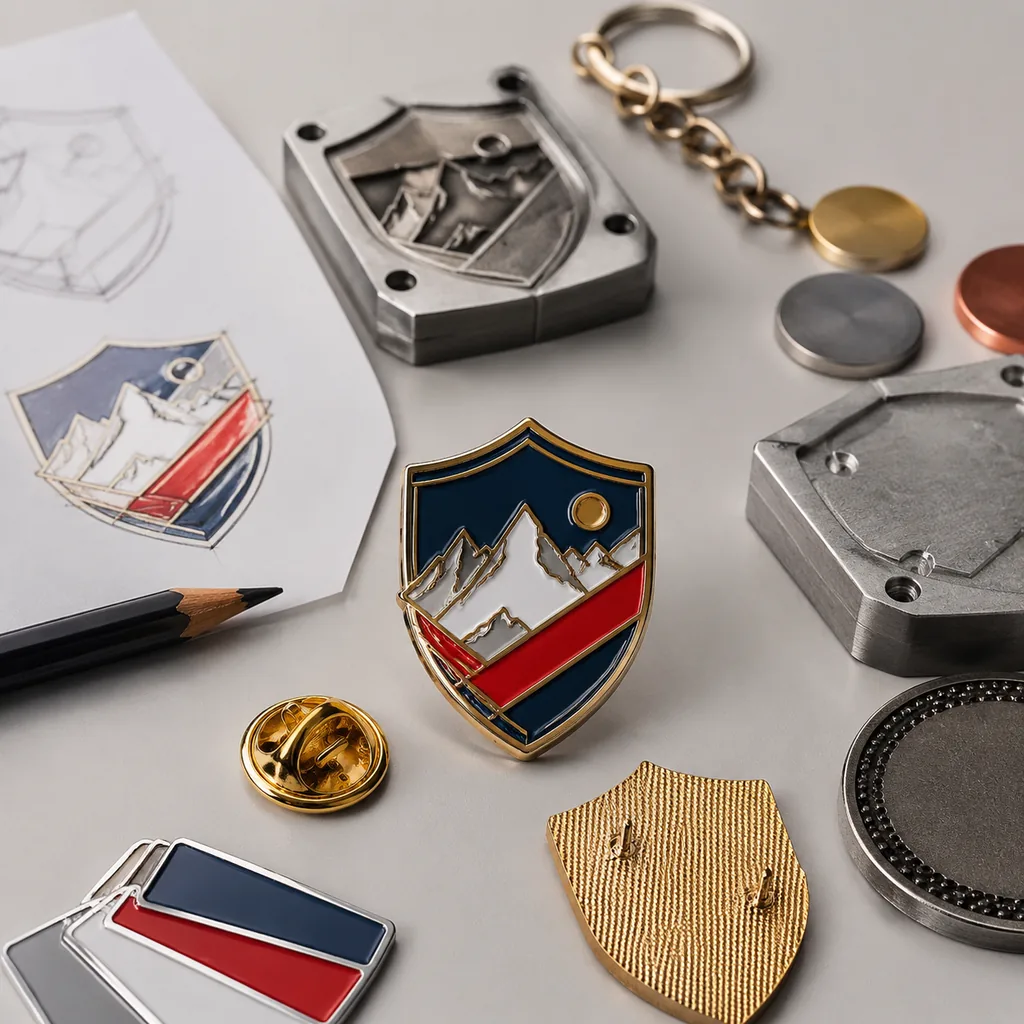
The real 2026 decision: tariff relief versus process capability
In 2026, many buyers are still being pushed toward an oversimplified sourcing decision: exit China or stay put. For custom metal promotional goods, that framing is usually wrong. Soft enamel pins, die-struck badges, challenge coins, zinc alloy keychains, bottle openers, fridge magnets, and carded promo sets are multi-step products with tight visual and dimensional controls. A quote that is USD 0.08 lower per unit can be wiped out by one tooling revision, one plating mismatch, one solder alignment issue, or one repack after a packing-count error.
The more useful comparison is a mature Chinese metalworking cluster versus a smaller Vietnam supply base that can perform well on selected SKUs but often has less depth in upstream tooling, specialty finishes, or accessory integration. On many Vietnam programs, chains, split rings, butterfly clutches, magnets, backing cards, and some packaging components are still sourced externally or from a narrower local network. That does not make Vietnam unworkable. It means buyers need to compare defect exposure, engineering flexibility, and landed cost rather than assume a second origin automatically improves the program.
The process sensitivity is higher than many non-specialist sourcing teams expect. On stamped soft enamel pins, raised metal lines usually need to hold at roughly 0.25 to 0.35 mm to fill cleanly; separations below 0.20 mm sharply increase enamel bleed and polishing risk. Open cutouts under 0.8 to 1.0 mm often require redesign for die stability. Finished thickness on stamped iron or brass parts is commonly specified at 1.2, 1.5, or 1.8 mm with a practical tolerance of plus or minus 0.10 to 0.15 mm. Post placement on a 30 to 50 mm pin typically needs to stay within plus or minus 0.30 to 0.50 mm to avoid visible skew on the backing card. Decorative plating is often flash-level, but many buyers still specify an appearance target equivalent to roughly 3 to 5 microns overall decorative build, with higher-wear hardware areas sometimes pushed to 5 to 8 microns depending on finish and use case.
Once those tolerances are visible, the country question becomes more practical: when does China still produce lower defect-adjusted landed cost despite tariff pressure, and when is Vietnam a credible second-source lane for simpler or less time-sensitive metalwork? The answer depends on SKU complexity, MOQ, finish sensitivity, and how disciplined the RFQ and approval package is.
China vs Vietnam by MOQ, lead time, price, and control point
| Factor | China supply base | Vietnam supply base | Buyer takeaway |
|---|---|---|---|
| Best-fit products | Soft enamel pins, imitation hard enamel pins, die-struck badges, challenge coins, zinc alloy keychains, bottle openers, fridge magnets, mixed promo kits | Simple 2D badges, basic keychains, flat medallions, and selected assembled promo goods with limited finish complexity | China remains stronger for detail-heavy metal items and multi-process bundles |
| Typical MOQ by design | 100 to 300 pcs standard; 50 pcs possible for paid samples or surcharge runs | 200 to 500 pcs common; 100 pcs possible but less consistent on custom metalwork | China is usually more flexible on small branded runs |
| Typical quantity breaks | 100 / 300 / 500 / 1,000 / 3,000 / 5,000 pcs widely quoted | 300 / 500 / 1,000 / 3,000 / 5,000 pcs more common | Match tiers exactly or price comparisons are distorted |
| Tooling charge | USD 45 to 120 for standard pin or badge dies; USD 90 to 220 for coin dies; USD 150 to 380 for zinc alloy molds | USD 60 to 150 for simple dies; USD 120 to 260 for coin dies; USD 180 to 450 for zinc alloy molds | Tooling is usually cheaper and faster in China |
| Tooling lead time | 2 to 4 days for iron or brass dies; 4 to 6 days for zinc alloy molds | 4 to 7 days typical; 6 to 10 days if external support is involved | Artwork changes are easier to absorb in China |
| Pre-production sample lead time | 5 to 8 days for pins and badges; 7 to 10 days for coins and zinc alloy keychains | 7 to 12 days for simple metal items; 10 to 14 days when subcontracting is involved | Rush development favors China |
| Mass production lead time | 7 to 15 days for most pins and basic keychains; 12 to 20 days for coins, spinners, or mixed sets | 12 to 25 days typical; 18 to 30 days on more complex programs | China is usually safer for event-driven deadlines |
| FOB unit price: 30 mm soft enamel pin, 300 pcs | USD 0.38 to 0.72 each plus mold charge | USD 0.52 to 0.92 each plus mold charge | Vietnam is not automatically cheaper before duty |
| FOB unit price: 50 mm die-cast zinc alloy keychain, 500 pcs | USD 0.88 to 1.55 each depending on plating, epoxy dome, and hardware | USD 1.05 to 1.95 each depending on subcontracted finishing and hardware | China usually holds better value on hardware-heavy items |
| FOB unit price: 45 mm challenge coin, 500 pcs | USD 1.10 to 2.10 each in iron or brass; 3D relief and antique finishes at the high end | USD 1.35 to 2.45 each with narrower finish options | Complex coin work still tilts toward China |
| Common tolerance window | Line width 0.25 to 0.35 mm achievable; post placement ±0.30 to 0.50 mm; thickness ±0.10 to 0.15 mm on stamped parts | Simple specs manageable, but tighter consistency varies more by supplier and subcontractor mix | Ask for tolerance confirmation in writing, not verbal assurance |
| Finish range | Bright gold, nickel, black nickel, copper, antique brass, antique silver, matte finishes, sandblast, epoxy dome, glitter, glow, pearl, translucent fill, dual plating | Basic nickel, gold-tone, black nickel, and selected antique finishes are more common; dual plating and specialty fills are less standardized | Special finishes are easier to source and control in China |
| QC baseline | AQL 2.5 major / 4.0 minor common; in-line checks at trimming, polishing, plating, fill, soldering, and packing | QC maturity varies more; some suppliers still rely heavily on final inspection | Ask where defects are prevented, not only where they are sorted |
| Supply-chain integration | Chains, magnets, clutches, backing cards, inserts, and cartons often sourced within one region | More external sourcing and longer coordination chains are common | China reduces mismatch risk on mixed-component orders |
| Best strategic role | Best for complex, deadline-sensitive, multi-SKU programs | Best as a diversification option when specs are simplified and origin strategy matters | Vietnam is more useful for concentration-risk management than pure process advantage |
Why China still leads on tight-tolerance metal promo work
A custom pin or coin is not one process. A typical order can include die engraving, stamping or die-casting, trimming, edge grinding, polishing, electroplating, enamel fill, oven curing, epoxy coating, soldering, hardware assembly, backing-card mounting, barcode labeling, and export packing. In the stronger Chinese clusters in Guangdong, Zhejiang, and nearby trading hubs, those steps are geographically concentrated. That shortens transport between operations, reduces queue time, and makes revisions faster when the first sample reveals a plating tone issue, a fill problem, or a post alignment correction.
That clustering matters most when artwork pushes technical limits. Common examples include internal metal lines at 0.30 mm, recessed text below 0.8 mm cap height, cutouts below 1.0 mm, spinner coins with moving centers, pins above 45 mm that need two posts for anti-rotation, or keychains with multiple jump rings and mixed attachments. An experienced Chinese factory will often flag manufacturability early: switch from iron to brass for cleaner fine lines, increase thickness from 1.2 mm to 1.5 mm to reduce warping, widen a cutout from 0.8 mm to 1.0 mm for die life, or replace imitation hard enamel with soft enamel plus epoxy when a flat jewelry finish is unlikely to polish cleanly.
Those engineering calls directly protect cost and lead time. A weak pre-production review often causes a second die charge, another sample loop, and a delayed production slot. China still has the advantage because many specialist factories have already run thousands of similar SKUs and can predict what is manufacturable at 100 pcs, 500 pcs, or 5,000 pcs with less trial-and-error. That experience also shows up in packaging coordination. If a campaign includes pins, keychains, coins, magnets, inserts, and retail cards in one shipment, Chinese suppliers are usually better at controlling artwork drift, carton assortment accuracy, and component matching across the full set.
Where Vietnam fits best in a 2026 sourcing mix
Vietnam makes the most sense when the goal is controlled diversification rather than maximum process complexity. If the business has a board-level mandate to reduce single-country exposure, qualify a second origin, or satisfy customer-specific country-of-origin requirements, Vietnam can be strategically useful even when unit economics are only flat or slightly worse than China.
The better-fit items are simple, repeatable products with forgiving specifications: flat 2D die-struck badges, standard-plated medallions, one-piece keychains, and uncomplicated carded items. A practical Vietnam spec window is often one to four enamel colors, no micro-text, no cutouts below about 1.0 mm, standard butterfly clutch or split ring hardware, and bulk pack or plain single-card packing. In that lane, suppliers can be competitive when volume is stable and the spec is frozen early.
Vietnam also fits replenishment programs better than urgent event launches. If development can absorb an extra 3 to 7 days on sample approval and production can tolerate lower flexibility on last-minute artwork changes, the thinner supplier base is less of a problem. But buyers should confirm how much of the bill of materials is actually local. If chains, magnets, card stock, foam inserts, or specialty-finish support are sourced from outside Vietnam, the origin strategy may be less independent than the first quote implies. For that reason, Vietnam is usually better positioned as a qualified second-source lane for selected SKUs than as a complete transfer destination for every badge, coin, and keychain in the catalog.
Use landed cost math, not FOB shortcuts
In 2026, tariff pressure still matters, but FOB is not the decision metric. A workable comparison needs at least these lines: FOB unit price, tooling, duty by declared origin, freight, inland handling, inspection cost, and expected quality loss. That last line should be quantified in dollars, not described vaguely as risk.
Take a representative order: 5,000 pcs of a 30 mm soft enamel pin with one backing card and butterfly clutch. Supplier A in China quotes USD 0.49 FOB. Supplier B in Vietnam quotes USD 0.58 FOB. China is ahead by USD 450 on invoice price. If the duty differential adds USD 700 against China, Vietnam appears ahead by USD 250. But that still ignores execution cost.
Now add realistic program effects. Assume the Vietnam order needs one extra sample loop, adding 5 days. Assume carding is outsourced, requiring an extra incoming inspection or photo approval step. Assume defect-adjusted remake or credit exposure is 3.0 percent in Vietnam versus 1.0 percent in China because of wider variation in plating tone, packing accuracy, or hardware assembly. If the fully loaded burden per failed unit is USD 1.60 including remake, reinspection, coordination, and expedited freight, expected failure cost is about USD 240 in Vietnam versus USD 80 in China, a USD 160 gap. Add USD 120 for extra coordination and incoming inspection on outsourced packing, and the apparent Vietnam advantage falls to roughly zero before any late-shipment penalty is considered.
This is why defect-adjusted landed cost is the right comparison. China often still wins total cost because it compresses several hidden lines at once: fewer sample loops, lower tooling-revision frequency, tighter finish consistency, and fewer packing mistakes. Vietnam starts to win when duty savings are material, the spec is simplified, timing is not critical, and the buyer places real strategic value on second-origin resilience.
Failure points that derail country transfers
Most failed source shifts do not fail because a supplier cannot shape metal. They fail because the control package is too loose for a thinner process chain. The recurring defects are predictable: black nickel that shifts warm or cool between lots, antique plating with inconsistent wipe depth, enamel overflow on fine borders, posts soldered off-center, jump rings that open under light pull, magnets with weak pull force, and mixed assortments packed to the wrong SKU count.
Packaging is especially underestimated. Buyers often write a strong metal spec but leave final packing vague. If the PO only says standard export packing, the supplier may deliver acceptable bulk packing but not retail-ready output. For custom metal promotions, the packing spec should define each unit method clearly: individual polybag or no bag, backing card size in mm, card stock GSM if appearance matters, barcode symbology and position, insert order, carton quantity, inner carton requirement, and a gross weight limit such as 12 to 15 kg per carton to reduce crush and handling damage.
Approval language also needs precision. Phrases such as good quality, same as sample, or standard finish are too weak for a country transfer. A usable specification names the base metal, finished thickness, plating family, approximate finish target, enamel type, attachment model, post location tolerance, edge treatment, packing method, AQL level, and the precedence rule if artwork, rendering, approved sample, and purchase order do not match. If you move an existing design from China to Vietnam, treat it as a new-source qualification. Identical artwork does not guarantee identical output because die pressure, polishing practice, bath chemistry, fill viscosity, and curing cycles all change the result.
RFQ and pilot checklist buyers should actually use
- Use an identical RFQ basis for both countries: same dimensions, thickness, attachment, plating, packaging, Incoterm, and quantity tiers such as 300, 500, 1,000, 3,000, and 5,000 pcs.
- Ask for MOQ by design, by colorway, and by packaging variant, especially when one backing card packs multiple SKUs.
- Require written specs for base metal, thickness in mm, line-width limit, plating type, enamel type, hardware model, backing-card size, and carton pack-out.
- Request tooling lead time, sample lead time, mass-production lead time, and a written statement showing whether tooling, plating, carding, or packing is subcontracted.
- Set inspection language before PO award. AQL 2.5 major / 4.0 minor is common for promo goods, but premium launches often require tighter internal sorting before final inspection.
- For magnets and keychains, define functional checks such as magnet pull consistency, jump-ring closure, chain length tolerance, clasp orientation, and solder pull resistance.
- Pilot one representative SKU first at 300 to 1,000 pcs, then compare actual defect rate, on-time shipment, remake burden, and communication speed before transferring a wider catalog.
- Choose China first for line widths below 0.4 mm, more than four enamel colors, dual plating, moving parts, custom hardware, or mixed-product retail packs.
- Consider Vietnam first when the item is simple 2D metalwork, the timeline is flexible, and origin diversification is a formal business requirement.
The practical 2026 playbook: segment the catalog, then qualify
The strongest next step is to divide the assortment into sourcing buckets rather than force one country answer across the entire category. First are detail-sensitive products that punish inconsistency: enamel pins, challenge coins, multi-part keychains, magnets with functional pull requirements, and retail-packed mixed sets. Second are simpler transferable items: flat badges, single-finish keychains, plain medallions, and uncomplicated carded pieces. Third are adjacent components such as lanyards, printed inserts, patches, or packaging materials that should be sourced on their own economics instead of being bundled into the metal decision.
Then run a matched RFQ on one representative SKU from each bucket. Ask both countries for the same quantity tiers, the same packaging, the same inspection basis, and the same lead-time assumptions. Request photos of comparable production at the same detail level, not generic catalog images. If a supplier cannot explain how it controls plating variation, enamel cleanliness, attachment alignment, and final assortment packing, the quote is not technically comparable yet.
For many buyers in 2026, the strongest answer is neither abandon China nor ignore Vietnam. It is a segmented strategy: keep China for complex, deadline-sensitive, quality-critical metal products where ecosystem depth reduces failure cost, and qualify Vietnam for simpler, more standardized SKUs where a second origin adds resilience. The decision that holds up is the one made after MOQ, tooling, lead time, tolerance, AQL, and hidden-cost math are made explicit.
Have a project? Send your artwork and target quantity and we’ll reply with a detailed quotation within 12 working hours.
Ready to get this made?
Send your sketch, target quantity and ship-date. Detailed quotation in 12 hours.



