China vs Nearshore Promo Manufacturing in 2026: Spec-by-Spec
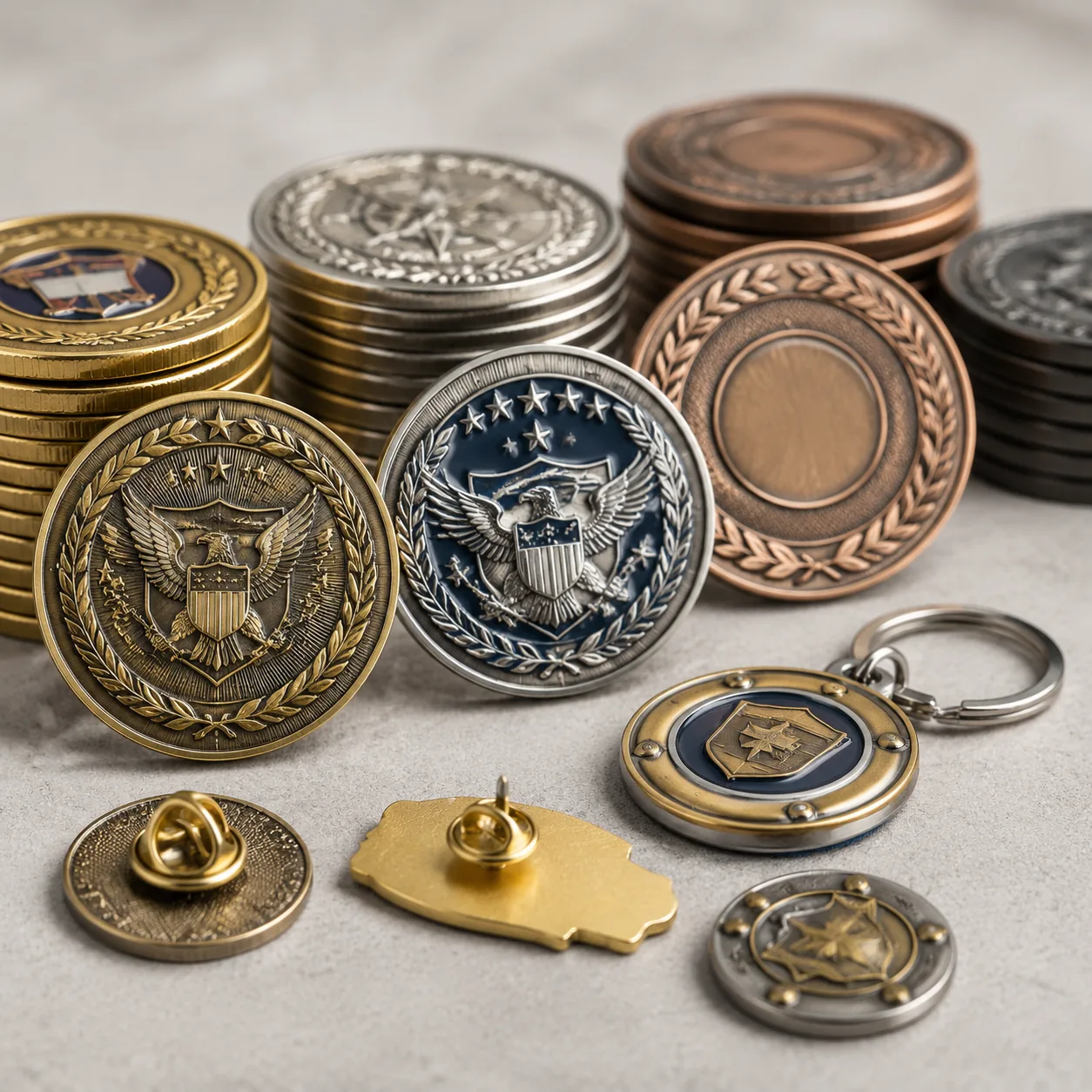
In 2026, promo sourcing is decided by calendar risk, spec complexity, and landed cost—not FOB alone
For repeat buyers of custom pins, keychains, challenge coins, patches, magnets, and lanyards, the 2026 decision is no longer a simple country-versus-country price check. Factory FOB still matters, but the commercial outcome is usually driven by four variables outside the unit quote: tariff and duty exposure, freight mode, customs and brokerage friction, and the cost of carrying buffer stock in case the first ETA slips. For event-driven orders, the real question is rarely "Who quoted lowest?" It is "Who can hit the in-hands date, stay inside the agreed defect limit, and avoid an emergency air shipment?"
That answer changes by exact build. A 35 mm die-struck iron soft-enamel pin at 1.5 mm thickness with four Pantone fills, bright nickel plating, one butterfly clutch, and individual polybag has a different sourcing profile from a 50 mm zinc-alloy spinner keychain with two platings, a 608-style micro bearing, epoxy dome, and printed backing card. A 900 x 20 mm polyester sublimation lanyard with swivel hook, breakaway, and buckle release behaves differently again: low tooling intensity, low unit value, and freight that can represent a large share of landed cost.
That is why broad claims such as "China is always cheaper" or "nearshore is always faster" are not decision-grade. Buyers need to compare identical specifications across the same commercial frame: MOQ per design, mold fee, sample cycle, production days from final approval, transit days to destination, AQL level, dimensional tolerance, plating thickness, packaging method, and quote basis such as FOB, EXW, or DDP. If any of those fields are missing, the quote is not ready for a sourcing decision.
Head-to-head by specification: 2026 ranges buyers should actually expect
| Factor | China factory cluster | Nearshore supplier cluster | What changes the result most |
|---|---|---|---|
| MOQ, custom metal pins | 100-300 pcs/design typical; 50 pcs possible with setup surcharge of USD 20-60 | 100-500 pcs/design typical; under 250 pcs often carries steep setup recovery | Per-design volume, number of colors, packaging labor |
| Tooling, 35 mm die-struck pin | USD 45-110 for standard 2D iron mold; USD 110-220 for openwork/deeper relief | USD 75-180 for standard mold; USD 140-260 for more complex cavities | 2D vs 3D, cutouts, relief depth, revision count |
| Unit price, 35 mm soft enamel pin, 300 pcs, FOB/EXW | USD 0.48-0.92 | USD 0.95-1.75 | Iron vs zinc alloy, 1.2 vs 1.5 mm thickness, carding |
| Unit price, 50 mm challenge coin, 500 pcs | USD 1.25-2.60 | USD 2.30-4.60 | Die-struck vs cast, edge text, capsule, epoxy |
| Unit price, 50 mm zinc alloy spinner keychain, 500 pcs | USD 1.95-3.80 | USD 3.40-6.40 | Bearing quality, dual plating, dome, assembly time |
| Unit price, 900 x 20 mm sublimation lanyard, 500 pcs | USD 0.40-0.82 | USD 0.58-1.08 | Hook style, breakaway, buckle, bagging |
| Pre-production sample lead time | 4-7 days for standard metal items; 2-4 days for simple lanyards | 4-9 days typical | Physical sample vs digital proof, queue load |
| Mass production after approval | 10-16 days standard; 18-26 days for cast, hinged, spinner, or multi-part builds | 7-16 days simple items; 12-22 days when capacity is tight | Seasonality, plating queue, hand assembly, packaging |
| Transit to US buyer | Express 2-4 days; air 3-7 days; ocean 18-35 days port to port, often 25-40 door to door | Truck or regional air 2-10 days | Destination, customs lane, consolidation model |
| Common inspection level | AQL 2.5 major / 4.0 minor standard; 1.5/2.5 available with tighter QC cost | Capable exporters can match 2.5/4.0, but discipline varies more by supplier | Written defect library, third-party inspection scope |
| Dimensional tolerance, common metal items | ±0.15 to ±0.25 mm on major dimensions; attachment placement typically ±0.50 mm | Often similar on simple builds; wider variation on mixed processes | Stamped vs cast, part size, moving parts |
| Decorative plating thickness | 0.03-0.10 micron typical; flash gold often 0.03-0.05 micron | Common bright/antique finishes available; specialty finish may be outsourced | Wear exposure, corrosion expectation, budget |
| Best fit in 2026 | Complex metalwork, multi-process builds, mixed-category programs, forecastable demand | Rush reorders, lower-complexity SKUs, shorter inbound calendar, emergency top-ups | Lateness cost, SKU complexity, forecast accuracy |
Where China still leads on economics—and where nearshore can win on total commercial cost
China still holds the structural advantage on metal-heavy promo categories because the supply base is dense and vertically linked. In a mature cluster, die-making, stamping, casting, polishing, plating, enamel filling, pad printing, offset print, epoxy, assembly, and final packing can often stay within one local network. That reduces handoffs, shortens internal transfer time, and limits markup stacking across subcontractors. On soft-enamel pins, hard-enamel styles, cast keychains, challenge coins, medals, bottle opener coins, and mixed-material gift sets, that concentration is still difficult for nearshore suppliers to match at scale.
On a like-for-like basis, the gap is still clear. A 35 mm iron soft-enamel pin at 1.5 mm thickness with four fills, bright nickel, one clutch, and polybag is commonly quoted around USD 0.48-0.92 at 300 pieces from China, versus roughly USD 0.95-1.75 nearshore. A 50 mm die-struck coin at 500 pieces with one-sided design, raised polished areas, recessed antique nickel background, and standard PVC sleeve may land around USD 1.25-2.00 from China versus USD 2.30-3.60 nearshore. Move the build to cast zinc alloy with cutouts narrower than 2.0 mm, dual plating, edge text, and clear capsule, and the spread usually widens because more manual finishing and process control are involved.
But a cheaper FOB does not always produce a cheaper order. On low-value or urgent programs, freight and handling can erase much of the factory advantage. A 500-piece lanyard order with FOB value under USD 450 can absorb USD 120-280 in air freight, brokerage, and final-mile delivery surprisingly fast. If a nearshore option prices 20-35 percent higher per unit but cuts 7-15 calendar days and avoids an air expedite, it may be the cheaper commercial choice after all charges are counted.
A workable rule is simple: the more the product depends on metal complexity, relief detail, plating variation, moving parts, or multi-process assembly, the more China tends to win on landed cost. The more the SKU behaves like a repeat textile or print item with low tooling intensity and volatile demand, the more nearshore becomes viable.
Lead-time math: inbound days and variance usually matter more than quoted production speed
Many teams overweight the factory promise and underweight the logistics calendar. In practice, total lead time has at least four clocks: artwork proofing, pre-production sample, mass production after final approval, and transit to final destination. A supplier that says only "2 weeks lead time" is not giving enough detail to compare options.
For standard metal goods from China, a realistic planning window is 1-3 days for artwork revision, 4-7 days for a physical pre-production sample, and 10-16 production days after sample approval. Cast, hinged, spinner, or multi-part builds often extend to 18-26 production days, especially if they include dual plating, epoxy domes, laser engraving, hand assembly, or individual retail carding. Nearshore may trim only a few production days on simple items, but the bigger advantage is usually transit: truck or regional air can deliver in 2-10 days instead of requiring export handling, international freight, customs clearance, and domestic handoff.
Variance matters as much as average days. Saving three production days is useful. Cutting ten inbound days and reducing ETA uncertainty is usually more valuable because it lowers the need for safety stock and gives marketing or sales teams more time to adjust quantities. For conference kits, distributor launches, or stadium-event merchandise, the cost of lateness often exceeds the duty differential.
China can still win on total calendar when one release includes multiple categories. If a program bundles pins, lanyards, magnets, backing cards, barcodes, and master-carton labels under one shipment, a coordinated supplier often beats several regional vendors because color matching, pack-out approval, and export paperwork stay inside one operating schedule. Buyers routinely lose 3-7 days in cross-supplier coordination even when each vendor is individually competent.
Quality, tolerances, and DFM: simple SKUs narrow the gap; fine detail and moving parts widen it
On straightforward products, a disciplined nearshore supplier can match a disciplined China factory if the specification is complete. A 35 mm stamped iron pin at 1.2-1.5 mm thickness, up to four soft-enamel fills, one butterfly clutch, and polybag is within the capability of many exporters. The same is true for standard polyester sublimation lanyards and basic embroidered patches. On these items, the performance gap is usually driven less by geography than by the quality of the RFQ: minimum line width, Pantone references, edge finish, hardware code, attachment placement, and written defect criteria.
The gap widens when the build becomes less forgiving. Openwork bridges below 0.8-1.0 mm, recessed text below 0.20-0.25 mm line thickness, spinner assemblies, hinged parts, transparent or glow enamel, offset print on metal, epoxy domes, and dual plating all raise reject risk. Experienced factories add value before tooling by flagging weak bridge sections, enamel cells too narrow to fill cleanly, cavities that may trap plating, spinner imbalance, or print areas that need a flatter substrate.
The numbers should be stated explicitly. For common promo metal parts, buyers can generally expect ±0.15 to ±0.25 mm on major dimensions for stamped items and ±0.20 to ±0.30 mm for many cast features, depending on size and geometry. Pin post or attachment placement tolerance is often ±0.50 mm. For lanyards, finished width is commonly held within about ±1.0 mm, and sewn attachment placement may vary by 3-5 mm depending on hardware and sewing method. Decorative plating on promo goods is usually 0.03-0.10 micron; flash gold often sits around 0.03-0.05 micron. That is a cosmetic finish, not a heavy-wear finish. If the item will be handled frequently or sold as premium merchandise, specify a protective topcoat or a heavier finish where available.
Inspection needs the same precision. AQL 2.5 major / 4.0 minor is common for promotional products. Premium programs may justify AQL 1.5 major / 2.5 minor, but only if the supplier and inspector are working from the same defect library. Terms such as "good plating" or "acceptable print" are too vague to enforce. A usable QC sheet should define limits for burr height, pits, scratches, enamel underfill, color shift, epoxy bubbles, print registration, loose findings, and sharp edges. For example, many buyers reject exposed burrs detectable by finger swipe on exterior edges, visible scratches from 30 cm on front-facing areas, or epoxy bubbles larger than 0.5 mm on a logo zone.
Best category fit in 2026: what still favors China, what travels well nearshore, and where hybrid sourcing works
Metal-heavy categories still favor China because process density supports both cost and repeatability. That includes soft- and hard-enamel pins, die-struck and cast keychains, challenge coins, medals, bottle opener coins, metal-front magnets, and combo sets that require plating, enamel, print, epoxy, and assembly in one pack. When the product requires multiple finishing steps and visual consistency across them, keeping the order inside one mature cluster usually lowers defect risk and schedule slip.
Textile-led and print-led SKUs are more portable. Standard polyester sublimation lanyards, low-complexity woven patches, basic embroidered badges, and simple printed accessories can be competitive nearshore, especially when order values are modest and the cost of missing the date is high. A 20 mm lanyard with one swivel hook, one breakaway, and bulk packing does not need the same metalworking ecosystem as a 3D cast coin with edge text and antique finish.
- Usually strongest in China: die-struck pins, cloisonne or hard-enamel styles, cast keychains, 3D coins, antique platings, spinner or hinged products, and programs requiring one supplier across categories
- Often viable nearshore: plain sublimation lanyards, standard woven or embroidered patches, repeat simple badges, heat-transfer textile accessories, and short-run emergency replenishment
- Good hybrid candidate: launch in China for tooling economy and process range, then qualify nearshore replenishment for top-selling simple SKUs with stable specs and repeat demand
- Avoid split sourcing when Pantone consistency must hold across metal, textile, print, and packaging, or when final kitting must look uniform across the campaign
- If multiple factories are involved, issue one golden sample set, one approved artwork file package, and one written defect library; without them, visual drift is common even when drawings match
The real risk question is usually stockout cost versus duty and expedite cost
In 2026, many teams react first to tariff headlines. That is understandable, but often incomplete. On low-unit-value promo products, the duty percentage can look severe while the absolute dollars remain smaller than the cost of a missed event, a delayed channel rollout, or a forced air shipment. For event-tied campaigns, the dominant commercial risk is often lateness, not duty.
Nearshore lowers some risks: shorter transit, fewer customs touchpoints, easier communication in similar time zones, and faster emergency replenishment. China lowers different risks: stronger DFM on difficult builds, broader process choice, better tooling economics, and easier category bundling. Neither model is inherently safer. They fail in different ways, so buyers should map likely failure modes to the program rather than to a country label.
A practical decision rule works well. If lateness cost is high and spec complexity is low, nearshore often wins despite a higher unit price. If spec complexity is high and the program can tolerate a 3-5 week total calendar after approval, China usually remains the better fit. If both lateness cost and complexity are high, the answer is often dual-track planning: keep primary tooling and production in China, but hold regional safety stock or a qualified backup source for one or two proven SKUs.
RFQ checklist: standardize the specification before comparing quotes
Most quote tables are misleading because suppliers are not pricing the same product. One quotes 1.5 mm iron, another quotes 1.8 mm zinc alloy, and a third silently includes backing cards, barcode labels, and individual polybags. That is not real price competition; it is specification mismatch. In a tariff-sensitive year, those mistakes get expensive because teams spend time modeling duties while missing basic manufacturing detail.
The fix is a single RFQ template with identical technical and commercial fields for every supplier. For metal items, define finished size in mm, thickness, base material, process, plating finish, number of enamel colors, attachment type, packaging, sample requirement, QC level, quote basis, carton details, and country of final delivery. For lanyards and patches, define fabric type, width, print or weave method, hardware code, edge finish, color reference, packing method, and artwork orientation. If a field is blank, treat the quote as provisional.
- Request price breaks at 100, 300, 500, 1000, and 3000 pcs per design to see where tooling amortization changes the curve
- Separate mold fee, sample fee, unit price, packaging adders, and mold-revision charges; bundled pricing hides repeat-order economics
- State the exact metal spec, for example: 35 mm W x 35 mm H, iron, 1.5 mm thick, soft enamel, bright nickel, one butterfly clutch, individual polybag
- For plating, name the finish precisely: bright gold, imitation gold, black nickel, antique copper, antique brass, matte silver, or dual plating; these are not interchangeable
- Set QC in writing, such as AQL 2.5 major / 4.0 minor, and attach photos showing unacceptable burrs, scratches, underfill, color deviation, and print shift
- Ask when lead time starts: artwork approval, sample approval, or deposit receipt each produces a different promise
- Request master-carton dimensions, gross weight, net weight, and units per carton so freight can be estimated before PO placement
- For lanyards, specify the full build, for example: 900 x 20 mm, polyester sublimation, both-side print, swivel hook, breakaway, buckle release, 10 pcs/polybag
What buyers should do next: choose by program type, then validate with one controlled order
If you buy complex custom metal products, mixed-category promo sets, or campaign-specific designs with frequent detail changes, start with a full-spec RFQ to a capable China factory and compare landed cost rather than FOB. In many cases, that route still offers the strongest combination of process range, tooling economy, and repeatability, provided your calendar allows for proofing, sample approval, production, and transit.
If you buy simple, repeatable SKUs with uncertain demand and expensive deadline failure, run a controlled nearshore trial on one reorder. Measure more than price. Compare quote clarity, sample accuracy, on-time shipment rate, defect handling, dimensional consistency, and whether the supplier can hold a stable spec file without drift from one PO to the next. Fast email response is not the same as operational performance.
For many B2B buyers, the best 2026 model is hybrid rather than ideological. Keep complex launches and mixed-material sets with the supplier best equipped to engineer them, often in China. Then test regional replenishment only on simple, fast-moving SKUs where logistics speed clearly outweighs process advantage. The cleanest comparison is still the simplest one: send the identical spec sheet to both source options, score landed cost, total calendar days, AQL commitment, DFM quality, and change-control discipline, and let the program type rather than a country slogan choose the sourcing model.
Have a project? Send your artwork and target quantity and we’ll reply with a detailed quotation within 12 working hours.
Ready to get this made?
Send your sketch, target quantity and ship-date. Detailed quotation in 12 hours.



