Challenge Coin vs Enamel Pin: Which Spec Wins in Promo Sets?
The buying problem: one brief, two different products
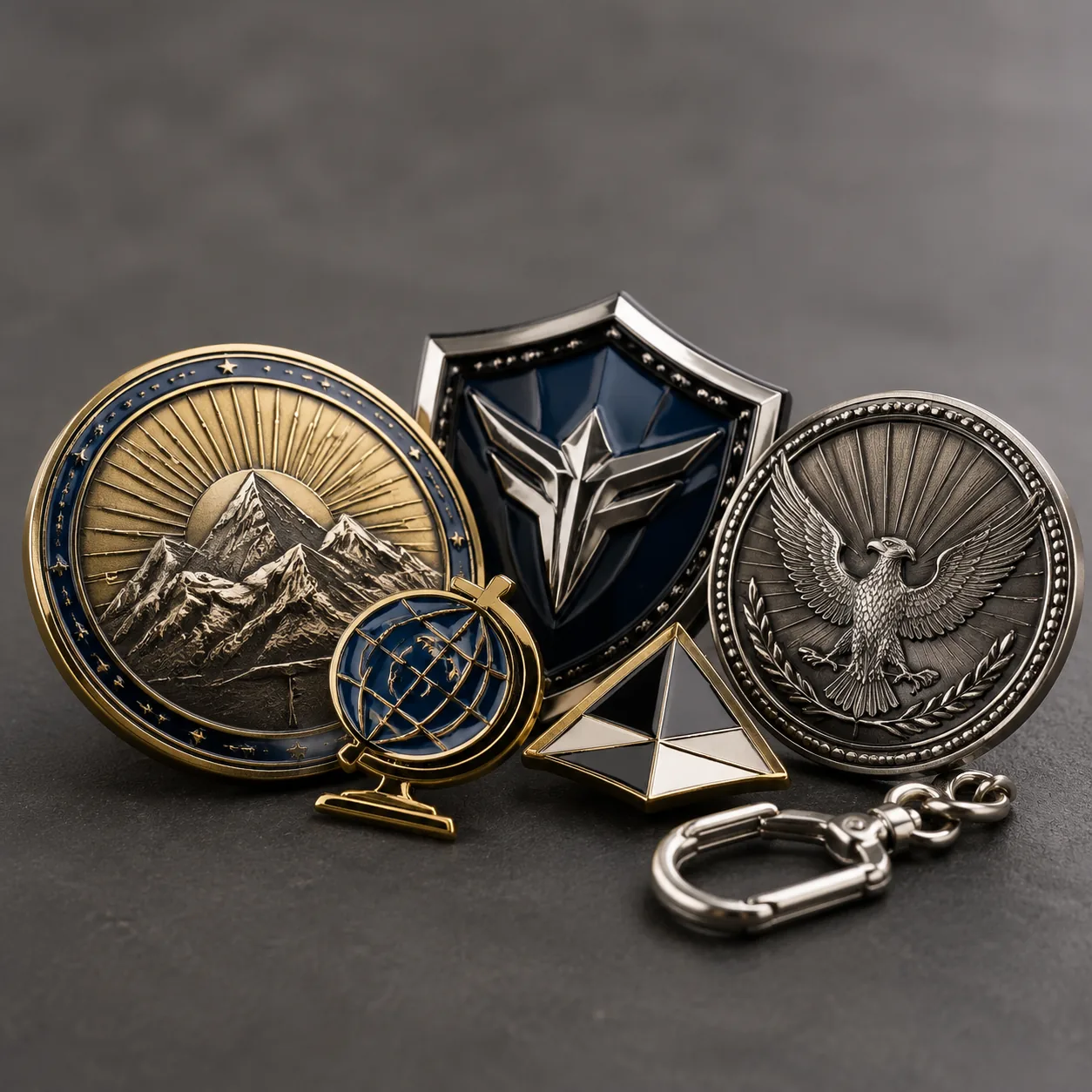
Challenge coins and enamel pins sit on the same buying shortlist because both are compact metal promos, both can carry brand artwork, and both can be produced in repeatable factory runs. That is where the similarity ends. A pin is engineered to be worn; a coin is engineered to be held, displayed, and kept. If you pick by render alone, you can easily end up with a piece that looks strong on screen but fails in use.
The right decision comes down to function: do you need daily visibility on clothing or a bag, or a heavier keepsake that signals recognition and value? A 25 mm pin and a 45 mm coin can both carry a logo, but they behave differently in artwork density, edge treatment, plating, packaging, freight, and reorder economics. This comparison focuses on the specs that matter at production stage, before tooling and samples lock in your cost.
Quick spec comparison
| Spec | Enamel pin | Challenge coin |
|---|---|---|
| Typical size | 20–35 mm common; 40 mm for statement pieces | 38–45 mm common; 50–57 mm for premium awards |
| Typical thickness | 1.2–1.8 mm soft enamel; 1.5–2.0 mm hard enamel | 2.0–3.5 mm typical; 4.0 mm+ for heavy presentation pieces |
| Minimum readable detail | 0.25 mm line width; text under about 4 pt equivalent becomes risky | 0.30–0.40 mm line width; edge text needs more breathing room |
| Plating target | Decorative plating often specified at 0.1–0.3 microns for appearance | Decorative plating often specified at 0.1–0.3 microns; antique finishes hide handling better |
| Common decoration | Soft enamel, hard enamel, printed detail, cutouts, glow, epoxy dome | 2D relief, 3D relief, soft enamel fill, printing, edge text, serial numbers |
| Attachment / handling | Butterfly clutch, rubber clutch, safety pin, magnet back | No wearable back; usually smooth edge, reeded edge, or presentation stand |
| Typical MOQ | 100–300 pcs standard; 50–100 pcs possible at higher unit cost | 100–200 pcs standard; 300 pcs+ usually improves pricing stability |
| Typical lead time after sample approval | 10–18 days | 12–20 days |
| FOB price range | USD 0.35–1.80 per pc | USD 0.80–4.50 per pc |
The table shows the core distinction: pins prioritize wearability, outline clarity, and low freight weight. Coins prioritize mass, tactile value, and face detail. If the item must live on a garment, the pin usually wins. If it must feel ceremonial in the hand, the coin usually wins.
When an enamel pin is the better spec
Choose an enamel pin when the item needs to be worn on a lapel, jacket, cap, backpack, or event lanyard and still read clearly from arm’s length. Pins are strongest when the artwork has a clean silhouette, limited depth, and distinct color blocks. A 25 mm soft enamel pin can usually handle a compact logo plus two to four Pantone-matched colors without crowding. A 35 mm pin gives enough room for a secondary mark, date, or short slogan without looking oversized.
Soft enamel is the default for promotional programs because it is efficient and forgiving. The recessed color areas make small runs economical, and the raised metal borders keep shapes legible. Hard enamel has a flatter, retail-grade face, but it is less tolerant of tiny islands, sharp internal corners, and narrow gaps because polishing can soften the relief. As a practical rule, if your stroke width drops below 0.25 mm or your text is smaller than about 4 pt at final size, enlarge the pin or simplify the artwork.
Pins also win when the campaign needs volume or frequent reorders. The tooling is simpler than a deep-relief coin, the part is lighter, and freight is lower. In a 500-piece shipment, a 25 mm pin run can weigh dramatically less than an equivalent coin run, which matters for air freight and fulfillment. For marketing teams that mail kits individually, that weight difference can move the landed cost more than the unit price does.
- Use for wearable branding and staff identifiers
- Use for compact logo artwork with clear color separation
- Use when shipping weight and carton volume matter
- Use when backing cards or retail hang tags are part of the presentation
- Avoid when the goal is a heavy, award-like keepsake
When a challenge coin is the better spec
Choose a challenge coin when the recipient should feel substance rather than wear the item. Coins fit awards, anniversaries, leadership recognition, milestone gifts, onboarding kits, and collector-style promotions. The larger face area supports multi-ring layouts, seal-style graphics, dates, serial numbers, and reverse-side messages that would feel cramped on a pin. A 45 mm coin with antique brass plating and raised relief reads as premium immediately, even before packaging enters the picture.
Coins also handle layered storytelling better than pins. You can put a corporate seal in the center, a border legend around the outer ring, and a short message or event date on the reverse without forcing everything into a tiny footprint. That said, coins are less forgiving on microtype. If the design depends on very fine text, thin negative spaces, or narrow border accents below roughly 0.30 mm, it is safer to enlarge the coin or simplify the copy before die cutting and polishing begin.
The biggest coin advantage is perceived value. A 2.5 mm to 3.0 mm thick coin with deep relief and an antique finish usually feels more substantial than its FOB price suggests. That is useful when the promo set is meant to convey recognition rather than visibility. The tradeoff is tighter finishing control: the die must balance relief, the rim must be clean, and the edge treatment must stay consistent across the lot.
Decoration and finish: what each format can actually carry
The finish stack matters more than many buyers expect. On pins, the usual choices are soft enamel, hard enamel, printed detail, or a hybrid approach, with plating used for contrast. On coins, the decision is typically between flat 2D faces, sculpted 3D relief, antique brushing, spot color fill, and edge treatment. Both product families can use gold, silver, nickel, black nickel, copper, and antique brass, but the same finish looks different because the geometry is different.
For decorative plating, the appearance matters more than the nominal micron figure alone, but buyers should still ask for the factory’s plating target and inspection basis. A common decorative range for promotional metal goods is 0.1–0.3 microns. If the item will be handled often, ask how the factory checks wear, not just what the plating is called. A good purchasing spec should include the visual standard, the test method, and the lighting condition for inspection, such as daylight or D65.
Hard enamel pins need flatter fills and controlled cure cycles to avoid sink marks or over-polish. Coins with antique finishes often hide small handling marks better than bright polished coins, which is why antique silver and antique brass are common in recognition programs. If your set includes both a coin and a pin, matching the plating family helps the kit feel intentional, but the surface texture should still be chosen independently for each part.
Production tolerances and quality risks
Pins and coins fail in different ways, so the acceptance criteria should differ too. Pins are more likely to show clutch fit problems, bent posts, enamel bleed, or lines that disappear in fill and polishing. Coins are more likely to show soft edge definition, uneven relief depth, over-polishing, or mismatched symmetry between front and back. In both cases, the dimensional tolerance should be written into the order before the first sample is approved.
A practical target for this category is usually ±0.2 mm on outer dimensions for smaller pins and ±0.3 mm for coins, with all cut edges deburred and free of flash. For pins, post position and clutch alignment matter because a crooked post makes the wearable sit off-center. For coins, rim width, border spacing, and relief transitions matter more because the product is judged in the hand and under close inspection. Always request a golden sample and tie it to the production spec.
For higher-value programs, a workable acceptance framework is: outer dimension within ±0.2 mm for pins up to 35 mm, ±0.3 mm for coins, visible front-face cosmetic defects no worse than AQL 2.5 for critical points, and no burrs or sharp edges. If the design includes cutouts, specify minimum bridge width and reject sections that deform during plating or polishing. That is far more useful than writing “good quality” on a purchase order.
Cost, MOQ, and lead time side by side
Unit price is not just a function of size. It changes with mold complexity, number of colors, plating family, packaging, and whether the part needs cutouts or 3D relief. Simple enamel pins are often more cost-efficient at low quantities because the part is small and the metal mass is light. Challenge coins have a higher base cost because the blank is heavier and the die work is more involved, especially with deep relief or detailed edges.
A realistic sourcing range for standard promotional orders is this: a 25 mm soft enamel pin at 300 pieces may land around USD 0.55–0.95 FOB per piece, while a 45 mm antique brass coin at 300 pieces may land around USD 1.40–2.80 FOB per piece depending on relief and packaging. If you add backing cards, custom polybags, velvet pouches, or numbered sleeves, the unit cost rises quickly. Tooling is usually separate from piece price, so confirm whether the die fee is one-time or reusable on reorders.
Lead time is usually similar once the sample is approved, but pins can move a little faster if the artwork is simple and the attachment is standard. A common workflow is 3–5 days for artwork confirmation, 5–8 days for a sample or pre-production proof, and 10–20 days for bulk production depending on factory load. If the order is urgent, confirm whether rush service shortens only production or also the sample stage. In many cases, sample approval is the real bottleneck.
- Ask for FOB pricing on the same basis: same size, same plating, same packaging
- Separate tooling from piece price so reorders stay comparable
- Confirm whether MOQ changes with soft enamel, hard enamel, or 3D relief
- Ask whether rush service affects production only or also sampling
- Check carton weight early to avoid freight surprises
How to choose the right format for your campaign
If the item must be worn on clothing, bags, or event lanyards, choose the pin. If it must function as a collectible or award, choose the coin. If the artwork is logo-led and compact, the pin usually gives better economy. If the artwork includes seals, dates, border copy, or ceremonial symbols, the coin usually gives better presentation value.
There is also a strong middle case: internal recognition kits and premium promo sets. In those programs, some buyers use a coin as the hero piece and a smaller pin as the wearable extension of the same visual system. That works when the coin carries the story and the pin carries the logo. The risk is overcomplicating the set and spending too much budget on packaging instead of the core item, so keep the spec language aligned across both pieces.
Example: a 45 mm antique silver coin can carry a company anniversary seal, a serial number, and a short mission statement, while a 22 mm hard enamel pin carries the logo for day-to-day wear. That pairing works well for executive onboarding, sales incentives, or VIP event kits. By contrast, if the campaign is a conference giveaway meant to spread brand visibility across attendee clothing, the pin should be the primary item and the coin should be used only if it has a clear recognition purpose.
What to do next
Start by reducing the brief to three decisions: wearable or hand-held, fine-line logo or relief artwork, and volume-first or value-first. Then request quotes on one pin spec and one coin spec using the same artwork so the comparison is real, not theoretical. Keep size, plating, attachment or edge style, and packaging fixed before sample approval so the factory can quote the true finished cost instead of a loose estimate.
If you are still undecided, ask for one pre-production sample in the target finish and one in the alternate format. Side-by-side samples usually settle the choice faster than another round of renderings. The best spec is the one your recipient will actually wear, keep, or display without confusion.
Have a project? Send your artwork and target quantity and we’ll reply with a detailed quotation within 12 working hours.
Ready to get this made?
Send your sketch, target quantity and ship-date. Detailed quotation in 12 hours.



