Challenge Coin Edge Styles Compared for Bulk Orders
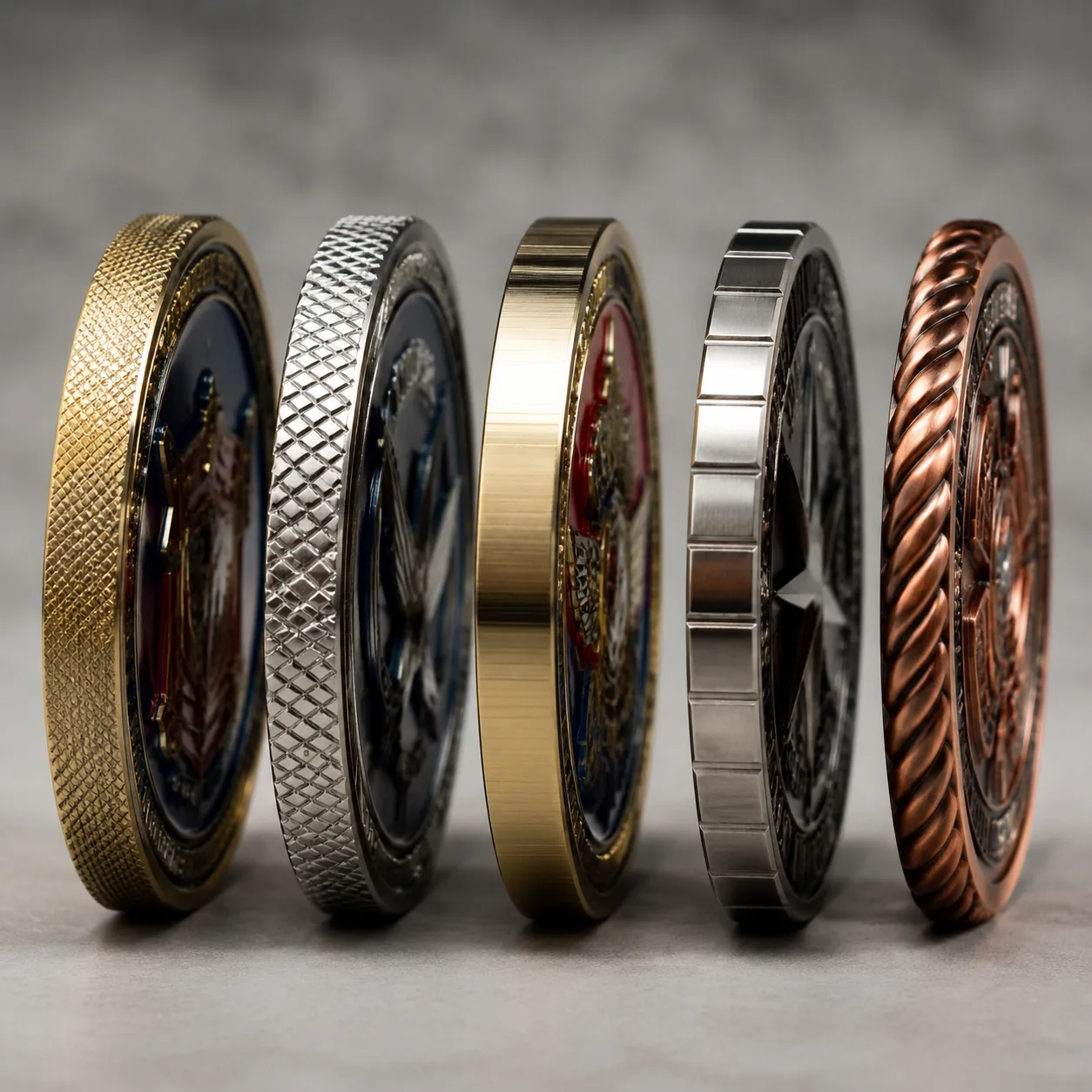
Why Edge Style Affects Cost, Weight and Rework
Challenge coin buyers usually approve the front and back artwork first, then treat the edge as a small decorative choice. In production, the edge can change the mold, side tooling, polishing route, plating coverage, packing weight and inspection standard. A 45 mm coin at 3.0 mm thickness with a plain edge is not the same manufacturing job as the same coin with a 0.6 mm rope relief or a diamond-cut side wall.
For bulk orders from 300 to 10,000 pcs, lock the edge style before mold quotation. Changing from plain to reeded after sampling may require a new side tool or a secondary CNC side-cutting operation. In China production, that usually adds 3 to 7 calendar days and USD 40 to 180 in revised tooling, depending on diameter, metal hardness and cut depth. A late change to diamond-cut can also delay plating approval because sharp facets reveal polishing marks and thin coverage faster than flat side walls.
At ZheCraft, we confirm edge style, coin thickness, plating finish and target weight together because these four specifications interact. A deep rope edge needs enough side-wall height. A bright diamond edge needs controlled polishing pressure. A thin iron coin with aggressive reeding may save unit cost but create burr and rust risks inside grooves. The following comparison covers plain, reeded, rope and diamond-cut edges for zinc alloy, brass and iron challenge coins.
Bulk RFQ Spec Table by Edge Type
Use this table as an RFQ baseline, not a decorative catalog. The ranges assume custom coins from 38 to 60 mm diameter, 2.5 to 4.0 mm thickness, antique or bright plating, enamel on one or both faces, and bulk packing or individual PVC pouch packing. Coins below 35 mm or above 70 mm need separate review because groove pitch, facet width and polishing access do not scale linearly.
| Edge style | Best use | Recommended size | Typical edge spec | MOQ fit | FOB unit impact | Lead-time impact | Main QC risk |
|---|---|---|---|---|---|---|---|
| Plain edge | Corporate awards, event coins, budget reorders, clean modern designs | 38 to 70 mm diameter; 2.0 to 5.0 mm thick | No decorative cut; 0.2 to 0.5 mm radius after polishing | 100 pcs and up | Base price; common 45 mm zinc alloy coin at 500 pcs is USD 1.35 to 2.70 FOB | 12 to 18 days after artwork and sample approval for 300 to 1,000 pcs | Looks unfinished if face relief is shallow or plating is too flat |
| Reeded edge | Military-style coins, service awards, traditional commemoratives | 40 to 60 mm diameter; 3.0 to 5.0 mm thick | Groove pitch 0.6 to 1.2 mm; groove depth 0.15 to 0.35 mm | 300 pcs and up | Adds about USD 0.05 to 0.18 per coin at 500 pcs | Adds 1 to 3 days if side cutting is separate | Uneven groove depth after heavy polishing |
| Rope edge | Ceremonial coins, club coins, maritime, heritage or lodge designs | 45 to 70 mm diameter; 3.5 to 5.0 mm thick | Twist width 1.2 to 2.5 mm; relief depth 0.3 to 0.8 mm | 300 pcs and up | Adds about USD 0.12 to 0.35 per coin at 500 pcs | Adds 2 to 5 days for tooling, polishing and plating checks | Plating shadow, black residue or soft detail in valleys |
| Diamond-cut edge | Executive gifts, donor recognition, retail-style collectibles | 45 to 60 mm diameter; 3.0 to 4.5 mm thick | Facet width 1.0 to 2.0 mm; cut depth 0.2 to 0.6 mm | 500 pcs and up | Adds about USD 0.20 to 0.60 per coin at 500 pcs | Adds 3 to 7 days for cutting, polishing and extra QC | Facet waviness, visible tool marks or exposed high points |
Standard tooling is normally quoted separately from unit price. For common stamped or cast coins, expect USD 50 to 180 for face tooling. Complex side detail may add USD 30 to 120, especially when the edge is not formed cleanly in the main mold. If a supplier quotes plain, reeded, rope and diamond-cut edges at the same unit price, ask whether the edge is molded, machined, hand-finished or only shown in the rendering.
Plain vs Reeded: Clean Side Wall or Coin Grip
Plain edge is the lowest-risk option when the face artwork carries the design value. It suits 2.5 to 3.5 mm coins with antique gold, antique silver, satin nickel, black nickel or dual plating. A practical dimensional target for standard zinc alloy coins is diameter ±0.15 mm, thickness ±0.20 mm and weight ±5 percent unless the coin must fit a capsule, tray or velvet insert.
A good plain edge should not mean a raw edge. Specify a light radius of 0.2 to 0.5 mm to remove burrs and improve hand feel. For safety inspection, the side wall should not snag cotton fabric and should have no burr visible at 30 cm under 500 to 800 lux light. For bright plating, require a continuous side-wall color with no exposed gray zinc, yellow brass or dark iron at high points.
Reeded edge adds grip and a more official coin-like feel. It needs enough side-wall height to stay consistent after polishing. On a 2.5 mm coin, grooves often look shallow or uneven; on a 3.5 to 4.0 mm coin, the factory can hold a cleaner pitch. For a 45 mm coin, specify 0.8 to 1.0 mm groove pitch and 0.20 to 0.30 mm groove depth. Deeper grooves may look stronger in a rendering but can trap polishing compound and antique wash.
Choose plain edge for tight budgets, low-MOQ orders under 300 pcs, card-mounted coins or designs with strong face relief. Choose reeded edge when the coin will be handled often and the side should feel intentional without premium finishing cost. Avoid fine reeding with mirror black nickel if close inspection is expected; fingerprints, polishing residue and shade variation show more clearly inside narrow grooves.
Rope vs Diamond-Cut: Raised Relief or Bright Facets
Rope edge is usually formed as a raised twisted rim around the side of the coin. It works well with antique finishes because dark wash settles in the low areas and the raised twist catches light. For a 50 mm coin, a durable rope edge normally needs at least 3.5 mm coin thickness, 1.5 to 2.0 mm twist width and 0.4 to 0.6 mm relief depth. Below those dimensions, the rope can look like a blurred line after polishing and plating.
Rope is a strong choice for ceremonial coins, unit coins, club coins and maritime themes. It creates perceived value without the sharper machining risk of diamond-cut. The main control point is plating coverage in the valleys. Antique residue is acceptable if it is stable, but loose black powder is not. A simple factory check is a dry white cloth rub for 10 back-and-forth cycles; visible loose residue should be treated as a major defect, not a normal antique effect.
Diamond-cut edge creates brightness through angled facets around the coin side. It is often used for executive gifts, donor recognition coins and premium retail packaging. The effect depends on consistent facet angle, cutting depth, polishing pressure and plating adhesion. A practical specification is 1.0 to 2.0 mm facet width with 0.2 to 0.6 mm cut depth. On small 38 mm coins, wide facets can overpower the design; on heavy 60 mm coins, very narrow facets may look busy rather than premium.
Decorative plating on promotional challenge coins is thin. A normal top layer for gold, silver, nickel or black nickel finish is often around 0.03 to 0.08 microns over copper and nickel underlayers, depending on finish and corrosion expectation. Heavy plating can soften facet definition, while insufficient coverage can expose base metal on sharp high points after handling. If the coin needs better wear resistance, specify a rub test or salt-spray requirement and expect cost to increase beyond the edge surcharge.
Material, Thickness and Edge Compatibility
Zinc alloy is the most common material for complex 2D and 3D challenge coins because it casts detailed relief at a controlled cost. It is suitable for rope and diamond-cut edges on 45 to 70 mm coins, especially at 3.0 to 4.0 mm thickness. The trade-off is softness. Sharp high points can dent more easily than brass, so diamond facets should not be overly aggressive if the coins will be carried loose in pockets or shipped in bulk bags.
Brass gives a denser hand feel and cleaner stamped detail. It is a strong fit for 40 to 55 mm coins where perceived value matters. A 45 mm brass coin at 3.0 mm thickness can feel materially heavier than a zinc alloy coin of the same size, and unit price may rise by about USD 0.30 to 0.90 depending on relief depth, plating and enamel coverage. Brass also resists small edge dents better, but deep rope and diamond cuts increase tooling wear and machining time.
Iron is economical for simple coins, especially plain or light reeded edges, but it is not ideal for deep decorative side detail. It can rust if plating coverage is thin inside grooves, and magnetic behavior may be undesirable for presentation sets, retail packaging or coins placed near magnetic closures. If the coin uses reeded or rope edge and may be stored in humid conditions, zinc alloy or brass is usually safer than iron.
Thickness should be chosen before edge detail. A 2.0 to 2.5 mm coin can use a plain edge or very light reeding. A 3.0 to 3.5 mm coin can support standard reeding and modest diamond-cut facets. A 3.5 to 5.0 mm coin gives the factory enough side wall for rope relief, stronger reeding and cleaner premium edges. Increasing thickness also increases carton weight, so confirm export carton limits before approving heavy brass designs.
Plating, Polishing and Edge Defect Limits
Edges reveal finishing problems faster than coin faces. A small enamel issue may appear in one area; an edge defect repeats around the entire circumference. For antique plating, specify whether dark wash is expected inside rope valleys or reeded grooves. Stable darkening is normal; loose residue, flaking, exposed base metal or rough burrs should not pass bulk inspection.
For bright plating, the main edge risks are cloudy side walls, pinholes, over-polished high points, tool chatter and exposed base metal on facets. A robust finishing stack may include a copper underlayer where needed, nickel barrier layer, then decorative top finish such as gold, silver, antique bronze, black nickel or rose gold. For promotional coins, the QC standard should focus on consistent appearance, plating adhesion and practical corrosion exposure rather than jewelry-grade plating thickness.
A workable inspection condition is 500 to 800 lux light at about 30 cm viewing distance, with the coin rotated once to inspect the full side wall. Dimensional checks should use calipers for diameter and thickness, and a scale for weight. For standard bulk orders, AQL 2.5 for major defects and AQL 4.0 for minor defects is common. Major edge defects include unsafe sharpness, burrs that catch fabric, exposed base metal, loose plating, severe groove irregularity and visible tool marks on premium diamond-cut coins.
Minor variation should be defined clearly. Slight antique shade variation in recessed edge areas can be acceptable if the approved sample has the same character. Small polishing direction marks on plain edges may be acceptable for bulk promotional coins, but not for retail-sold collectibles. Diamond-cut coins need tighter visual control because the buyer is paying for a reflective edge; uneven facets should be judged more strictly than on a standard plain edge.
Cost, MOQ and Lead-Time Planning
The edge is rarely the largest cost item, but it can create hidden cost through tooling, polishing time, plating yield and rejection rate. A 45 mm zinc alloy coin with soft enamel and antique plating may quote around USD 1.35 to 2.70 FOB at 500 pcs, excluding mold and premium packaging. The same design with rope edge may move to USD 1.50 to 3.05. Diamond-cut may reach USD 1.70 to 3.40 if extra cutting, polishing and inspection are required.
Volume changes the surcharge. At 300 pcs, a rope edge may add USD 0.20 to 0.40 per coin because setup time is spread across fewer units. At 1,000 pcs, the same edge may add USD 0.10 to 0.25. Diamond-cut is usually better from 500 pcs because the cutting setup and reject control are difficult to absorb in a 100 or 200 pc order. For 5,000 pcs and above, unit surcharges improve, but the factory may need staged production and in-line inspection to keep facets or grooves consistent.
A normal China production schedule is 2 to 4 days for artwork proof, 5 to 7 days for mold and pre-production sample, and 10 to 15 days for mass production after sample approval. Plain and simple reeded coins often fit within 12 to 18 days after sample approval for 300 to 1,000 pcs. Rope edge usually adds 2 to 5 days. Diamond-cut can add 3 to 7 days because side machining, polishing and plating checks are slower.
Freight and packing also matter. A 45 mm coin commonly weighs about 30 to 45 g in zinc alloy and can be higher in brass depending on thickness. Export cartons should usually stay under 15 kg gross weight for safe handling. If each coin is packed in an acrylic capsule, velvet box or PVC pouch, confirm carton quantity and carton dimensions before comparing freight quotes.
Approval Checklist Before Bulk Release
Approve the edge on a physical sample whenever possible. Renderings make rope twists and diamond facets look cleaner than plated metal can deliver at scale. If timing does not allow a full pre-production sample, ask for a previous factory sample with the same edge style, diameter, thickness, metal and plating family. A side-view photo is useful, but it cannot confirm hand feel, burr risk or actual edge brightness.
- Confirm diameter, thickness, base metal and target weight range before edge tooling starts.
- Specify measurable edge details: groove pitch, groove depth, rope width, relief depth, facet width or plain radius.
- State plating finish, underlayer expectation and whether antique darkening inside edge recesses is acceptable.
- Set safety limits: no burrs, no cutting sharpness, no loose plating flakes and no snagging on fabric.
- Approve one golden sample and require bulk production to match side-wall color, edge definition and hand feel.
- Use AQL 2.5 for major defects and AQL 4.0 for minor visual defects unless the coins are retail-sold.
- Confirm packing method, carton gross weight limit and whether capsules or trays require tighter diameter tolerance.
For general challenge coins, a buyer tolerance of ±0.15 mm on diameter, ±0.20 mm on thickness and ±5 percent on weight is practical. If the coin must fit a capsule, velvet insert or acrylic display, tighten the diameter tolerance only after confirming the factory’s process capability. Over-tight tolerances on cast zinc alloy coins can raise cost and rejection rate without improving the user experience.
Choose the Edge by Use Case
For a budget handout, reorder item or event giveaway, choose plain edge or light reeding and spend the saved budget on clearer face relief, cleaner enamel fill or individual pouch packing. For a ceremonial presentation coin, rope edge gives strong perceived value and works especially well with antique gold, antique silver and antique bronze. For an executive gift, donor coin or retail collectible, diamond-cut can justify the surcharge, but only with a physical sample and clear QC limits for facet consistency.
Before sending an RFQ, prepare five fixed details: diameter, thickness, base metal, plating finish and preferred edge style. Add quantity tiers such as 300, 500, 1,000 and 5,000 pcs because edge surcharges change with volume. Also state your required delivery date and packing method. A complete RFQ lets the factory quote the real process instead of guessing from a front-view image.
For buyers sourcing from Yiwu or other China production hubs, ask for side-view sample photos and a short video rotating the coin under normal light. At ZheCraft, we can quote multiple edge options against the same artwork, then recommend the version that fits the MOQ, handling feel, delivery date and inspection standard. The best edge is not the most decorative one; it is the edge that supports the design, survives production and passes QC without avoidable rework.
Have a project? Send your artwork and target quantity and we’ll reply with a detailed quotation within 12 working hours.
Ready to get this made?
Send your sketch, target quantity and ship-date. Detailed quotation in 12 hours.



