Challenge Coin Edge Options: A Buyer Decision Framework
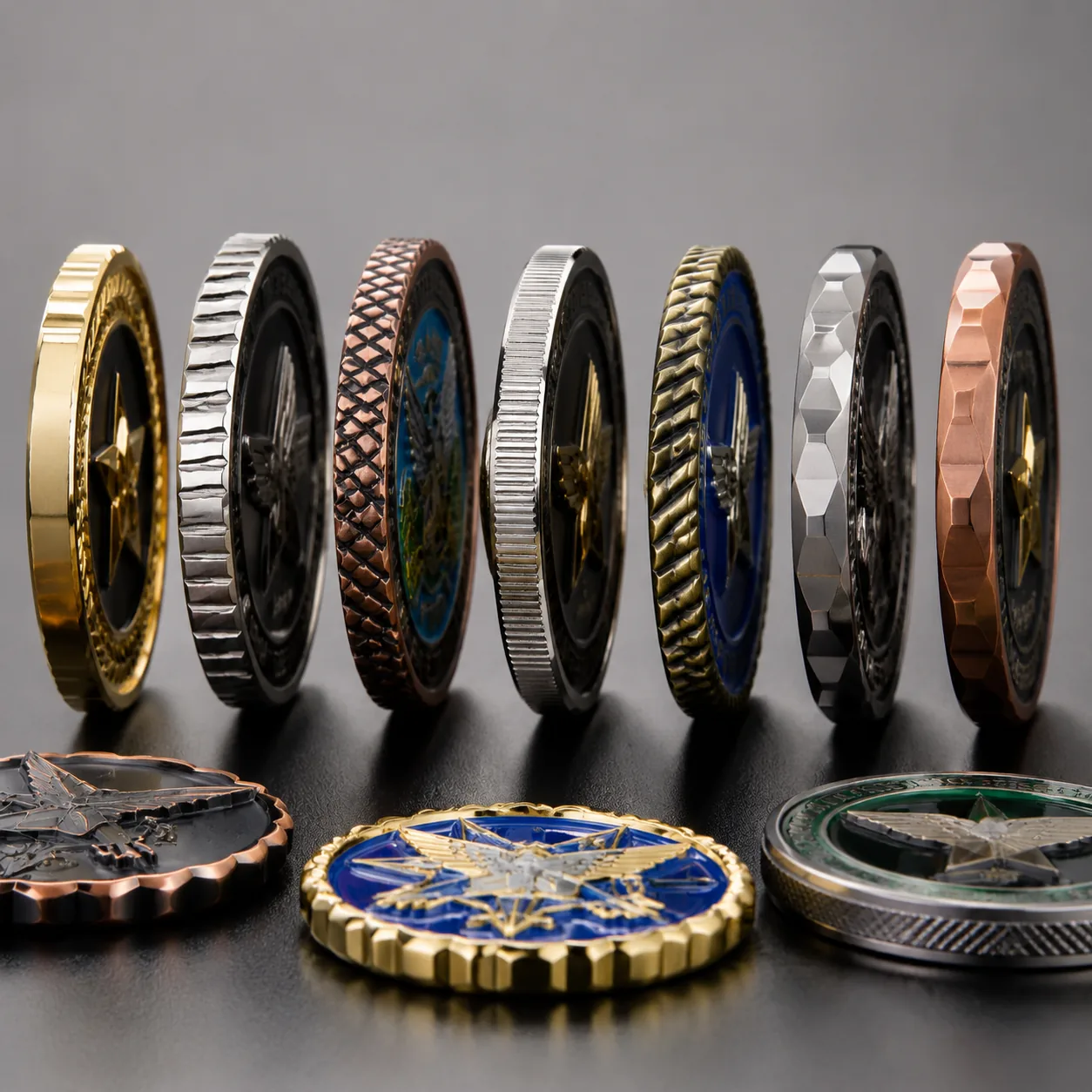
Lock the Edge Before Tooling Starts
Most challenge coin rework starts when the front and back artwork is approved but the side wall is left as a note such as premium edge or nice edge. The edge is not a late cosmetic choice. It affects die layout, casting draft, stamping pressure, CNC programming, plating coverage, hand-polishing time, packing method and final inspection speed.
For a standard 45 mm coin, the safest specification range for a visible decorative edge is 3.0-4.0 mm thickness. At 2.0-2.5 mm, rope, wave and diamond-cut details become shallow and can disappear during polishing. At 4.5-5.0 mm, the coin feels substantial but weight, mold wear, plating time and freight cost increase. A 45 mm zinc alloy coin at 3.5 mm usually weighs about 42-50 g; the same size in brass can reach 52-60 g depending on relief depth.
The edge decision should be made before the first production drawing. Changing from plain to rope, reeded or diamond-cut after sample approval can require a revised die, side-wall CNC program or new casting mold. That normally adds 3-6 working days and a tooling adjustment of about USD 35-120, depending on coin size and whether the change affects the rim. The best RFQ treats the edge as a measurable production feature, not a style preference.
Choose Visibility, Handling and Brand Tone
Start with how the coin will be used. A coin displayed in a velvet box, acrylic stand or retail blister exposes the edge and can justify extra cost. A coin carried on a keyring, handed out at a booth or stored loose in cartons is mainly judged by face artwork and hand feel, so a simpler edge is safer. Decorative edges create more surface area for dents, polish marks and plating shade variation, especially when coins rub against each other during ocean or courier transit.
Plain polished edges are best for budget programs, QR-code coins, serial-numbered coins and designs with complex enamel because they keep attention on the face. Reeded edges give a traditional currency feel with moderate risk and low added cost. Rope edges suit military, fire, police, maritime and heritage artwork because the twist reads well with antique finishes. Diamond-cut edges work for VIP gifts and retail presentation coins, but the facets reveal scratches and plating defects quickly. Wave or scallop edges fit sports, mascots and youth campaigns, provided the packaging cavity is designed around the maximum outside diameter.
| Edge style | Best use case | Practical thickness | Typical FOB impact at 500 pcs | Main control point |
|---|---|---|---|---|
| Plain polished | Corporate gifts, QR coins, tight budgets | 2.5-4.0 mm | Base price, often USD 1.35-2.90 for 45 mm zinc alloy | Avoid visible mold seam or flat spots |
| Reeded | Military, police, clubs, currency-style coins | 3.0-4.0 mm | Add USD 0.05-0.12 per pc | Keep reed pitch and depth consistent around 360 degrees |
| Rope | Ceremonial, heritage, award and maritime coins | 3.5-4.5 mm | Add USD 0.10-0.24 per pc | Prevent soft twist detail after polishing |
| Diamond-cut | Retail, VIP boxes, high-shine presentation coins | 3.5-4.5 mm | Add USD 0.18-0.38 per pc | Control burrs, facet symmetry and packing scratches |
| Wave or scallop | Mascots, sports, youth brands, custom silhouettes | 3.0-4.0 mm | Add USD 0.12-0.30 per pc | Confirm maximum OD and insert fit before tooling |
Match Edge Detail to Base Metal and Process
Zinc alloy is the most common base for custom challenge coins because it casts 2D and 3D relief economically, supports complex perimeter shapes and usually accepts MOQs from 100 pcs. Pricing improves sharply from 300-500 pcs because setup cost is spread across more units. Zinc works well for rope, wave and irregular edges, but it is softer than brass. Sharp diamond facets can dent if the factory bulk-packs coins before final boxing.
Brass is preferred for die-struck coins that need crisp plain or reeded edges and a heavier traditional feel. It is less suitable for very deep 3D relief unless the design is simplified and the strike pressure is appropriate. At 500 pcs, brass commonly adds USD 0.30-0.85 per coin over zinc alloy for a 45 mm design, with higher tooling pressure and longer polishing time. Brass is a good choice when the buyer values weight, clean rim definition and a classic coin sound.
Iron is usually selected for price-sensitive, flatter designs. It is harder to form clean decorative edges and is less forgiving if plating coverage is thin at the side wall. For iron coins, avoid aggressive diamond-cut edges unless the factory has a proven sample and robust plating control. A conservative decorative stack is copper 3-5 microns, nickel 3-6 microns and a top decorative layer of 0.05-0.12 microns for imitation gold, silver tone, black nickel or similar finishes. The copper layer improves leveling; the nickel barrier improves corrosion resistance and brightness.
Manufacturing method matters. Cast zinc edges can capture waves and rope profiles in the mold but may need more hand finishing. Die-struck brass gives cleaner reeds but cannot easily create deep undercut side detail. CNC-cut diamond edges create brighter facets but add cycle time and expose any plating or polishing inconsistency. If a supplier does not state whether the edge is cast, struck, machined or hand-finished, the quote is incomplete.
Specify Finish, Plating and Polishing Limits
Plating changes the edge appearance more than artwork renderings suggest. Shiny nickel, shiny gold and shiny silver make reeded and diamond-cut edges stand out, but they also reveal pinholes, polishing lines and small burrs. Antique gold, antique silver and antique bronze hide minor handling marks and make rope edges more legible, but they reduce sparkle and can darken small text near the rim.
Use layer thickness rather than vague terms such as thick gold or premium plating. For most indoor challenge coins, a practical stack is copper 3-5 microns, nickel 3-6 microns and decorative top color 0.05-0.12 microns. For frequent handling, humid storage or outdoor ceremonies, ask for a defined salt-spray target such as 24 hours neutral salt spray with no visible red rust on plated iron, or request a higher corrosion specification if the coin will be exposed to sweat and weather. Decorative coin plating is not equivalent to industrial hardware plating, so the expectation must be stated.
Avoid pairing matte black plating with aggressive diamond cutting unless a process sample already exists. Matte black absorbs light and can make facets look flat; later polishing can expose brightness differences at the cuts. For a black premium coin, antique black nickel with shallow reeds or a controlled rope edge is usually more reliable. If a faceted black edge is required, specify individual OPP bagging before bulk handling and require close-up side-view photos from the production sample.
Polishing must also be controlled. A decorative edge can lose 0.05-0.15 mm of apparent sharpness after tumbling and hand buffing. For rope or reed detail, ask the factory to confirm a minimum visible groove depth, commonly 0.20-0.35 mm on a 3.5 mm thick coin. For diamond-cut edges, require no sharp burrs to touch and no exposed base metal at facet peaks.
Control Diameter, Rim, Tolerance and Packaging Fit
Edge design must be checked with packaging before tooling. A nominal 50 mm wave-edge coin may have high points at 50.6-51.0 mm. If the buyer orders a stock 50 mm capsule or a tight EVA insert, the coin may scuff during insertion or fail to seat. The drawing should show nominal diameter, maximum outside diameter, thickness and box cavity size. Packaging should be approved from the same production sample, not selected afterward from a catalog photo.
For standard round coins, use diameter tolerance of ±0.15 mm on stamped designs and ±0.25 mm on cast or irregular-edge designs. Thickness tolerance is typically ±0.15 mm for 2.5-4.0 mm coins. Heavy 3D relief or antique finishes may require a wider tolerance, but that should be agreed before the sample. For a retail blister, capsule or coin stand, the cavity should normally allow 0.3-0.6 mm clearance over the maximum outside diameter, depending on edge style and plating sensitivity.
Rim width is the transition between face artwork and edge tooling. For a 45 mm coin, a 1.2-1.8 mm raised face rim is a practical range. A rim below 0.8 mm can round off during polishing and may not protect enamel. A rim above 2.5 mm can crowd logos and make the piece feel like a token rather than a commemorative coin. If the artwork has small text near the perimeter, keep letters at least 0.6 mm high with 0.15-0.20 mm raised stroke width; otherwise antique wash and polishing can close the detail.
Set Inspection Rules Before Mass Production
Complex edges increase inspection time because defects are spread across the 360-degree side wall. A plain edge is checked for dents, seam lines, plating blisters and exposed metal. A reeded, rope or diamond-cut edge must also be checked for pitch consistency, missing sections, uneven antique wash, polishing burn, burrs and scratches caused during packing.
For most B2B promotional coin orders, ANSI/ASQ Z1.4 general inspection level II with AQL critical 0, major 2.5 and minor 4.0 is a practical starting point. For VIP presentation coins, shiny plating or diamond-cut edges, tighten major defects to 1.5. The extra sorting and documentation may add USD 0.03-0.08 per piece, but it is cheaper than rejecting cartons after import. Critical defects should always be zero-acceptance because sharp burrs, wrong edge style and severe plating peel cannot be solved by discounting the invoice.
- Define critical defects as sharp burrs, exposed base metal, wrong edge style, severe plating peel, rust, or coins that do not fit the approved packaging.
- Define major defects as dents over 0.5 mm, missing reed or rope detail over 3 mm, visible polishing burn, heavy antique wash pooling, or facet asymmetry visible at arm’s length.
- Define minor defects as handling marks under 0.3 mm, slight reed depth variation, tiny shade differences, or micro-scratches not visible at 60 cm under white light.
- Inspect side walls under consistent 5000-6500 K white light at about 60 cm viewing distance, with magnification used only to confirm borderline defects.
- Pull random samples from the middle and bottom of cartons, not only the top tray or factory-retained approval samples.
- Photograph approved side views and defect examples so reorders can match the same edge standard.
Price Edge Options by Quantity and Schedule
At low quantity, decorative edge cost is driven by setup, sampling and handwork. A 45 mm zinc alloy coin with two-sided 2D relief, soft enamel up to 6 colors and standard plating may run about USD 2.60-4.50 FOB at 100 pcs. At 500 pcs, the same coin often falls to USD 1.45-2.90 FOB, depending on finish, enamel area, packaging and inspection requirement. At 1,000 pcs, a rope or reeded edge may add only a modest premium, while a diamond-cut edge still needs careful packing and sorting.
Normal timing is 10-15 working days for sampling after artwork approval and 15-25 working days for mass production after sample approval. Decorative edges can add 1-3 working days for tooling setup and 1-2 working days for polishing, side-wall inspection and repacking on medium orders. International courier transit commonly adds 3-7 days; ocean or consolidated air freight needs a separate schedule. For events under 21 calendar days total, choose plain or reeded edges unless the edge is already tooled and proven.
| Quantity tier | Best edge choice | Typical commercial logic | Lead-time guidance |
|---|---|---|---|
| 50-100 pcs | Plain or simple reeded | Minimize sample risk and setup cost | Use proven tooling; avoid unusual silhouettes for fixed events |
| 300-500 pcs | Reeded, rope or controlled wave | Decorative edge becomes cost-effective for gifts | Plan 30-40 calendar days including approval and freight buffer |
| 1,000-3,000 pcs | Rope, diamond-cut or custom perimeter | Sorting and edge QC are easier to justify | Approve physical pre-production sample before bulk plating |
| 5,000 pcs and above | Standardized decorative edge after pilot run | Repeatability matters more than novelty | Lock golden sample, photos, AQL and packing method; consider split shipment |
Use RFQ Wording That Removes Guesswork
A strong RFQ turns edge preference into measurable production data. Include diameter, maximum outside diameter if shaped, thickness, base metal, relief type, enamel count, edge style, plating stack, finish, rim width, tolerance, packaging and inspection level. If budget is uncertain, ask for two controlled options, such as plain edge versus rope edge, rather than five decorative versions that cannot be compared cleanly.
A useful specification line is: 45 mm round challenge coin, 3.5 mm thick, zinc alloy, two-sided 2D relief, soft enamel up to 6 colors, antique silver plating with copper 3-5 microns and nickel 3-6 microns underlayer, rope edge, 1.5 mm raised face rim, diameter tolerance ±0.25 mm, thickness tolerance ±0.15 mm, individually OPP bagged then packed in black velvet box, inspection to general level II AQL 0/2.5/4.0.
Also ask the supplier to mark the edge profile on the production drawing, state the edge process and send side-view sample photos before mass production. Photos can confirm profile, plating shade and obvious burrs, but they do not fully prove hand feel, weight or box fit. For VIP, retail or reorder programs, approve one physical pre-production sample and keep it as the golden sample.
- Use plain or reeded edges for rush orders, tight boxes, QR-code designs, serial-numbered coins and low-MOQ campaigns.
- Use rope or diamond-cut edges only when coin thickness is at least 3.5 mm and individual packing is included.
- Confirm maximum outside diameter before ordering capsules, EVA inserts, blister packs or acrylic stands.
- Specify plating layers, tolerance, AQL level and defect definitions in the PO, not only in email notes.
- Reject quotes that omit edge process, tooling assumptions, sample timing or packing method because the low price may be missing real work.
Have a project? Send your artwork and target quantity and we’ll reply with a detailed quotation within 12 working hours.
Ready to get this made?
Send your sketch, target quantity and ship-date. Detailed quotation in 12 hours.



