Challenge Coin Cost and Lead-Time Breakdown for Buyers
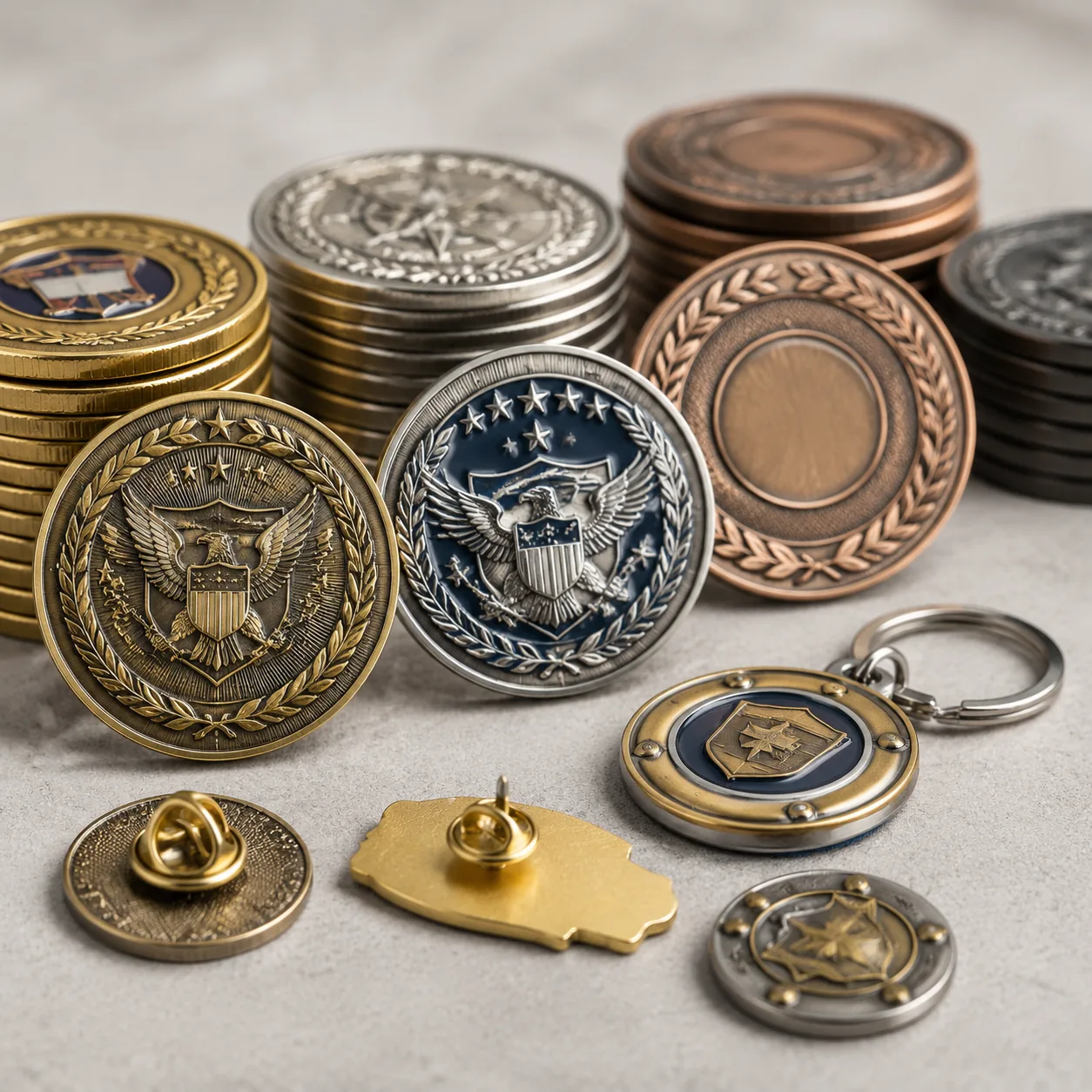
Why challenge coin quotes vary so much
A 2-inch custom challenge coin can legitimately quote at USD 1.20, USD 3.80, or USD 9.50 per piece and still be a fair price. The spread usually comes from the spec, not the salesperson: base metal, thickness, relief depth, plating stack, enamel type, edge treatment, and how much manual finishing the design demands. A zinc alloy coin at 2.0 mm with antique brass plating, one enamel side, and a plain edge is a different manufacturing job from a brass coin at 3.5 mm with dual plating, cutouts, and soft enamel plus epoxy. Comparing only unit price hides tooling, sampling, packaging, inspection, and schedule risk.
Factories also price by process count. A flat, single-side coin with standard rim geometry may need one die set, one fill operation, and one plating run. A high-relief coin with recessed text, sandblasted fields, serialized edge numbering, and a proof-like polish can add die polishing, masking, extra inspection, and higher scrap risk. In practice, the cheapest quote is often the one that uses the fewest process changes, not the one that cuts visible quality first.
What actually moves the unit price
The largest cost drivers are size, thickness, metal, and finish. For a standard 2-inch coin, 1.8 to 2.5 mm thickness is the common value zone; 3.0 to 3.5 mm begins to feel premium but raises material use and polishing time. Zinc alloy is usually the lowest-cost base metal for complex shapes and high relief because it casts well and tolerates detail. Brass and iron can work well for stamped or die-struck coins, but they often cost more once machining, polishing, and finishing are counted. If the design needs deep 3D relief, undercuts, or a cutout, expect longer die preparation and tighter control to avoid burrs and incomplete fill.
Decoration method matters just as much. Soft enamel is typically cheaper than hard enamel because the fill is left slightly recessed and requires less leveling. Hard enamel usually needs more precise curing and a flatter final polish, which raises labor and rejects. UV print and offset print can be economical for gradients, small text, or photographic effects, but they do not deliver the same tactile premium as molded metal and filled enamel. Dual plating, glow enamel, glitter enamel, epoxy domes, sandblasted backgrounds, and sequential numbering all add handling steps and usually increase per-piece cost by USD 0.10 to USD 1.20 depending on run size.
- Higher relief increases die time and polishing labor.
- Dual plating, cutouts, and edge text add setup and inspection steps.
- Epoxy, glow, glitter, and numbering slow output and raise reject risk.
- Small reorders carry a higher share of fixed setup cost per coin.
MOQ tiers and what they buy you
For custom challenge coins, practical MOQ tiers are often 50, 100, 200, 300, 500, and 1,000 pieces, depending on complexity and finish. At 50 pieces, setup cost dominates and the unit price looks high even when the factory margin is normal. At 100 to 200 pieces, standard round coins in the 1.75- to 2.25-inch range usually become much more efficient because tooling, plating, and packing are spread across a larger run. By 300 to 500 pieces, the cost curve usually improves again because the factory can purchase raw material in more efficient lots and run a steadier plating batch.
MOQ should match the use case. A VIP award, executive gift, or one-time anniversary coin may justify a smaller batch even if per-piece cost is 20% to 35% higher. A retail program, distributor order, or event giveaway usually benefits from a larger run because the fixed tooling cost gets diluted quickly. Buyers can often reduce total program cost by standardizing one diameter, one metal finish, and one packaging format across multiple SKUs instead of creating a unique setup for every version.
| MOQ tier | Typical FOB range per coin | Best fit | Trade-off |
|---|---|---|---|
| 50 pcs | USD 4.50-9.50 | VIP gifts, prototypes, small ceremonies | Highest setup share, weakest unit economics |
| 100-200 pcs | USD 2.80-6.20 | Corporate awards, club merch, pilot programs | Moderate setup cost, still a per-piece premium |
| 300-500 pcs | USD 1.80-4.20 | Events, distributor orders, repeat programs | Good balance of cost and flexibility |
| 1,000+ pcs | USD 1.10-3.20 | Retail, national campaigns, large promotions | Best unit economics, less forgiving of spec changes |
Lead time from artwork to shipment
A realistic lead time for a standard custom coin is 12 to 20 days for sample approval plus mass production, then another 3 to 7 days for packing and export coordination before transit time. If the design is simple and the factory has open plating capacity, a sample can often be ready in 5 to 8 days. Mass production usually takes 10 to 15 days for small and mid-sized orders, but complex coins or peak-season schedules can stretch that to 18 to 25 days. Buyers should always separate production time from shipping time, because freight mode, customs handling, and destination clearance sit outside the factory’s direct control.
The fastest projects are the ones with the fewest variables. One metal finish, one color system, one edge style, and one packaging method keep the process moving. Lead time gets longer when a design combines multiple die-cut areas, antique and polished contrast on the same face, soft enamel with epoxy, serialized numbering, or custom inserts. Rush orders are possible, but they usually require priority tooling, overtime on polishing or plating, and a higher tolerance for rework risk. If the launch date matters, simplification is usually a better solution than pressure.
| Stage | Standard range | What can delay it |
|---|---|---|
| Artwork confirmation | 1-2 days | Missing vector files, unclear Pantone references, late approval |
| Tooling / die making | 2-5 days | Deep relief, multiple levels, cutouts, custom edge text |
| Sample production | 5-8 days | New finish, special edge work, epoxy, multi-color fill |
| Mass production | 10-15 days | Complex plating, high reject rate, large quantity |
| Packing and dispatch | 2-4 days | Custom inserts, barcode labels, export documents, carton changes |
How to trim cost without hurting quality
The easiest savings usually come from simplifying the build, not downgrading the material blindly. A flatter relief profile, one plating finish, and a single-sided design can cut cost materially while keeping the coin visually strong. Standardizing on 2.0 to 2.5 mm thickness for many 2-inch coins is usually enough for a solid hand feel without adding unnecessary weight or longer polishing time. Antique brass and antique silver remain popular value finishes because they hide minor surface variation better than mirror-polished surfaces.
Packaging is another place where cost can drift upward without adding much value. A velvet pouch, acrylic capsule, or printed backing card works well for awards and resale, but an internal distribution coin often does fine in a plain OPP bag or simple paper envelope. That choice affects not only packaging cost but also labor time and carton density. If the coin ships by mail, the packaging spec should also consider crush protection and dimensional weight, not just presentation.
- Keep one diameter and one thickness across the program.
- Avoid mixed plating unless the visual gain clearly justifies the setup cost.
- Use standard edges before adding rope, reeded, or edge text.
- Choose packaging by channel: internal, retail, mailer, or award presentation.
- Approve vector artwork before die cutting starts.
- Confirm whether the quote includes packing, cartons, and standard defect allowance.
When a lower quote is actually more expensive
The cheapest quote is often the one that leaves out something important. A supplier may quote a low unit price for a 2-inch coin but exclude tooling, sample courier cost, custom packaging, or a second plating pass after inspection. Another common trap is quoting on approximate thickness and then revising the price after the die is made because the finished profile uses more metal than expected. Buyers should ask whether the quote includes tooling ownership, one sample revision, standard cartons, and a normal defect allowance, and they should get that answer in writing.
Quality risk matters for reorders. A very aggressive price can mean lower polishing standards, more surface pinholes, looser edge consistency, or inconsistent enamel fill. That may be acceptable for a one-off event, but it creates problems when the coin becomes a recurring brand item. For repeat programs, the buyer should lock the reference sample, thickness tolerance, plating code, and inspection method so the next order matches the first one. Otherwise, a cheaper second quote can quietly produce a different product.
| Low quote signal | Hidden risk | Buyer response |
|---|---|---|
| No tooling line shown | Die or mold cost may appear later | Ask for separate tooling ownership and sample cost |
| Very short lead time promised | Inspection or overtime assumptions may be missing | Confirm capacity, not just calendar days |
| Price much lower than peers | Lower finish standard or thinner base metal | Request material spec and thickness in writing |
| Packaging excluded | Extra cost appears at packing stage | Specify packed condition before approval |
A buyer spec that keeps quotes comparable
Comparing suppliers only works when every factory gets the same brief. A usable challenge coin spec should include diameter to the nearest 0.1 inch or 1 mm, thickness in mm, base metal, plating finish, number of artwork sides, enamel type, edge style, and packaging type. If the coin needs a display box or capsule, state the exact dimensions and whether an insert is required. Without those details, one supplier may quote a basic coin while another quotes a gift-ready package, which is not a valid comparison.
Good specs also define tolerances and inspection expectations. For standard coins, diameter tolerance can usually be held around +/-0.3 mm and thickness around +/-0.2 mm, depending on structure and finish. Relief height tolerance is commonly controlled within +/-0.15 to +/-0.25 mm on standard jobs, while edge burrs should be kept visually clean and non-sharp. Color placement should be checked against a signed sample rather than a verbal description. For quality control, AQL 2.5 is a reasonable starting point for major defects and AQL 4.0 for minor defects, then adjusted based on brand risk. If the coin is for a premium program, ask the factory to record the reference sample, finish code, and approved Pantone callouts on the job sheet so reorders stay consistent.
What to do next
Start by deciding which lever matters most: lowest unit price, fastest shipment, or premium presentation. Then lock the diameter, thickness, plating, packaging, and quantity tier before asking for final quotes. If you are unsure which combination is cost-efficient, request two versions from the same factory: a standard build and a premium build, so the price delta is visible instead of hidden. For ZheCraft buyers, the fastest path is usually to send artwork, target quantity, preferred finish, and ship date together, then ask for a split quote showing tooling, sample cost, unit price, and lead time separately.
If you want the cleanest comparison, do not ask suppliers to quote “best price.” Ask them to quote the same specification at 100, 300, and 500 pieces, with sample time, mass production time, and packaging cost shown on separate lines. That gives procurement a real basis for negotiation and makes the trade-offs obvious. It also helps you decide whether to simplify the design, increase quantity, or accept a slightly higher price for a more reliable timeline.
Have a project? Send your artwork and target quantity and we’ll reply with a detailed quotation within 12 working hours.
Ready to get this made?
Send your sketch, target quantity and ship-date. Detailed quotation in 12 hours.



