Carton Packing Specs for Custom Pins, Coins and Keychains
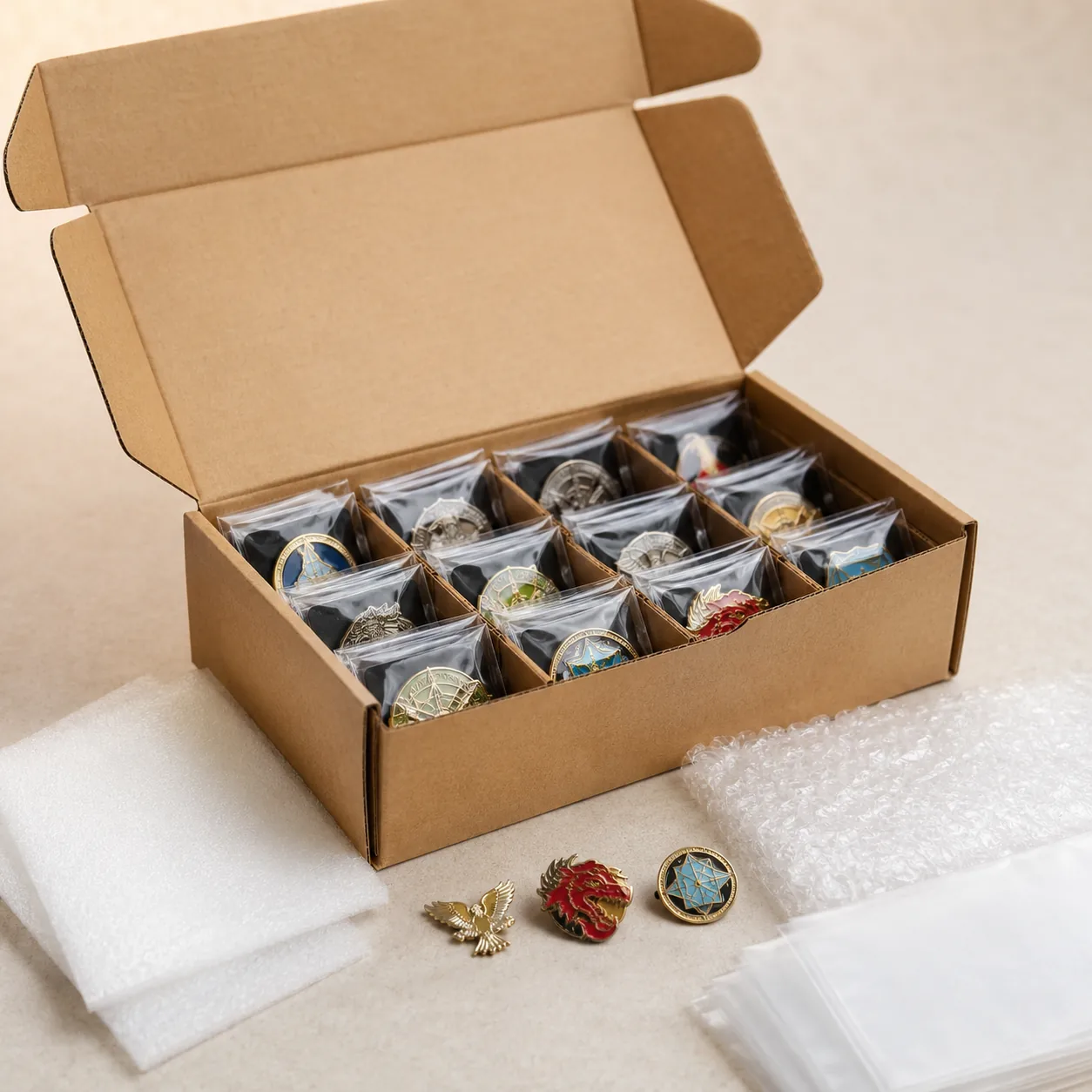
Why good metal goods still fail at receiving
A buyer can approve perfect enamel pins, keychains or challenge coins and still receive a difficult shipment: crushed retail boxes, mixed event SKUs, cartons too heavy for one person to lift, or missing carton marks that stall inbound scanning. These failures rarely come from the die, plating bath or enamel fill. They usually come from packing instructions left vague until the last production week.
For B2B promotional orders, export packing is a control point, not a cosmetic add-on. It affects freight billing, pallet utilization, warehouse receiving time, pick-and-pack accuracy and damage claims. A 25 mm enamel pin in an OPP bag weighs only a few grams, but 10,000 pcs packed without a carton standard can become 20 to 35 cartons with inconsistent weights, weak corners and no usable SKU separation.
At ZheCraft in Yiwu, we treat the packing page as part of the production specification. The target is practical: cartons strong enough for international handling, light enough for safe manual movement, clear enough for warehouse teams to identify in seconds, and repeatable enough that reorders arrive in the same format.
Set carton weight and size limits first
The first packing decision is maximum gross weight per export carton. For enamel pins, badges and small keychains, a safe working range is usually 12 to 18 kg gross weight per carton. For dense challenge coins, bottle-opener keychains, zinc-alloy magnets or multi-piece metal kits, 10 to 15 kg is safer because weight concentrates in a compact carton and corners crush faster.
Do not reduce carton count by pushing every carton to 22 or 25 kg. Heavy compact cartons split more easily in courier networks, are more likely to be dropped, and often trigger handling complaints at third-party warehouses. Many receiving teams prefer cartons below 18 kg, with 15 kg as the internal ergonomic target for repetitive lifting.
Air express also requires volumetric checks. DHL, FedEx and UPS often use a divisor around 5,000 cm3 per kg, depending on service and lane. A 40 x 30 x 25 cm carton is 30,000 cm3 and bills at about 6 kg volumetric weight. Metal promo products usually bill by actual weight; patches, lanyards, paper backing cards and gift boxes often bill by volume. For every RFQ, ask for estimated carton quantity, gross weight, net weight and total CBM before deposit.
| Product type | Recommended gross weight | Typical carton size | Packing note |
|---|---|---|---|
| Enamel pins in OPP bags | 12-16 kg | 36 x 28 x 24 cm to 40 x 30 x 25 cm | Reduce to 12-14 kg for large backing cards or mirror plating |
| Metal keychains | 12-18 kg | 38 x 28 x 25 cm to 42 x 32 x 28 cm | Separate split rings and epoxy faces to prevent abrasion |
| Challenge coins | 10-15 kg | 30 x 25 x 20 cm to 36 x 28 x 22 cm | Keep inner boxes tight; avoid loose bulk packing |
| Fridge magnets | 10-16 kg | 36 x 28 x 24 cm to 42 x 32 x 28 cm | Use dividers for epoxy domes or ceramic magnets |
| Patches and lanyards | 8-14 kg | 45 x 35 x 35 cm to 50 x 40 x 40 cm | Check volumetric weight before choosing air freight |
Choose carton board by route and density
For most custom metal promotional products, a five-layer corrugated export carton is the minimum safe specification. Common local board descriptions include K=K, K=A and A=A; exact strength varies by mill, moisture content and flute. For dense metal items, a smaller reinforced carton is usually better than a large carton with void space. Empty space allows product movement, corner collapse and tape stress.
A useful baseline is five-layer board at about 6 to 7 mm thickness with edge crush strength suitable for 15 to 20 kg gross weight. For heavier coin orders or courier shipments, request reinforced five-layer board, full-width sealing tape at 48 to 60 mm, and H-taping on top and bottom seams. For sea freight, add an inner poly liner when cartons may sit in humid warehouses; a liner helps against moisture but does not replace dry storage or desiccant planning.
Seven-layer cartons are not automatically better. They increase carton cost and volume, and can be excessive for 3,000 pins in small inner boxes. Use seven-layer board for 45 to 60 mm coins, premium coin cases, dense mixed hardware kits, or palletized sea freight where cartons may be stacked three to five layers high for several weeks.
| Carton or protection spec | Best use | Typical FOB cost impact | Limit |
|---|---|---|---|
| Five-layer export carton | Most pins, keychains and magnets | USD 0.60-1.40 per carton | Keep gross weight under 18 kg |
| Reinforced five-layer carton | Courier express or compact metal goods | USD 0.90-1.80 per carton | Still needs snug inner packing |
| Seven-layer carton | Heavy coins and long sea routes | USD 1.50-3.20 per carton | Higher CBM and freight volume |
| Inner PE liner, 40-60 micron | Humid storage or sea freight | USD 0.05-0.20 per carton | Not a substitute for dry pallets |
| Corner pads or dividers | Retail boxes and premium cases | USD 0.03-0.12 per protected area | Adds labor and carton volume |
Control inner packing by SKU
The most common packing error is writing only “1,000 pcs per carton.” That may work for one simple pin design, but it fails when the order has five designs, two plating finishes, three backing cards and event-specific receiving rules. Packing control should start with SKU, not total piece count. Each SKU should define design, size, plating, attachment, retail packaging and barcode status.
For enamel pins, practical inner packs are 50 or 100 pcs per sealed bag, white inner box or labeled master bag. Pins on backing cards often pack at 50 pcs per inner carton to protect card corners. Challenge coins are better at 25 to 50 pcs per inner box, depending on diameter and thickness. For example, a 45 mm x 3.5 mm coin may weigh 38 to 45 g before packaging, so 100 pcs in one inner box becomes heavy and rub-prone.
Treat retail packaging as part of the SKU. A 32 mm hard enamel pin in an individual OPP bag packs very differently from the same pin on a 70 x 90 mm card, and differently again in a 60 x 60 x 25 mm rigid box. The unit FOB difference may be only USD 0.15 to 0.60, but the carton volume and air freight charge can change sharply.
- Assign one SKU code for each design, plating finish, attachment and packaging format.
- Specify inner quantity, such as 50 pcs per inner box or 100 pcs per sealed bag.
- Require one SKU per inner carton unless mixed packing is approved in writing.
- For mixed export cartons, require a carton-level packing list with exact SKU quantities.
- Use inner labels showing SKU, quantity, PO number and carton sequence.
- Request carton photos before shipment when the order has more than three SKUs.
Prevent abrasion, dents and crushed retail packs
Most transit damage is caused by vibration and compression, not one dramatic impact. Pins develop black rub marks on plating, keychains scratch epoxy domes, and coins dent enamel edges when pieces move inside the carton. Better protection is usually about controlling contact points, not simply adding thicker packaging.
For metal pins, individual OPP bags at 30 to 50 micron are common and economical. For polished gold, mirror silver, black nickel, dyed black or epoxy-coated surfaces, avoid loose bulk packing even when the unit price target is tight. For premium coins, use capsules, coin flips, PVC pouches or foam slots if the retail value justifies the extra volume. For budget event coins, a tight 25 pcs inner box with tissue separation may be enough.
A simple pre-shipment abrasion check is useful: pack 20 finished samples in the proposed inner packing, shake by hand for 60 seconds, then inspect plating, enamel, epoxy and printing under normal warehouse lighting at about 50 cm viewing distance. For larger orders, inspect finished packed goods to AQL 2.5 for major surface defects and AQL 4.0 for minor rub marks, unless the buyer has a stricter standard.
| Damage risk | Typical cause | Practical control | Tolerance target |
|---|---|---|---|
| Plating rub marks | Loose metal-to-metal contact | Individual 30-50 micron OPP bag or tissue wrap | No visible scratch at 50 cm on A-side |
| Bent pin posts | Compression inside bulk bags | Backing card, foam layer or post protector | Post angle within ±5 degrees |
| Scratched epoxy dome | Ring or clasp rubbing clear surface | Fold bag to isolate hardware or add divider | No scratch crossing printed logo |
| Coin edge dents | Heavy coins loose in rows | 25-50 pcs inner box, tight fit or capsules | No dent exposing base metal |
| Crushed gift boxes | Oversized or weak master carton | Snug carton, corner pads and 15 kg limit | No collapsed retail box corners |
Make carton labels warehouse-readable
Shipping marks should let a receiving team identify cartons without opening them. Each carton should show buyer or project code, purchase order number, SKU or design code, carton number, quantity, gross weight, net weight, carton dimensions and country of origin when required. Labels should be printed clearly, applied flat and placed on at least one long side; for warehouse scanning, two adjacent sides are better.
For multi-SKU promotional campaigns, carton numbering must match the packing list exactly: CTN 1/24, CTN 2/24 and so on, with no skipped numbers. If a carton contains mixed SKUs, the label should state “MIXED” and list the SKU breakdown, or reference a carton-level packing list inside a document pouch.
Do not rely on color labels alone. Cartons may be photographed in poor light, labels may fade, and warehouse systems usually record text or barcodes, not color. A 60 x 100 mm label is adequate for simple orders. Multi-SKU programs should use 100 x 150 mm labels with a Code 128 barcode or QR code tied to the buyer’s receiving system. Use text at least 8 to 12 mm high for PO and SKU lines.
- Project code or PO number printed in large text, minimum 8 mm character height.
- SKU code and design name matching the approved packing list exactly.
- Carton sequence such as CTN 7/36, with the same number on the packing list.
- Quantity per carton, gross weight, net weight and dimensions in centimeters.
- Country of origin and handling marks only when required or operationally useful.
- Barcode or QR code tested by phone or scanner before mass labeling.
Inspect packing before sealing export cartons
Packing inspection should happen after final assembly and before cartons are released for export. The inspection should not only count pieces; it should confirm that the approved packing method was followed. For many promotional programs, general inspection level II with AQL 2.5 for major defects and AQL 4.0 for minor defects is a practical baseline, with carton-specific checkpoints added.
Major packing defects include wrong SKU in carton, missing inner quantities, unsealed seams, carton labels that do not match the packing list, and damage that exposes product to loss or contamination. Minor defects include slightly tilted labels, light carton scuffs or functional inner bags that are not perfectly neat. If retail presentation is part of the product, crushed or stained gift boxes should be classified as major defects.
Drop testing should match the route. For courier shipments, a practical test is one packed carton dropped from 60 to 80 cm on one corner, three edges and six faces, then opened for inspection. For palletized sea freight, compression, moisture and stacking are more important than repeated free-fall drops. If cartons will be stacked four layers high, confirm the bottom cartons do not deform after simulated or actual pallet stacking.
| Inspection item | Acceptance target | Major defect example | Minor defect example |
|---|---|---|---|
| Carton label accuracy | 100% match to packing list | Wrong PO, SKU or carton number | Label tilted but readable |
| Carton gross weight | Within ±1 kg of approved standard | Carton exceeds agreed max weight | Small variance from mixed inner packs |
| Inner quantity | Correct count per inner pack | 10 pcs missing from inner box | One inner label missing but count correct |
| Carton condition | No split seams or crushed corners | Tape open or wall torn | Light outer scuff |
| Product protection | No transit rub beyond approved limit | Visible scratches from loose packing | Wrinkled OPP bag |
Price, MOQ and lead-time impact
Packing changes rarely dominate unit cost, but they can change landed cost. Standard OPP bags are usually USD 0.01 to 0.03 per piece; printed backing cards are USD 0.03 to 0.12; velvet pouches are USD 0.08 to 0.25; acrylic coin capsules are USD 0.06 to 0.18; and rigid gift boxes are USD 0.25 to 0.90 depending on size, paper, insert and print. Export cartons are inexpensive by comparison, but carton volume affects freight immediately.
MOQ depends on whether the material is standard or custom. Plain OPP bags, export cartons and common white inner boxes can usually be arranged from 100 to 300 pcs. Printed backing cards and barcode labels become more efficient at 500 pcs per design. Custom printed rigid boxes, molded trays and foam inserts usually make sense from 500 to 1,000 pcs per design because setup, die-cutting and assembly labor are spread across more units.
Lead time should be locked before mass production finishes. Standard export cartons usually need 1 to 3 days. Printed labels and backing cards take 3 to 7 days after artwork approval. Custom rigid boxes, molded inserts or special foam slots normally take 7 to 15 days. If metal goods take 12 to 20 days for tooling, plating, enamel and assembly, the packaging artwork should be approved before plating is completed. Waiting until final inspection to confirm carton marks commonly causes a 1 to 3 day shipment delay.
RFQ checklist before placing the order
Add a packing page to the RFQ instead of relying on the supplier’s default method. The page should define carton weight limits, inner packing, SKU separation, label content, inspection standard and any freight constraints from your forwarder or warehouse. Ask the factory to quote product and packing together, then provide estimated carton quantity, dimensions, gross weight and total CBM before deposit.
For air shipments, request actual and volumetric weight estimates. For sea freight or pallet delivery, confirm whether cartons will be loose-loaded or palletized, because the carton strength requirement changes. For warehouse programs, share barcode rules, receiving label format and maximum carton weight before production starts.
- Confirm maximum carton gross weight: 12-18 kg for pins and keychains, 10-15 kg for coins.
- Lock inner packing by SKU, including design, plating, attachment and retail packaging.
- Approve carton label content and barcode format before mass packing starts.
- Request carton photos, final packing list and weight summary before balance payment.
- Use AQL 2.5 for major packing defects and AQL 4.0 for minor defects unless stricter rules apply.
- Save the packing spec with the artwork file so reorders arrive in the same carton format.
Have a project? Send your artwork and target quantity and we’ll reply with a detailed quotation within 12 working hours.
Ready to get this made?
Send your sketch, target quantity and ship-date. Detailed quotation in 12 hours.



