Can This Custom Promo Order Still Make My Trade Show?
Q: I have 3 weeks until the event. What is still realistic without gambling on quality?
With 21 calendar days left, the constraint is not whether a supplier says yes. It is whether artwork approval, tooling release, production, inspection, export packing, pickup, transit, customs clearance and final delivery can all happen before the venue receiving cutoff. For most event programs, buyers should reserve 3-5 days for express courier or 5-9 days for air freight, plus at least 1 business day for final QC release and document handoff. If delivery is to a hotel, convention center or show-appointed warehouse, add another 1-3 days because those sites often have booking windows, labeling rules and limited receiving hours.
In practice, a nominal 21-day window usually leaves only 7-10 working production days once weekends, proof turnaround, die approval and pickup cutoff are removed. That makes the safest choices the products built from standard materials and short process chains: polyester screen-printed lanyards, standard woven patches, simple soft enamel pins and 2D zinc alloy keychains with one-side decoration. These items can usually move from approved art to packed cartons without pre-production sample remakes, complex polishing or hand assembly.
Treat schedule as a hard specification, not a hope. Lock the ship method before artwork release, approve the digital proof the same day it is issued, and remove any feature that depends on manual cosmetic touch-up. Rush orders usually succeed because the build was simplified early, not because every downstream step was somehow compressed without risk.
Q: Which products survive a rush schedule best, and which ones usually break it?
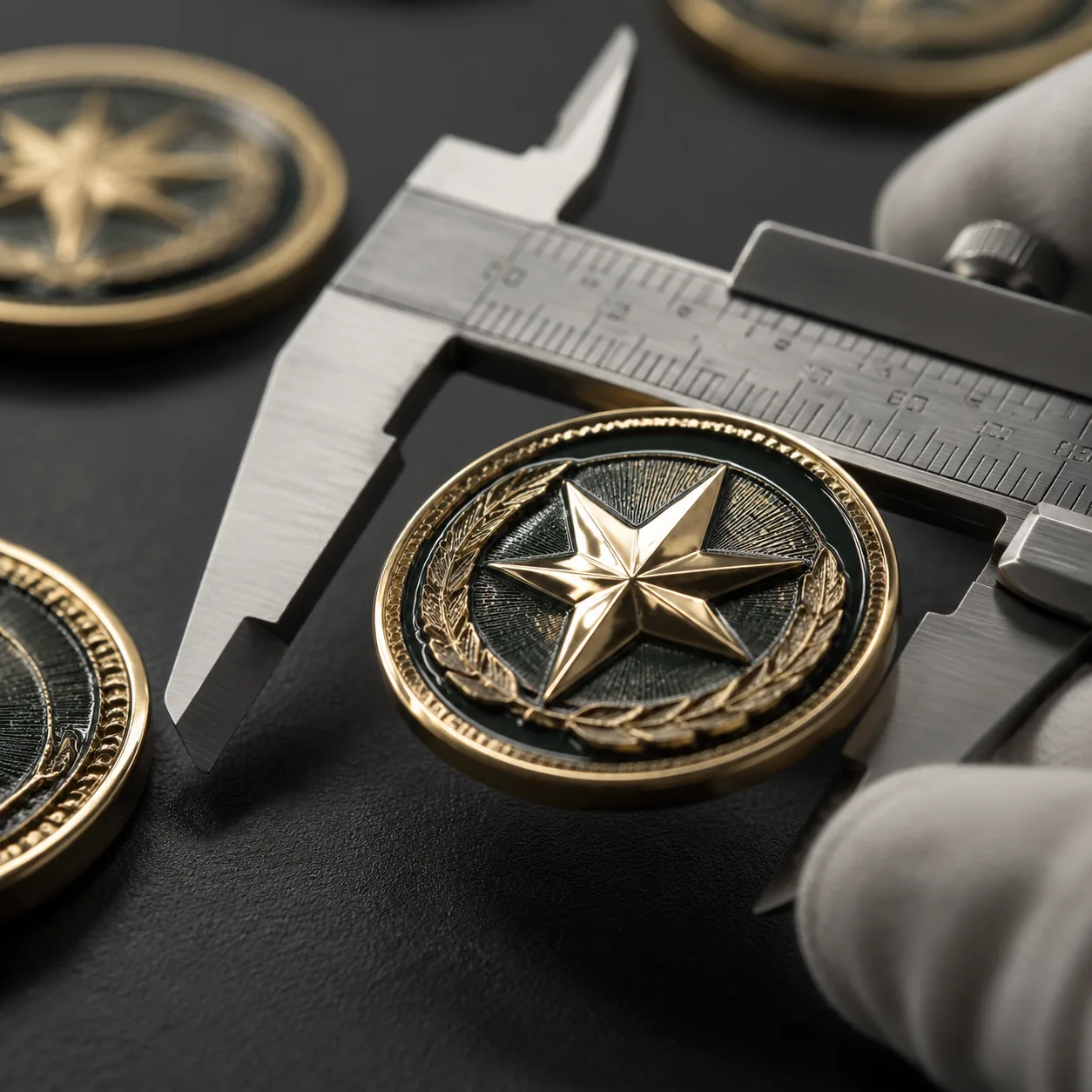
Rush performance depends more on process count than on category name. A 20 x 900 mm polyester lanyard with 1-color screen print and a stocked swivel hook is fast because there is no mold charge, no plating queue and very little finishing risk. A 45 mm die-cast coin with edge text, soft enamel, epoxy dome and gift box is slow because each added operation creates another queue, another inspection point and another chance for cosmetic rejection.
| Product type | Rush-ready specification | Typical MOQ tiers | Factory lead time | Indicative FOB USD |
|---|---|---|---|---|
| Printed lanyard | 15 mm or 20 mm polyester, 1-2 spot colors, standard J-hook or swivel hook, optional safety break | 100 / 300 / 500 / 1,000 pcs | 4-6 working days | $0.24-0.62 at 500 pcs |
| Woven patch | 75-90 mm, merrow border, up to 6 thread colors, sew-on or heat-seal backing | 100 / 300 / 500 / 1,000 pcs | 5-7 working days | $0.20-0.54 at 500 pcs |
| Soft enamel pin | 25-35 mm, stamped iron or brass, 1.0-1.2 mm thickness, up to 4 fill colors, no cutouts, butterfly clutch | 100 / 300 / 500 / 1,000 pcs | 7-9 working days | $0.32-0.78 at 500 pcs |
| Zinc alloy keychain | 50-60 mm, 2D die-cast, 2.0-3.0 mm thickness, one-side color fill, standard split ring | 100 / 300 / 500 / 1,000 pcs | 8-11 working days | $0.72-1.48 at 500 pcs |
| Challenge coin | 40-45 mm diameter, 3.0 mm thick, 2D relief, one plating, no numbering, no gift box | 100 / 300 / 500 pcs | 10-14 working days | $1.20-2.70 at 300 pcs |
| Hard enamel pin | 25-30 mm, polished flat face, simple outline, no glitter, no translucent colors | 100 / 300 / 500 / 1,000 pcs | 12-16 working days | $0.70-1.58 at 500 pcs |
Products that commonly break a 3-week program are the ones with rework-sensitive finishing or hand assembly. Hard enamel requires repeated filling, baking and stone or wheel polishing, then a tighter flatness and scratch review than soft enamel. Hinges, spinning centers, bottle opener inserts, chain-linked danglers, rhinestones, glow pigment and layered parts all add assembly time and alignment risk. Retail presentation can be just as disruptive: backing cards, EVA trays, custom sleeves, barcode stickers and assortment packing often add 2-4 working days after the main item is already complete.
If the deadline matters more than presentation, standardize aggressively. Use one plating finish, one attachment style, one packing method and one carton mark format. On many orders that removes 1-3 working days of avoidable handling and reduces late-stage sorting errors.
Checklist: What should I send on day one so the factory can quote and schedule accurately?
Rush orders usually fail in the first 48 hours, not the last 48. The common cause is an incomplete RFQ that forces the supplier to chase basic decisions on size, material, backing, packaging, consignee data or shipping method. For event goods, commercial terms and technical specs need to arrive together so the quote, proof and production slot are based on the same assumptions.
- In-hand event date, venue or warehouse address, and latest acceptable arrival date
- Quantity by SKU, plus whether a 3-5% overrun or underrun is acceptable
- Final vector artwork in AI, EPS or editable PDF, with all dimensions in mm
- Target size, thickness and any max unit weight if the item will be mailed or worn
- Material choice: iron, brass, zinc alloy, polyester, twill, PVC or silicone
- Finish details: plating color, enamel type, print method, thread colors, border style and hardware
- Attachment requirement: butterfly clutch, rubber clutch, split ring, lobster clasp, heat-seal, hook-and-loop or sew-on
- Packaging requirement: bulk export pack, individual OPP bag, backing card, barcode label or retail box
- Inspection standard requested, such as AQL 2.5 major and 4.0 minor
- Shipment method, consignee details, tax ID if required, and whether split shipment is allowed
If a point is still open, say so and ask for option pricing in the same round. Requesting 300, 500 and 1,000 piece pricing together, or asking for both butterfly clutch and rubber clutch costs on the same design, is far faster than approving a quote and then reopening the specification after tooling starts. For metal items, also confirm whether the quoted die charge is included, amortized or billed separately; on low-MOQ rush orders, that detail can change the real unit economics.
Q: When should I simplify the spec instead of paying rush fees?
Rush fees can move an order up the queue, but they do not turn a slow design into a fast one. If the event date is close, remove the operations that consume time or generate rework. On metal items, reduce color count, avoid internal cutouts below about 1.0-1.2 mm, skip epoxy domes unless surface protection is essential, and choose stocked attachments instead of custom fittings. On patches, a standard merrow border is usually faster than a laser-cut silhouette or embroidered edge. On lanyards, screen print is typically faster than jacquard weave or dye sublimation with sewn-on accessories.
Artwork detail is often the hidden schedule risk on pins and keychains. As a practical manufacturing rule, keep raised metal lines at 0.25-0.30 mm minimum, recessed gaps at 0.30 mm minimum, and text height above 1.2 mm if it must remain readable on a 25-30 mm item. For stamped iron or brass, bridges narrower than about 0.6 mm can deform during forming. For die-cast zinc alloy, inner corners below roughly a 0.3 mm radius may soften, and deep narrow recesses can trap plating and color inconsistently. If the logo depends on hairline strokes, micro text or nested cutouts, simplify before proof approval. A rejected proof costs hours; a remade die commonly costs 2-4 working days.
Packaging is usually the fastest place to recover schedule. If the event batch only needs to be handed out at a booth, use bulk export packing or plain OPP bags and postpone branded backing cards or retail boxes to a replenishment run. That single decision often saves 2-5 days on orders that would otherwise require card matching, barcode application, hand insertion and final recount by SKU.
Q: What quality risks increase when production is compressed to under 10 days?
The risk profile is straightforward: the same defects seen on normal orders, but with less buffer for correction. On metal goods, watch for shallow or uneven enamel fill, plating pits, scratches on raised surfaces, color contamination between small cells, clutch posts soldered off-center, rough edges and attachment solder marks. On lanyards and patches, rush defects usually show up as fuzzy print edges, loose trim, skipped stitches, off-center logos, crooked hook placement or wrong hardware loaded during packing.
That is why the buyer needs measurable acceptance criteria. For rush promo goods, a commercially realistic standard is often AQL 2.5 for major defects and 4.0 for minor defects on finished goods, using ANSI/ASQ Z1.4 or the supplier's equivalent single-sampling plan. Typical dimensional tolerances are plus or minus 0.20 mm for small pins under 35 mm, plus or minus 0.30 mm for keychains and coins around 50 mm, and plus or minus 1.0 mm to 2.0 mm for soft goods such as patches and lanyards depending on width and cut method. Lanyard width tolerance is often held to plus or minus 0.5 mm on 15 mm and 20 mm tape when using standard polyester stock.
Decorative electroplating on promo hardware is commonly about 0.03-0.08 microns for gold-tone, nickel-tone or black nickel finishes. That is an appearance layer suitable for promotional use, not a heavy corrosion-resistance specification. Color control also needs precise language: Pantone matching on screen-printed polyester can usually be held to a normal visual tolerance when ink is mixed to target, but woven thread, PVC, epoxy and metal-filled color areas should be treated as close visual matches rather than exact cross-substrate matches. For a trade show giveaway, define the no-fail points clearly: correct logo, readable event date, functioning clasp or ring, front-side appearance acceptable at arm's length, and carton counts correct by SKU.
Q: How should I choose between express, air and split shipment when the clock is tight?
Logistics often kills schedules that production technically met. For near-date events, sea freight is usually out unless stock already exists domestically. The real decision is between express courier, air freight and a split shipment that sends only the event quantity first. The right method depends on carton count, chargeable weight, consignee readiness, customs predictability and whether the program can tolerate partial receipt.
| Ship method | Transit range | Best fit | Main limits | Typical event use |
|---|---|---|---|---|
| Express courier | 3-5 days door-to-door | Small urgent orders under about 8 cartons or 120 kg chargeable weight | Highest cost per kg, parcel size limits, brokerage rules vary by destination | 500 pins, 500 lanyards and booth inserts to one venue |
| Air freight | 5-9 days including terminal handling and customs | Mid-size event orders where express cost is too high | Needs consignee coordination, import clearance and local handling | 3,000 mixed promo items to a distributor or 3PL |
| Sea freight | 22-40+ days | Large replenishment or post-event inventory | Too slow and too variable for a near-date launch | Restock only, not launch quantity |
| Split shipment | Express for event qty, air or sea for balance | Programs with urgent launch needs but larger total volume | Requires carton segregation, fixed counts and separate paperwork | 1,000 needed for show now, 4,000 for later channel use |
Split shipment is often the most rational choice when only part of the order is time-critical. For example, if 5,000 pieces are ordered but only 1,200 are needed for booth distribution, send those 1,200 by express in clearly segregated cartons and move the balance by air or sea after the event is protected. This avoids premium freight on the full order and reduces the chance that one customs delay sinks the entire program. The key is timing: carton separation, SKU counts, consignee details and carton marks must be frozen before final packing begins.
Q: What can I still negotiate on a rush order, and what should I stop pushing?
You can still negotiate commercial points that do not destabilize production: MOQ tiers, overrun tolerance, whether tooling is charged separately, whether approval can be digital-only instead of requiring a physical pre-production sample, and whether the event quantity can ship first. It is also reasonable to ask for side-by-side FOB pricing for 300, 500 and 1,000 pieces, or for two standard hardware options on the same design, as long as those choices are settled before proof approval.
What usually stops helping is repeated design revision after die-line approval, exact Pantone promises across different materials, or internal debate over retail presentation after the factory has already scheduled the line. On a tight deadline, a 24-hour signoff delay can matter more than a 10-15% unit-price swing. Low-MOQ arguments also backfire when the build is too customized. A supplier may accept 100 pieces, but if the order also requires custom plating, barcoded backing cards, individual bagging and full inspection, the setup burden remains almost the same and the order may become slower rather than faster.
As a rule, negotiate where the process is still flexible and stop negotiating where the process has already been committed. Once artwork, finish, packing and ship method are approved, decision speed matters more than squeezing out a few cents per piece.
What to do next if your event date is fixed
Start from the venue delivery date, not the date your office hopes to receive the goods. Then choose the item that fits the remaining production window instead of forcing the original concept through an unrealistic schedule. With fewer than 14 calendar days left, default toward printed lanyards, simple woven patches or a split-shipment plan using standard stock. If you still need metal goods, keep them to soft enamel pins or simple die-cast keychains with standard hardware, one plating finish and plain packing.
- Freeze the in-hand date, ship-to address and shipping method immediately
- Choose one plating, one attachment and standard export packing
- Send one complete RFQ with artwork, dimensions, quantities and QC standard
- Ask for feasibility by option, with lead time in working days and FOB pricing by MOQ tier
- Approve proofs the same day and assign one internal signoff owner
- Request pre-production checkpoints: proof approval, in-line photo if needed, final inspection result and carton marks
- Use split shipment if only part of the order is required for the event
- Keep a backup item ready in case tooling rework or hand assembly delays the preferred design
A rush promo order can still make a trade show, but only when schedule, specification and logistics are managed as one decision. The orders that land on time are rarely the most elaborate. They are the ones with manufacturable artwork, standard components, measurable QC limits and fast approvals. That is the practical difference between a realistic rush program and a quote that sounds feasible until the calendar catches up.
Have a project? Send your artwork and target quantity and we’ll reply with a detailed quotation within 12 working hours.
Ready to get this made?
Send your sketch, target quantity and ship-date. Detailed quotation in 12 hours.



