Can One Spec Sheet Cover Pins, Coins, and Lanyards?
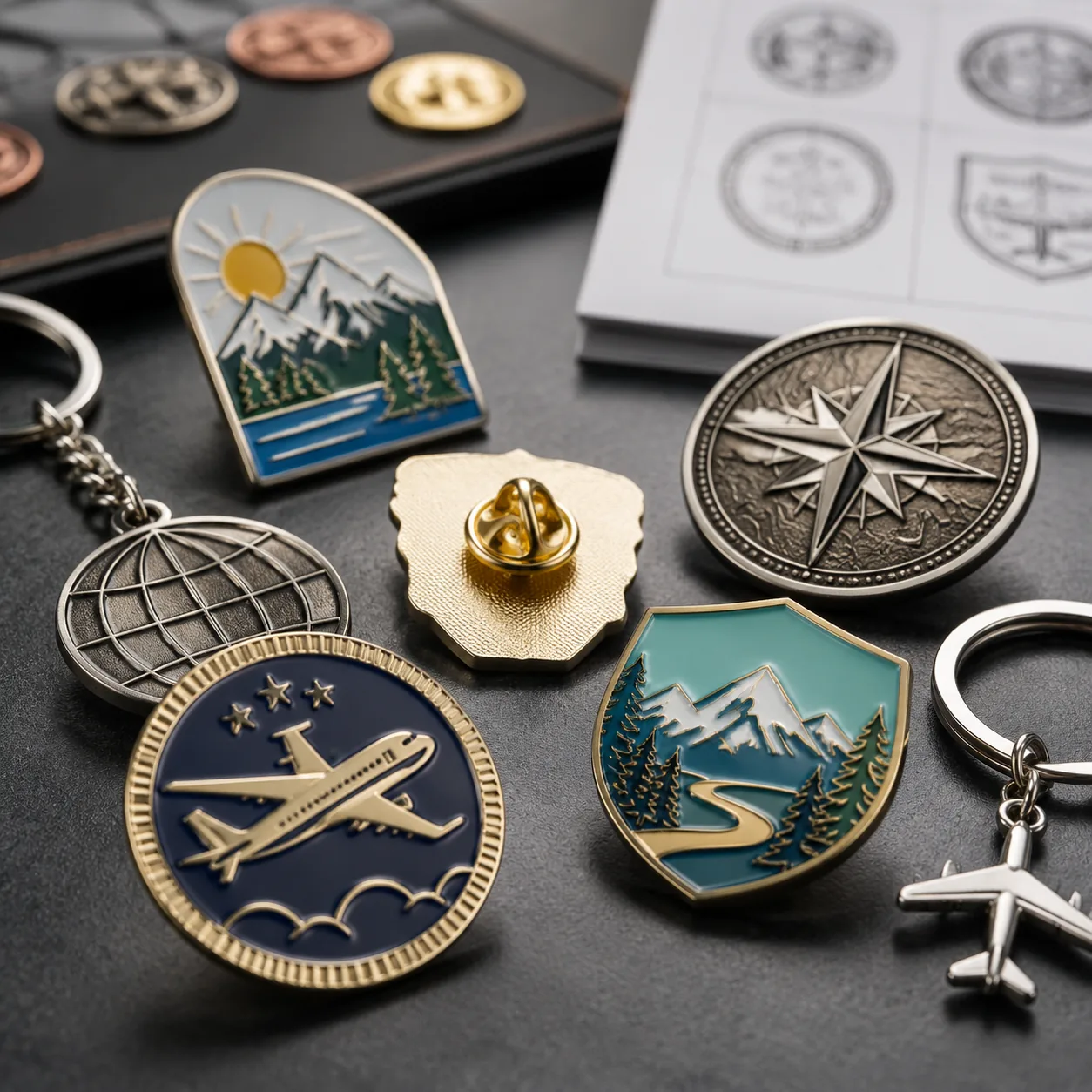
Why do mixed promo sets fail at approval?
The most common failure in a mixed promotional set is not the decoration method. It is spec drift. A pin, coin, patch, and lanyard can all carry the same artwork and still fail as a set because each process has different limits for thickness, line detail, color reproduction, edge behavior, and assembly. If those limits are not written down before sampling, the first round often comes back visually close but mechanically inconsistent.
The buyer problem is straightforward: one brand system is being translated through four manufacturing routes. A hard-enamel pin may hold a 0.20 mm line, a woven patch may need 1.0 mm minimum text, and a dye-sublimated lanyard may shift slightly on polyester webbing depending on heat, ink load, and fabric weave. A spec sheet has to separate what must stay identical from what must vary by product. The cleanest approvals happen when buyers treat the campaign as one visual system and assign process limits per SKU instead of forcing one generic tolerance across all items.
- Use one master artwork file with product-specific callouts.
- Lock shared brand items first: logo geometry, Pantone targets, approved copy, and finish family.
- Allow process-specific tolerances for thickness, edge radius, and color shift.
- Ask the factory to confirm where each SKU will diverge, not only where it matches.
What should stay identical across the whole set?
Q: Which specs should be identical across pins, coins, patches, and lanyards? The parts that define brand recognition, not the parts that depend on machinery. Keep logo proportions, copy, date format, approved Pantone references, and packaging hierarchy consistent. If the set is tied to an event or campaign, also lock the visual tone: for example, polished gold across the metal items, or one navy base across textile items.
A good rule is to define one visual master and then map each product to it. That preserves campaign identity without pretending the processes are the same. For example, a pin may use hard enamel with polished nickel plating at roughly 0.1 to 0.2 microns over brass, while a coin may use antique brass with recessed sandblasting and a raised rim. The brand still reads as one system because icon geometry, color family, and finish direction are controlled together. This is the right approach when buyers need one coordinated set but do not want to over-specify each SKU into a poor manufacturing fit.
| Shared element | Recommended control | Why it matters |
|---|---|---|
| Logo geometry | Master vector file and locked ratio | Prevents shape drift across product types |
| Brand colors | Pantone target plus acceptable delta note | Avoids mismatched reds, blues, and neutrals |
| Text content | One approved copy deck | Prevents spelling and date errors |
| Finish family | Gloss, matte, brushed, or antique callout | Keeps the set visually coherent |
| Packaging language | Same logo placement and front-panel hierarchy | Reduces buyer-side presentation inconsistency |
Which specs must be product-specific?
Q: What should never be copied blindly from one item to another? Anything tied to material behavior. Metal products need thickness, relief depth, minimum line width, and plating direction. Textile products need fabric weight, weave density, stitch density, and print method. Lanyards also need safety breakaway, attachment hardware, and seam strength, which have no direct equivalent in a pin or coin spec.
This is where rework usually starts. A buyer may ask a patch to match a pin by color count, then discover the embroidery file cannot hold a 0.8 mm highlight or a 0.6 mm serif. Or they may ask a lanyard to mimic a coin’s dark antique accent, only to find the woven surface reads it as flat gray. Product-specific specs should be treated as process constraints, not preferences. The more detailed the decoration, the more important it is to state what the process can actually hold.
| Product | Specs you must state | Typical working range |
|---|---|---|
| Custom pins | Thickness, plating, line width, fill depth | 1.0 to 2.5 mm; 0.10 to 0.20 micron plating; 0.20 mm minimum line for hard enamel |
| Custom coins | Rim style, relief, edge finish, weight | 2.0 to 3.5 mm; 1.0 to 2.5 mm relief; 20 to 45 g; serrated, rope, or flat edge |
| Patches | Backing type, stitch density, border width | 2.5 to 4.5 mm border; heat-cut or merrowed edge; 75 to 120 stitches per cm depending on art |
| Lanyards | Width, print method, hardware, safety release | 10 to 25 mm width; 1- or 2-sided print; 22 to 50 cm finished length; safety breakaway optional |
How do you build one RFQ without confusing factories?
Q: Can one RFQ cover several products? Yes, if it is structured like a master brief with product appendices. Start with a shared campaign section that defines artwork, color references, ship-to destination, carton standard, and target in-hands date. Then create a separate block for each SKU with dimensions, materials, finish, attachment, target quantity, and packaging. That prevents a factory from quoting the set as if all items share one production route.
The best RFQs also state what is fixed and what is open to recommendation. You can fix the logo, color family, and delivery date, but still allow the factory to recommend whether the coin should be stamped, die-cast, or double-sided relief based on relief density and target weight. The main benefit is lower quote variance and fewer surprise adders after sampling, because the supplier has priced the real process complexity from the start.
- State one final quantity per SKU, not only a total set quantity.
- Separate must-match brand elements from factory-discretion elements.
- Include reference photos for each item type, not just one mood board.
- Ask for itemized lead times in days so the longest process is visible early.
- Request packaging and assembly confirmation if the items ship as a set.
What specs and price ranges are realistic by product?
Q: What should a buyer expect for MOQ, lead time, and FOB price? The market varies by decoration complexity, finish count, and packing requirements, but there are dependable working ranges. Knowing these ranges helps you spot unrealistic quotes before sampling starts. A pin with full epoxy color and a butterfly clutch has a very different cost structure from a woven patch or a screen-printed lanyard, so the cheapest item in the set should not be used as a benchmark for the whole order.
The numbers below are practical starting points for custom promotional production at standard factory quality. They are not universal, but they are close enough to flag outliers. If a quote falls far below these bands, check whether it excludes mold, plating upgrades, thread count, backing, packaging, or any pre-production sample fee. For inspection, most routine visual defects are accepted against AQL 2.5, while critical fit or safety issues should be treated more strictly by buyer spec.
| Product | Typical MOQ | Typical lead time | FOB price range (USD) | Key tolerance/quality note |
|---|---|---|---|---|
| Soft or hard enamel pin | 100 to 300 pcs per design | 12 to 18 days after proof approval | $0.65 to $2.40 | Thickness ±0.2 mm; plating 0.10 to 0.20 micron; visual defect target AQL 2.5 |
| Challenge coin | 100 to 200 pcs per design | 15 to 22 days after proof approval | $1.20 to $4.80 | Thickness ±0.15 mm; relief depth ±0.2 mm; edge and surface scratches checked to AQL 2.5 |
| Embroidered patch | 200 to 500 pcs per design | 10 to 16 days after artwork approval | $0.35 to $1.60 | Border width ±0.5 mm; stitched fill coverage should close 95%+ of intended area |
| Polyester lanyard | 100 to 500 pcs per design | 8 to 14 days after print approval | $0.18 to $0.95 | Width tolerance ±1 mm; seam pull strength typically 15 to 20 kg; AQL 2.5 for print defects |
When should you accept differences between items?
Q: Is perfect uniformity always worth the cost? No. Some differences are necessary. A patch needs a softer visual edge than a pin because thread cannot hold the same geometry as metal. A lanyard may use screen print or dye sublimation for cost and speed, while a coin uses antique plating for depth. The goal is controlled consistency, not identical manufacturing behavior.
Buyers should accept differences when forcing uniformity would raise failure risk, extend lead time, or push the item into an inefficient construction. Forcing tiny text into embroidery can produce unreadable fuzz or broken stitches. Forcing a lanyard weave to imitate a glossy metal gradient can produce muddy color blocks and inconsistent registration. In a mixed set, the right trade-off is usually to preserve brand recognition while letting each process do what it does best.
| Question | If yes, allow variation | If no, tighten control |
|---|---|---|
| Does the process have a natural color limitation? | Accept a small visual shift | Hold the same Pantone target and finish family |
| Will the required detail exceed the process limit? | Simplify artwork locally | Revise the master artwork |
| Does matching the other item add cost without brand gain? | Use process-appropriate finish | Keep the specification strict |
| Will forcing uniformity increase defect risk? | Relax that one spec | Escalate to engineering review |
What checklist prevents rework before sampling?
Q: What should a buyer verify before approving samples? Start with the things that are expensive to change later. Artwork scaling, thickness, closure method, backing, edge treatment, and packaging insert all deserve review before mass production. The sample should prove that the design survives the chosen process, not just that it looks good in a render.
A practical checklist is better than a long narrative approval note because it forces decision points. If your team includes procurement, marketing, and operations, the checklist also exposes hidden assumptions, such as whether the same logo file is being used everywhere or whether one team expects retail packaging while another expects bulk-packed cartons. Mark each line as approved, revised, or not applicable so the supplier knows what is still open.
- Confirm each SKU has a separate spec line.
- Check minimum line width against the weakest process.
- Approve Pantone targets and note any acceptable variance.
- Verify attachment, backing, and safety requirements.
- Confirm assembly order and carton packing method.
- Record whether sample changes apply to all SKUs or only one.
- Lock the delivery sequence if items ship together.
How do you compare quotes from different suppliers?
Q: Why do quotes look similar at first but diverge later? Because some suppliers quote only the easiest item and assume the rest can be aligned later. Others include detail up front, which makes the unit price look higher but often saves you from surprise tooling charges, repacks, or color corrections. For mixed sets, compare total landed value, not single-item unit price.
The useful comparison is not just price per piece. It is MOQ, sample fee policy, lead time in days, whether packaging is included, and whether each SKU has separate tooling ownership. A lower quote can be expensive if it comes with vague sample limits or a forced retool on the second order. It is also worth asking for defect handling terms: a supplier working to AQL 2.5 with a clear rework policy is usually more reliable than one quoting a slightly lower unit cost with no inspection standard stated.
| Quote factor | Supplier A | Supplier B | What to check |
|---|---|---|---|
| MOQ per SKU | 200 | 500 | Can you meet the smallest MOQ across all items? |
| Sampling lead time | 7 days | 12 days | Does the slowest sample fit the launch date? |
| Tooling ownership | Buyer-owned | Factory-owned | Can you reorder without lock-in risk? |
| Packaging included | No | Yes | Are inserts, bags, and assembly extra? |
| Color approval | Photo only | Physical sample | Is the approval method strong enough? |
| Inspection standard | Not stated | AQL 2.5 | Can you compare defect acceptance on equal terms? |
What to do next?
Q: If the set is already in development, what is the fastest path to fewer errors? Turn the current brief into a one-page master spec plus one appendix per SKU. Then ask the factory to confirm the shared brand rules, the item-specific process limits, and the approval sequence in writing. That one move usually prevents the late-stage mismatch that causes delayed launches, partial rework, and split shipments.
If you want a clean first pass, send three things: the master artwork, the target quantity by item, and the packaging plan. The supplier can then split the quote and sample path by product while keeping the campaign identity aligned. The goal is not to make every item identical. The goal is to make every item look intentionally designed together when the buyer opens the carton.
Have a project? Send your artwork and target quantity and we’ll reply with a detailed quotation within 12 working hours.
Ready to get this made?
Send your sketch, target quantity and ship-date. Detailed quotation in 12 hours.



