Can One RFQ Cover Pins, Coins, Patches and Lanyards?
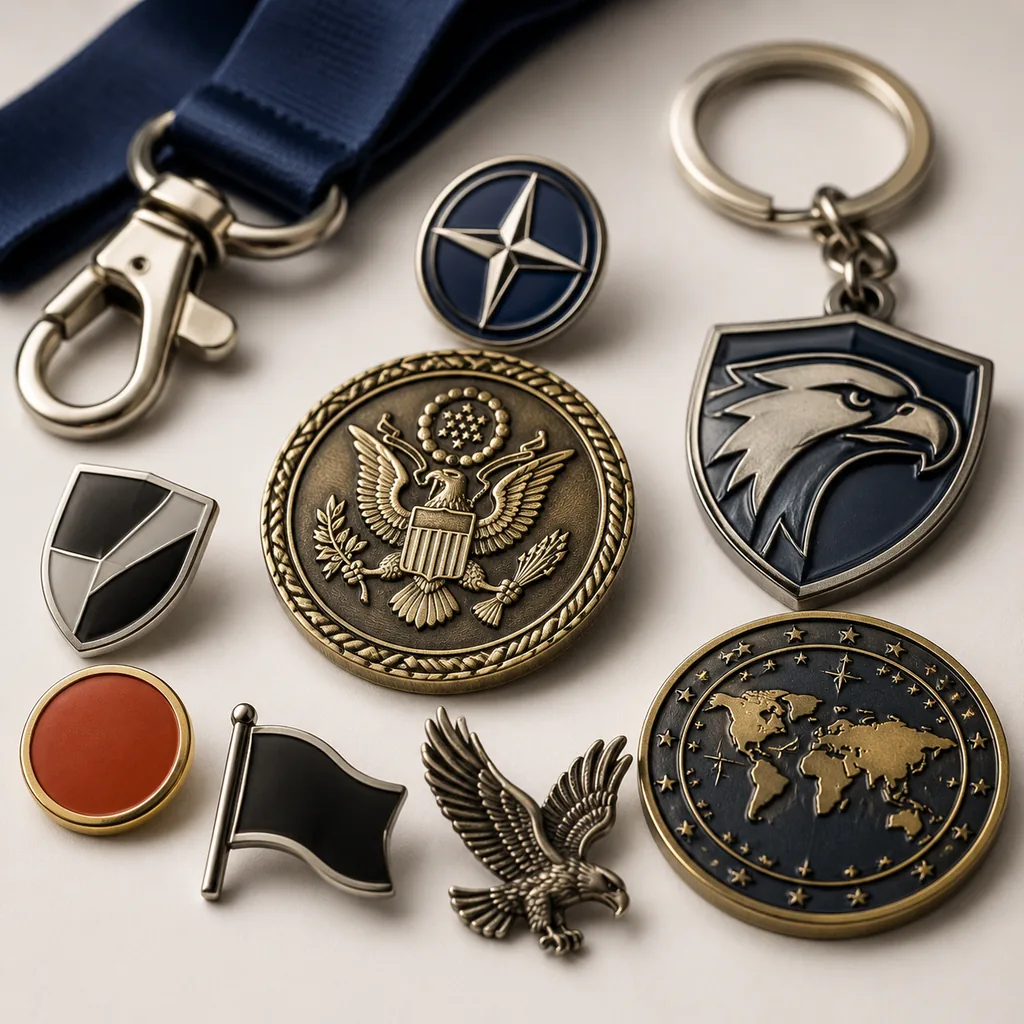
Q1: Can one RFQ cover different promo products?
Yes — one RFQ can cover mixed promo items, but only if you separate commercial terms from technical specs. Buyers often bundle pins, coins, patches, and lanyards into one request and then receive quotes that cannot be compared because each supplier assumed different materials, tooling, packaging, or inspection levels. The clean approach is one cover sheet for the order and one spec block per SKU.
A single campaign might include 1,000 hard enamel pins, 500 die-struck coins, 2,000 woven patches, and 3,000 printed lanyards. Those items can share the same ship-to country, Incoterm, artwork owner, target delivery date, and payment terms, but they should not share one technical description. A 25 mm pin and a 75 mm patch do not have the same process risk, MOQ logic, or unit-cost structure.
The RFQ should also state whether it is a first run or a reorder. First runs usually include tooling, pre-production sampling, and artwork confirmation; reorders may only need color confirmation and a sample reference. On low-volume custom goods, that distinction can move the quote by 10% to 35%.
- Use one cover sheet for all items: destination, Incoterm, target ship date, payment terms, and currency.
- Create one spec sheet per SKU with size, material, finish, packaging, and artwork files.
- Ask suppliers to separate tooling, sample, and mass-production pricing.
- Require all quotes in USD under the same Incoterm, ideally FOB or EXW only if your freight team controls pickup.
- State clearly whether tooling ownership stays with the buyer or the factory.
Q2: What can be shared across all items?
The shared layer of the RFQ should cover logistics, quality gates, and documentation, not geometry. Common terms include carton labeling, barcode format, master carton quantity, declared commodity description, inspection method, and approval flow. These are the items that affect receiving, freight booking, and whether your warehouse can process all SKUs consistently.
For mixed promo orders, it is reasonable to standardize the carton philosophy across the campaign. For example, you might require 1 piece per polybag, 50 to 100 pieces per inner carton, and master cartons capped at 18 to 20 kg gross weight. That keeps freight costs predictable and reduces crush risk for softer items like patches or lanyards.
Quality settings can also be shared, but only at the process level. A practical baseline is pre-shipment inspection to AQL 0 for critical defects, 2.5 for major defects, and 4.0 for minor defects, unless the product is retail-facing and your buyer standard is stricter. If the order includes gift packaging, you may also want a drop test requirement and carton compression tolerance stated in advance.
| Shared Spec | Why It Matters | Typical Buyer Note |
|---|---|---|
| Incoterm | Defines who pays freight and where risk transfers | Use the same Incoterm across all SKUs so pricing is comparable |
| AQL target | Sets the acceptance threshold for inspection | Common baseline: Critical 0, Major 2.5, Minor 4.0 |
| Carton packing | Affects damage rate and freight efficiency | State pcs/inner and max gross weight per carton |
| Artwork format | Prevents redraw delays and color drift | Supply vector files plus Pantone references |
| Sample approval | Stops mass production from starting too early | Require golden sample approval before bulk |
Q3: Which specs must never be combined?
Do not combine construction specs that drive different production methods. A coin, a pin, a woven patch, and a lanyard can look similar in artwork but still require completely different tooling and process settings. If you write a vague line such as “mixed metal promo items, same quality,” the factory will have to guess on die casting, stamping, plating thickness, thread count, print method, and edge finish.
The most common mistake is assuming one dimension note can cover all products. A 30 mm hard enamel pin may need 1.2 to 1.5 mm thickness and 0.03 to 0.05 mm plating, while a 38 to 45 mm challenge coin usually needs 3.0 to 4.0 mm thickness and a relief decision for both sides. A woven patch can hold fine detail that a molded metal badge cannot, but it has limits on thread density and edge definition. Those are not interchangeable specs.
Textile products also need their own tolerance logic. Lanyards often use 15 to 20 mm width with ±1 mm cut tolerance and print registration tolerance around ±0.5 mm to ±1.0 mm depending on the process, while patches may need size tolerance of ±2 mm on smaller shapes. Metal items are usually tighter on thickness and plating consistency than textiles, but looser on surface texture because of the finishing method.
- Do not combine thickness, plating, and backing in one generic line.
- Do not reuse a pin spec as a coin spec, even if the artwork is identical.
- Do not assign one tolerance note to both rigid metal and flexible textile items.
- Do not assume the same color standard applies to enamel, print, and woven thread.
- Do not let packaging requirements override product-safe dimensions.
Q4: How should you compare supplier quotes?
Compare quotes only after normalizing the spec set. That means same size, same artwork, same finish, same packaging, same tolerance requirement, and same delivery term. If one supplier quotes FOB Shenzhen and another quotes EXW, the numbers are not directly comparable because inland handling and export costs may be embedded differently.
A useful quote sheet should break out one-time and recurring costs. Ask for mold or tooling cost, sample cost, unit price by quantity tier, plating surcharge, special-effect surcharge, and packaging surcharge. If any supplier bundles those into one number, you risk underestimating the true landed cost by 8% to 20% on low-volume mixed orders.
Use quantity tiers to expose the real price curve. For example, a metal pin might price at USD 0.78 to 1.30 FOB at 500 pcs, USD 0.55 to 0.95 at 1,000 pcs, and USD 0.40 to 0.72 at 3,000 pcs, depending on complexity and plating. A challenge coin may sit around USD 1.60 to 3.50 FOB at 500 pcs and USD 1.10 to 2.40 at 2,000 pcs. Lanyards are usually much lower, often USD 0.18 to 0.65 FOB depending on print method, width, and hardware.
| Quote Item | Low-Cost Trap | What to Verify |
|---|---|---|
| Tooling | Too cheap to be real | Confirm mold ownership, cavity count, and lifespan |
| Unit price | Low only at large MOQ | Check 500, 1,000, and 3,000 pcs tiers |
| Packaging | Quoted as bulk only | Ask for polybag, retail card, and gift-box options |
| Lead time | Starts after sample approval | Define calendar days, not working days |
| Inspection | Not included | Confirm whether pre-shipment inspection is extra |
Q5: What MOQ and lead time should you expect?
MOQ behavior depends on product type and the amount of setup work behind it. Simple custom metal items often become economical around 100 to 300 pcs per SKU, but most factories quote more comfortably at 300 to 500 pcs when the job involves enamel fill, multi-color plating, or custom backing cards. Woven patches and printed lanyards may have lower visual setup costs, but they still need enough volume to absorb screen setup or weave programming.
A realistic lead time for first-run mixed promo orders is usually 18 to 30 calendar days after artwork and sample approval. Simple reorder metal items can move in 12 to 18 days, while patches and lanyards may need 15 to 25 days depending on print method, edge finish, and packing style. Add 5 to 10 days if the campaign needs revised artwork, multiple approval rounds, or special retail packaging.
Treat lead time as a chain, not a single number: tooling, pre-production sample, bulk production, inspection, packing, and consolidation can each add time. If one SKU is delayed, the whole shipment may miss the event date. For hard deadlines, build at least one buffer week into the plan and ask the supplier for a schedule by SKU instead of one blended timeline.
- Ask each supplier for lead time by SKU, not one blended timeline.
- Confirm whether the clock starts at deposit, artwork approval, or sample approval.
- Request a schedule for tooling, sampling, mass production, and packing.
- Build in one correction round for artwork or color issues.
- Avoid urgent combined orders unless all artwork is already frozen.
Q6: What spec ranges should buyers lock?
The useful RFQ ranges are the ones that drive fit, feel, and rework risk. For metal items, lock size, thickness, plating finish, and attachment type. For textiles, lock width, backing, print or weave method, and edge finish. For any item with tight visual branding, include Pantone targets and a tolerance note so the supplier knows where the appearance must stay consistent.
These are practical starting ranges, not universal standards. They work well for common promo campaigns and give factories enough information to price without overengineering the request. If the item is premium retail quality, increase the finishing requirement and say so explicitly, especially for plating, edge trimming, and packaging presentation.
| Item Type | Core Specs to Lock | Practical Buyer Range |
|---|---|---|
| Enamel pin | Size, thickness, plating, attachment | 25-35 mm; 1.2-1.5 mm thick; 0.03-0.05 mm plating |
| Challenge coin | Diameter, rim, relief, finish | 38-45 mm; 3.0-4.0 mm thick; raised or recessed rim |
| Patch | Size, backing, edge, method | 70-90 mm; iron-on or hook-and-loop; merrowed or laser cut |
| Lanyard | Width, print method, hardware | 15-20 mm width; screen print or sublimation; breakaway if needed |
| Keychain | Body thickness, ring, finish | 35-50 mm body; split ring or lobster clip |
If you need tighter control, add tolerances directly to the RFQ. Typical practical values are ±0.2 mm to ±0.3 mm for small metal dimensions, ±0.5 mm for coin diameters in normal production, ±1 mm on lanyard width, and ±2 mm on patch dimensions depending on shape and edge style. Those figures are enough to stop factories from quoting against an unrealistically vague target.
Q7: What should your checklist include before you send the RFQ?
The fastest way to get usable quotes is to send a complete package on the first pass. Missing artwork, vague packing, and undefined delivery dates force suppliers to pad pricing or delay their response. A disciplined checklist reduces quote noise more than arguing over a few cents of unit price.
- Final vector artwork with dimensions marked and all text outlined.
- Pantone references or approved color standards for each SKU.
- One spec sheet per item with material, size, finish, backing, and packaging.
- Required quantity per SKU plus any quantity-price breakpoints.
- Packaging requirement, including polybag, retail card, or gift box.
- Destination port, delivery term, and target arrival date.
- Inspection standard, sample approval rule, and defect handling.
- Whether tooling belongs to the buyer or the supplier.
What to do next
If you are sourcing a mixed campaign, split the RFQ into one commercial cover sheet and separate technical sheets for pins, coins, patches, lanyards, or other SKUs. Keep the shared terms identical, but never force one product description to cover metal, textile, and printed items at the same time.
If you want the process cleaner, turn that structure into a supplier-ready template with line-by-line fields for quantities, tolerances, packaging, inspection, and quote tiers. That usually cuts clarification emails, makes factory quotes easier to compare, and lowers the risk of sample-round surprises.
Have a project? Send your artwork and target quantity and we’ll reply with a detailed quotation within 12 working hours.
Ready to get this made?
Send your sketch, target quantity and ship-date. Detailed quotation in 12 hours.



