Can One Promo Design Work Across Pins, Coins, Patches?
Q: When does one design become a production risk?
One promo design becomes risky when the artwork file is treated as the manufacturing specification. A 30 mm enamel pin, 45 mm challenge coin, 75 mm woven patch, 20 mm lanyard and 60 mm epoxy magnet can share a campaign identity, but they cannot share identical line weights, color limits, edge construction, attachment placement or inspection criteria. Each process translates the same logo through different constraints: raised metal walls, recessed enamel cells, die-struck relief, thread density, woven yarn, sublimation ink, webbing stretch, adhesive lamination or magnet pull strength.
The problem usually appears after the quote. A supplier may accept a vector file, then flag open enamel cells, unreadable 3 mm text, weak pin posts or impossible stitch detail during pre-production. In worse cases, the factory silently thickens lines, deletes small copy or changes colors to fit its material library. That creates second samples, tooling revisions, brand approval delays and cost increases that were not visible in the first offer.
The safer rule is to reuse the brand system, not the same mechanical artwork. Lock the master visual first: logo proportions, color hierarchy, required text, preferred silhouette and elements that may be simplified. Then issue one production-ready variant per item. ZheCraft sees the cleanest mixed programs when buyers separate brand intent from process engineering before tooling starts.
Q: Which products can share the same artwork logic?
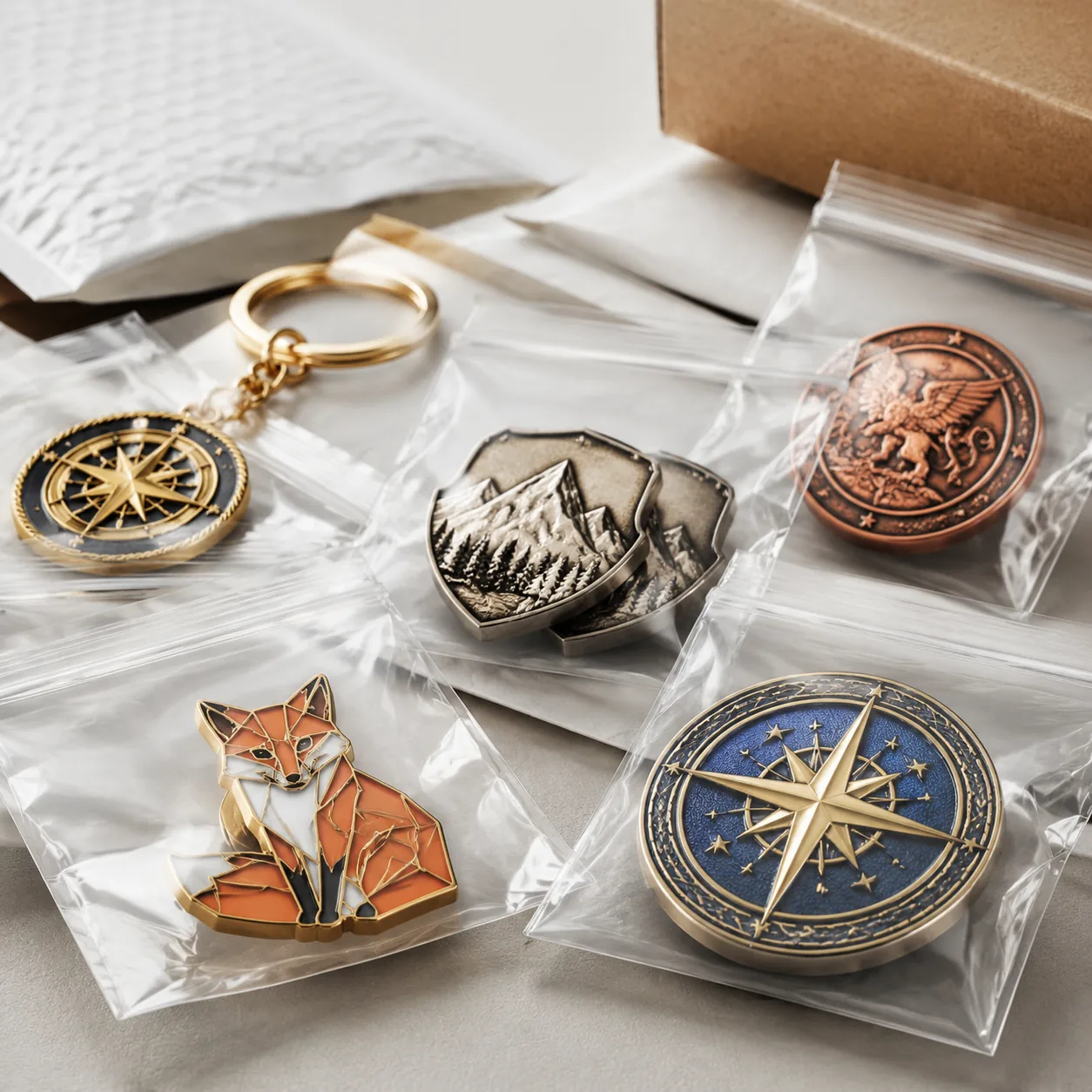
Pins and coins share the closest production logic. Both can use metal bases, raised borders, recessed color areas, plating and optional antique finish. A simple mascot, shield or event badge can often keep the same outer silhouette across both. The difference is scale and relief. A 25 to 35 mm pin usually needs heavier metal walls and fewer internal islands. A 40 to 50 mm coin can carry perimeter text, textured fields, 2D relief or 3D sculpted detail, but very fine color fills may be better converted into metal texture.
Patches and lanyards need more interpretation. Embroidered patches are limited by thread thickness, stitch direction and fabric movement. Woven patches hold finer detail than embroidery, but tiny serif letters still soften. Sublimated lanyards can print gradients and small logos, yet the file must account for cut length, seam allowance, clip foldover, safety breakaway position and repeat spacing. Magnets vary by construction: printed epoxy magnets reproduce full-color art well, while die-struck metal magnets behave more like badges.
Run a smallest-detail test before approving one shared concept. For soft enamel pins, keep raised metal walls at 0.25 to 0.30 mm minimum and enamel channels at 0.35 mm or wider. For hard enamel, use 0.30 mm or wider polished metal lines to reduce polishing loss. For die-struck coins, fine relief lines are safer at 0.35 to 0.50 mm than hairline engraving. For woven patches, positive text should be about 5 mm cap height or larger; embroidered text usually needs 6 to 8 mm. For lanyards, 300 dpi sublimation can print fine marks, but logos under 8 to 10 mm high often lose legibility once sewn and worn.
Q: What should stay consistent across the set?
A mixed promo set needs a brand control sheet before item-level specs. The sheet should lock logo proportions, Pantone targets, color priority, clear-space rules, minimum readable text size by viewing distance and prohibited substitutions. It should also state whether the outline is part of the brand. If a shield, mascot head or campaign badge changes shape from pin to patch, the set may look mismatched even if the central logo is correct.
Do not over-control material behavior. Pantone 186 C in enamel, polyester thread, sublimation ink and plated metal will not look identical under the same light. The practical target is controlled consistency, not impossible sameness. Define which color must match closely, which colors may be visually matched, and which effects are material-specific. Gold plating, metallic thread, printed gold and antique brass are different visual languages.
| Spec field | Set-level control | Product-level adjustment |
|---|---|---|
| Logo proportions | Keep fixed unless legibility fails | Simplify internal detail without changing the main mark |
| Primary colors | Use Pantone C/U targets and approved hierarchy | Match to enamel, thread, yarn or ink libraries; approve physical chips |
| Minimum text | Define by viewing distance and usage | Increase text size for patches, small pins and lanyards |
| Outer silhouette | Keep consistent for recognition | Add coin rims, patch borders or magnet bleed without changing the profile |
| Line weight | Control visual hierarchy | Use 0.25-0.30 mm enamel walls; 0.35-0.50 mm coin relief lines |
| Attachment zone | Control placement intent | Shift for clutch posts, magnet backs, hook-and-loop or lanyard clips |
| Packaging | Define set presentation | Adjust backing cards, OPP bags, kit cartons or retail boxes by SKU |
Q: What must change by product type?
Each product needs its own mechanical file and quote line. For pins, specify size, plating, enamel type, metal wall thickness, post count and backing. A 30 mm soft enamel pin with nickel plating and one butterfly clutch is not the same product as a 35 mm hard enamel pin with black dye plating, epoxy coating and two posts. Close all enamel cells, avoid unsupported islands and keep outer borders thick enough for polishing and handling.
Challenge coins need relief planning. Common sizes are 40 to 50 mm diameter and 3.0 to 4.0 mm thickness. Define 2D relief, 3D sculpting, edge style, plating, antique wash and enamel areas. Rope, reeded, diamond-cut and oblique edges change both cost and artwork space. Perimeter text normally needs wider spacing than screen artwork because the rim compresses visual detail.
Patches need stitch engineering. Embroidery works well for bold marks and large lettering, but full-coverage embroidery raises cost and can warp the fabric. Woven patches suit detailed crests and smaller type. Typical finished thickness is about 1.0 to 1.8 mm depending on backing. Merrowed borders are durable but rounded; heat-cut or laser-cut borders hold sharper custom shapes. PVC patches are another option when raised relief, weather resistance and bright color blocks matter more than textile feel.
Lanyards need layout engineering. Standard widths are 10, 15, 20 and 25 mm, with 20 mm common for corporate use. Screen printing suits simple one- or two-color designs. Heat transfer and sublimation suit full-color art. The file should show total cut length, foldover allowance, clip type, breakaway location and whether the logo repeats one-way, two-way or alternates with sponsor marks.
- Pins: confirm 25-35 mm size, 0.25-0.30 mm minimum metal walls, plating, enamel type, post count and clutch style.
- Coins: confirm 40-50 mm diameter, 3.0-4.0 mm thickness, 2D or 3D relief, edge style, antique finish and enamel fill areas.
- Patches: confirm embroidered, woven or PVC build; 50-100 mm size; border type; backing; thread or PVC color count.
- Lanyards: confirm 10-25 mm width, 900 mm common finished loop length, print method, repeat spacing, breakaway and clip hardware.
- Magnets: confirm printed, PVC or metal face; 0.4-1.0 mm magnet thickness; lamination; pull-force target; backing alignment.
Q: How do you prevent color drift?
Color drift is normal across enamel, thread, ink, PVC and yarn. The procurement mistake is asking for an exact match without defining the approval method. A stronger RFQ states the Pantone target, material library, acceptable deviation and required sample. For printed goods, Delta E can be useful: under 2 is tight, under 3 is usually acceptable for brand work, and 4 to 5 may be practical on textured fabric. For enamel, thread and PVC, approved physical chips or lab dips are more reliable than screen comparison.
Create a color hierarchy. Brand-critical colors should be matched first on items likely to be compared side by side, often pins and coins on the same backing card. Secondary colors can be adjusted on patches and lanyards if the logo reads correctly at normal viewing distance. If the design uses metallic effects, define the intent: reflective plated metal, warm yellow print, antique brass tone or metallic thread. These should not be approved as interchangeable finishes.
Approve colors under the lighting where the items will be used. Daylight, office fluorescent light and warm retail lighting can make the same navy, red or gray look different. For programs above roughly USD 5,000 or with strict brand control, request one pre-production sample per process and photograph the set together with the intended packaging before mass production.
Q: What should the RFQ include?
A useful RFQ separates the master brand brief from item-level requirements. The master brief explains the campaign, artwork priority, required delivery date, packout and must-match colors. Item sheets define size, material, process, attachment, packaging and inspection. This prevents the supplier from quoting a low base version and later adding charges for details that were implied but not specified.
Quote by SKU, not only by total program volume. A 5,000-piece order split across 10 designs does not price like one 5,000-piece design. Tooling, setup, sampling, color changes and packing are usually driven by SKU count. If the design family includes different names, dates, regions or team numbers, state whether those changes require separate molds, printed inserts or digital artwork swaps only.
- Send editable vector art plus a flattened PDF or PNG reference for comparison.
- List dimensions in millimeters for each item, including thickness where relevant.
- Mark mandatory elements, removable details and approved simplification rules.
- Specify Pantone targets, physical color references and allowed visual matches.
- State MOQ target by SKU, reorder forecast and whether mixed colors are allowed.
- Request separate pricing for tooling, samples, mass production, packaging and freight.
- Ask for sample lead time, production lead time and the approval cutoff date in calendar days.
- Define packout: individual polybag, backing card, OPP bag, retail box, kit carton or bulk pack.
Q: What cost, MOQ and lead-time ranges are realistic?
Mixed promo programs have different cost drivers by item. Metal pins and coins are tooling-sensitive but efficient at scale. Patches are driven by size, stitch density, backing and color count. Lanyards are driven by width, print method, hardware and one-sided versus two-sided printing. Magnets depend on face material, magnet grade, thickness, lamination and shape.
| Item | Typical MOQ per design | FOB China unit range | Tooling/setup | Sample days | Production days |
|---|---|---|---|---|---|
| Soft enamel pin, 25-35 mm | 100; better breaks at 300/500/1,000 | USD 0.38-1.35 | USD 45-90 mold | 5-8 | 10-18 |
| Hard enamel pin, 25-35 mm | 100; better breaks at 300/500/1,000 | USD 0.55-1.80 | USD 50-100 mold | 6-10 | 12-22 |
| Challenge coin, 40-50 mm | 100; better breaks at 300/500/1,000 | USD 1.20-4.50 | USD 80-220 mold | 7-10 | 14-25 |
| Embroidered or woven patch, 50-100 mm | 50-100; better breaks at 300/500 | USD 0.28-1.80 | USD 20-60 setup | 5-7 | 8-18 |
| Printed lanyard, 15-20 mm | 100-300; special hardware 500+ | USD 0.20-0.95 | Often USD 20-50 setup | 3-6 | 7-15 |
| Custom magnet, 40-80 mm | 100-300 | USD 0.18-1.20 | USD 20-80 by construction | 4-7 | 7-14 |
These are practical FOB reference ranges, not fixed quotes. Add cost for epoxy doming, double-sided coin relief, premium clips, individual backing cards, retail barcode labels or custom kit cartons. Custom packaging usually adds 3 to 7 production days after artwork approval. Third-party inspection, CPSIA-related paperwork or retailer compliance labeling can add more time.
Q: What quality checks belong in the PO?
The purchase order should read like an inspection plan. Include approved artwork revision, dimensions, tolerance, color standard, material, finish, attachment test, packaging count and AQL level. Without those fields, an inspector can only compare against a general sample, which is weak control when one set contains several manufacturing processes.
Use realistic tolerances. For small metal pins, ±0.3 mm for length and width and ±0.2 mm for thickness are common unless the item must fit a fixture. For coins, ±0.3 to ±0.5 mm may be acceptable depending on diameter and edge style. For patches, ±1.0 to ±2.0 mm is more realistic because fabric and heat-cut edges move. For lanyards, finished length tolerance is commonly ±10 mm, with print repeat and logo placement checked separately. For magnets, check thickness because a 0.4 mm magnet and 0.8 mm magnet feel very different in pull strength.
For inspection, many B2B promo orders use AQL 2.5 for major defects and AQL 4.0 for minor defects. Tighter retail or executive gift programs may use AQL 1.0 for critical issues such as wrong logo, broken attachment, sharp edge, severe plating contamination, failed magnet adhesion or incorrect packout. Cosmetic rules should define enamel overflow, missing fill, thread fray, color stain, off-center print, scratched plating and dented packaging.
Functional checks matter as much as appearance. Pin posts should survive a light bend or pull test appropriate to the backing style. Lanyard clips should open and close smoothly, and breakaway buckles should release without cracking. Hook-and-loop patch backing should align within the patch edge. Magnets should hold on a clean vertical steel surface without sliding under normal handling.
What to do next
Start with one master brand sheet and one production sheet per item. Keep the logo hierarchy, color targets and campaign message consistent, then adapt the mechanical artwork for each process. Ask the supplier to mark risky details before quoting tooling; that is when line weights, text size and color separations are cheapest to fix.
For the fastest quote, send vector artwork, quantity per SKU, delivery deadline, packaging plan and must-match Pantone colors in one packet. Ask for FOB unit pricing, tooling charges, sample timing, production timing and MOQ breaks at 100, 300, 500, 1,000 and 3,000 pieces. Approve the product differences before approving the price. That is the simplest way to avoid rework, color disputes and hidden setup costs across pins, coins, patches, lanyards and magnets.
Have a project? Send your artwork and target quantity and we’ll reply with a detailed quotation within 12 working hours.
Ready to get this made?
Send your sketch, target quantity and ship-date. Detailed quotation in 12 hours.



