Can One Mold Serve Multiple SKUs? Tooling Split Rules for 2026
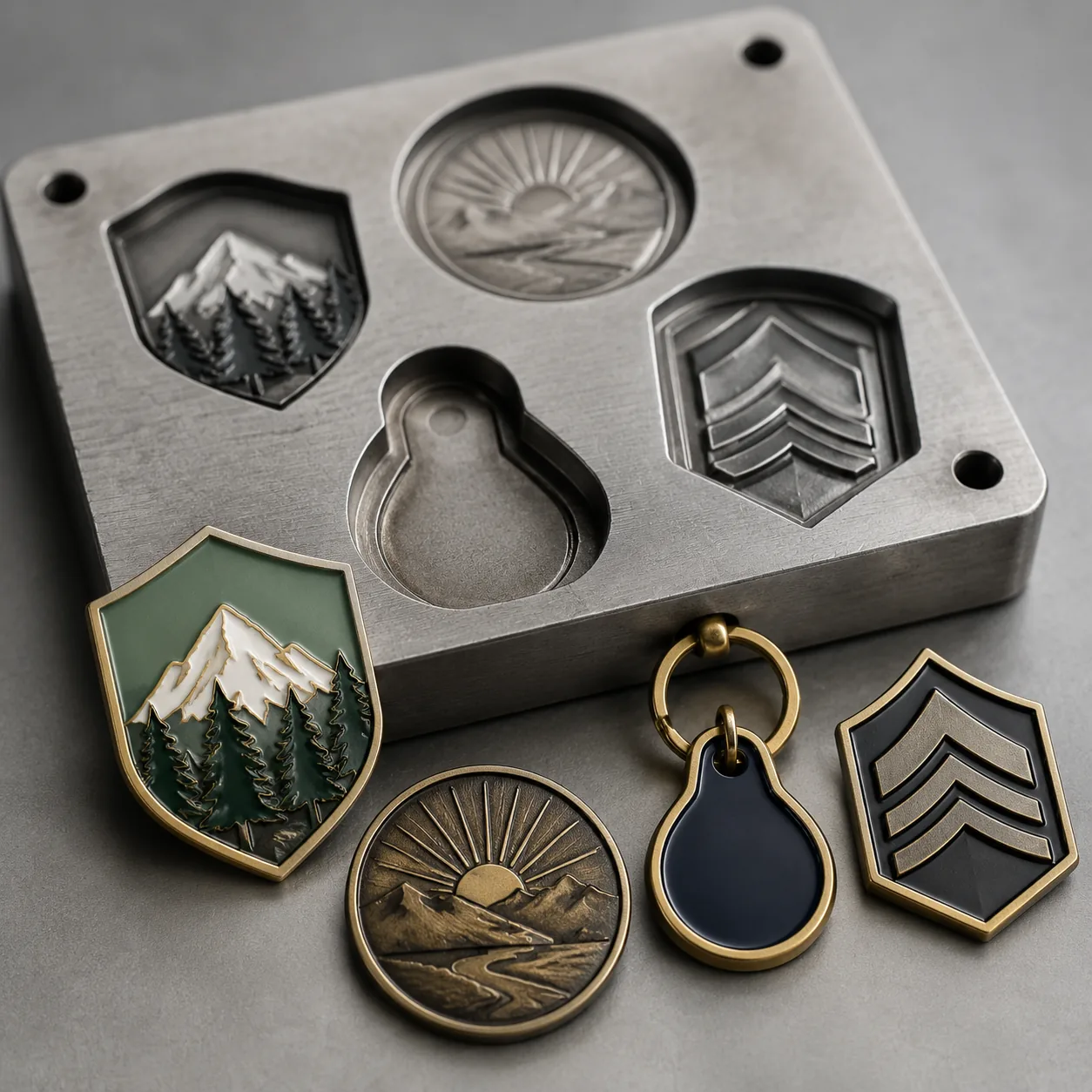
When shared tooling actually lowers total cost
The tooling invoice is only one line in the economics. The real comparison is total landed manufacturing cost across the first run and likely reruns: tool amortization, setup loss, cavity balancing yield, hand sorting, rework, and the cost of keeping each SKU reorderable. One mold makes sense only when all SKUs stay inside the same process family and close enough in geometry to use the same steel hardness, cavity depth, trim path, plating access, and assembly sequence. In practice that means the same base metal, the same forming route, similar relief density, the same nominal thickness, and the same backside construction. A 35 mm stamped iron soft-enamel pin at 1.5 mm thickness should not share tooling with a 35 mm die-cast zinc-alloy bottle-opener keychain at 3.0 mm thickness. The metal flow, shrink behavior, burr profile, deburring method, and hardware loads are different enough that the apparent saving disappears in production.
Typical 2026 FOB tooling prices are tight enough to use as a first screen. A standard stamped die for a 25 to 40 mm iron or brass pin usually runs USD 90 to 180 FOB. Fine-detail stamped dies with internal cutouts, multiple welded posts, or text strokes near the lower process limit are more often USD 180 to 300. A zinc-alloy die-cast mold for a 40 to 60 mm keychain, charm, or magnet is commonly USD 220 to 480, while multi-slide tools, bottle-opener geometries, or high-relief cavities can reach USD 550 to 900. If a family tool saves only USD 70 to 150 against separate tools but adds USD 0.03 to 0.10 per piece in sorting, cavity-specific QC, balancing loss, or partial-rerun inefficiency, that saving is gone by roughly 1,500 to 3,000 pieces.
A workable approval rule is stricter than many suppliers propose. Use shared tooling only when three conditions hold at the same time: first, every variant uses one manufacturing route; second, the tooling saving is at least 25 percent versus separate tools; third, each active SKU has a credible reorder path of at least 300 to 500 pieces per release. If the expected reorder is below that, simpler inspection, easier replenishment, and cleaner traceability usually matter more than a small reduction in the first mold charge.
Which SKU combinations are viable and which should stay separate
The safest shared-tool programs are variants where the metal geometry is fixed and the change happens after forming. One stamped pin outline with different enamel colors, screen prints, or backing cards is the standard low-risk case. The die does the same work every run, and the variant changes happen in fill, print, or packaging. Another viable case is a challenge coin with one common outer ring and interchangeable center inserts, provided the insert seat is controlled within plus or minus 0.05 mm to 0.08 mm, concentricity stays within 0.10 mm, and the press-fit or adhesive method is frozen at sample approval.
For zinc-alloy die casting, family molds can work for charms or keychains only when wall thickness, projected area, cavity volume, and mass balance are close. A practical target is 2.0 to 3.0 mm nominal wall thickness, general dimensional tolerance of plus or minus 0.15 mm to 0.20 mm, local flatness within 0.20 mm on hardware pads, and cavity volume spread within about 10 to 12 percent. Once one cavity introduces thin projections below 1.2 mm, heavier bosses for split rings, deeper undercuts, or much denser relief, fill pattern and polishing behavior separate. That is where one cavity runs cleanly and another becomes a chronic short-fill, porosity, or polishing-loss problem.
Products should stay on separate tools when backside engineering changes the stress path or finishing route. A magnet with a glue pad, a pin with welded posts, and a keychain with a jump-ring boss may share similar front artwork, but they do not share the same mechanical requirements. Post welding adds heat and flatness risk, glue pads require better back-face planarity, and keychain bosses carry repeated pull loads. The same logic applies when one SKU needs mirror polish, another needs sandblast texture, and a third needs laser numbering or epoxy dome. Shared artwork is not enough; the production controls have to match as well.
| Scenario | Shared tooling? | Why | Typical tooling saving | Primary risk |
|---|---|---|---|---|
| Same 30 mm stamped pin outline, different enamel colors | Yes | Forming geometry, trim line, and backside hardware stay unchanged | USD 40 to 120 per extra SKU | Color or carding mix-up during fill and packing |
| Same 45 mm coin outer ring, different center inserts | Sometimes | Works if insert seat, concentricity, and press force are controlled | USD 80 to 180 | Gap above 0.10 mm, insert rotation, uneven antique wipe |
| Same front artwork used for a pin and a keychain | Usually no | Back hardware, load path, and flatness targets are different | Usually under USD 80 | Warp, weak hardware zone, attachment interference |
| Artwork scaled from 25 mm pin to 50 mm magnet | No | Scaling changes line width, relief ratio, forming pressure, and glue area | None in practice | Lost detail, unstable edge quality, poor glue-pad flatness |
| Four zinc-alloy charms in one family mold | Sometimes | Possible only if cavity volume and gate balance stay close | USD 120 to 260 | Short fill, porosity, plating variation by cavity |
Technical checks to complete before tool release
Most family-tool failures start before the first sample because the buyer approves the concept without locking process limits. The factory then discovers that one cavity fills late, one traps polishing compound in dense recesses, and one has weak plating reach on sharp inside corners. Those are predictable engineering issues. The only useful approval is one that fixes the route, geometry window, and inspection standard in writing before steel is cut.
Start with process and geometry. Confirm whether the item is stamped iron, stamped brass, die-cast zinc alloy, photo-etched brass, or a CNC insert assembly. Do not combine SKUs across routes. Lock thickness explicitly: for example 1.2 mm or 1.5 mm plus or minus 0.10 mm for stamped pins, 2.5 mm plus or minus 0.15 mm for die-cast zinc charms, or 3.0 mm plus or minus 0.20 mm for bottle-opener bodies. Define minimum feature limits on approved artwork. For stamped parts, raised or recessed line width should usually stay above 0.25 to 0.30 mm, text stroke above 0.20 to 0.25 mm when legibility matters, and narrow bridges above 0.70 to 0.80 mm to avoid distortion on release. For die castings, avoid isolated knife-edge projections below 0.60 mm and deep recesses with aspect ratios that prevent consistent polishing access.
Then review finishing and hardware attachment. Decorative plating on promotional metal goods is thin by design. Bright nickel, imitation gold, and black nickel commonly use a decorative flash in the range of about 0.03 to 0.08 microns over the supplier's standard base process, while antique finishes depend heavily on recess depth and wipe consistency. If one cavity has dense relief and another has broad open fields, polishing pressure and visual appearance will not match cavity to cavity. On higher-value programs, ask for cavity ID marks, cavity-by-cavity first-off photos, and dimensional checks on at least 5 pieces per cavity before mass-production approval.
- Confirm one process family only: stamped, die-cast, etched, or CNC insert. Do not mix routes.
- Lock nominal thickness and tolerance for every variant before tooling release.
- Approve minimum line width, bridge width, relief depth, and text stroke limits on final art.
- Define inspection in writing, typically AQL 2.5 for major defects and AQL 4.0 for minor defects for promotional metal goods.
- Request cavity ID marks if the tool has more than two cavities or interchangeable inserts.
- Confirm whether one damaged cavity can be isolated for repair without rebuilding the full tool.
- Require first-article photos and measurements by cavity, not one mixed set of best pieces.
- State expected annual reorder volume by SKU so the supplier can judge whether family tooling is commercially viable.
How shared tooling changes MOQ, unit price, and lead time
MOQ structure usually determines whether the family tool is commercially useful. In 2026, many factories will accept 500 pieces total across several variants on one tool, but still require 100 to 150 pieces per SKU to keep enamel filling, plating racks, and packing stable. For simple stamped pins, some suppliers will quote 300 pieces total, but FOB unit cost below 100 pieces per variant rises quickly because setup, tray segregation, manual counting, and carding do not scale down well. For die-cast keychains, a more realistic floor is often 500 total with at least 125 to 200 pieces per SKU.
Representative 2026 FOB unit ranges help show where the math changes. A 30 mm stamped iron soft-enamel pin at 500 pieces is commonly USD 0.32 to 0.55 FOB depending on plating, color count, and backing card; at 1,000 pieces that often falls to USD 0.26 to 0.44. A 45 mm zinc-alloy die-cast keychain at 500 pieces is more often USD 0.68 to 1.20 FOB, and about USD 0.58 to 1.00 at 1,000 pieces. Shared-tool handling typically adds USD 0.02 to 0.12 per piece for cavity-specific sorting, masking, count verification, hardware segregation, or SKU-specific carding. On 2,000 to 5,000 pieces, that handling cost can exceed the tooling saving that justified the family mold.
Lead time also tends to get longer, not shorter. A realistic 2026 schedule is 5 to 8 calendar days for artwork confirmation and stamped die making, or 7 to 12 days for a die-cast mold and first sample set. Sample revision adds another 3 to 7 days if one cavity needs steel adjustment, post relocation, or insert rework. After sample approval, mass production for standard metal goods is often 10 to 18 days, with plating and assembly capacity pushing complex orders toward 16 to 21 days. Shared-tool jobs usually sit in the slower bracket because cavity balancing, cavity-specific repair, and variant sorting add handling. If one SKU needs correction, the whole grouped PO can stall.
Quality risks that are specific to one mold serving several SKUs
The first risk is uneven forming behavior by cavity or insert. In die casting, one cavity may fill cleanly while another shows short fill on a thin tail, gas porosity near a raised logo, or sink around a heavy boss. In stamping, one nested profile may release cleanly while another distorts at a narrow bridge or leaves heavier burr on an inside cutout. These are yield losses, not cosmetic trivia. A family tool can look efficient on paper while generating a steady flow of borderline parts that consume inspection labor and slow packing.
The second risk is finish inconsistency. Mixed relief density changes how parts polish, rack, and plate. One SKU may lose edge sharpness after over-buffing while another retains light burr because access is poor. Recessed faces can plate darker or duller than open fields if rack orientation or current distribution is inconsistent. Because decorative plating on badges and coins is thin, small differences in edge exposure, wipe pressure, or recess depth remain visible. For museum merchandise, commemorative coins, or licensed retail pins, that finish shift alone can be enough to trigger rejection.
The third risk is traceability and packing error. Once three or four similar variants move through one work order, mix-ups become common unless lots are physically separated at every station. The control method does not need to be elaborate, but it does need discipline: labeled trays by SKU, one SKU per inner bag, carton labels with SKU and count, and final verification by both weight check and manual spot count. If goods are mounted on backing cards, barcode or visual-code confirmation before sealing the export carton is usually worth the extra labor because mixed packing is expensive to unwind.
When buyers should refuse a family tool
Refuse shared tooling when appearance consistency drives the sale. Separate tools are usually the better decision for museum-store items, licensed retail merchandise, commemorative coins, and premium badges where relief fidelity, edge sharpness, and finish match affect sell-through. The same applies when logo geometry is tight, finished text stroke drops below about 0.80 mm, or the product uses alignment-sensitive multi-part assembly such as rotating inserts, magnets, or layered emblems.
Refuse it when reorder demand will be uneven. A best-selling SKU can wear one cavity or insert section much faster than the rest, while low-volume variants trap the tool in outdated artwork or hardware choices. Practical tool life depends less on theoretical shot count than on repair frequency, corrosion control, storage conditions, and whether the design stays current. A low-cost family tool becomes expensive once repeated repairs interrupt the only SKU that still sells. Buyers should also be cautious when one active cavity may need refurbishment after roughly 80,000 to 150,000 hits while the other variants barely reorder.
It is also the wrong choice when compliance, market, or packaging paths differ. If one version enters a children's program with tighter attachment scrutiny and warning-label requirements while another is for corporate gifting, the inspection and documentation path diverges. If one SKU needs polybagging, another needs barcoded carding, and a third needs retail blister packing, separate tooling and separate work orders usually keep production cleaner and reduce audit risk.
What the PO and sample approval must state
If shared tooling is approved, the paperwork has to carry the control load. Each SKU needs its own line-item data, not a loose note that several versions are the same mold. List item code, finished size, nominal thickness, plating, attachment, packaging, artwork revision, and approved cavity or insert structure. State whether the tool is single-cavity, multi-cavity, or a shared outline with interchangeable inserts. Define dimensional tolerances in measurable terms: 30.0 mm plus or minus 0.20 mm overall size, post location plus or minus 0.30 mm, insert fit plus or minus 0.05 mm, concentricity within 0.10 mm, or glue-pad flatness within 0.20 mm across the magnet area.
Set appearance standards just as clearly. Typical language should cover no exposed base metal on the front face, no sharp burrs on hand-contact edges, enamel fill level flush within normal process tolerance, and micro-pits permitted on the back side only if not visible in normal use. Define the acceptance plan, usually AQL 2.5 major and AQL 4.0 minor unless the retail program requires tighter inspection such as AQL 1.5 major and AQL 2.5 minor. Require cavity-by-cavity first-off records, pre-production notice if any gate location, cavity insert, post position, or back-hardware location changes, and written confirmation of tool ownership and cavity-repair responsibility.
For packing, specify variant-separated inner bags or tray compartments and no mixed SKUs in one export carton unless authorized in writing. Also require the supplier to quote rerun MOQ by SKU, any charge for isolating or repairing one cavity, and expected mass-production lead time for partial reruns. Those details matter more six months later than they do on the day the first sample is approved.
A practical 2026 decision rule
Start by sorting planned SKUs into three groups: color-only variants, geometry variants within one process family, and fully separate products. Color-only variants are usually the best shared-tool candidates because the forming route stays constant. Geometry variants in one family need a side-by-side quote comparing separate tooling versus shared tooling, including tooling charge, unit price by SKU, MOQ per SKU, sample lead time, rerun MOQ, expected cavity-repair charge, and cavity-specific risk notes. Fully separate products should almost always stay on separate tools.
For most promotional-metal buyers, the decision rule is simple. Use shared tooling only for low-risk geometry changes inside one process family where the tooling saving is material, the MOQ still fits the program, and the reorder path is real. Avoid it for mixed hardware, mixed product categories, mixed finishing routes, and mixed compliance paths. Insist on separate tools for premium retail, long-term repeat programs, or any job where one weak cavity can damage brand consistency. If a supplier cannot show the savings in tooling, unit price, MOQ, lead time, and rerun economics with concrete numbers, the saving is probably not real.
Have a project? Send your artwork and target quantity and we’ll reply with a detailed quotation within 12 working hours.
Ready to get this made?
Send your sketch, target quantity and ship-date. Detailed quotation in 12 hours.



