Buying One Promo Set Across Pins, Coins, Patches and Lanyards
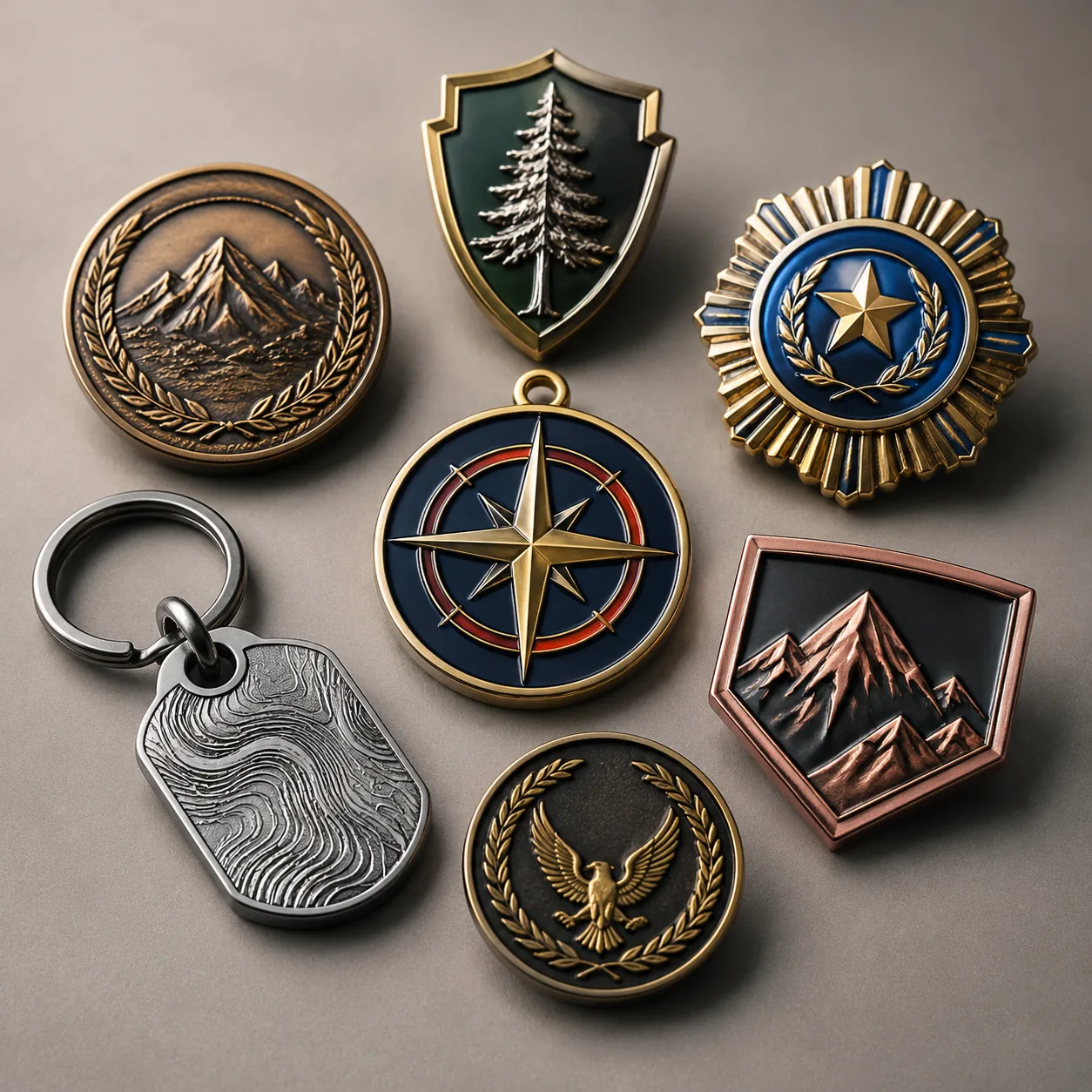
Define the kit before defining the SKUs
A multi-item promo order usually starts as one campaign: one launch date, one brand system, one recipient group, and one in-hands deadline. The problem is that pins, coins, patches, and lanyards do not share the same manufacturing logic. A 30 mm enamel pin depends on metal wall separation, enamel fill, plating, and clutch strength. A 44.5 mm coin depends on die relief, rim height, edge cutting, and finish control. A woven or embroidered patch depends on thread density, border method, and backing adhesion. A lanyard depends on webbing width, print registration, heat transfer, hardware, and cut length.
The common failure is not a dramatic defect. It is visual drift. The pin blue matches Pantone 286 C in glossy enamel, the coin enamel reads darker under antique nickel, the patch thread shifts toward royal blue, and the sublimated lanyard looks brighter on white polyester. Each item can pass its own inspection while the finished kit looks assembled from unrelated vendors. The campaign specification must therefore control shared intent first: master artwork, color targets, product hierarchy, minimum detail, sample sequence, packing method, and inspection level.
This matters most when four factories or workshops are involved. Pin suppliers often quote efficiently at 500 and 1,000 pieces. Coin suppliers may accept 100 to 300 pieces but become more competitive at 1,000 pieces because tooling and die setup are heavier. Patch factories may price by embroidery coverage or woven thread count. Lanyard plants can have low unit costs but strict carton counts, attachment substitutions, and kitting labor charges. Treat the order as one coordinated kit with four process-specific interpretations, not four isolated products competing only on unit price.
Set a visual hierarchy and cost tier
Before requesting prices, decide which item carries the primary brand value. In many event or corporate sets, the pin or coin is the hero item because it can hold metal finish, relief, enamel, and perceived permanence. The patch often supports the identity with a team name, unit mark, year, or campaign line. The lanyard delivers repeated visibility but should not be asked to reproduce tiny detail across a narrow strip of fabric. When all four items are treated as equal, cost goes into the wrong places and weak decoration methods are pushed beyond their limits.
A practical design hierarchy might use a full logo on a 30 mm hard enamel pin, translate the same mark into raised 2D relief on a 44.5 mm coin, simplify secondary text on a 75 mm woven patch, and repeat an icon plus short URL on a 20 mm sublimated lanyard. That keeps the system recognizable without forcing a woven edge or 20 mm strap to perform like enamel or offset print. If legal marks, QR codes, or sponsor names are required, assign them to backing cards or insert cards rather than squeezing them into metal or thread.
Also define whether the order has tiers. A VIP kit may justify a 3.0 mm brass coin, dual plating, hard enamel pin without epoxy, merrowed patch edge, safety breakaway lanyard, and a rigid presentation box. A mass handout kit may use a 1.2 mm soft enamel iron pin, zinc alloy coin, heat-cut woven patch, and bulk-packed lanyard. Writing these tiers before RFQ release prevents over-specifying the low-retention items while under-specifying the item recipients are most likely to keep.
Build specs around process limits
Good specifications are narrow enough to quote and inspect but realistic for production. Enamel pins usually work best at 20 to 35 mm for logo-led designs, with 1.2 to 1.5 mm base metal thickness. Minimum raised metal walls should be about 0.20 to 0.25 mm, with enamel color fields separated by metal. Text below 1.2 mm character height is risky, especially after plating. Hard enamel gives a flat polished surface and higher perceived value; soft enamel is lower cost and leaves recessed color fields. Zinc alloy can support irregular shapes, while iron or brass is common for cleaner stamped designs.
Challenge coins commonly sit at 38 to 50 mm diameter and 2.5 to 4.0 mm thickness. A 44.5 mm by 3.0 mm coin is a reliable balance of weight, detail, and FOB cost. Relief depth should be stated: 0.3 to 0.5 mm is typical for 2D relief, while 3D sculpting needs stronger grayscale art, longer die review, and usually 2 to 4 more production days. Rope, reeded, wave, or diamond-cut edges add cost and may require a thicker rim to prevent distortion.
Patches need a separate detail test. Embroidery works for bold logos and textured coverage, but small text can close if stitch density is too high. Woven patches hold sharper detail, often down to 0.8 to 1.0 mm line width, with a flatter hand. Sublimated patches handle gradients, shadows, and photographic art, but the result feels less traditional. Common promo sizes are 60 to 90 mm on the long side. Specify border width at 2 to 3 mm for merrowed edges, ±2 mm size tolerance, backing type, and whether adhesive must survive laundering or only temporary application.
Lanyards should be specified by width, finished length, fabric, decoration, attachment, and safety requirement. Standard widths are 15, 20, and 25 mm; standard finished length is often 900 mm before the attachment, with ±10 mm tolerance. Sublimation is best for full-color art and gradients. Screen print is economical for one or two spot colors but can crack or rub if ink and curing are weak. Woven lanyards feel durable but cannot hold small type cleanly. Hardware should be named, not implied: J-hook, lobster clip, bulldog clip, split ring, detachable buckle, and safety breakaway each change cost and use case.
Use one RFQ matrix for comparable quotes
A set quote is only useful when all suppliers price the same assumptions. Without a matrix, one factory may quote a 1.2 mm iron pin while another assumes 1.5 mm brass; one patch supplier may include heat-cut edges while another includes merrowed borders; one lanyard plant may include a breakaway while another treats it as an add-on. The apparent low quote may not be equivalent.
The RFQ should show MOQ tiers, tooling, sample cost, sample lead time, mass lead time after approval, packing, overage policy, and inspection criteria. For typical China or Southeast Asia FOB sourcing, useful tiers are 300, 500, 1,000, 2,500, and 5,000 pieces. Pins and coins usually improve at 1,000 pieces because mold, plating, and setup are spread across more units. Lanyards can quote from 500 pieces, but stronger pricing often appears at 2,500 or 5,000 pieces because printing, cutting, and attachment setup stabilize.
| Item | Controlled spec target | MOQ and FOB guide | Critical risk to lock |
|---|---|---|---|
| Enamel pin | 28-32 mm; 1.2-1.5 mm iron, zinc alloy, or brass; 2-5 enamel colors; min metal wall 0.20-0.25 mm; ±0.3 mm size tolerance; clutch pull checked | MOQ 300-500; USD 0.42-1.85 FOB at 500-5,000 pcs; mold USD 45-120; sample 5-8 days; mass 10-15 days after approval | Small text, plating mismatch, enamel underfill, loose butterfly or rubber clutch |
| Challenge coin | 40-45 mm; 2.5-3.5 mm zinc alloy or brass; 2D or 3D relief; enamel optional; rim height controlled; ±0.5 mm diameter tolerance | MOQ 100-300; USD 1.35-4.80 FOB at 300-2,500 pcs; mold USD 80-250; sample 7-12 days; mass 12-20 days | Muddy relief, weak rim, antique finish too dark, edge cutting inconsistent |
| Patch | 65-85 mm long side; woven, embroidered, or sublimated; merrowed or heat-cut edge; 2-3 mm border; ±2 mm size tolerance | MOQ 300-500; USD 0.38-2.35 FOB at 500-5,000 pcs; setup USD 35-100; sample 5-8 days; mass 10-18 days | Unreadable text, border shift, frayed edge, adhesive or hook backing failure |
| Lanyard | 20 mm x 900 mm polyester; sublimation or screen print; named hardware; breakaway if required; ±10 mm length tolerance | MOQ 500; USD 0.26-1.15 FOB at 1,000-10,000 pcs; setup USD 0-60; sample 3-6 days; mass 7-14 days | Color drift, print registration, weak stitching, hardware substitution |
Use the matrix as a commercial control document, not just a design brief. Ask each supplier to confirm inclusions and exclusions in writing: PMS matching, tooling, pre-production sample, backing card, individual polybag, mixed kitting, export carton, barcode label, spare parts, and rework policy. If the campaign needs exactly 2,000 complete kits, the PO should state whether overage is allowed and whether the supplier must deliver 2,000 accepted pins, coins, patches, and lanyards after QC rejects.
Control color, finish, and artwork translation
Color matching across enamel, plating, thread, ink, and polyester is coordinated approximation, not exact duplication. Pantone references are necessary, but they behave differently on each substrate. Glossy hard enamel reflects light differently from matte thread. Antique brass darkens recessed enamel. Black nickel can make adjacent colors look deeper. Sublimation on white polyester can oversaturate bright colors if the ICC profile and heat dwell are not controlled. The specification should state the Pantone target and the acceptable process interpretation.
For most promo kits, the practical standard is visual match to the approved sample under D65 daylight or a light booth, with no obvious mismatch at arm’s length. Where numeric control is possible, Delta E under 3 is a reasonable target for printed lanyards and printed cards. It is often unrealistic for dyed thread, plating, or enamel batches. For those processes, approve physical swatches or pre-production samples instead of relying only on screen proofs. If brand color is critical, require one lab dip or thread card before tooling.
Artwork should be translated once and controlled by revision code. Keep one master vector file in AI, EPS, or PDF format with outlined fonts, defined Pantone values, final dimensions, and a file name such as CampaignA_RevB. From that master, create production art for each process: enamel separations for the pin, relief and plating layers for the coin, stitch-safe or weave-safe art for the patch, and repeat-pattern art for the lanyard. Every derivative should carry the same revision code so a late logo change does not reach only one factory.
Minimum detail checks should happen before tooling. Confirm pin metal walls, coin relief levels, patch line width, lanyard repeat length, and barcode or URL placement. A 0.20 mm enamel wall, a 0.50 mm raised coin line, a 1.0 mm woven line, and a 1.5 mm screen-printed lanyard stroke do not behave the same. If the smallest process cannot hold a letter or line, simplify the shared design rather than accepting one weak item in the set.
Approve samples in a fixed sequence
Mixed-item programs need one approval path. First approve master art, dimensions, and hierarchy. Second approve color and finish references. Third approve physical samples or controlled photo samples. Fourth approve packing, carton marks, and kitting layout. If every supplier runs its proof cycle independently, the kit can drift even while each component appears to be on schedule.
A realistic sample schedule is 3 to 5 days for digital proofs, 5 to 8 days for pins or patches, 7 to 12 days for coins because of die work, and 3 to 6 days for printed lanyards. International courier transit commonly adds 3 to 5 days. Photo approval can save time, but it should require the sample beside a ruler, color card, approved reference, and neutral lighting. For high-value or repeat orders, physical approval is worth the extra transit time.
The approved sample set becomes the golden reference. Keep one set with the buyer, one with the final assembly factory, and one with the QC inspector for large or repeatable orders. The golden sample should include the backing card, polybag, barcode, insert, carton label, and hardware if those elements affect presentation or compliance. For reorders, quote against the golden sample number and revision code, not only the old PO, because plating baths, thread lots, polyester webbing, and attachment suppliers can change.
- Freeze master vector artwork before RFQ release
- State Pantone targets and process-specific color tolerance
- Check minimum metal wall, text height, relief depth, and woven line width
- Confirm plating, thread type, fabric width, backing, and hardware model
- Approve one complete pre-production kit before mass production
- Set ANSI/ASQ Z1.4 AQL 2.5 major and 4.0 minor in the PO
- Define zero tolerance for sharp burrs, wrong logo, unsafe attachments, and missing breakaway
- Retain golden samples and material codes for reorder control
Price the hidden work and lead time
The lowest unit price often excludes the work that makes the kit successful. Tooling, sample revisions, backing cards, individual bags, barcode labels, mixed packing, inspection sorting, spare parts, and export cartons can change the landed cost more than a small finish change. A pin quoted at USD 0.52 may become USD 0.68 with a custom backing card, rubber clutch, and individual polybag. A lanyard quoted at USD 0.31 may become USD 0.46 with safety breakaway, detachable buckle, and kitting labor.
Separate the quote into unit cost, tooling or setup, sample cost, packing material, kitting labor, inland freight, and export term. For FOB sourcing, typical tooling or setup ranges are USD 45 to 120 for pins, USD 80 to 250 for coins, USD 35 to 100 for patches, and USD 0 to 60 for lanyards depending on decoration. Pre-production samples may be free at higher MOQs, but many factories charge USD 30 to 150 per item type plus courier. If tooling is refundable, state the refund trigger in pieces or order value.
Lead time should run from approved sample, not PO date. Standard mass production after approval is commonly 10 to 15 days for pins, 12 to 20 days for coins, 10 to 18 days for woven or embroidered patches, and 7 to 14 days for lanyards. Add 3 to 7 days for mixed kitting, final carton verification, and corrective sorting if defects are found. Peak-season and pre-holiday periods can add 5 to 10 days, especially for plating, embroidery, and courier capacity.
Quality control should combine kit-level and category-level checks. ANSI/ASQ Z1.4 with AQL 2.5 for major defects and AQL 4.0 for minor defects is a practical default for promotional goods. Critical defects should be zero tolerance: sharp metal burrs, wrong logo, missing safety breakaway where specified, unsafe pin posts, mold contamination, or prohibited materials. For kitted orders, count accuracy is a quality requirement. One missing coin in a 500-set event shipment creates more client pain than a minor finish variation on a lanyard.
Close the order as a packed kit
The order should close as a kit, not as four finished-item shipments. Confirm whether the pin mounts to a backing card, whether the coin sits in a PVC pouch, capsule, or box, whether the patch is loose or attached to an insert, and whether the lanyard is folded, banded, or placed behind the flat items. Presentation affects both perceived value and freight. A foam insert gift box may look premium but can double carton volume; a printed insert card with a compartmented polybag may deliver a coherent campaign at lower landed cost.
Carton specifications should be written before final production. State pieces per inner bag, kits per inner carton, gross weight limit, carton dimensions, SKU label, PO number, country-of-origin marking, and barcode requirement. Keep export cartons under about 15 to 18 kg where possible to reduce handling damage. If pins or coins are packed with lanyards, protect metal edges from rubbing against fabric during transit. If cartons contain mixed colors or tiers, require a carton-level packing list and a photo of the loaded carton before sealing.
Reorder risk deserves the same control as first production. Tooling should be retained for a defined period, commonly 12 to 24 months, and the PO should state whether mold storage is free or chargeable. Ask the supplier to record plating type, enamel codes, thread codes, fabric GSM, webbing supplier, hardware model, backing adhesive, and packing material. For annual events or distributor programs, these records reduce the chance that a reorder looks close but not identical.
The strongest buying step is to issue one campaign specification sheet instead of four loose RFQs. Include the visual hierarchy, category specs, Pantone targets, MOQ tier pricing, FOB assumptions, sample path, AQL standard, and packed-kit configuration. Then require all suppliers to approve against the same master artwork and golden sample set. That discipline makes the program easier to quote, easier to inspect, and far less likely to arrive as four acceptable products that fail as one coordinated campaign.
Have a project? Send your artwork and target quantity and we’ll reply with a detailed quotation within 12 working hours.
Ready to get this made?
Send your sketch, target quantity and ship-date. Detailed quotation in 12 hours.



