Buyer Q&A: How to Approve Custom Promo Samples
What Does Sample Approval Really Freeze?
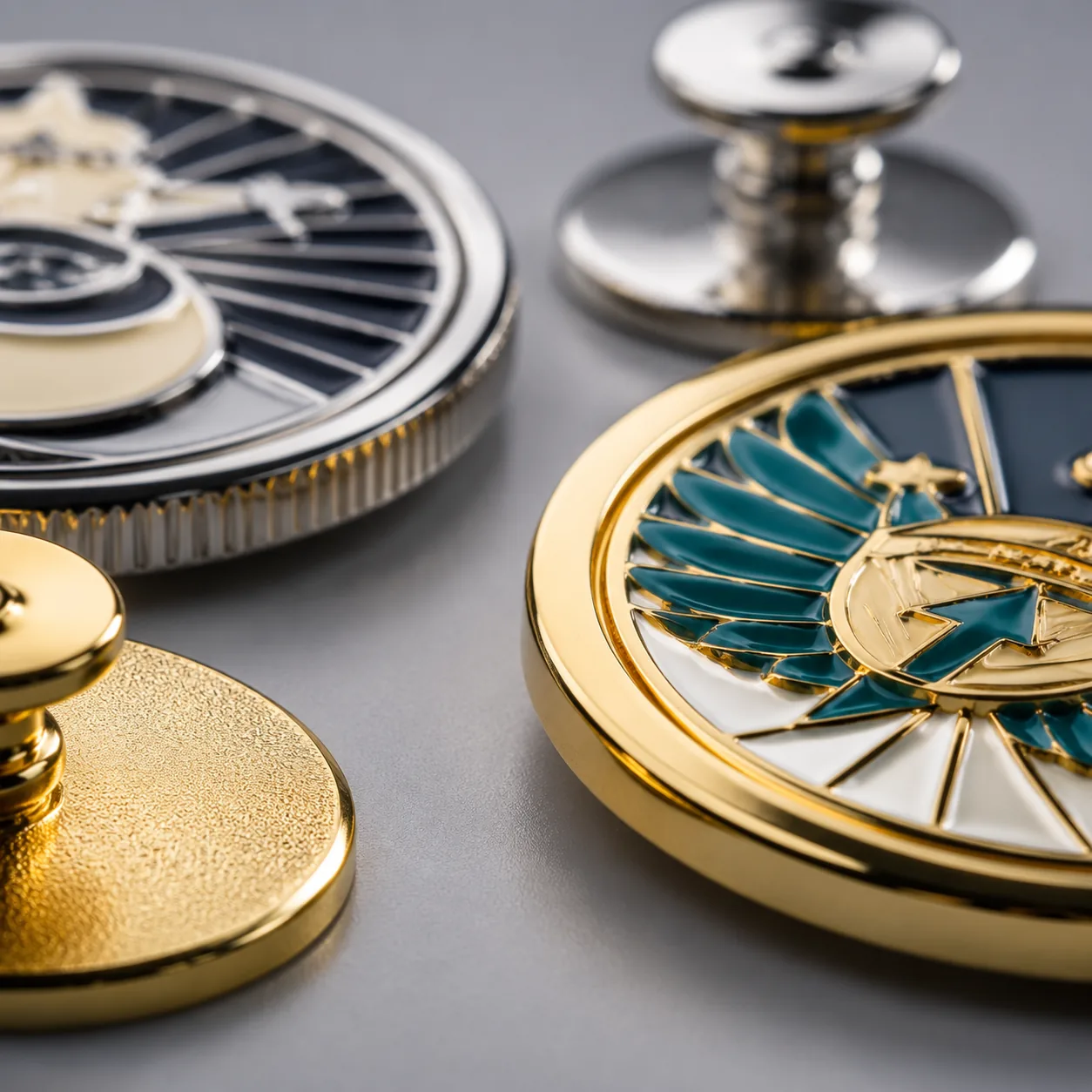
A sample is not a souvenir. It is the production reference that freezes the artwork revision, dimensions, material, finish, attachment, packaging, inspection standard, and acceptable defect band before bulk runs start. For custom pins, coins, keychains, patches, and lanyards, approval should also lock the MOQ, FOB price basis, lead time, and any agreed deviation from the drawing.
Approving by appearance alone is where most avoidable disputes begin. A 25 mm hard enamel pin may look fine on camera while still failing production control if the metal line is only 0.20 mm wide, the enamel sits 0.40 mm below the rim, or the post is offset by 0.8 mm. A 38 mm challenge coin can polish well but lose detail if the relief depth is under 0.25 mm. A 20 mm printed lanyard can match color yet drift 3 mm off center at the repeat seam. Treat the approved sample as the control baseline for first production and reorder, not as a one-off showpiece.
Which Sample Stage Should You Request First?
Choose the sample stage based on the risk you need to remove. A digital proof verifies spelling, scale, Pantone callouts, placement, and packaging text. A tooling sample confirms whether the mold can hold thin lines, deep relief, cutouts, and undercuts. A pre-production sample proves the full route: plating, color fill or print, assembly, packaging, and carton marking. A golden sample is the signed reference used for incoming inspection, in-line checks, final inspection, and future reorder matching.
For simple 2D soft enamel pins or printed lanyards, a proof plus one physical pre-production sample is often enough. For 3D coins, cast keychains, moving parts, glow enamel, epoxy doming, mixed plating, or licensed retail packaging, request a tooling or first-article sample before bulk approval. The extra 5-10 working days is cheaper than remaking a mold after discovering that a logo stroke or recessed area cannot be controlled at scale.
| Sample type | What it proves | Typical fee / lead time | Best use |
|---|---|---|---|
| Digital proof | Artwork, spelling, scale, Pantone, placement | Usually free / 1-2 working days | First approval before mold or print setup |
| Tooling sample | Mold cut, line sharpness, relief depth, cutouts | USD 40-180 / 7-14 working days | Pins, challenge coins, die-struck badges, metal keychains |
| Pre-production sample | Full construction, plating, color fill, assembly, packing | USD 50-220 / 8-18 working days | Launch orders, licensed brands, retail programs |
| Golden sample | Signed production and inspection reference | Usually free after approval / 0-3 working days | Final QC, reorders, warehouse comparison |
What Specs Must Be Written Before Sign-Off?
Do not approve a sample until the measurable specification is written down. The spec sheet should include artwork revision, finished dimensions, thickness, material, surface finish, decoration method, attachment, packing, carton marks, inspection standard, and acceptable variation. For small metal promo products under 50 mm, a practical dimensional tolerance is usually ±0.30 mm; for larger coins and keychains, ±0.50 mm is more realistic. Thickness can often be held to ±0.20 mm on die-struck or zinc alloy parts, but hand-filled enamel height and antique finishing need both a number and a visual reference.
Plating should be defined by finish and target thickness. Decorative nickel, gold, black nickel, antique brass, or imitation rhodium is commonly 3-5 μm on visible surfaces; wear-heavy items may need 5-8 μm plus a clear protective coat. Epoxy doming is usually 0.8-1.5 mm thick. For patches, specify woven or embroidered construction, stitch density, border type, and backing. For lanyards, specify width, finished length, print method, hardware, breakaway position, and any safety requirement for schools, events, or workplaces.
| Product | Specs to freeze | Typical control range | High-risk defect |
|---|---|---|---|
| Hard or soft enamel pin | Size, thickness, metal line width, enamel depth, clutch type | Size ±0.30 mm; metal line 0.25-0.30 mm minimum; fill flush to -0.20 mm | +0.5 mm post shift, low enamel, burrs, loose clutch |
| Challenge coin | Diameter, thickness, rim height, 2D/3D relief, antique tone | Diameter ±0.30 mm; thickness ±0.20 mm; relief ±0.10 mm | Shallow relief, muddy antique wash, uneven edge |
| Metal keychain | Overall size, ring size, connector, swivel, plating | Size ±0.50 mm; split ring pull target 8-12 kg depending design | Weak jump ring, plating wear, wobbly joint |
| Woven or embroidered patch | Width, height, border, stitch density, backing | Size ±1.0 mm; border shift within 1 stitch row | Frayed edge, loose thread, curled backing |
| Printed lanyard | Width, length, logo repeat, clip, breakaway | Width ±1.0 mm; length ±20 mm; logo drift ≤2 mm | Twisted tape, off-center print, weak clasp |
How Should You Inspect the Physical Sample?
Use three checks: visual, dimensional, and functional. Visual review should be done under neutral 5000-6500K light, not warm office lighting that hides plating tone and color drift. Compare enamel, print, thread, or plating against an approved Pantone chip, thread card, or signed reference sample. For Pantone-matched enamel or screen print, ΔE below 2.0 is a tight retail target; ΔE 3.0-4.0 is usually the practical promotional range depending on substrate and finish.
Dimensional review should use a caliper with 0.01 mm resolution, not a ruler. Measure finished size, thickness, post position, hole diameter, ring opening, border width, and logo offset in at least three locations. Functional review should simulate real use: open and close a clasp 20 times, pull a key ring with steady load, test magnet hold on the intended surface, bend a patch edge after heat backing, and tug a lanyard clip and breakaway. A product that photographs well but fails handling is not ready for approval.
- Compare the sample against the approved drawing revision, not a chat image or memory.
- Measure size, thickness, hole position, post position, and critical offsets with a caliper.
- Check color against Pantone, thread card, or approved print target under 5000-6500K light.
- Inspect plating, enamel, print, stitching, and cut edges for pits, burrs, voids, scratches, or loose thread.
- Test all attachments: clutch, magnet, split ring, swivel, clasp, snap hook, breakaway, adhesive, or heat backing.
- Confirm insert card, barcode, polybag, warning label, master carton mark, and carton quantity match the PO.
- Keep one signed golden sample with date, item code, revision number, and approver name.
What Defect Limits and AQL Should You Use?
Sample approval should define critical, major, and minor defects before final inspection begins. Critical defects are safety or compliance failures: sharp burrs, broken needles, toxic material concerns, choking-risk parts on children’s items, or a lanyard breakaway that does not release when required. Major defects affect function, brand appearance, or saleability: wrong plating, wrong size outside tolerance, loose hardware, unreadable logo, missing barcode, weak magnet, or severe print misalignment. Minor defects are cosmetic issues that do not affect normal use, such as slight polishing marks on the back or light thread fuzz inside an accepted range.
For standard promotional orders, many buyers use ANSI/ASQ Z1.4 or ISO 2859-1 with General Inspection Level II, AQL 2.5 for major defects, and AQL 4.0 for minor defects. For retail gift sets, licensed merchandise, or executive awards, tighten the plan to AQL 1.0 major and 2.5 minor. Critical defects should be set at AQL 0.0. Do not rely on the phrase good quality; write the defect list and acceptance plan into the PO or inspection brief.
| Order type | Suggested inspection level | Major AQL | Minor AQL |
|---|---|---|---|
| Standard promotional giveaway | General Level II | 2.5 | 4.0 |
| Retail or licensed merchandise | General Level II | 1.0 | 2.5 |
| Premium awards or launch kits | General Level II or tightened sampling | 1.0 | 1.5-2.5 |
| Safety-sensitive lanyards or children’s items | Critical checks plus General Level II | 0.0 critical / 1.0 major | 2.5 |
Approve, Revise, or Reject?
Approve when the sample matches the approved drawing, the measurable items are within tolerance, functional tests pass, and the remaining cosmetic variation fits the agreed defect standard. Approval should be written, not implied. A clean approval note should state the item code, drawing revision, sample date, approved deviations if any, final MOQ, unit price, packing method, and production lead time.
Revise when the issue is correctable without changing the product structure. Examples include shifting a lanyard logo 2 mm toward center, increasing a patch border by 1 mm, replacing a weak O-ring, changing Pantone 186C to 200C, or correcting insert-card spelling. Reject when the issue is systemic: the logo text is too small to cast, a 3D relief cannot hold detail, enamel bleeds over thin metal lines, plating peels after tape test, or a magnet cannot support the product weight. In those cases, ask the factory for a design-for-manufacturing change, not just another identical sample.
Do not demand showroom perfection from hand-finished products. Die-cast zinc, soft enamel, antique coin finishing, embroidery, and woven labels all have controlled variation. The buyer’s job is not to eliminate every process mark; it is to define which marks are acceptable, where they may appear, and how often they can occur under the AQL plan.
How Do MOQ, FOB Price, and Lead Time Change After Approval?
Sample approval locks the commercial assumptions behind the quotation. If the approved sample uses a thicker base metal, heavier plating, epoxy dome, custom back stamp, upgraded clutch, individual barcode, or retail box, the unit price and lead time may change from the first estimate. For custom metal items, MOQ commonly starts at 100-300 pieces for simple enamel pins and 300-500 pieces for complex multi-color or 3D parts. Patches often start at 100-200 pieces, while printed lanyards are more efficient at 300-500 pieces because setup time is spread across the run.
Typical production lead time after signed sample approval is 10-15 working days for simple enamel pins, 14-22 working days for 3D coins or complex metal keychains, 7-12 working days for embroidered or woven patches, and 6-10 working days for standard printed lanyards. A revised sample usually adds 3-7 working days if only color or packing changes are needed, and 7-14 working days if tooling must be adjusted.
| Product and MOQ tier | Typical USD FOB range | Main price drivers | Post-approval lead time |
|---|---|---|---|
| Enamel pins, 300-500 pcs | USD 0.55-1.60 each | Size, plating, colors, clutch, back stamp, card packing | 10-15 working days |
| Challenge coins, 100-300 pcs | USD 1.40-4.80 each | Diameter, thickness, 2D/3D mold, antique finish, edge text | 14-22 working days |
| Metal keychains, 300-500 pcs | USD 0.85-2.90 each | Casting size, swivel, split ring, epoxy, plating thickness | 12-20 working days |
| Woven or embroidered patches, 100-300 pcs | USD 0.32-1.35 each | Size, stitch coverage, border, iron-on or hook-and-loop backing | 7-12 working days |
| Printed lanyards, 500-1000 pcs | USD 0.18-0.75 each | Width, length, sublimation or silk print, clip, breakaway | 6-10 working days |
What Should You Send the Factory Next?
Send one complete approval package instead of scattered chat messages. Include the final artwork file, drawing revision, target size, material, finish, Pantone references, attachment choice, packing details, carton marks, MOQ, delivery deadline, inspection standard, and any market compliance requirement. If you already have a physical reference, mark what must match exactly and what can be improved. This prevents the factory from reinterpreting the design when it moves from sampling to production.
The most efficient next step is a signed sample approval sheet. Attach photos of the approved front, back, side profile, hardware, packaging, and carton label. Record all tolerances, AQL levels, agreed deviations, and the golden sample ID. For a multi-item brand set covering pins, brooches, challenge coins, keychains, fridge magnets, patches, and lanyards, keep one shared spec format so color, plating, logo scale, and packaging stay consistent across the order. That discipline reduces rework on the first shipment and makes the second order easier to match.
Have a project? Send your artwork and target quantity and we’ll reply with a detailed quotation within 12 working hours.
Ready to get this made?
Send your sketch, target quantity and ship-date. Detailed quotation in 12 hours.



