Burrs and Sharp Edges on Metal Giveaways: Buyer Specs
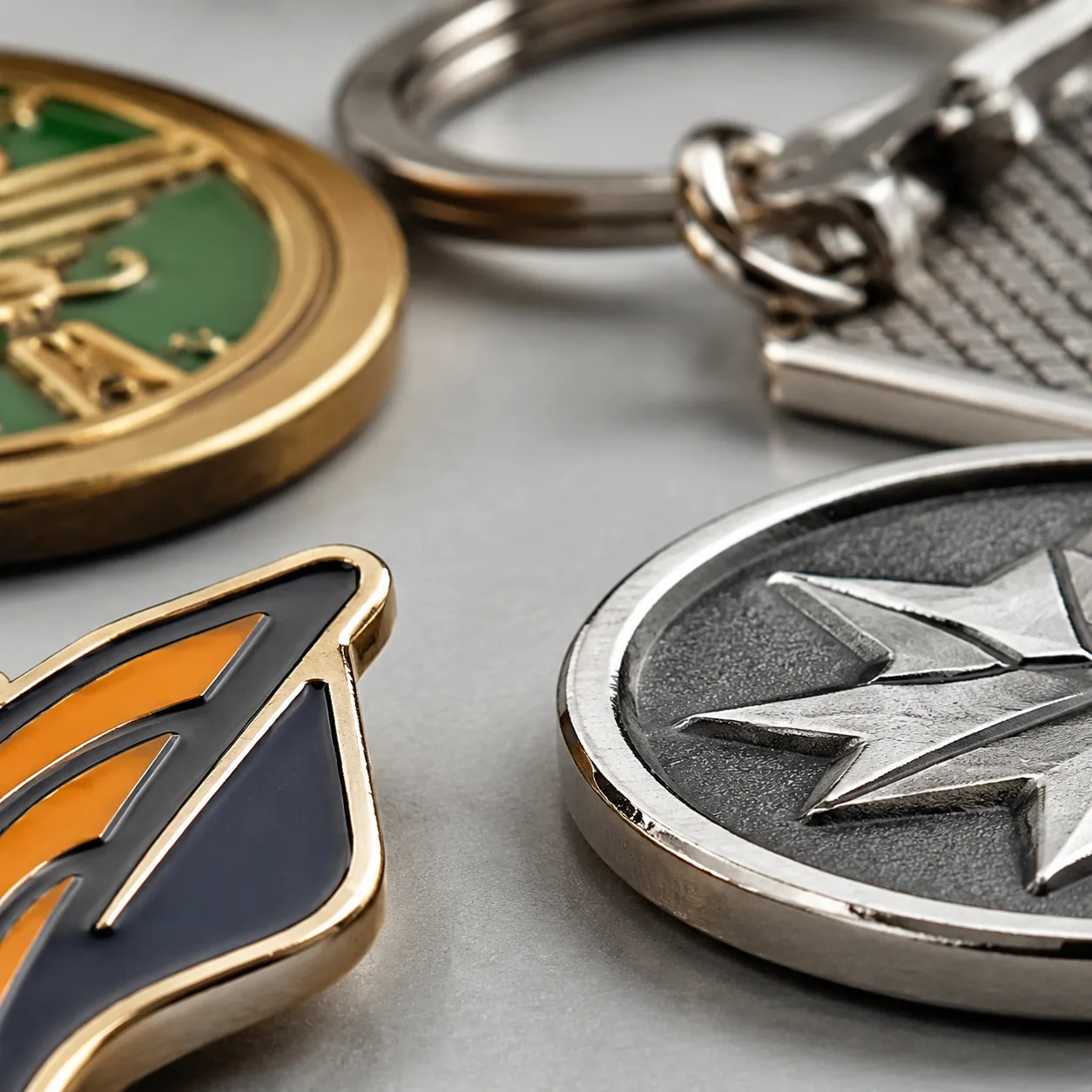
Why Edge Quality Fails Late
A metal pin, coin, keychain or brooch can pass artwork, color and plating approval but still fail when the buyer handles it. The usual symptoms are cut fingers, scratched backing cards, torn polybags, snagged lanyards and complaints that the item feels cheap or unsafe. These issues often appear after plating and packing, when rework is slow and expensive.
Burr control is not one operation. It is affected by base metal, sheet thickness, stamping clearance, die wear, casting flash, polishing media, plating build-up and artwork geometry. A 0.8 mm etched stainless bookmark behaves differently from a 1.5 mm iron enamel pin, a 3.5 mm zinc alloy keychain or a 4.0 mm brass challenge coin.
For procurement teams, the fix is to specify measurable edge requirements before tooling. Do not rely on phrases such as “smooth edge” or “good polishing.” They are difficult to inspect and easy to dispute. A better purchase requirement defines maximum burr height, minimum practical edge radius, inspection method, AQL classification and the surfaces where crisp detail must be protected.
| Risk level | Typical item | Recommended burr limit | Recommended edge radius | Defect class |
|---|---|---|---|---|
| Standard promotional | Simple lapel pin, coin insert | No loose burrs; raised burrs ≤0.05 mm | R0.10 to R0.15 mm | Major if snagging or cutting |
| Wearable fabric contact | Brooch, badge, lanyard charm | No loose burrs; raised burrs ≤0.03 to 0.05 mm | R0.15 to R0.25 mm | Major |
| Child-facing or pet item | Kids badge, pet tag | No sharp points; burrs not tactile | R0.25 to R0.40 mm where design allows | Critical or major |
| Collector display item | Challenge coin, medal | Functional edges burr-free; decorative rim controlled by sample | R0.05 to R0.15 mm depending on rim style | Major if unsafe to handle |
Where Burrs and Sharp Edges Come From
Stamped iron and brass parts usually create burrs on the exit side of the die. For enamel pins and badges made from 1.2 to 2.0 mm sheet, the back edge is often sharper than the front edge. If die clearance is too large, the edge shows rollover, fracture and a tall burr. If clearance is too tight, the tooling wears faster and can create ragged edges after several thousand strikes.
Die-cast zinc alloy creates a different defect pattern: parting lines, gate marks, ejector marks and thin flash. Flash of 0.05 to 0.20 mm can appear along mold split lines, especially around small holes, raised letters, mascot details and recessed grooves. Tumbling removes broad flash, but deep internal corners often need hand filing or rotary tools.
Photo-etched brass and stainless steel can feel sharp even with no visible burr. Thin stock from 0.5 to 0.8 mm has a small natural edge radius, so contact pressure on skin or fabric is high. If the item is worn on clothing, inserted into a wallet, or packed against printed paper, specify a stricter touch test than for a display-only part.
CNC-cut and laser-cut items may show heat tint, recast metal or micro-burrs on the entry and exit edges. These parts should include a secondary deburr operation in the routing sheet, not just a cosmetic polish after plating.
Write an Inspectable Edge Specification
A practical RFQ line is: “Touchable outer edges, holes and back edges must be free of loose burrs; raised burrs on touchable areas must not exceed 0.05 mm; item must not cut a nitrile glove or snag 180 gsm coated card during five manual passes.” This gives the factory, inspector and buyer the same pass/fail target.
For most promotional metal items, a realistic touchable-edge radius is R0.10 to R0.20 mm. Brooches, children-facing items, pet accessories and lanyard-mounted badges should target R0.20 to R0.30 mm where the artwork permits. Collector coins may need a sharper decorative front rim, but the back rim and handling edge should still be polished enough to prevent cutting or snagging.
Dimensional tolerance must be written together with edge requirements. Heavy deburring can reduce outer size, soften lettering and thin the rim. For a 45 mm badge, use a final size tolerance such as ±0.20 mm and thickness tolerance of ±0.10 mm after plating. For functional holes, specify final plated size, for example 3.2 mm ±0.10 mm for a jump ring hole.
- Use measurable wording: no loose burrs; raised burrs ≤0.05 mm on touchable edges.
- Specify edge radius: R0.15 mm minimum for standard wearable items; R0.20 mm or higher for brooches and child-facing items.
- Define inspection: visual check at 30 cm, finger touch, nitrile glove snag test and backing-card rub test.
- Mark exceptions: decorative coin rims or crisp front outlines may be controlled by approved sample instead of heavy rounding.
- Confirm internal cutouts: slots under 1.5 mm wide require extra hand finishing or a relaxed cosmetic expectation.
Material, Thickness and Design Choices
Low-carbon iron such as Q195 or SPCC is economical for soft enamel pins and badges, usually 1.2 to 2.0 mm thick. It stamps well with fresh tooling, but narrow cutouts and thin points can leave sharp back edges. It is a good choice for simple outlines and common FOB targets of about USD 0.28 to 0.85 per 25 to 35 mm pin at 1,000 pieces, depending on colors, plating, backing and packing.
Brass, commonly H65 or similar copper-zinc alloy, cuts cleaner and polishes better than iron. It costs more but is useful for premium badges, challenge coins and pierced details. For a 35 mm hard enamel badge at 1.5 to 2.0 mm thickness, brass may add USD 0.08 to 0.25 per piece versus iron at 1,000 pieces, while reducing edge complaints on complex outlines.
Zinc alloy is suitable for thick 3D shapes, keychains and medallions from 2.5 to 5.0 mm. Rounded edges can be built into the mold, but gate and parting-line locations must be reviewed before production. Small holes below 2.0 mm and deep slots still need manual cleanup, so zinc alloy is not automatically safer unless the mold and deburring plan support the edge requirement.
Artwork is often the root cause. Star points, mascot ears, lightning bolts and script tails should be rounded in the vector file before tooling. For handheld products, use at least R0.30 mm on outside points; for daily-use keychains, R0.50 mm is safer. Keep enamel or printed color at least 0.30 mm from the final edge on simple outlines and 0.50 mm on complex outlines where heavier polishing is expected.
| Item type | Lower-risk material | Suggested thickness | Design control |
|---|---|---|---|
| 25 to 35 mm enamel pin | Iron or brass | 1.2 to 1.6 mm | Avoid cutouts below 1.2 mm wide |
| 40 to 60 mm brooch | Brass or zinc alloy | 1.5 to 2.5 mm | Use R0.20 mm or larger on fabric-contact edges |
| 50 to 70 mm keychain | Zinc alloy | 2.5 to 4.0 mm | Keep gate marks away from split-ring hole |
| 45 to 60 mm challenge coin | Brass, iron or zinc alloy | 3.0 to 4.0 mm | Specify front rim and back rim separately |
| Thin etched badge or bookmark | Brass or stainless steel | 0.6 to 1.0 mm | Choose thicker stock if hand feel matters |
Finishing, Plating and Coating Trade-Offs
Barrel polishing is efficient for standard pins, coins and keychains. It rounds edges evenly and controls cost, but it can soften fine relief and reduce separation between raised and recessed areas. Typical tumbling time is 30 to 90 minutes depending on material, media and load size. Extra tumbling may improve hand feel but can blur metal lines below about 0.25 mm.
Hand filing and hand polishing are better for gate marks, brooch edges, 3D mascot parts and difficult internal corners. The trade-off is cost and consistency. At MOQ 300 to 500 pieces, extra hand-deburring on a zinc alloy keychain may add USD 0.05 to 0.18 per piece. On runs above 3,000 pieces, the unit impact can drop, but fatigue and missed corners become inspection risks.
Plating does not remove burrs. Common nickel, gold, black nickel and antique finishes on promotional metal goods are often 3 to 8 microns thick; premium specifications may require 8 to 12 microns depending on corrosion target. A 0.10 mm burr equals 100 microns, so plating will cover and brighten it, not eliminate it. In some cases, a plated burr feels sharper because the hard deposit follows the raised edge.
Epoxy coating can soften the top face of a pin or charm, but it does not protect the outer metal edge or the back edge. If the complaint risk is fabric snagging or skin contact, epoxy is not a substitute for deburring.
| Finishing step | Helps with | Cannot fix | Typical impact |
|---|---|---|---|
| Barrel polishing | General edge rounding | Deep slots, heavy gate scars | Included on many items; heavy cycle adds 1 to 2 days |
| Hand filing | Local flash and gate marks | Bad artwork points or weak thin sections | Adds USD 0.03 to 0.18 per piece |
| Mirror polishing | Premium flat shine | Uneven stamped edges | Adds labor and reveals scratches |
| Antique plating | Masks small surface marks | Loose burrs or sharp points | Adds 1 to 3 days versus standard plating |
| Epoxy dome | Top-surface protection | Outer edge and back edge sharpness | Adds USD 0.04 to 0.15 per piece |
Inspection Standard Before Shipment
AQL is useful only when burr defects are classified clearly. For standard promotional metal goods, use AQL 1.5 for major defects and AQL 4.0 for minor cosmetic defects. A sharp edge that cuts skin, tears a polybag, damages a backing card or snags fabric should be major. For child-facing products or safety-sensitive retail programs, the buyer may classify cutting edges as critical with zero acceptance.
Inspection should combine visual and tactile methods. Visual inspection at 30 cm under neutral white light catches flash, rough seams and unpolished areas. Tactile inspection catches what the eye misses: the inspector should run a fingertip or nitrile-gloved finger along the outer edge, back edge, pierced holes, split-ring hole, clasp area, magnet recess and any moving hardware contact point.
For a 5,000 piece keychain lot, ANSI/ASQ Z1.4 general inspection level II typically leads to a 200-piece sample size. Under AQL 1.5, the acceptance number for major defects is commonly 7 and rejection is 8 for code letter L, but buyers should confirm the exact table used by their inspection provider. If the lot fails, it should be reworked and re-inspected across cartons, not only sorted at the carton top.
- Classify cutting, glove-tearing, card-scratching or fabric-snagging edges as major defects.
- Use AQL 1.5 for major edge defects and AQL 4.0 for minor cosmetic roughness unless the brand requires stricter limits.
- Inspect outer edges, back edges, pierced holes, split-ring holes, clasp zones, magnet recesses and gate areas.
- Require re-inspection after deburring rework because polishing dust, exposed base metal or plating scratches can create secondary defects.
- Keep one approved golden sample for hand feel, not only for Pantone color, size and plating tone.
MOQ, Price and Lead-Time Reality
Simple enamel pins with clean outlines can usually meet a basic burr-free requirement without changing price. Realistic MOQ tiers are 100 pieces for sampling or small events, 300 pieces for stable production pricing and 1,000 pieces for stronger FOB efficiency. For 25 to 35 mm iron soft enamel pins, typical production lead time after artwork and sample approval is 12 to 18 days, plus 3 to 7 days for express or air shipment depending on route.
Complex edge requirements affect price when the design needs extra tooling care, hand polishing or inspection. A 50 mm zinc alloy keychain with 3D relief, split ring and enamel may quote around USD 1.10 to 2.40 FOB at 500 pieces depending on thickness, plating and packing. Strict hand-deburring of internal cutouts can add USD 0.08 to 0.25 per piece and 2 to 4 production days.
Challenge coins depend heavily on rim style. Smooth rims are easiest to polish; rope, reeded and diamond-cut rims are decorative but can feel aggressive if the peaks are not controlled. For 45 to 50 mm coins at 3.0 to 4.0 mm thickness, common FOB ranges are about USD 1.60 to 3.80 at 300 to 1,000 pieces. Antique plating, dual plating, edge numbering and premium rim inspection add cost and usually 1 to 3 days.
| Order type | Practical MOQ tier | Lead time after approval | Edge-control impact |
|---|---|---|---|
| Simple enamel pin | 100, 300, 1,000 pieces | 12 to 18 days | Usually included if outline is simple |
| Complex cutout badge | 300 to 500 pieces | 15 to 22 days | Adds USD 0.03 to 0.12 per piece |
| 3D zinc alloy keychain | 300 to 500 pieces | 18 to 25 days | Adds USD 0.08 to 0.25 per piece |
| Challenge coin with decorative rim | 100 to 300 pieces | 18 to 24 days | Adds 1 to 3 days for rim checks |
| Brooch with fabric contact | 300 pieces and up | 16 to 24 days | Needs stricter touch inspection and sample approval |
Buyer RFQ Notes That Prevent Rework
Before requesting quotes, mark the touch-critical zones on the drawing: outer edges, pierced holes, backs, clasp areas, magnet recesses, split-ring holes and any surface touching skin, fabric, paperboard or polybags. Then decide whether the item needs a normal promotional standard, a stricter wearable standard or a child-facing standard. This decision affects material, polishing time, inspection level and price.
Ask the factory to confirm the deburring route in writing: die adjustment, mold revision, barrel polishing, hand filing, hand polishing or a combination. For premium retail packaging, fabric contact or child-facing use, approve a physical sample by hand. A loose sample may feel acceptable, but the same item can scratch a card or snag a pouch when packed tightly.
The strongest specification is short and measurable: maximum burr height, minimum practical radius, inspection method, AQL classification and surfaces that must remain crisp. That keeps procurement, design, production and QC aligned before mass production begins.
- Send final-size artwork with material, thickness, finish, attachment and packing stated.
- Add a burr limit such as: no loose burrs; raised burrs over 0.05 mm not allowed on touchable edges.
- Specify R0.15 to R0.20 mm for normal wearable goods and R0.25 mm or higher for child-facing or fabric-sensitive items.
- Approve a physical sample for hand feel, glove snag and backing-card rub, not only photo appearance.
- Keep the approved sample for reorders so edge feel, polishing level and rim sharpness do not drift between batches.
Have a project? Send your artwork and target quantity and we’ll reply with a detailed quotation within 12 working hours.
Ready to get this made?
Send your sketch, target quantity and ship-date. Detailed quotation in 12 hours.



