Burr Control Specs for Custom Metal Pins, Coins and Keychains
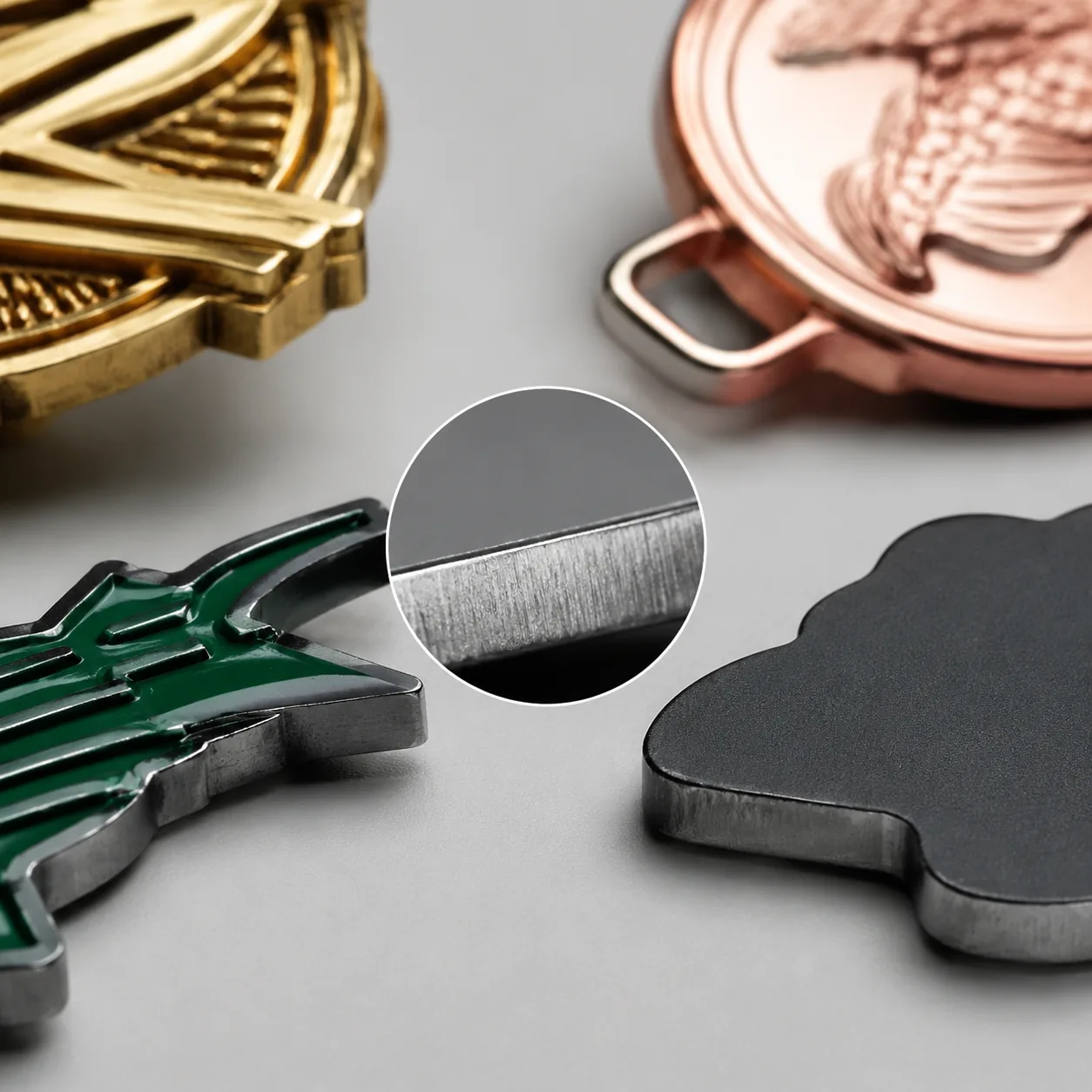
Why “Smooth Edge” Is Not a Usable Quality Spec
Burr complaints usually appear after value has already been added: pins are mounted on backing cards, keychains are packed for an event, or coins are distributed to customers. Artwork, enamel color and plating can be correct, but one unfinished edge can scratch fingers, snag fabric, chip plating or make a metal giveaway feel unsafe. For B2B buyers, burr control is a functional requirement, not a cosmetic preference.
A burr is a raised lip, sliver or sharp peak left by blanking, stamping, trimming, drilling, casting gate removal, die wear or aggressive polishing. On enamel pins, common locations include the outer profile, internal cutouts, pin-post weld area and recessed enamel cells. On coins and keychains, the risk areas are chain holes, split-ring holes, bottle-opener slots, scalloped rims, moving joints and engraved recesses.
The phrase “smooth edge” is too subjective for purchasing, sampling or inspection. A workable RFQ should define maximum burr height, edge class, inspection method, AQL level and whether the part contacts skin, fabric, packaging or hard goods such as phones and bags. At ZheCraft, burr control is quoted as a production requirement because the correct process changes by material: stamped iron pins, die-struck brass coins, zinc alloy keychains and stainless accessories do not finish the same way.
Where Burrs Form by Product and Process
For die-struck iron, brass or copper pins, the main burr source is blanking: the punch and die cut the outer profile after stamping. A new die may produce a clean shear, but worn clearance increases rollover on one side and breakout on the other. On small pins under 25 mm, a 0.05 mm burr may be hard to see yet still catch a cotton pad or scratch coated paper packaging.
For zinc alloy keychains, burrs usually come from parting lines, overflow vents and sprue gate removal. Casting is cost-effective for thick 3D shapes, but it adds manual trimming risk. Deep bottle-opener slots, hinge gaps, rotating parts and internal corners need specific attention because barrel or vibratory media may not reach them evenly.
For challenge coins, rim design drives the risk. A flat rim is easy to polish, while rope edges, diamond-cut edges, reeded rims and gear profiles create small peaks that can feel sharp if over-defined. Drilling or laser engraving after plating can also expose base metal and create micro-burrs unless post-operation cleaning is specified.
| Product type | Common burr locations | Practical burr limit | Higher-risk designs |
|---|---|---|---|
| Soft or hard enamel pins | Outer profile, cutouts, post weld base, recessed cells | 0.03-0.05 mm on exposed edges | Thin lettering, sharp star points, cutouts below 1.2 mm |
| Zinc alloy keychains | Parting line, chain hole, split-ring hole, sprue trim area | 0.05-0.08 mm after polishing | Bottle-opener slots, rotating parts, internal corners |
| Challenge coins | Outer rim, rope edge, reeded edge, drilled holes | 0.03-0.06 mm on rim and holes | Diamond-cut rims, gear edges, high 3D relief |
| Metal fridge magnets | Outer edge, magnet recess, stamped corners | 0.05 mm max on exposed edges | Thin backing plates, large flat magnets |
| Brooches and badges | Outer contour, hinge catch, pin stem tip | 0.03-0.05 mm for fabric contact | Pointed logos, long thin shapes, heavy badges |
Write Burr Requirements as Edge Classes
Start by classifying edges before quoting. A hidden burr inside a blind recess may be acceptable if it cannot scratch skin, block assembly, damage plating or show through enamel. A burr on a brooch edge, keyring hole or coin rim matters more because it contacts fingers, fabric, bags and retail packaging.
For most promotional metal products, a realistic baseline is: exposed touchable edges must have no continuous burr above 0.05 mm and no sharp point detectable by cotton-swipe or glove-swipe test. For premium brooches, retail keychains and coins handled directly, 0.03 mm is a better exposed-edge target. For hidden non-contact areas, 0.08 mm may be acceptable if plating, assembly and appearance are unaffected.
Avoid specifying every surface to jewelry standards unless the product requires it. A 15 mm enamel pin with thin raised metal walls can lose artwork definition if polished heavily. A 50 mm zinc alloy bottle-opener keychain can tolerate more deburring, but excessive rounding may reduce opener performance or distort a branded silhouette.
- Classify edges as skin-contact, fabric-contact, assembly-contact or hidden before pricing.
- Use 0.03 mm max burr height for premium skin or fabric contact; use 0.05 mm for normal exposed edges.
- Allow up to 0.08 mm only on hidden, non-critical areas that do not affect plating or assembly.
- Require cotton-swipe testing for apparel, bags, uniforms, lanyards and retail packaging.
- State whether controlled edge break is allowed; do not ask for broad rounding on sharp logo geometry.
- Ask the supplier to confirm deburring method before sample approval, not after mass production starts.
Match Deburring Method to Material and Geometry
Barrel tumbling is common for simple pins, coins and keychains because it is economical and repeatable in large batches. Ceramic, resin or stainless media can remove light burrs and soften edges before plating. The limitation is access: tumbling will not reliably clean deep slots, narrow cutouts below about 1.2 mm, acute internal corners or areas shielded by raised 3D relief.
Manual filing and wheel polishing are used where media cannot reach or where the edge feel must be controlled. This is common for brooch catch components, cutout logos, cast keychain joints, bottle-opener slots and premium coin rims. The trade-off is labor variation, so the approved sample should define the acceptable edge profile, not just the artwork.
Chemical or electrochemical deburring can be useful for selected stainless steel or brass parts, but it is not a default choice for enamel pins because it may soften fine relief and complicate color-fill preparation. For zinc alloy promotional products, controlled mechanical finishing is usually more predictable. A robust route is die maintenance, rough tumbling, selective manual deburring, plating, then final edge inspection.
| Method | Best use | Typical added lead time | Typical FOB cost impact | Main risk |
|---|---|---|---|---|
| Barrel tumbling | Simple pins, coins and keychains before plating | 0.5-1.5 days | 0.01-0.04 USD per small part | Rounds fine lines and weakens crisp corners |
| Vibratory tumbling | Flat badges, medium coins, 35-60 mm keychains | 1-2 days | 0.02-0.06 USD per part | Misses deep holes or narrow slots |
| Manual filing | Cutouts, inner corners, sprue marks, opener slots | 1-3 days per 5,000 pcs | 0.03-0.12 USD per part | Worker variation and uneven edge shape |
| Wheel polishing | Premium rims and broad outer contours | 1-2 days | 0.04-0.15 USD per part | Over-polishing thins lines and distorts relief |
| Magnetic polishing | Small stainless or brass components | 1-2 days | 0.03-0.10 USD per part | Not suitable for all alloys or assembled parts |
Control Burrs Before Plating and Enamel Fill
Burrs create plating failures as well as handling problems. A raised burr has high current density during electroplating, so metal deposits unevenly at the peak. That peak is also the first point to chip during bagging, keyring assembly or use. Increasing plating thickness does not fix burrs; it can make sharp raised edges more obvious.
For standard promotional pins and coins, nickel, brass, copper or black nickel plating is commonly specified at about 3-5 microns total deposit. For high-contact keychains, zipper pulls and bag charms, 5-8 microns is more realistic when budget allows. Antique finishes may use a different process sequence, but exposed edges still need deburring before color or patina work.
Enamel fill is also affected by burrs along recessed metal walls. A raised sliver can trap air, block soft enamel flow or break through hard enamel during flat polishing. For stable production, raised metal walls between enamel colors should usually be at least 0.25-0.30 mm wide, and cutout gaps should stay at 1.2 mm or wider if tumbling access is required.
- Deburr before plating whenever possible; do not rely on plating to cover sharp metal.
- For drilled holes after plating, require post-drill edge cleaning and exposed-metal review.
- Avoid knife-like outside angles below 20 degrees unless the item is display-only.
- Keep enamel metal walls at 0.25-0.30 mm minimum for stable color separation.
- Use 5-8 microns plating for high-contact keychains, but specify burr removal separately.
Inspect Burrs With Factory-Realistic Methods
A burr-control plan must be inspectable in normal factory conditions. Practical checks include visual inspection under 5x magnification, fingertip or nitrile-glove swipe testing, and cotton-swipe testing on exposed edges. If cotton fibers catch on a fabric-contact edge, the part should be reworked or rejected.
For measurable checks, use a burr height gauge, optical comparator or calibrated microscope on first articles, production samples and disputed lots. The drawing should identify measurement points: outer top edge, outer bottom edge, chain hole, cutout corner, functional slot and any drilled feature. This prevents the supplier from measuring an easy flat edge while the complaint occurs at a keyring hole.
For mass production, use AQL unless the item is safety-critical. A practical setting is AQL 1.0-1.5 for sharp burrs that can scratch skin or tear fabric, AQL 2.5 for visible burrs or plating chips linked to burrs, and AQL 4.0 for slight roughness on hidden areas. For child-oriented products, do not simply inspect harder; simplify the design and remove needle-like projections.
| Defect class | Example | Suggested AQL | Typical decision |
|---|---|---|---|
| Critical | Sharp point cuts glove, cotton catches heavily, wire-like sliver exposed | 1.0-1.5 | Reject or 100 percent rework |
| Major | Visible burr above 0.05 mm on exposed edge, rough keyring hole | 2.5 | Rework affected batch or sort |
| Minor | Hidden back recess roughness under 0.08 mm | 4.0 | Accept if assembly and appearance are unaffected |
| Process warning | Burr appears mainly on one side of stamped profile | First article hold | Check die wear or blanking clearance before continuing |
Price, MOQ and Lead-Time Impact
Burr control adds cost because it consumes die maintenance, finishing labor and inspection time. For simple 25-35 mm enamel pins, normal smooth-edge control is usually included at MOQ 100 pcs. A premium 0.03 mm exposed-edge limit with cotton-swipe testing often adds 0.02-0.06 USD per piece and 1-2 production days below 5,000 pcs.
For zinc alloy keychains, the quote impact is more visible. A simple 50 mm plated keychain at 500 pcs may range from 0.75-1.60 USD FOB depending on thickness, plating, color fill and attachment. Bottle-opener slots, rotating parts or multiple internal cutouts can add 0.05-0.18 USD per piece for manual finishing and 2-4 days to production.
Challenge coins are less sensitive on flat faces but more sensitive at rims. A 45 mm, 3 mm thick zinc alloy or brass coin at 300 pcs commonly ranges from 1.20-2.80 USD FOB before premium packaging. Complex 3D relief, antique finish and diamond-cut edges push cost higher. If every rim peak must meet a 0.03 mm exposed-edge target, sampling may take 7-10 days instead of 5-7, and mass production may add 1-3 days for finishing and QC.
- Normal enamel pin MOQ: 100 pcs for simple outlines with standard smooth-edge control.
- Premium burr-control MOQ: practical from 300 pcs because setup and inspection time spread better.
- Standard sampling lead time: 5-7 days for pins; 7-10 days for cast keychains or complex coins.
- Mass production lead time: 10-18 days for pins; 14-24 days for keychains and coins after approval.
- Rush orders should avoid narrow cutouts, sharp outer points and post-plating drilling.
Sample Approval Clause for Purchase Orders
Before approving a sample, inspect it as the end user will handle it. Rub the outer profile with a cotton pad, rotate the split ring through the hole, slide a brooch across comparable fabric, and check coin rims under side lighting. If one point catches fibers or feels sharp, mark the exact location on a photo and ask whether the cause is tooling, trimming, drilling or polishing.
Add a burr-control clause to the purchase order instead of relying on chat messages. A practical standard clause is: exposed skin-contact and fabric-contact edges must be free of sharp burrs; maximum burr height 0.05 mm; cotton-swipe test must show no fiber catch; AQL 1.5 for sharp burrs and AQL 2.5 for visible edge roughness. For premium brooches, retail keychains or collector coins, change the exposed-edge limit to 0.03 mm and request first-article confirmation before mass production.
When sending ZheCraft an RFQ, include artwork, intended use, product size, thickness, material preference, finish, attachment type and whether the item touches skin, fabric, children’s products, phones or bags. With that information, we can recommend stamping, casting, etching or stainless cutting, then quote the deburring level honestly instead of hiding it behind a vague “high quality” promise.
Have a project? Send your artwork and target quantity and we’ll reply with a detailed quotation within 12 working hours.
Ready to get this made?
Send your sketch, target quantity and ship-date. Detailed quotation in 12 hours.



