Burr and Edge Specs for Custom Metal Giveaways
Why Edge Quality Fails After Artwork Approval
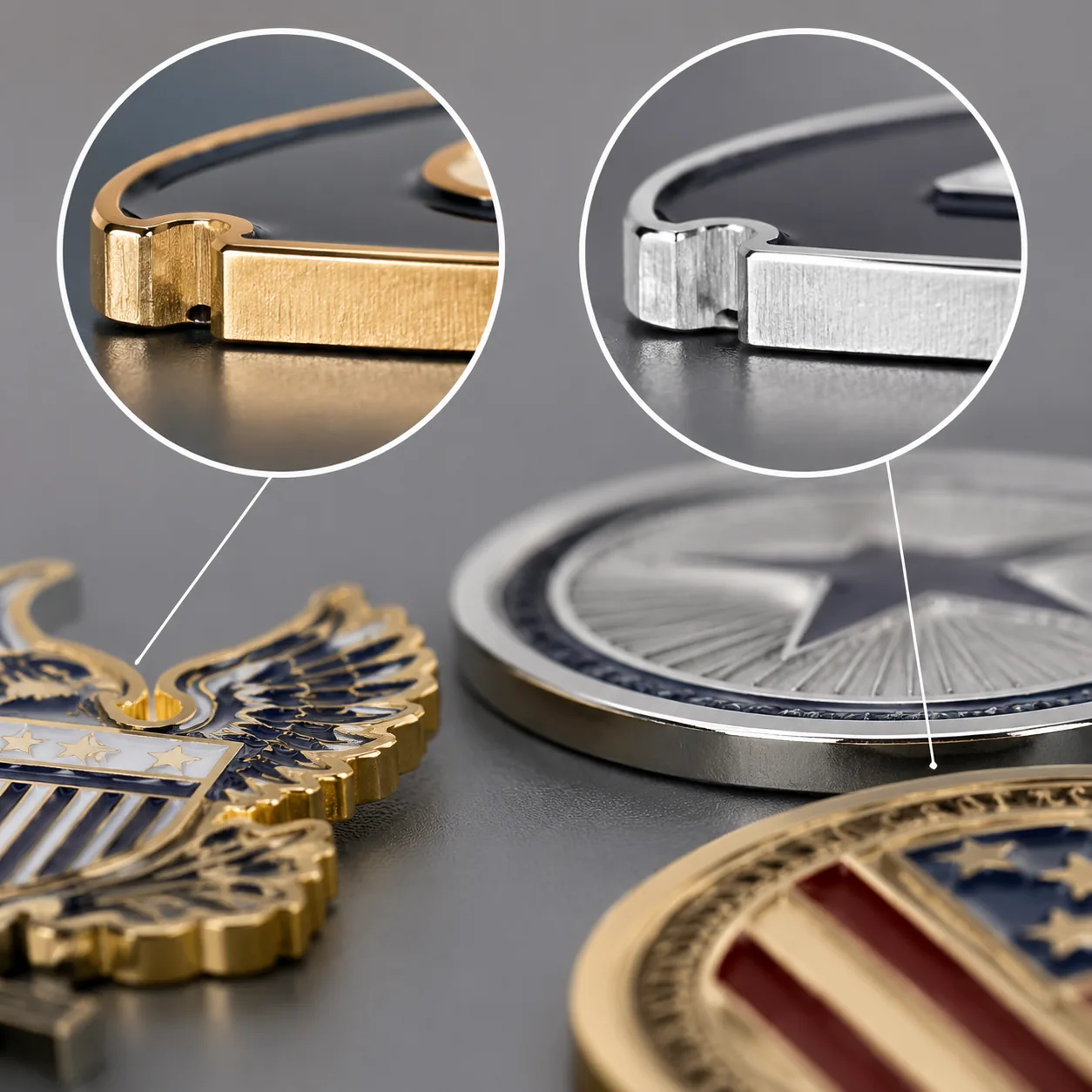
A custom coin, enamel pin or keychain can match the approved artwork and still fail in use because the edge is sharp, ragged or uncomfortable. The problem often appears late: after plating, after color fill, during final assembly, or after an event attendee scratches a phone, snags a lanyard or says the item feels cheap.
The usual cause is not poor artwork. It is an incomplete RFQ. Terms such as “smooth edge,” “no burr” or “good polishing” are not enough for mass production. For metal promotional products, the drawing should define burr height, minimum edge radius, parting-line location, gate-removal method, polishing limits and inspection level. These details matter most on die-struck brass pins, stamped iron badges, zinc alloy keychains with cutouts, challenge coins with raised rims, and thin brass tags below 1.2 mm thickness.
The target is not a mirror-polished edge on every surface. Over-polishing can soften raised text, reduce enamel wall height and blur 3D relief. A better specification separates safety from appearance: touchable edges must not cut, catch or scratch; non-touch internal areas may allow small cosmetic burrs if they stay within the agreed limit and do not flake after finishing.
Define Burr Limits, Radius and Tolerances
A burr is raised or loose metal left by blanking, stamping, die casting, trimming, drilling, laser cutting or machining. On a 25 mm lapel pin, a 0.08 mm burr may be hard to photograph but easy to feel. On a 55 mm coin, the same burr may be acceptable inside a recessed texture but unacceptable on the rim. This is why burr limits should be assigned by touch area, not only by product type.
For most custom metal giveaways, a practical mass-production standard is maximum 0.05 mm burr height on touchable outer edges and maximum 0.10 mm on non-touch internal recesses. For premium retail pins, jewelry-style brooches or executive coins, specify maximum 0.03 mm on all touchable edges. For low-cost event pins handled briefly, maximum 0.08 mm may be acceptable if the edge is rounded and passes a finger-swipe check.
Avoid a blanket “zero burr” requirement unless the budget allows hand finishing, 100% sorting and a higher reject rate. Metal forming creates natural variation at the cut edge. A clear commercial clause is: no sharp burr detectable by cotton-gloved finger swipe; no burr exceeding the stated height under 10x inspection; no loose metal flakes after tape pull or light nylon brushing.
| Product and size | Outer-edge burr limit | Radius or chamfer target | Normal dimensional tolerance |
|---|---|---|---|
| Soft enamel pin, 25–35 mm | ≤0.05 mm touch edge; ≤0.10 mm recess | R0.10–0.20 mm | Outline ±0.15 mm |
| Hard enamel badge, 20–40 mm | ≤0.03–0.05 mm touch edge | R0.15–0.25 mm | Outline ±0.15 mm; thickness ±0.10 mm |
| Challenge coin, 40–60 mm | ≤0.05 mm rim; ≤0.10 mm relief recess | R0.20–0.40 mm on rim | Diameter ±0.20 mm; thickness ±0.15 mm |
| Die-cast zinc keychain, 35–70 mm | ≤0.05 mm touch edge; ≤0.10 mm cutout | R0.20–0.35 mm | Outline ±0.20–0.30 mm |
| Stamped brass tag, 0.8–1.2 mm thick | ≤0.03–0.05 mm edge | R0.08–0.15 mm or light chamfer | Outline ±0.10–0.20 mm |
Design Edges That Can Be Manufactured Safely
The safest edge is rarely the sharpest-looking CAD outline. A vertical wall may look precise on screen, but after blanking or casting it can create a knife-like feel unless the top corner is broken. A small radius, bevel or raised rim usually improves handling without changing the visible front artwork.
For pins and badges, specify a broken outer edge of R0.10–0.20 mm. For coins, use a rim radius of R0.20–0.40 mm to improve pocket feel and reduce plating wear. For keychains and bag charms, avoid outer points below 60 degrees unless the tip is rounded to at least R0.30 mm. If the item may contact children, bags, phones or fabric, use R0.30 mm as the default for exposed points.
Internal cutouts need separate rules. Openwork stars, letters and logo gaps trap burrs, polishing compound and plating residue. For zinc alloy die casting, keep slot width at least 2.0 mm and internal corner radius at least R0.25 mm where possible. For chemical etching, 1.2 mm slots are workable on thin brass or stainless steel, but the edge will feel flatter and less rounded than a cast or struck part.
- Mark A-side, B-side, outer touch edges and internal cutouts on the production drawing.
- Use minimum R0.20 mm for general promotional handling and R0.30 mm for keychains, bag charms or youth items.
- Avoid pointed tips below 60 degrees unless a physical sample confirms the tip is safe.
- Keep open slots at least 2.0 mm for zinc die casting and 1.2 mm for chemical etching when the design allows.
- Use a raised rim, bevel or rope edge on coins that will be handled loose or carried in pockets.
- Avoid square 90-degree edges on stamped brass, iron or stainless parts below 1.0 mm thickness.
Match the Process to the Edge Requirement
Each manufacturing route creates a different edge risk. Die striking brass or iron gives clean face detail, but the blanking edge usually has rollover on one side and a sharper fracture zone on the other. Zinc alloy die casting supports thicker 3D shapes and openwork, but flash, parting lines, ejector marks and gate scars must be positioned away from touch areas.
Chemical etching is suitable for thin nameplates, patches and detailed badges, but it produces a slightly undercut edge and a lighter hand feel. Laser cutting stainless steel or brass can hold accurate outlines, often around ±0.10 mm, but the heat-affected edge usually needs tumbling, brushing or passivation before plating or paint. CNC machining gives the best control, down to about ±0.05 mm on simple profiles, but it is usually reserved for premium small batches because cycle time is high.
A buyer does not need to prescribe the process blindly. The RFQ should state the edge performance requirement, then ask the factory to confirm the safest production method for the geometry. As a practical guide, use die-struck brass for premium pins with crisp outlines, zinc alloy die casting for thicker keychains and 3D coins, chemical etching for flat detail-heavy tags, and CNC only when the unit value justifies machining.
| Process | Main edge risk | Practical tolerance | Best-fit products |
|---|---|---|---|
| Die striking and blanking | Sharp fracture edge on back; rollover on front | Outline ±0.15 mm typical | Lapel pins, badges, simple coins |
| Zinc alloy die casting | Parting-line flash, gate scar, burrs in cutouts | Outline ±0.20–0.30 mm | 3D keychains, thick badges, openwork charms |
| Chemical etching | Undercut edge and thin hand feel | Outline ±0.10–0.20 mm | Thin metal tags, photo-etched badges |
| Laser cutting | Heat tint, square edge, micro-burr | Outline ±0.10 mm | Flat stainless or brass tags |
| CNC profiling | Tool marks if not deburred | Outline ±0.05–0.10 mm | Premium short runs and precise components |
Control Deburring, Polishing and Plating
Deburring removes sharp metal; polishing changes surface feel and appearance. They should not be treated as the same instruction. If the RFQ only says “high polish,” the factory may buff the front face heavily, rounding small text, thinning enamel walls or flattening 3D relief. The edge note should protect both touch safety and design detail.
For enamel pins and small badges, light hand deburring plus controlled wheel polishing is usually enough. For coins and keychains, vibratory tumbling can give consistent edge feel before plating, but media size and time must be controlled. Fine ceramic media may run 20–45 minutes for coins; aggressive media or long cycles can dull relief below 0.15 mm height or raised strokes below 0.30 mm width. For zinc castings, gates should be clipped and belt-smoothed before general polishing so the scar does not remain visible after plating.
Plating also affects edges. Corners see higher current density, while the same areas receive the most handling wear. A sharp unbroken rim may look bright after plating but lose finish faster because the coating is stressed at the corner. General decorative nickel, brass-tone, copper-tone or black nickel plating is commonly 3–5 microns. Higher-wear coins and keychains should use a 5–8 micron total plating system when budget allows. Economy gold flash is often only 0.05–0.10 micron over base plating, so it is better for presentation pins than abrasive key-ring use.
| Finish or operation | Typical specification | Edge concern | Buyer instruction |
|---|---|---|---|
| Hand deburring | 100% touch-edge pass on complex shapes | Labor variation between operators | Define burr limit and finger-swipe test |
| Vibratory tumbling | 20–45 minutes, media matched to relief | Can dull fine raised detail | Protect text below 0.30 mm stroke width |
| Nickel or silver tone plating | 3–5 microns decorative layer | Moderate corner wear | Good default for pins and coins |
| Black nickel plating | 3–5 microns | Scratches show on high points | Use rounded edges and individual bags |
| Gold flash | 0.05–0.10 micron gold over base | Fast wear on sharp keychain edges | Avoid for heavy abrasion unless upgraded |
| Heavy decorative plating | 5–8 microns total system | Higher cost, better coverage | Use for pocket coins and bag charms |
Inspect Edges with AQL and Shop-Floor Tests
Edge quality cannot be controlled by front-view photos alone. Inspection should combine touch, magnification, simple abrasion checks and a defined sampling plan. For most B2B promotional orders, General Inspection Level II with AQL critical 0, major 1.5 and minor 4.0 is practical. For youth, retail or phone-accessory projects, tighten major defects to AQL 1.0 or request 100% touch-edge screening on exposed edges.
Classify any edge that can cut skin, snag normal fabric or scratch a phone screen as critical when severe and major when localized but unsafe. Burrs above the agreed limit, loose flakes, unremoved gate scars on A-side edges, plating cracks on corners and exposed base metal on rims should be major defects. Slightly uneven side-wall gloss, polishing waves or burrs within tolerance on non-touch recesses can be minor defects.
A reliable outgoing inspection includes finger-swipe handling, 10x loupe checks, spot measurement with a burr gauge or optical comparator where available, caliper checks on thickness, and comparison against the approved golden sample. Pull parts from the top, middle and bottom cartons because polishing quality can drift during a production run.
- Finger swipe: run a cotton-gloved finger around the outer edge and accessible cutouts; any catching point is flagged.
- Fabric snag: rub the edge against woven cotton or polyester lanyard fabric for 5 passes.
- Tape pull: apply and remove tape around cutouts to detect loose flakes after trimming or polishing.
- 10x inspection: check burr height, plating cracks, gate scars and sharp internal corners.
- Dimensional check: verify outline, thickness and critical slot width against the approved drawing.
- Carton audit: sample from early, middle and late-packed cartons to catch polishing drift.
Budget MOQ and Lead-Time Impact
Cleaner edges add cost because they require more labor, tumbling time, polishing control, sorting and sometimes tool changes. On a 1,000 pc enamel pin order, tightening an outer-edge burr limit from 0.08 mm to 0.05 mm may add little if the outline is simple. Tightening to 0.03 mm on a complex openwork badge can add 8–15% because more pieces require manual deburring and stricter rejection.
Typical FOB pricing depends on size, metal, plating and packaging. A 30 mm soft enamel pin at 1,000 pcs may run USD 0.45–0.95 FOB China; premium edge sorting and individual OPP bags may add USD 0.03–0.08 per piece. A 50 mm zinc alloy keychain may run USD 1.20–2.80, with extra side-wall polishing and cutout deburring adding USD 0.08–0.20. A 45 mm challenge coin may run USD 1.60–3.50 depending on thickness, antique finish and enamel fill, with premium rim finishing adding USD 0.10–0.25.
MOQ can remain low, but tight edge control becomes more economical above 300–500 pcs because setup, first-article review and QC time spread across more units. Simple pins and keychains often start at 100 pcs; coins with custom molds are commonly quoted from 100–300 pcs; strict child-safe or retail-pack programs are more stable from 500 pcs upward.
| Spec tier | Typical MOQ | FOB cost impact | Lead time after sample approval |
|---|---|---|---|
| Commercial standard | 100+ pcs simple pins or keychains | Base price | 12–18 days pins; 15–22 days keychains |
| Controlled touch edge | 300+ pcs corporate pins, coins, charms | +3–8% | Add 0–2 days |
| Premium retail edge | 500+ pcs gift sets or executive coins | +8–15% | Add 2–5 days |
| Openwork strict deburring | 500+ pcs complex cutout designs | +10–18% | Add 3–6 days |
| Child-safe strict edge | Case by case, usually 500+ pcs | Quote after drawing review | Add 3–7 days plus stricter sorting |
RFQ Wording to Lock the Standard
Before ordering, mark the drawing with the A-side, B-side, touchable outer edges, internal cutouts, hanging holes and any areas that contact skin, fabric, phones, keys or bags. Add the burr limit, minimum radius, plating thickness expectation and AQL level. If no engineering drawing exists, send the vector artwork and ask the factory to return a production drawing with edge notes before tooling starts.
Approve edge quality on a physical pre-production sample, not only on a digital proof. Hold the sample the way the final user will use it: pinned to clothing, rotated in fingers, carried with keys or attached to a lanyard. If the sample feels slightly sharp, mass production will not automatically improve unless the correction is written into the sample approval notes.
For mixed promotional sets, keep the edge standard consistent. A smooth premium coin packed next to a rough keychain makes the whole kit feel uneven. Keep one approved golden sample for reorders so edge feel, polishing level and side-wall finish do not drift between batches.
- RFQ line for general metal giveaways: touchable outer edges deburred to maximum 0.05 mm burr height; no sharp feel by cotton-gloved finger swipe; inspect under General Level II, AQL critical 0, major 1.5, minor 4.0.
- Keychain line: all exposed points minimum R0.30 mm unless otherwise approved on the physical sample; gate marks not allowed on A-side or hand-contact edges.
- Coin line: rim radius R0.20–0.40 mm; no plating cracks, exposed base metal or sharp high spots on the rim; diameter tolerance ±0.20 mm unless otherwise agreed.
- Openwork line: factory to confirm minimum slot width, internal corner radius, deburring method and parting-line position before tooling.
- Premium line: touchable burrs maximum 0.03 mm; 10x inspection required; retain approved golden sample for all future production lots.
Have a project? Send your artwork and target quantity and we’ll reply with a detailed quotation within 12 working hours.
Ready to get this made?
Send your sketch, target quantity and ship-date. Detailed quotation in 12 hours.



