Bulk, Kit, or Drop Ship? Promo Order Packing Decisions
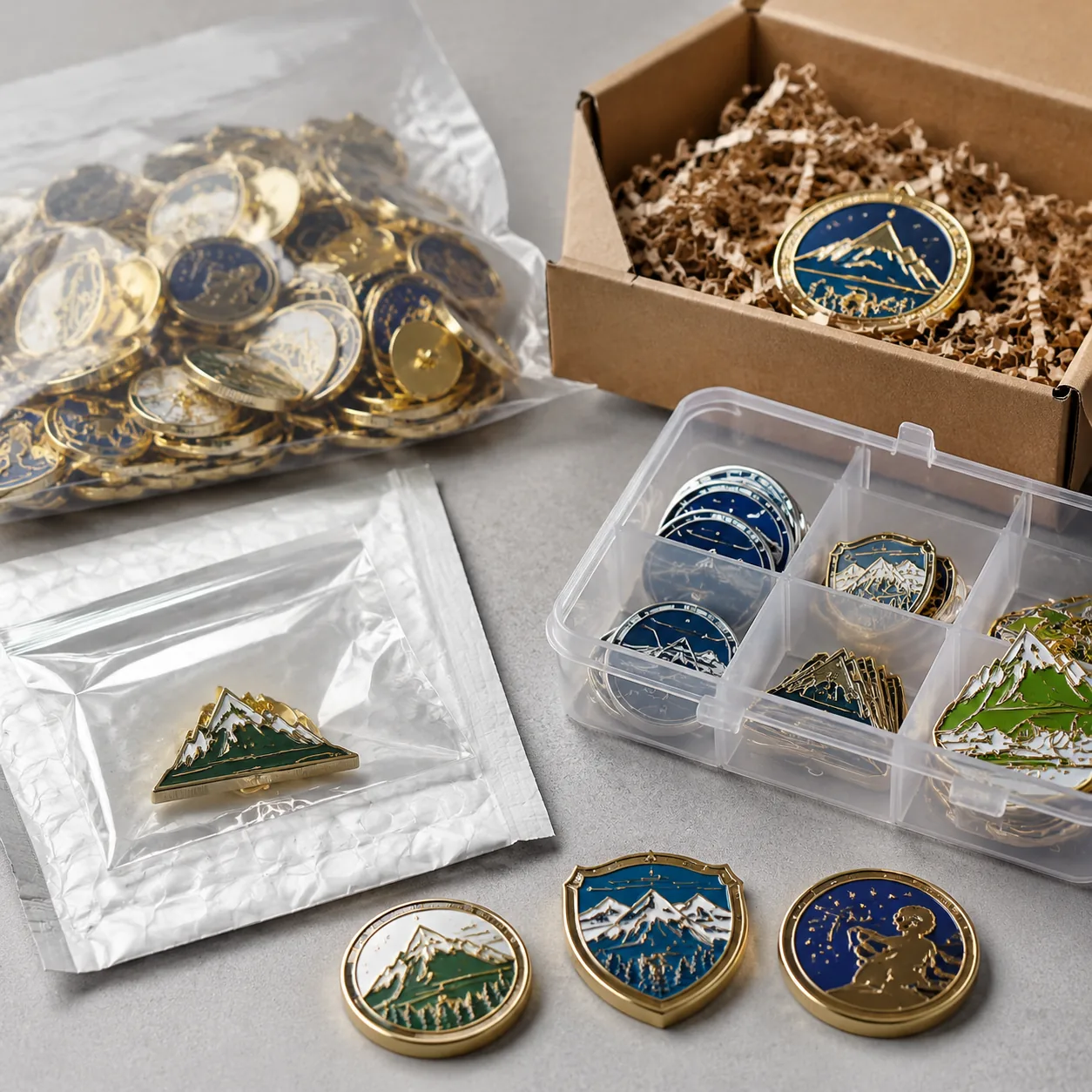
1. Price Packing by Total Handling Cost, Not Carton Cost
Packing is not a cosmetic afterthought. It determines labor hours, carton count, freight volume, warehouse receiving time, scan accuracy, and the probability that the right item reaches the right location before an event. A buyer may save USD 0.03 to 0.06 per piece by accepting bulk export cartons, then spend more in domestic labor opening cartons, counting units, applying labels, building kits, and forwarding stock to field offices.
For a 25 mm soft enamel pin with butterfly clutch, a common factory-standard pack is one pin in a 30 to 40 micron OPP bag, 50 or 100 pieces per inner bag, and 500 to 1,000 pieces per export carton. The packing cost is often USD 0.02 to 0.04 per piece FOB Shenzhen, Ningbo, or Shanghai, excluding any printed card or barcode. A 50 mm challenge coin is different: if packed in a capsule, velvet pouch, or rigid gift box, the carton may be limited to 100 to 200 pieces because gross weight should normally stay below 18 kg. Many retail DCs and 3PLs prefer 12 to 15 kg cartons to reduce manual handling claims.
The correct question is where the final handling should happen. If a central warehouse will repack all stock anyway, bulk cartons are usually efficient. If goods move directly to stores, field teams, trade show desks, influencers, or individual recipients, factory carding, kitting, destination sorting, or parcel packing can remove one full handling step. A useful quote should show the base FOB packing and the ready-to-distribute option separately, including material cost, labor, carton impact, and packing lead time.
2. Lock the Packing Level Before Product Pricing
Packing changes the production job. A 30 mm pin loose in a 60 x 80 mm OPP bag is not the same order as the same pin mounted on a 70 x 100 mm retail card, sealed in a resealable bag, labeled with an EAN-13 barcode, and sorted into 18 destination cartons. The second version requires printed material approval, hole positioning, barcode control, line setup, additional inspection, and a different carton plan.
As a planning rule, factory-standard unit bagging adds 0 to 2 working days after product QC. Printed backing cards, barcode stickers, header cards, and SKU sorting normally add 3 to 5 working days after all packing artwork and data are approved. Multi-component kits with pins, patches, lanyards, coins, inserts, and mailers generally add 5 to 10 working days, depending on SKU count and whether all components finish at the same time. For event orders, packing time should be a separate line in the schedule, not hidden inside “production.”
| Packing level | Efficient MOQ / order tier | Practical specification | Typical FOB add-on | Lead time add-on | Primary risk to control |
|---|---|---|---|---|---|
| Bulk packed | 500+ pcs per SKU | 1 pc in 30-40 micron OPP; 50-100 pcs per inner bag; master carton under 18 kg | USD 0.00-0.04/pc | 0-2 working days | Buyer-side sorting labor, count errors, carton overfill |
| Retail carded | 1,000+ pcs per card design preferred | 300-350 gsm C1S/C2S card; 60 x 90 mm or 70 x 100 mm; OPP bag; optional EAN/UPC | USD 0.06-0.18/pc | 3-5 working days | Bent cards, wrong barcode, poor pin alignment |
| Gift boxed | 300-500+ pcs depending on box tooling | Velvet, paper, tin, PU, or rigid box with EVA/foam insert cut to product profile | USD 0.35-1.80/pc | 4-8 working days | High volumetric freight, carton crush, insert mismatch |
| Event kit | 500+ kits recommended; 1,000+ efficient | Multiple components in pouch, mailer, or box; BOM label; carton-level kit count | USD 0.18-0.90/set labor plus materials | 5-10 working days | Missing component, wrong version, scuffing inside kit |
| Split by destination | 10+ cartons or 5+ destinations | Locked allocation sheet; destination code; carton label; location packing list | USD 0.03-0.15/pc or quoted by SKU | 2-5 working days | Late allocation changes, wrong destination carton |
| Direct drop ship | Usually 200+ parcels; address-file dependent | 1 unit or kit per mailer; recipient label; courier manifest; tracking export | USD 0.50-2.50/parcel plus freight | 3-7 working days after goods ready | Address errors, customs value, return handling |
3. Specify Retail Cards as Functional Parts
Backing cards fail when they are treated as simple print. Common failures are a euro slot placed too low, pin posts puncturing the front artwork, a card curling because the stock is too thin, or a barcode sitting under the OPP seam where scanners cannot read it. Retail packing needs measurable specifications, not only a PDF design.
For most enamel pins, brooches, small medals, and patch cards, use 300 to 350 gsm C1S or C2S art card. Typical sizes are 55 x 85 mm for small pins, 60 x 90 mm for standard pins, and 70 x 100 mm for larger badges or two-pin sets. Use a 5 mm euro slot or 6 mm round hang hole, positioned at least 8 mm from the top edge. Set tolerances at artwork approval: trim tolerance ±1.5 mm, hole position ±1 mm, pin-post hole spacing ±1 mm from the signed dieline, and color matched to the approved proof or Pantone reference within normal offset-print tolerance.
For heavy brooches above 30 g, do not rely on a single 300 gsm card unless the item is supported by a blister, foam pad, folded card structure, or rear locking feature. A 40 g brooch can sag, tear post holes, or rub through the print during sea-freight vibration. For polished gold, mirror silver, black nickel, and other abrasion-sensitive plating, prevent metal-to-metal or metal-to-paper friction. A 30 to 40 micron OPP bag is standard; use 50 micron OPP, PE, or PP when the item has sharp edges, chains, dangling charms, or loose fittings.
Barcode requirements should be testable. Confirm code type, data string, label size, quiet zone, print position, scan direction, and whether the code is printed on the card or applied as a sticker. A practical rule is 100% scan pass on first-article samples and at least 99.5% scan pass during packing inspection. Any barcode tied to the wrong SKU should be classified as a critical packing defect, not a minor print defect.
4. Build Kits Around the BOM, Then the Box
Kitting multiplies small errors. A kit with one enamel pin, one woven patch, one lanyard, and one PVC magnet may involve four production lines, four artwork revisions, four inspection reports, and four packing speeds. The box design matters, but the bill of materials controls the job.
A usable kit specification should state item code, artwork revision, quantity per kit, orientation, insertion order, protective material, label text, carton count, and approved substitutions. A concrete specification might read: one 30 mm hard enamel pin on card A, revision 03; one 80 mm woven patch in a 40 micron OPP bag; one 20 mm polyester lanyard folded twice with black metal swivel hook; one 60 x 80 mm soft PVC magnet; all inserted into a 180 x 120 x 35 mm E-flute mailer with SKU-KIT-2026 label on the short side. If the kit will be mailed, leave at least 5 mm clearance around the tallest component and test one packed kit from 60 cm on one corner, three edges, and six faces.
MOQ and output depend on complexity. Simple two-piece kits can be practical from 300 to 500 sets when both components are already produced. Retail-quality multi-SKU kits become more efficient at 1,000 sets because line setup, label printing, first-article approval, and carton planning take similar time whether the order is 300 or 3,000. For 5,000 four-component conference kits, allow one working day for setup and signed first-article approval, then expect 1,500 to 4,000 kits per line per day depending on folding, sealing, labeling, and inspection requirements.
Approve one complete kit sample before mass kitting, even if each component sample has already passed. The kit sample confirms fit, scuff risk, rattle, insert sequence, label placement, and actual packing time. For higher-risk kits, use staged QC: component count before kitting, first-article kit approval, in-process weight checks against a target kit weight tolerance such as ±3% or ±5 g for small kits, and final carton inspection before sealing.
5. Control Split Shipments With Locked Data
Split shipment is a data-control task. A factory can divide 10,000 pins across 20 destinations, but only if the allocation file is locked before packing starts. Revisions after cartons are sealed create rework, extra counting, mixed versions, and delayed dispatch.
Use destination codes that cannot be confused, such as US-NY-001, DE-BER-002, or JP-TKY-003. Put the same code on the master carton label, inner carton label if used, packing list, commercial invoice line, and courier file. For mixed-SKU cartons, decide in advance whether mixing is permitted. If it is, require a carton-level contents label listing destination code, SKU, product description, quantity, and sequence, for example: “US-NY-001, Carton 03 of 18.”
For fixed event kits, shortage tolerance should be zero per destination. For loose promotional stock, use +1/-0 per SKU per destination if overage is acceptable; negative shortages cannot be repaired after dispatch. Packing accuracy should be inspected separately from product appearance. A practical standard is AQL 1.0 for wrong SKU, wrong destination, missing unit, or wrong barcode; AQL 2.5 for readable but skewed labels and non-critical carton mark defects; and 100% visual check for carton sequence and destination codes on split shipments.
Direct drop shipping adds recipient-level data. Name, address, phone, postal code, product value, HS description, and courier service must match the carrier template. Address changes should close before label printing: usually 2 to 3 working days before China domestic dispatch and 3 to 5 working days before international courier pickup. Clarify in the PO who pays for undeliverable parcels, re-labeling, returns, remote-area surcharges, and customs re-declarations.
6. Balance Presentation With Freight Volume
Gift packaging can make a coin or award feel more valuable, but it can double or triple shipment volume. A 45 mm zinc alloy coin in a PVC pouch may pack 200 pieces in a 36 x 28 x 20 cm carton at about 14 to 16 kg gross weight. The same coin in a 90 x 90 x 30 mm rigid box may require a 50 x 45 x 35 cm carton for only 100 pieces, and air freight may charge dimensional weight instead of actual weight.
Dimensional weight is commonly calculated as length x width x height in centimeters divided by 5,000 for express courier, or 6,000 on some air-freight lanes, but the carrier rule controls. A packing upgrade of USD 0.60 per unit FOB can add USD 0.20 to 0.80 per unit in air freight when the package is bulky, especially for light products such as lanyards, patches, medals with ribbons, stickers, and retail card sets.
When presentation matters but freight is sensitive, choose flat or semi-flat packing: a pin on printed card, a coin in a clear capsule with paper sleeve, a woven patch on a header card, or a medal in a thin velvet pouch. For e-commerce fulfillment, add bend and crush protection such as 350 gsm backing board, honeycomb sleeve, or a small corrugated mailer. For sea freight, specify 5-ply export cartons, appropriate edge crush strength for the carton weight, moisture-resistant tape if needed, and a gross weight limit under 18 kg unless the receiver approves heavier cartons.
7. RFQ Checklist for Packing Specifications
A short packing specification removes guesswork. Send it with the RFQ, not after production. If retail cards, barcode labels, destination sorting, or kit assembly are requested at final inspection, the factory may need to reopen cartons, recount goods, print new material, and extend delivery by several days.
- SKU and artwork revision for every item, using the same code on the PO, artwork, sample approval, barcode file, allocation sheet, and carton label.
- Unit packing method: loose, individual OPP bag, backing card, pouch, capsule, gift box, mailer, or kit, including dimensions and material thickness such as 40 micron OPP or 350 gsm card.
- Inner packing quantity: for example 50 pcs per inner bag, 20 kits per inner carton, 10 boxed coins per tray layer, or 100 lanyards per polybag.
- Master carton limits: target gross weight under 18 kg, maximum carton dimensions if the warehouse has limits, pallet requirement, and whether mixed SKUs are allowed.
- Carton mark layout: buyer name, PO number, SKU, destination code, quantity, carton sequence, gross weight, net weight, carton size, and country of origin if required.
- Barcode or QR requirements: data string, file type, label size, print position, scan direction, quiet zone, and whether labels apply to unit, inner pack, carton, or parcel.
- Inspection standard: product AQL plus separate packing checks for count accuracy, label accuracy, barcode scan pass, carton damage, allocation accuracy, and carton sequence.
- Change cut-off date: final date for allocation, address, and label changes, normally before mass packing starts rather than before vessel or courier booking.
- Anti-scratch protection for metal goods: individual bags, tissue separation, foam slots, trays, or card separators for polished plating, black nickel, mirror gold, and other abrasion-sensitive finishes.
8. Approve a Packing Mock-Up Before Cartons Are Sealed
Before placing a promotional order, ask the supplier for two prices if packing affects distribution: factory-standard bulk packing and the actual delivery-ready method. Compare total landed cost, including local labor, repacking materials, barcode work, courier handling, dimensional freight, warehouse receiving fees, and the risk of missing an event date. The lowest FOB line is not always the lowest campaign cost.
Request a packing mock-up before mass packing. It should show one complete unit pack, one inner pack, one master carton, carton markings, barcode position, destination label if applicable, and the quantity arrangement by layer, bag, tray, or mailer. For kitted orders, approve a physical sample or a video-verified kit sample, then require at least one in-process packing inspection before all cartons are sealed.
If sourcing from ZheCraft, send the destination list, packing expectation, MOQ target, retail or event deadline, and any warehouse carton limits with the first RFQ. We can then advise whether the project fits bulk packing, retail carding, gift boxes, kitting, split cartons, or direct drop shipping, and quote the added labor, materials, carton impact, FOB range, and lead time before the purchase order is locked.
Have a project? Send your artwork and target quantity and we’ll reply with a detailed quotation within 12 working hours.
Ready to get this made?
Send your sketch, target quantity and ship-date. Detailed quotation in 12 hours.



