Budgeting Custom Metal Giveaways After Tariffs in 2026
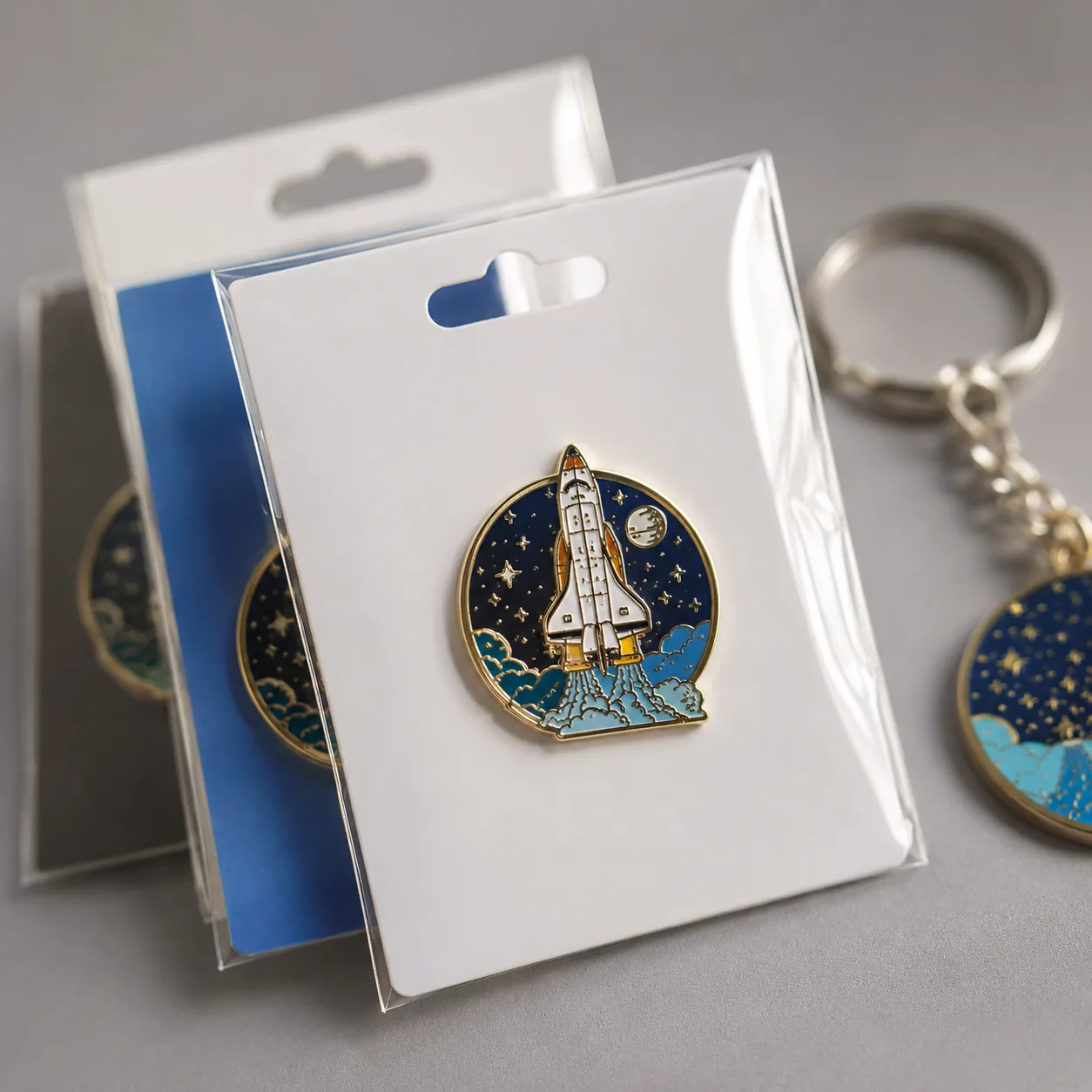
Start with landed cost per accepted piece, not the FOB unit rate
The most common 2026 buying error is still comparing suppliers on FOB unit price alone. For custom metal giveaways, FOB hides too much of the real spend. A USD 0.68 FOB lapel pin can cost more in hand than a USD 0.74 FOB pin once duty, MPF, customs brokerage, sample courier, domestic drayage, inspection, carton inefficiency, and reject exposure are included. On low-value metal items, fixed and semi-fixed charges are large relative to piece price, so a small difference in yield or packing density can erase an apparent FOB saving.
Build the budget in this order: RFQ, landed-cost model, sample approval, then bulk release. If landed cost is calculated only after sample approval, too many cost drivers are already locked: mold type, base metal, thickness, plating, attachment hardware, and packaging format. For 2026 buying, model at least four quantity bands: 100, 300, 500, and 1,000 pieces. Those tiers matter because tooling amortization, minimum plating charges, inspection fees, and carton utilization change sharply between them.
Ask each supplier for a clean USD FOB breakdown with separate lines for tooling, pre-production sample, bulk unit price, hardware upgrades, packaging upgrades, and spare-piece allowance. Require carton data before order placement: outer carton dimensions in cm, gross and net weight in kg, pieces per carton, and inner-pack method. A supplier that can commit to piece-weight tolerance within plus or minus 3 percent and carton specs within plus or minus 5 percent is materially easier to budget than one offering only a blended unit rate.
A simple comparison shows why finance should work from accepted pieces, not ordered pieces. Quote A is 500 stamped iron pins at USD 0.62 FOB with a USD 55 mold fee and no spare pieces. Quote B is USD 0.69 FOB with a USD 40 mold fee, 2 percent spares, and denser packing. Add USD 45 to 70 for third-party inspection, USD 75 to 95 for sample and courier, and USD 120 to 180 for freight and customs-related charges. If Quote A delivers 96.5 percent usable yield and Quote B delivers 99.0 percent, Quote A lands around USD 0.98 to 1.03 per accepted piece while Quote B lands around USD 0.95 to 0.99. The lower FOB offer is not the lower cost program.
Write RFQs that purchasing, QC, and suppliers can price the same way
A usable RFQ describes the actual object, not the marketing intent. For stamped pins or badges, specify finished size in mm, thickness in mm, number of enamel colors, plating finish, edge style, attachment hardware, and individual packaging. For example: '32 x 28 mm stamped iron pin, 1.5 mm thickness, soft enamel, black nickel plating at 0.03-0.05 microns, sandblast background, one butterfly clutch, one OPP bag.' That is quotable. 'Premium custom pin' is not.
Break quotation into cost drivers at RFQ stage. Ask suppliers to separate tooling fee, pre-production sample fee, bulk FOB unit price, hardware surcharges, packaging surcharges, and any spare-piece provision. If the factory works to ANSI/ASQ Z1.4 or equivalent with AQL 2.5 major and 4.0 minor, get that written into the quote before the PO is issued. Inspection standard directly affects expected usable yield, and yield changes true unit economics.
Define tolerances early enough that engineering and QC can use them. Practical baselines for promotional metal goods are size tolerance of plus or minus 0.15 to 0.20 mm for simple stamped items, plus or minus 0.20 to 0.30 mm for die-cast zinc alloy parts, and thickness tolerance of plus or minus 0.10 to 0.20 mm depending on process and section thickness. Decorative plating is commonly specified at 0.03 to 0.05 microns for nickel-tone, black nickel, antique brass, or imitation gold; premium bright gold or higher-wear applications may require 0.08 to 0.10 microns, which raises both cost and cycle time. On soft enamel designs, recessed channels below about 0.30 mm width and raised lines below about 0.25 mm often create avoidable fill, cleanup, and edge-break issues.
- Artwork files: AI, EPS, or vector PDF with Pantone references where color match matters
- Finished size: exact width x height in mm plus target thickness in mm
- Base material: iron, zinc alloy, brass, stainless steel, or aluminum
- Process: stamped, die cast, die struck, etched, printed, laser engraved, or mixed process
- Decoration: soft enamel, imitation hard enamel, UV print, epoxy dome, cutout, relief, or dual plating
- Plating: finish color plus target decorative thickness such as 0.03-0.05 microns
- Hardware: butterfly clutch, rubber clutch, deluxe clutch, split ring, jump ring, magnet set, brooch pin, or rope edge
- Packaging: bulk pack, OPP bag, backing card, velvet pouch, acrylic capsule, or paper box
- Inspection terms: AQL 2.5 major and 4.0 minor unless a stricter plan is required
- Carton controls: max carton weight, dimensions, shipping marks, barcode labels, and pieces per carton
- Commercial terms: FOB port, sample lead time in calendar days, bulk lead time in calendar days, and over/under shipment tolerance such as plus or minus 5 percent
Match the process to the design and the use case
Tariff pressure often pushes buyers toward a cheaper process, but forcing the wrong process usually increases total cost through extra sample rounds, weaker first-pass approval, and lower yield. A 30 mm logo pin with flat color blocks and moderate line detail is usually most economical in stamped iron at 1.2 to 1.5 mm thickness. A 50 mm challenge coin with deeper 3D relief, sculpted edges, or multiple levels is better in zinc alloy die casting at 3.0 to 3.5 mm or die-struck brass at 3.0 mm and above. Trying to force a relief-heavy coin into a thin stamped build usually produces shallow detail, softer edges, and longer approval cycles.
Process minimums should drive the design review. Stamped iron handles crisp outlines and simple recesses well, but deep undercuts, multiple planes, and openwork with thin bridges typically belong in die-cast zinc alloy. Die-struck brass gives cleaner detail and a denser feel than zinc, but its material cost is higher and MOQs are often less forgiving on premium finishes. Stainless steel and aluminum are usually selected for printed, etched, or engraved tags where corrosion resistance or lighter weight matters more than sculpted relief.
Over-specification is another budget leak. Buyers often request brass where iron is sufficient, or imitation hard enamel where soft enamel is adequate for a one-event giveaway. Brass, high polish, and more level enamel surfaces make sense for resale, collector programs, military-style commemoratives, or executive gifting. They are often unnecessary for conference pins, school badges, event medals, and campaign merchandise. The right question is not what sounds premium on paper. It is what construction meets the use case at the target yield and delivery window.
| Product Type | Cost-Focused Build | Typical MOQ Tiers | Typical Lead Time After Sample Approval | Typical FOB Range at 500 pcs |
|---|---|---|---|---|
| 30 mm lapel pin | Stamped iron, 1.2-1.5 mm, soft enamel, butterfly clutch, OPP bag | 100 / 300 / 500 / 1,000 | 10-14 days | USD 0.45-0.85 |
| 50 mm challenge coin | Zinc alloy or brass, 3.0 mm, 2D relief, sandblast background | 100 / 300 / 500 / 1,000 | 12-18 days | USD 1.25-2.90 |
| 45 mm keychain | Zinc alloy, 3.0-4.0 mm, split ring plus 25 mm short chain | 100 / 300 / 500 / 1,000 | 12-18 days | USD 0.95-1.90 |
| 60 mm magnet | Stamped metal face with ferrite backing | 100 / 300 / 500 / 1,000 | 10-16 days | USD 0.70-1.55 |
| 70 mm medal | Zinc alloy die cast, 3.5-4.0 mm, ribbon packed separately | 100 / 300 / 500 / 1,000 | 14-22 days | USD 1.60-3.80 |
Compare quotes by yield, defect risk, and commercial protection
Two quotes with the same FOB total are not commercially equivalent if one assumes higher fallout or offers weaker post-inspection remedies. Convert every offer into landed cost per accepted piece: tooling plus sample fee plus freight estimate plus customs-related charges plus expected defect allowance, divided by accepted quantity rather than ordered quantity. On low-value giveaway programs, even a 2-point yield difference matters. At 500 pieces, the difference between 97 percent and 99 percent usable yield is 10 accepted units. If the item is event-dated, those 10 pieces are often the difference between buffer stock and a shortage.
Probe quality assumptions before award. Ask what tolerance the factory can actually hold on enamel fill height, how it judges pits and scratches on plated side edges, what minimum repeatable line width it can hold below 0.50 mm, and what contractual overrun or underrun is allowed. For many promo-metal factories, practical baselines are size tolerance of plus or minus 0.15 to 0.20 mm on stamped pins, plus or minus 0.20 to 0.30 mm on die-cast zinc parts, and thickness variation of plus or minus 0.10 to 0.15 mm on simple stamped items versus up to plus or minus 0.20 mm on heavier cast pieces.
Also clarify remedy terms before the order is placed. If defects are found after third-party inspection or after receipt, is the remedy remake, credit, spare replacement stock, or partial refund? How many spare pieces ship with the order: 1 percent, 2 percent, or none? What is the remake lead time: 7 days, 14 days, or 21 days? A supplier quoting USD 0.66 with no AQL, no spare policy, and no remedy language is not equivalent to one quoting USD 0.71 with AQL 2.5/4.0, 2 percent spares, and written responsibility for major appearance defects. In a tariff-loaded year, a replacement order for 200 pieces can trigger another round of freight, customs, admin time, and event risk.
Use sampling to close the expensive unknowns
The sample stage should answer only the variables that cannot be closed on paper: color appearance, relief definition, edge smoothness, hardware alignment, actual weight, and packaging fit. It should not become an open design workshop. If artwork, dimensions, or plating concept are still shifting during sampling, the cost model is already unstable because each revision can affect tooling, scrap rate, and lead time.
For standard custom metal goods, realistic pre-production sample lead times are 5 to 7 calendar days for simple stamped pins, 7 to 10 days for standard coins and keychains, and 10 to 14 days for larger medals, multi-part assemblies, or mixed-process builds. Sample charges commonly run USD 35 to 80 for simple stamped items and USD 60 to 150 for thicker cast items or multi-component parts. Many factories credit the sample fee back on orders above 500 or 1,000 pieces, but that credit should be written into the quotation rather than assumed.
Photo approval can remove one courier cycle when technical risk is low. If the only open point is whether black nickel plating and Pantone-matched enamel are visually acceptable, calibrated photos with caliper readings, weight-on-scale photos, and close shots of side edges may be enough for a low-risk event giveaway. That is usually not adequate for retail, collector, or executive gifting programs where tactile finish, edge break, polish level, and plating uniformity affect perceived value.
On mixed-SKU orders, physically sample the highest-risk item and paper-approve lower-risk variants only when process, thickness, plating, and packing are identical. If one SKU adds a spinner, hinge, magnet set, or dual plating, it is a separate risk profile and should be sampled as such. Sampling exists to protect the bulk run, not to create extra prototype rounds.
Control bulk cost through packing density, lead time, and shipment terms
After sample approval, economics are driven as much by packing density and schedule control as by quoted unit rate. Packaging can materially change freight on small metal products. A 40 mm zinc-alloy keychain in an individual paper gift box can consume two to three times the carton volume of the same item in an OPP bag. Coins in acrylic capsules or velvet boxes often shift a shipment from weight-driven to cube-driven freight with very little change in metal cost.
Typical bulk lead times for standard promo-metal projects are about 10 to 18 calendar days after sample approval for 300 to 1,000 pieces, and about 18 to 30 days for higher volumes, mixed finishes, dual plating, or multi-part assemblies. During peak season, or when plating capacity is tight, completion can stretch beyond that range. Buyers working around tariff changes or fixed event dates should keep at least a 7 to 10 day buffer between ex-factory completion and required in-hand date, and more where customs clearance has been volatile.
The purchase order should repeat all commercial controls: approved sample reference, exact packing method, pieces per inner pack, maximum carton weight such as 12 to 15 kg, outer carton dimensions, shipping marks, barcode requirements, AQL level, spare-piece policy, and shipment tolerance. Without these controls, the factory may technically ship conforming product while the importer absorbs relabeling, repacking, split-shipment, or warehouse handling costs.
Carton data should be confirmed before mass production starts. In practice, 500 polybagged 30 mm pins may fit in one compact export carton, while 500 individually boxed 50 mm coins may require several larger cartons at much lower packing density. That affects freight, receiving labor, storage, and final-mile handling. For low-value giveaway programs, carton efficiency is often a larger savings lever than negotiating another cent off FOB.
Cut cost where savings are durable, not where failure gets pushed downstream
The best savings usually come from simplification that does not harm performance or perceived value. Reducing a pin from 38 mm to 30 mm, standardizing one plating finish across several SKUs, switching from custom die-cut backing cards to standard OPP bags, or consolidating similar designs into one production run usually saves more reliably than chasing a marginal reduction in metal thickness. On many projects, a packaging saving of USD 0.04 to 0.08 per unit is safer than trying to save the same amount by weakening hardware or reducing relief depth.
The worst savings are the ones that move failure into the field. Common examples are split rings with inadequate wire gauge on keychains, ferrite magnets where real holding force requires NdFeB, coin thickness reduced below what the relief needs, or artwork lines forced below process minimums. Those decisions may improve the initial quote while increasing complaint rates, rework, or outright event failure later. For magnets, ferrite is usually adequate for lightweight handouts, but if the application requires holding force above roughly 0.8 to 1.2 kg on steel surfaces, NdFeB should be specified and tested.
- Good cost cuts: reduce dimensions where logo legibility and perceived value remain acceptable
- Good cost cuts: standardize plating, attachment hardware, and packing across multiple SKUs
- Good cost cuts: use bulk pack or OPP bag for event giveaways with no retail presentation requirement
- Good cost cuts: combine similar items to spread tooling, inspection, and freight fixed costs
- Risky cost cuts: reduce thickness until warp, shallow relief, or weak hardware retention becomes likely
- Risky cost cuts: downgrade keychain rings, clutch quality, or magnet grade below actual use conditions
- Risky cost cuts: remove finishing steps after sample approval and create mismatch across a branded set
- Risky cost cuts: award to the lowest quote without written AQL, tolerance, spare, and remake terms
Release orders with one approval record and one cost model
Before releasing the next 2026 custom metal order, rebuild the quote sheet around landed cost per accepted unit rather than FOB price alone. Require at least three quantity tiers, separate tooling and sample charges, exact carton data, written lead times in calendar days, and inspection terms. For items above roughly USD 1.00 FOB, or for any program tied to resale, collectors, or fixed event dates, approve at least one physical pre-production sample before bulk release.
Then sort requirements into three buckets: non-negotiable brand requirements, performance requirements, and optional premium features. That makes tariff-era tradeoffs manageable because it shows what can be simplified without damaging the program. On multi-SKU projects, one capable supplier that can normalize process assumptions, plating, QC terms, and packing methods is often easier to manage than several fragmented quotes built on different assumptions.
Do not issue the PO until the approved sample reference, tolerances, AQL level, packaging method, shipment window, spare-piece allowance, and remake responsibility are captured in one approval record. That document, more than the lowest headline unit price, is what protects margin when tariffs, freight, or timing move late in the cycle. In 2026, disciplined specification and clean commercial terms remain the cheapest cost-control tools available.
Have a project? Send your artwork and target quantity and we’ll reply with a detailed quotation within 12 working hours.
Ready to get this made?
Send your sketch, target quantity and ship-date. Detailed quotation in 12 hours.



