Brooch Pins vs Badges: Choosing the Right Build
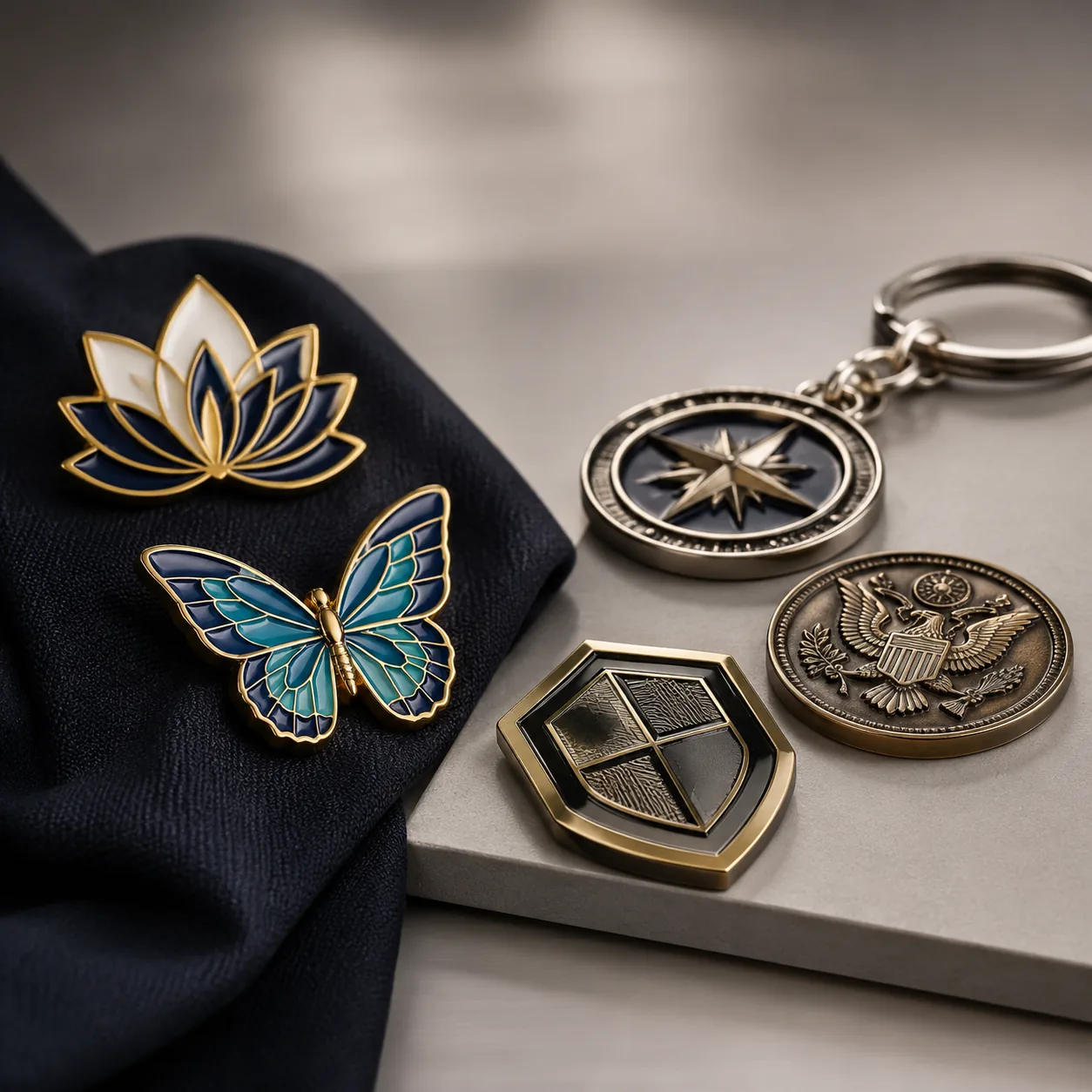
Brooch pins and badges solve different manufacturing problems
Buyers often group brooch pins and badges together because both are worn on clothing and both can be metal, printed, or enamel. In production, they fail for different reasons. Brooch pins are judged like small accessories: they need cleaner edges, better visual balance, and a more refined hand feel. Badges are judged like identification tools: they need fast legibility, secure attachment, and repeatable output across a lot.
That difference matters at RFQ stage. A quote can look correct on paper and still produce the wrong build if the intended use is vague. If you specify a brooch as if it were a badge, the sample may be too heavy, too small in text, or too plain to justify retail pricing. If you specify a badge as if it were jewelry, you may pay for polishing and plating quality that end users will not notice.
The simplest rule is this: brooch pins are selected to be seen up close; badges are selected to be recognized quickly. That one choice drives material, thickness, finish, attachment, cost, and reject criteria.
Specification comparison at a glance
Use the table below as the first filter before you discuss artwork, packaging, or secondary processes. It shows the practical differences that usually affect tooling, price, and approval speed.
| Spec | Brooch pin | Badge |
|---|---|---|
| Typical use | Fashion, gift, museum, premium promo | Uniforms, events, identity, campaigns |
| Common size | 20-45 mm; premium pieces often 25-35 mm | 25-70 mm; name/role badges often 50-70 mm |
| Typical thickness | 1.0-1.5 mm stamped brass; 1.2-2.0 mm cast zinc alloy | 0.8-1.2 mm stamped; 1.0-1.5 mm printed or enamel zinc alloy |
| Weight target | Light enough for lapels, knitwear, and scarves without drag | Can be slightly heavier if worn on shirts, jackets, or lanyard-backed garments |
| Surface finish | Polished, satin, antique, hard-enamel, soft-enamel, pearl, or jewelry-style plating | Printed, offset, stamped, soft-enamel, matte or gloss protective coating |
| Attachment | Butterfly clutch, deluxe clutch, safety pin, magnet | Safety pin, clutch, magnet, clip, badge reel, pin-back |
| Artwork tolerance | Fine lines and tiny text often need simplification | Text and logos need strong hierarchy and higher contrast |
| Best when | Presentation matters as much as function | Visibility and identification matter more than presentation |
| Less suitable when | You need large text at distance or frequent on/off use | You need a luxury look or very fine decorative detail |
Use case should decide the build, not the other way around
A brooch pin is usually the better choice when the item is meant to feel like an accessory, collectible, or gift. Fashion brands, beauty labels, museums, and executive gifting programs usually want a piece that sits flat, catches light well, and feels finished from every angle. In that context, plating quality, edge polish, and attachment comfort matter more than visibility across a room.
A badge is usually the better choice when recognition matters at arm’s length. Event staff, retail teams, volunteers, schools, clubs, and campaign teams need clear names, roles, or logos that can be read quickly. That favors larger copy, stronger contrast, and simpler geometry rather than jewelry-like detail.
A practical decision test helps: is the person wearing it being identified by the item, or is the item itself the object of interest? If the answer is the latter, choose a brooch-style build. If the answer is the former, choose a badge-style build. That avoids the most common revision cycle: a beautiful sample that cannot do the job.
Materials, thickness, and finish change the outcome
For brooch pins, brass is often preferred when buyers want crisp stamping, sharp line definition, and a premium plated surface. Zinc alloy is more common when the design needs deeper relief, sculpted form, or a 3D profile. Brass usually gives better detail on small, flat motifs; zinc alloy is better for bolder forms and layered surfaces. For decorative pieces, buyers should ask for edge deburring of no more than 0.1-0.2 mm visible burr under normal inspection lighting, because rough edges stand out immediately on jewelry-style items.
For badges, zinc alloy and iron are common because the build is usually optimized for scale and cost. Printed badges often use a flat metal base with epoxy or clear coating, while soft-enamel versions can use recessed color areas for stronger brand impact. Small text is the main risk: if the copy is too tight, the badge may look acceptable in artwork but lose legibility after plating, enamel fill, or print gain.
Thickness should match the garment and the expected wear pattern. A brooch pin that is too thick can tilt on thin fabric and feel bulky on a lapel. A badge that is too thin can warp in packing or look cheap on arrival. In practice, many factories start around 1.2 mm for brooch-style stamped metal and 1.0-1.2 mm for standard badges, then adjust by size and attachment load. For pieces above 45 mm, tolerance control becomes more important because even a small bend is visible on clothing.
For plated decorative pieces, ask about plating stack rather than only the color name. A common commercial spec is 0.03-0.05 microns of flash gold or silver over a base layer, but premium retail work may require heavier plating, more consistent bath control, or a protective top coat. If the item will be handled repeatedly, clear coating or anti-tarnish packing is worth adding. A practical flatness tolerance is within 0.3 mm on small brooches and 0.5 mm on larger badges, assuming a standard visual inspection distance.
Attachment choice affects comfort, retention, and returns
Attachment is where many projects fail because the front design is approved without confirming how the piece will be worn. A brooch pin used on a blazer, scarf, or dress needs enough grip to stay in place without damaging fabric. A badge used by event staff may need faster removal and reattachment than a fashion item, which changes the best back finding.
Butterfly clutches are common for small, light pieces, typically under about 30 mm and under roughly 8-10 g. They are compact and low-cost, but they can feel less secure on heavier bodies. Deluxe clutches improve retention and create a more premium experience, but they raise unit cost. Safety pins are better for wider badges or items that need to hang naturally without rotating. Magnetic backings work well when fabric damage must be avoided, but they add cost and reduce holding strength on thick garments or heavier metal bodies.
- Use a butterfly clutch for compact brooch pins under about 30 mm and low weight.
- Use a deluxe clutch when the item is premium and retention matters more than cost.
- Use a safety pin for wider badges, thicker garments, or pieces that tend to rotate.
- Use a magnetic back when fabric damage is unacceptable and garment thickness is modest.
Price, MOQ, and lead time depend on finishing load
Brooch pins usually cost more than plain badges when the buyer wants cleaner polishing, tighter finishing, and a more refined visual standard. The raw metal cost is not the main driver; labor and reject tolerance are. A minor burr or slightly cloudy plate that may pass on a campaign badge is more likely to be rejected on a fashion brooch. That is why premium work tends to carry a wider price spread.
Typical FOB pricing from a China factory is about USD 0.35-0.80 per piece for simple badges at 500-1,000 pcs, and about USD 0.60-1.50 per piece for brooch-style pieces with better polishing or plating. Complex 3D cast pieces, soft enamel with multiple colors, or mixed-material assemblies can rise to USD 1.80-3.50+ FOB depending on size and finishing. Tooling is commonly USD 60-180 for simple stamped or cast items, and USD 180-350 when the design requires deeper relief, multiple cavities, or extra hand-finishing.
MOQ usually starts at 100-300 pcs for standard designs, but some factories set 500 pcs for highly customized premium brooch work because setup, plating, and hand inspection become more efficient at scale. Lead time is typically 10-18 days for samples and 15-25 days for production after sample approval. Add 3-7 days if you need mixed plating, special packaging, or a second sample round. If the design includes tiny text or fine linework, expect an extra day or two for artwork clarification before tooling starts.
As a rule, the more the product depends on visible finish quality, the more expensive the first acceptable sample becomes. That is why it pays to decide early whether the item is a presentation piece or a functional identifier.
Quality checks should be written into the RFQ
The most common quality mistake is approving artwork without defining measurable acceptance criteria. A production sample can look attractive on screen and still fail in lot production because the factory’s internal tolerance is looser than the buyer’s brand standard. For both brooch pins and badges, the spec should state what counts as a reject before tooling starts.
For decorative metal items, a practical inspection baseline is AQL 2.5 for major defects and AQL 4.0 for minor defects, unless the buyer needs a retail-grade standard or a stricter internal policy. Buyers should also define allowable size tolerance, usually ±0.3 mm for small items and ±0.5 mm for larger pieces, with a tighter tolerance if text alignment or pairing matters. If the design includes print, ask for print offset not exceeding 0.3 mm where it affects legibility.
Define the following in the RFQ so the factory does not guess:
- Base metal and plating color, including whether the finish is polished, antique, matte, or satin.
- Final thickness target and allowable tolerance by size class.
- Attachment type, pull expectation, and whether the garment is delicate or heavy.
- Acceptable defect types: burrs, bent posts, cloudy plating, misaligned print, or chipped enamel.
- Inspection method: daylight check, 100% visual check, or sampled AQL inspection.
If your badge includes printed text, define minimum font size at production scale. A practical floor is 5-6 pt equivalent for short labels and 7-8 pt equivalent for names or roles, assuming a clean sans-serif font and a 25-35 mm viewing distance. For fine jewelry-style brooches, keep line gaps wide enough that enamel or plating does not bridge them during fill or polishing.
When brooch pins win, and when badges win
Choose brooch pins when the item has to feel special. They are stronger for retail gifting, executive appreciation, luxury brand activations, museum merchandise, and collector programs where the object itself is part of the message. Brooches also suit irregular silhouettes, layered forms, and pieces with a jewelry-like profile that benefits from careful polishing and plating.
Do not choose brooch pins when the primary task is readability. A small brooch can look elegant and still fail as an identification tool if the text is too small or the logo too subtle. If staff must be recognized quickly at an event, or if the design contains multiple lines of copy, a badge is usually safer, cheaper, and more effective.
Badges also win when the garment is thin, expensive, or frequently changed. Heavy metal pieces and strong clutches can distort silk, knitwear, or lightweight uniforms. In those cases, a lighter badge with a safety pin, clip, or magnetic back often reduces return risk and fabric complaints. For regular use, a badge that weighs 6-12 g is usually easier to wear than a decorative brooch at 10-18 g, especially on thin fabric.
Checklist for sending a clean RFQ
Use this checklist before you send artwork to any factory. It reduces sample rounds and makes pricing more accurate.
- State whether the item is a brooch pin or a badge, and explain the wearing context.
- Provide size in millimeters, target thickness, and preferred base metal.
- Specify plating type, surface finish, and whether the piece needs anti-tarnish protection.
- Choose the attachment based on garment type and expected wear frequency.
- Set MOQ, target FOB range, and required lead time in days.
- Ask for one pre-production sample and one packed sample if presentation matters.
- Include tolerance, AQL target, and reject conditions for edges, plating, and alignment.
If you are sourcing from China, the best RFQs also mention the intended audience and the garment type. That extra context helps the factory decide whether to optimize for comfort, visibility, or presentation. In most cases, the quickest path to a good quote is not more artwork; it is a clearer definition of how the piece will actually be worn.
Have a project? Send your artwork and target quantity and we’ll reply with a detailed quotation within 12 working hours.
Ready to get this made?
Send your sketch, target quantity and ship-date. Detailed quotation in 12 hours.



