Breakaway Lanyard Specifications That Pass Event Safety Checks
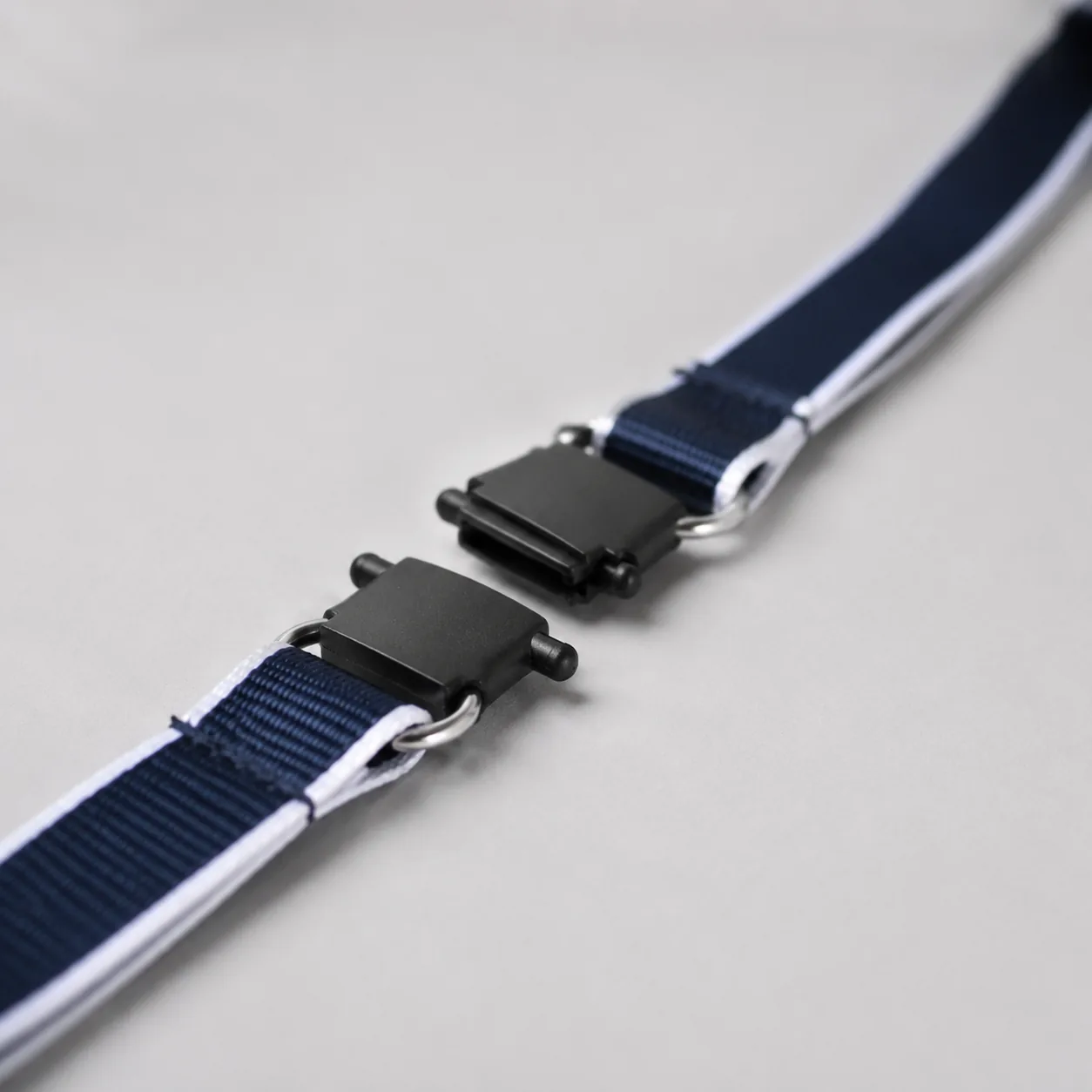
Why Approved-Looking Lanyards Fail at Venue Check-In
Breakaway lanyard problems usually appear at registration, not during quotation. The artwork is correct, the print is sharp, and the cartons arrive on time, but the venue safety team rejects the batch because the neck release is missing, too stiff, placed incorrectly, or inconsistent across colors. Reworking 10,000 assembled lanyards after packing is slow because the strap, stitching, breakaway, hook and badge holder have already been combined.
For adult conferences, a breakaway is not only a strangulation-risk control. It also reduces injury when a badge catches on a turnstile, door handle, escalator edge, exhibition booth hook, queue barrier or backpack strap. For children’s programs, hospitals, factories, schools and sports venues, treat breakaway performance as a functional specification, not a generic accessory line item.
At ZheCraft, we produce custom lanyards alongside pins, PVC cards, acrylic passes, patches and event gift sets. The safest orders define strap width, strap thickness, breakaway position, target release force, bottom hardware, badge weight and packing method before sampling. Without those numbers, two suppliers can quote the same “breakaway lanyard” and deliver products with very different safety behavior.
Set the Breakaway Layout and Release Force First
Most event lanyards use a rear-neck breakaway, a side breakaway or dual side breakaways. Rear-neck breakaways are the default for adult conferences because the release point sits behind the neck and leaves the front strap clear for logos. Side breakaways are easier to inspect visually but can rotate forward on lightweight 10 mm or 12 mm straps. Dual breakaways add redundancy and are better for children, sports events, industrial visitors and high-snag environments.
The key number is release force. Too low, and the lanyard opens when an attendee removes a jacket or bag. Too high, and it does not protect the wearer when the badge is pulled. For adult event use, a practical factory target is 2.5-4.5 kgf under steady pull in the wearing direction. For children’s programs or machinery-risk areas, buyers often specify 1.5-3.0 kgf, but this must be tested with the actual badge load to avoid nuisance opening.
| Breakaway layout | Best use case | Target release force | Buyer note |
|---|---|---|---|
| Rear-neck single breakaway | Adult conferences, trade shows, visitor passes | 2.5-4.5 kgf | Clean branding area; harder for staff to inspect quickly |
| Side single breakaway | Volunteers, temporary staff, lightweight IDs | 2.0-4.0 kgf | Visible safety feature; may rotate toward front on narrow straps |
| Dual side breakaway | Schools, sports venues, factories, children’s programs | 1.5-3.5 kgf per release point | Higher safety redundancy; adds assembly cost and bulk |
| No breakaway | Decorative giveaways not worn during activity | Not applicable | Use only when written venue policy allows it |
Plastic breakaway buckles are commonly POM or PP. POM gives better dimensional stability and more consistent snap feel across large lots, especially when multiple mold cavities are used. PP is cheaper, but release force can vary more with temperature and molding quality. For safety-controlled orders, specify both the material and the acceptable release range, then require pull-gauge records from production.
Specify Strap Width, Material and Tolerances Together
Breakaway performance changes with strap width, fabric stiffness and thickness. A 20 mm flat polyester strap with a firm weave transfers pulling force more directly to the buckle than a soft tubular strap, which can stretch, twist or absorb energy before the breakaway releases. If the fabric curls or the sewn loop is too tight, the same buckle can release later than it did as a loose component.
For most event orders, 15 mm and 20 mm flat polyester are the safest commercial choices. A 15 mm strap is economical and comfortable for paper inserts or PVC cards under 35 g. A 20 mm strap gives better print visibility and load distribution for rigid badge holders, metal badges, scanner tags or staff credentials weighing 35-80 g. Use 10 mm only for very light passes below 20 g, and avoid heavy hooks on narrow straps because they make the lanyard twist.
A practical production specification is 0.8-1.2 mm finished strap thickness, width tolerance of ±0.5 mm, finished cut length tolerance of ±10 mm and logo position tolerance of ±2 mm from the approved sample. For repeated sponsor logos, set repeat spacing tolerance at ±3 mm. Standard adult finished circumference is usually 850-900 mm; scanning-heavy events may request 780-830 mm so the badge sits higher on the chest.
- Use 10 mm only for light paper badges below 20 g and simple one-color logos.
- Use 15 mm for standard trade show passes, PVC cards and visitor badges up to about 35 g.
- Use 20 mm for rigid holders, staff passes, metal badges, keys or scanner tags up to about 80 g.
- Use 25 mm only when larger branding justifies extra fabric bulk and neck weight.
- Specify finished length, not only “standard adult size,” if scanners or turnstiles are involved.
Match Bottom Hardware to Badge Weight and Risk
Many lanyard complaints are blamed on the breakaway, but the bottom attachment is often the weak point. A thin J-hook can work for a paper badge sleeve, but it may bend open when paired with a rigid acrylic pass, coin pass, metal keychain or badge reel. If the badge falls off, event staff see a lanyard failure regardless of which component actually failed.
For paper inserts in PVC sleeves, a 0.8-1.0 mm iron J-hook or light lobster hook is usually adequate. For PVC cards, rigid holders and staff badges above 40 g, specify a 1.2-1.5 mm metal lobster hook, oval hook or bulldog clip. For scanner cards and access control badges, a detachable buckle with a 15-20 mm plastic side-release connector can help staff remove the credential without taking off the lanyard, but it adds another failure point and should be pull-tested.
Metal hardware is usually iron, zinc alloy or stainless steel. Iron is cost-effective for indoor events if plating is controlled at about 3-5 microns nickel equivalent with a clear topcoat where needed. Zinc alloy looks heavier and more premium but adds neck weight and is rarely necessary for short promotional events. Stainless steel improves corrosion resistance for outdoor, maritime or multi-day sports venues but limits shape options and increases cost.
| Badge load | Recommended hardware | Minimum pull check | Avoid |
|---|---|---|---|
| Under 20 g paper insert | 0.8 mm J-hook or light lobster hook | 4 kgf for 10 seconds | Heavy zinc hooks on 10 mm straps |
| 20-40 g PVC card or sleeve | 1.0-1.2 mm lobster or swivel hook | 5 kgf for 10 seconds | Magnetic attachments for security badges |
| 40-80 g rigid holder or staff pass | 1.2-1.5 mm lobster, oval hook or bulldog clip | 6-8 kgf for 10 seconds | Thin wire J-hooks |
| Badge reel or scanner tag | Detachable buckle plus tested hook | Full assembly tested at loaded weight | Untested extra connectors |
Sample the Complete Assembly, Not Loose Parts
A loose breakaway buckle can pass a pull test and still fail after sewing because strap thickness changes the buckle angle. A proper pre-production sample must use the same strap material, print process, sewing distance, breakaway model, hook and badge holder planned for mass production. Approving only a printed strap strip leaves the safety performance unknown.
For event lanyards, practical sample checks include release force, repeated open-close cycles, seam strength, hook strength, strap dimensions and logo placement. A workable benchmark is 20 open-close cycles without cracking, sewn-loop pull above 8 kgf for adult lanyards, bottom hook pull above 6 kgf for standard holders and release force within the approved range on at least 10 checked samples. These are factory working targets, not universal legal standards, so buyers should still compare them with venue rules and local safety requirements.
If the lanyard is supplied as a kit with pins, metal badges, PVC cards or keychains, sample it as a kit. Extra parts change hanging weight, scratch risk, packing pressure and the way the lanyard behaves when pulled. A signed golden sample should include the final strap color, Pantone reference, artwork file name, buckle model, hook type, badge load and packing format.
MOQ, FOB Pricing and Lead-Time Benchmarks
For standard printed polyester lanyards, MOQ is usually 500 pcs per design, but 1,000 pcs is the more cost-efficient starting point because setup, screen making and color matching are spread across more units. FOB Yiwu or Ningbo pricing for a 15 mm polyester lanyard with one-color screen print, rear breakaway and standard J-hook is commonly USD 0.28-0.55 per piece at 1,000-5,000 pcs. A 20 mm strap with metal lobster hook and POM breakaway typically runs USD 0.38-0.75 per piece.
Sublimation is better for gradients, photos, QR-style sponsor layouts and full-color edge-to-edge designs. Expect USD 0.45-0.95 per piece for 1,000-5,000 pcs depending on strap width, print coverage, hook and packing. Woven or jacquard lanyards usually start around USD 0.65-1.20 per piece and suit bold logos better than small sponsor text below 5 mm letter height. Dual breakaways typically add USD 0.04-0.12 per piece.
| Quantity tier | Typical MOQ or tier | FOB price reference | Production lead time |
|---|---|---|---|
| Sample approval | 1-5 pcs pre-production samples | USD 25-80 sample charge, often refundable | 4-7 days printed; 7-10 days woven |
| Small event order | 500-999 pcs | USD 0.45-0.95 per pc depending on specs | 10-14 days after approval |
| Standard event order | 1,000-5,000 pcs | USD 0.28-0.75 per pc for common polyester builds | 10-16 days after approval |
| Large conference order | 5,001-20,000 pcs | USD 0.22-0.62 per pc if hardware is standard | 14-22 days after approval |
| Custom-dyed or custom hardware | Usually 3,000-5,000 pcs minimum | Add USD 0.03-0.15 per pc | Add 3-7 days |
Rush orders are possible when strap color, hook and buckle are in stock, but do not remove breakaway testing to save two days. For fixed event dates, build the schedule backward: allow 4-7 days for sample approval, 10-16 days for production, 2-4 days for domestic consolidation and the chosen air or sea transit time. If badges, pins or cards are packed together, add at least 2-3 days for kitting and carton verification.
Inspection Criteria Before Shipment
Inspect lanyards as functional wearable products, not only printed textiles. For general event orders, AQL 2.5 for major defects and AQL 4.0 for minor defects is a practical baseline. For children, factories, hospitals or safety-controlled venues, keep the same visual AQL if appropriate but add tighter functional checks for breakaway release, hook strength and sharp edges.
Major defects include missing breakaway, non-releasing buckle, broken hook, wrong strap width, wrong artwork, incorrect logo color, unsafe stitching, sharp metal burrs and severe plating peel. Minor defects include small print dots, slight shade variation within approved tolerance, loose thread ends under 3 mm and minor packing scuffs. Textile color should be judged against a Pantone reference or physical approved sample under consistent light; fabric variation is normal, but mismatched event team colors are not acceptable.
Packing should protect both the print and hardware. A common format is 50 pcs per inner polybag and 500 pcs per export carton, with carton weight kept below 15 kg to prevent crushed bottom layers. If lanyards are packed with badges, pins or keychains, separate metal parts with paper or OPP sleeves so plating does not scratch the printed strap during transit.
- Check 20-32 pcs per lot for breakaway release using a calibrated pull gauge.
- Measure strap width, finished length and logo position against the signed golden sample.
- Open and close breakaways repeatedly on random samples to catch brittle plastic or loose fit.
- Inspect hooks for burrs, plating peel, weak spring action, deformation and sharp edges.
- Confirm carton labels show design code, quantity, event name, PO number and carton count.
Build the RFQ Around Safety-Critical Details
Before asking for prices, prepare a one-page lanyard specification instead of sending only a logo file. Include strap width, finished length, material, print method, breakaway position, target release force, hook type, badge weight, packing format, inspection requirement and required delivery date. This forces suppliers to quote the same product rather than guessing at safety level and hardware grade.
A strong RFQ for an adult conference might read: 20 mm flat polyester, 900 mm finished length, sublimation print both sides, rear POM breakaway releasing at 2.5-4.5 kgf, 1.2 mm metal lobster hook, badge load 55 g, AQL 2.5/4.0, 50 pcs per inner bag, delivery 18 days after sample approval. A school visitor order might change that to dual side breakaways at 1.5-3.0 kgf and avoid keys or metal charms on the same lanyard.
For repeat events, lock the buckle model, strap width, hook type, release-force range, artwork file name and approved sample photos in the reorder specification. That small discipline prevents the next batch from looking identical on screen but behaving differently around a guest’s neck. At ZheCraft, we can sample the lanyard with PVC cards, pins, metal badges or keychains so the buyer approves the complete wearable set before mass production.
Have a project? Send your artwork and target quantity and we’ll reply with a detailed quotation within 12 working hours.
Ready to get this made?
Send your sketch, target quantity and ship-date. Detailed quotation in 12 hours.



