Bottle Opener Keychains: Technical Buying Guide for Promo Orders
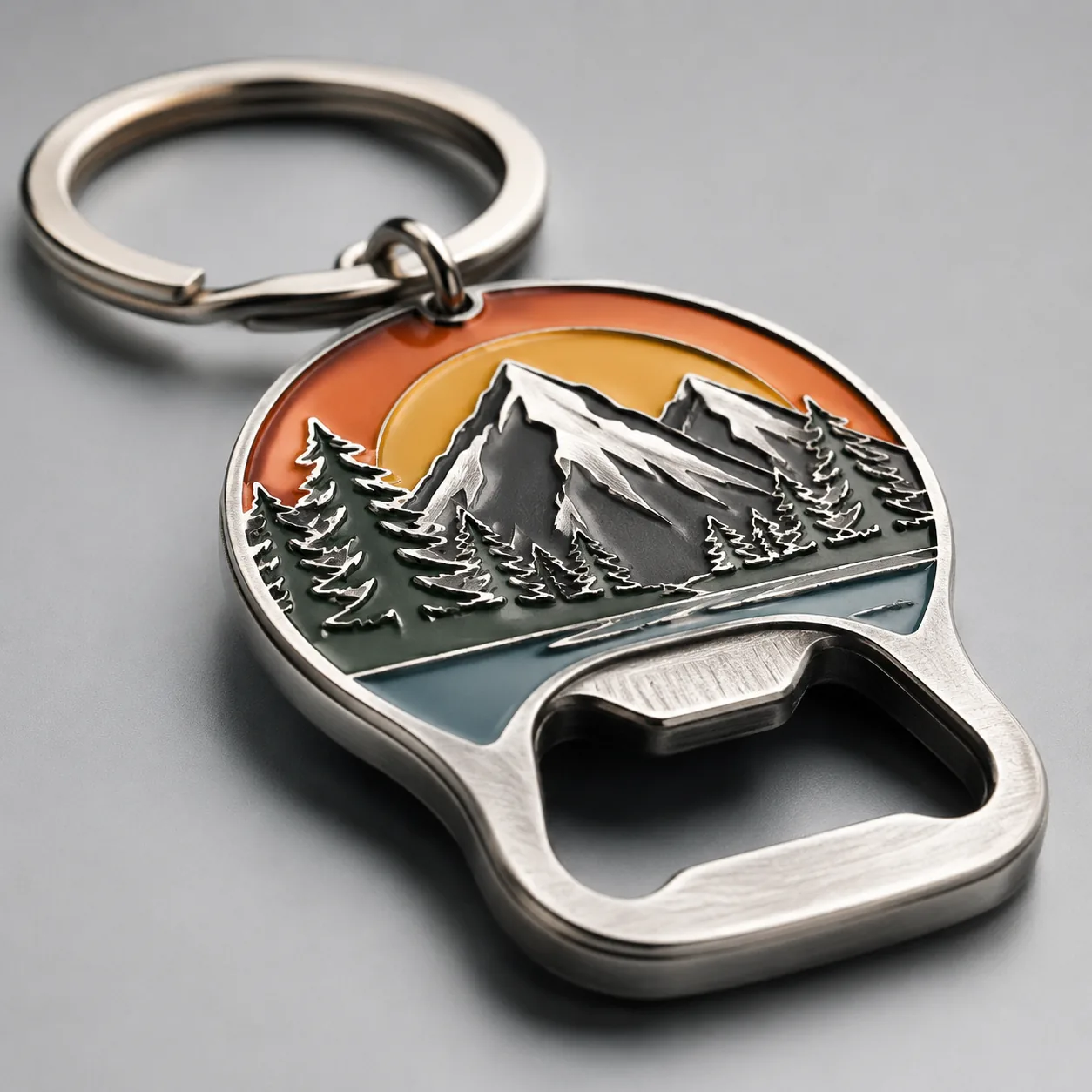
Engineer the Opener Before Decorating It
A beverage distributor needs 3,000 custom bottle opener keychains for a beer festival in six weeks. The brief sounds straightforward: soft-enamel logo on the front, opener function for standard 26 mm crown caps, 25 mm split ring, and a printed backing card for booth handout. The buyer has vector artwork and a target below USD 1.50 FOB, but no technical drawing.
The risk is that a bottle opener keychain is both a promotional item and a small hand tool. Common failures are predictable: the lip slips off the cap, the neck bends, the ring hole tears out, plating chips at the working edge, or loose metal scuffs the card in transit. These failures usually come from weak section thickness, uncontrolled mouth geometry, over-polished edges, or inspection criteria that judge appearance but not function.
For a 3,000-piece promotional order, the safest default is a zinc alloy die-cast body with recessed soft enamel, satin nickel or black nickel plating, a 25 mm split ring, and at least 2.5 mm of load wall around the opener mouth and ring hole. Stainless steel 304 is better for flat slim openers, but zinc alloy gives stronger logo relief, lower tooling cost, and more forgiving hand feel for custom silhouettes.
Convert Artwork Into Working Dimensions
The first decision is whether the logo can form the opener body or whether it should sit on a proven opener outline. Long thin letters, mascot tails, sharp internal corners, and narrow bridges often look good in artwork but become weak arms under cap-opening load. For zinc alloy keychain openers, a practical finished size is 60 to 85 mm long, 28 to 45 mm wide, and 3.0 to 4.5 mm thick. Below about 55 mm overall length, leverage drops and users apply more force through the ring end.
The opener mouth needs a bite point and a lifting lip, not a decorative cutout. A standard crown cap is about 26 mm in diameter with crimped teeth around the skirt. For cast zinc alloy, the working mouth is commonly 17.5 to 20.0 mm wide, with a 1.2 to 1.8 mm lip remaining after polishing. The mouth should hold a tighter tolerance than the outer logo shape: plus or minus 0.15 mm is realistic after tool correction, while plus or minus 0.30 mm is normally acceptable for the outside contour.
A useful approval drawing should show the front profile, side thickness, opener cutout, lip section, ring hole position, enamel zones, plating finish, and attached hardware. A flat artwork proof is not enough. If the factory interprets the mouth radius or lip thickness incorrectly during tooling, the pre-production sample may look right but fail after a few cap openings.
- Target body: 70 mm long by 36 mm wide, tolerance plus or minus 0.30 mm
- Nominal thickness: 3.5 mm zinc alloy, tolerance plus or minus 0.20 mm
- Opener mouth: 18.5 mm working width, tolerance plus or minus 0.15 mm
- Lifting lip: 1.5 mm after polishing, with no heavy rounding
- Minimum load wall: 2.5 mm around opener mouth, neck, and ring area
- Ring hole: 3.5 mm diameter with at least 2.5 mm edge distance
- Split ring: 25 mm outside diameter, 1.6 to 1.8 mm wire for better pull strength
Select Metal by Use Case, MOQ, and Cost
Material choice controls strength, edge definition, corrosion resistance, finish life, and lead time. Zinc alloy is the default for shaped promotional openers because it die casts cleanly, supports raised rims and recessed enamel, and keeps custom tooling moderate. Stainless steel 304 is stronger for thin flat pieces and resists corrosion better, but it is less suitable for deep 3D relief or enamel-filled raised borders unless additional stamping, etching, or printing is added.
Iron can reduce unit cost for simple stamped openers, but exposed cut edges and holes are more vulnerable to rust if plating is thin or scratched. Brass and copper alloys are used for premium merchandise, clubs, gift sets, and retail programs rather than cost-driven festival giveaways. For B2B orders from 1,000 to 10,000 pieces, the practical decision is usually zinc alloy for branding depth versus stainless steel for slim durability.
| Material | Best use | Typical thickness | Practical MOQ | FOB range at 3,000 pcs | Key control point |
|---|---|---|---|---|---|
| Zinc alloy die cast | Custom logo shapes with enamel | 3.0 to 4.5 mm | 500 pcs | USD 1.05 to 1.75 | Keep neck and ring areas at least 2.5 mm thick |
| Stainless steel 304 | Flat durable openers and slim keychains | 1.8 to 2.5 mm | 1,000 pcs | USD 1.15 to 1.95 | Deburr laser-cut or stamped edges before brushing or plating |
| Iron stamped | Low-cost flat promotional shapes | 1.8 to 2.2 mm | 1,000 pcs | USD 0.75 to 1.30 | Check plating coverage at cut edges and holes |
| Brass or copper alloy | Premium retail, club, or gift merchandise | 2.0 to 3.0 mm | 300 pcs | USD 1.90 to 3.80 | Control tarnish, fingerprints, and raw material volatility |
For the distributor order, zinc alloy is the better balance. It allows a raised metal border around the logo, two to four enamel colors, rounded edges, and a finished carded unit near the USD 1.50 FOB target if the design is not oversized. Stainless steel becomes the better choice only if the buyer wants a thin wallet-style opener, a brushed-metal retail look, or stronger corrosion resistance with little color fill.
Control Tooling, Sampling, and Lead Time
For a new die-cast zinc alloy opener, digital artwork review and technical drawing preparation usually take 1 to 2 working days when the buyer supplies clean vector files. Tooling and first samples normally require 7 to 12 days after deposit and drawing approval. Soft enamel can add 1 to 2 days when there are several Pantone colors, small separated cells, or two-sided decoration.
The sample should be evaluated as a working tool, not as a souvenir. Open 20 to 30 crown caps with different users and angles. Check whether the lip slips, whether the neck bends, whether the split ring pulls against the hole, whether plating scratches immediately at the lip, and whether any edge feels sharp under thumb pressure. A small witness mark on the working lip is normal. Cracking, visible deformation, enamel chipping near the mouth, or burrs that catch fabric are not acceptable.
A realistic schedule for 3,000 custom zinc alloy openers is 30 to 38 days ex-factory including sampling, approval time, mass production, final inspection, and packing. If an existing mold is reused and only enamel colors or printed cards change, 18 to 24 days is more realistic. Rush production can remove idle days, but skipping the sample is poor risk control because opener performance depends on leverage, lip geometry, casting density, and polishing.
| Stage | Typical duration | Buyer action that prevents delay |
|---|---|---|
| Artwork review and technical drawing | 1 to 2 days | Approve size, mouth width, lip, ring hole, plating, enamel colors, and packing |
| Tooling and first sample | 7 to 12 days | Confirm die-cast structure before mold cutting |
| Express sample transit and review | 3 to 6 days | Test 20 to 30 cap openings and return comments within 48 hours |
| Mass production after approval | 12 to 18 days | Freeze artwork, Pantone colors, card layout, and barcode data |
| Final inspection and packing | 2 to 4 days | Use AQL inspection plus a separate opener function check |
Specify Plating Thickness and Enamel Limits
Bottle opener keychains receive harsher handling than lapel pins. They rub against keys and coins, sit in pockets, and repeatedly contact steel crown caps. Mirror gold looks premium in photos but shows scratches quickly. Satin nickel, antique nickel, matte black nickel, and brushed chrome-style finishes usually hide abrasion better for beer festivals, distributor giveaways, and event merchandise.
For zinc alloy, a practical plating stack is 5 to 8 microns of copper undercoat, 4 to 6 microns of nickel, and a decorative top layer. Gold-tone flash is often only 0.05 to 0.10 microns unless upgraded; black nickel, chrome-style, or antique finishes may run about 0.10 to 0.25 microns depending on the process. If longer wear is required, specify a thicker nickel layer and avoid very soft high-gloss finishes at the opener lip. For iron, plating coverage at cut edges and ring holes is more critical because exposed base metal can rust after abrasion.
Soft enamel should stay away from the working mouth. Enamel placed inside the cutout or within 2.0 mm of the lifting edge can chip when the cap crown strikes the metal. A safer construction is a plain plated opener mouth, raised metal dividers around the logo, and recessed enamel only on the front face. For small text, keep raised metal strokes at least 0.25 to 0.30 mm wide and enamel cells at least 0.35 mm wide; smaller areas often fill unevenly after polishing.
Color tolerance should be defined before production. Pantone Solid Coated references are suitable for enamel, but exact paper-to-enamel matching is unrealistic because enamel has depth, gloss, and batch variation. For promotional orders, approve a physical pre-production sample and use that sample as the color standard. If a brand requires tighter control, state the acceptable visual range or Delta E requirement before quotation, because lab color matching adds time and cost.
Inspect Function Separately From Appearance
General visual inspection does not prove that the opener works. For promotional hardware, AQL General Inspection Level II with 2.5 for major defects and 4.0 for minor defects is common. That should be paired with a separate functional check because a lot can pass visual inspection while still containing rounded lips, weak necks, or poorly fitted split rings.
For a 3,000-piece lot, ANSI/ASQ Z1.4 General Level II normally gives a sample size code around K, which is 125 pieces for visual inspection under standard single sampling. A practical function check can test 32 randomly selected pieces and reject the lot if more than one piece fails to open a standard crown cap cleanly within two attempts. For higher-risk retail programs, test five pieces to 100 opening cycles each, or increase the functional sample to 80 pieces.
Hardware pull can be checked with a 5 kg static load for 10 seconds on the split ring, connector, and ring hole. This is not a laboratory tensile certification, but it catches weak jump rings, brittle cast holes, and poor assembly. If the buyer needs salt-spray hours, CPSIA, Prop 65, REACH, or formal tensile data, state that before quotation because third-party testing can add USD 150 to 600 and 5 to 10 working days.
| Inspection item | Acceptable standard | Reject example |
|---|---|---|
| Opener function | Opens a standard crown cap within two attempts without bending | Lip slips repeatedly or neck deforms |
| Working edge | No sharp burrs; cotton cloth does not catch | Burr at mouth, ring hole, or cut edge |
| Plating coverage | No exposed base metal on visible surfaces or working lip | Bare zinc or iron visible on side wall |
| Enamel fill | Even recessed fill, visually within plus or minus 0.20 mm level | Overflow onto raised metal, bubbles, or missing color |
| Logo position | Centered within plus or minus 0.30 mm against approved sample | Rotated or visibly off-center emblem |
| Hardware pull | Split ring and connector withstand 5 kg for 10 seconds | Jump ring opens, hole cracks, or ring deforms |
Defects should be sorted by cause, not only counted. Weak castings point to alloy flow, die design, or insufficient section thickness. Rounded lips are usually polishing control. Bare metal and pits indicate plating preparation problems. Dust, bubbles, and overflow come from the enamel line. Sorting defects this way helps the factory correct the process before the whole lot is packed.
Pack for Cards, Cartons, and Freight
The distributor wants each opener mounted on a printed backing card. That is practical if the card controls movement. A heavy metal opener swinging freely can scuff the print, tear the hang hole, and damage nearby pieces. For a 70 mm opener, a 55 by 90 mm or 60 by 100 mm card on 300 to 350 gsm coated paper is a sensible size. A die-cut slit, elastic tie, or paper locking tab holds the split ring better than a single weak punched hole.
Individual OPP bags typically add USD 0.02 to 0.04 per piece and reduce rubbing during transit. A printed card plus OPP bag normally adds USD 0.06 to 0.15 depending on paper weight, print coverage, hole punching, and manual assembly. Retail blister packs, EVA inserts, or rigid gift boxes can add USD 0.25 to 0.80 each, which usually does not fit a sub-USD 1.50 promotional target.
Cartons should be packed by weight, not only by piece count. A common export target for metal keychains is under 15 kg gross weight per carton. For zinc alloy openers with cards and bags, 300 to 500 pieces per carton is typical depending on body size and paperboard. Use inner polybags, dividers, or layered packing so metal pieces do not rub loose against printed cards. Confirm carton dimensions, gross weight, pieces per carton, and export marks before shipment because these affect air-freight cost and warehouse receiving.
Build an RFQ Suppliers Can Price Accurately
A useful RFQ tells suppliers what to build and how acceptance will be judged. If one supplier prices a thin iron opener with light plating and bulk packing while another prices a 3.5 mm zinc alloy opener with carding and AQL inspection, the lower quote is not a better quote; it is a different product.
For this 3,000-piece festival order, the RFQ should request zinc alloy die casting, 70 by 36 by 3.5 mm target size, 18.5 mm opener mouth, 2.5 mm minimum load wall, satin nickel plating, two to four soft enamel colors, 25 mm split ring, printed 300 to 350 gsm backing card, individual OPP bag, AQL Level II inspection with 2.5 major and 4.0 minor, plus the defined crown-cap function check. Ask the factory to return a dimensioned technical drawing before tooling starts.
- Send vector artwork and state the finished size in millimeters
- Request a drawing showing opener mouth, lip, wall thickness, and ring hole
- Quote zinc alloy and stainless steel if thickness or durability is undecided
- Keep enamel at least 2.0 mm away from the working opener lip
- Require a pre-production sample and test 20 to 30 real cap openings
- Set AQL II, 2.5 major and 4.0 minor, plus a separate function test
- Confirm card size, bag type, carton quantity, gross weight, and export marks
- Approve sample feedback within 48 hours if the event date is fixed
For a 3,000-piece custom zinc alloy bottle opener keychain with soft enamel and carded OPP packing, a realistic FOB Yiwu or Shenzhen range is USD 1.05 to 1.75 depending on size, finish, enamel count, and assembly. Tooling is commonly USD 80 to 180 for a standard custom die-cast shape and USD 200 to 350 for deeper relief, larger bodies, or complex two-sided detail. If artwork is approved within 24 hours and the sample is approved within 48 hours of receipt, a 30 to 38 day ex-factory schedule is responsible. A promised 20-day custom schedule is possible only with a simple mold, fast approvals, no rework, and no third-party testing.
Have a project? Send your artwork and target quantity and we’ll reply with a detailed quotation within 12 working hours.
Ready to get this made?
Send your sketch, target quantity and ship-date. Detailed quotation in 12 hours.



