Best Pin Fasteners by Use Case: 2026 Spec Sheet
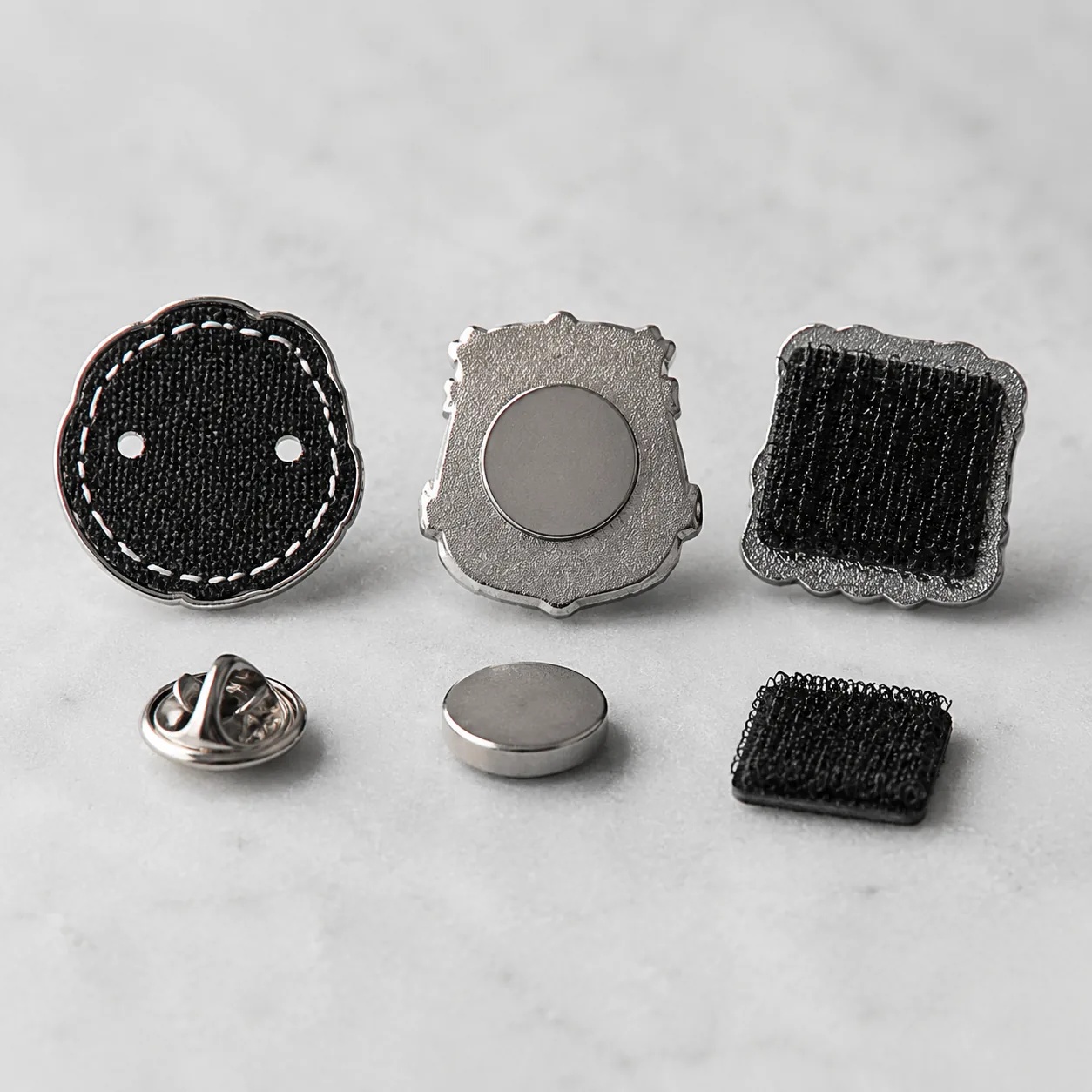
Treat the attachment as a performance spec, not an accessory
Custom pins usually fail in use for ordinary reasons: the badge rotates on a knit polo, leans forward on a soft lapel, pulls a visible hole in fine suiting, or loses its back during a full day of wear. Those are not artwork problems. They come from under-specifying the attachment system. In 2026 sourcing, the attachment line should be approved with the same discipline as size, plating, Pantone match, and packaging.
On a typical 20-32 mm custom pin, changing from a standard butterfly clutch to rubber, deluxe, or locking hardware usually shifts FOB cost by only USD 0.02-0.20 per piece at 500-1,000 pcs. That delta is small compared with replacement cost. A 1,000-piece order that saves USD 50-80 on cheaper backs can lose more than that if 3-5% of units generate claims for loss, fabric damage, or poor wear stability.
Attachment choice also depends on the pin build. A 1.0-1.2 mm stamped iron or brass pin with one centered post behaves very differently from a 2.0-2.5 mm zinc alloy cast badge with two offset posts, even if both use the same clutch. Weight, center of gravity, body thickness, post geometry, and garment type all matter. Buyers who lock attachment type, post count, post diameter, and post spacing during sampling generally see fewer complaints after launch than buyers who accept factory-standard hardware by default.
Post geometry rules that control spin, lean, and assembly rejects
For most lapel pins, standard post diameter is 0.8-0.9 mm and standard post length is 8-10 mm. That works for blazers, uniforms, caps, bags, and mid-weight polos. For heavier garments or foam-backed caps, 10-11 mm posts may be needed; on delicate fabrics, longer posts rarely help and can increase lean or snagging. Post diameter above 1.0 mm should be justified because it raises puncture force and fabric stress.
One post is usually sufficient for giveaway pins up to about 25 mm and 8 g finished weight. Above roughly 30 mm, above 10 g, or on top-heavy, asymmetrical, or horizontal designs, dual posts control rotation better than simply switching to a tighter clutch. For 30-45 mm pins, a practical center-to-center spacing is 12-22 mm, with each post placed at least 4 mm from the edge and as far apart as the back geometry allows.
Tolerances matter more than many buyers realize. Post location should typically be held within +/-0.5 mm. If the pin must fit a rigid insert, pre-punched retail card, or foam tray, tighten that to +/-0.3 mm. Post perpendicularity should stay within about +/-1 degree, especially on locking-back programs, because post lean slows assembly and raises reject rates. On small 15-18 mm pins, dual posts usually add labor without adding real performance. On long badges or all-day wear items, dual posts are often the cheaper option once field complaints are counted.
Fastener selection by use case, budget, and wear cycle
| Use case | Recommended attachment | Typical pin size and weight | Typical MOQ impact | FOB add-on vs butterfly | Lead time effect |
|---|---|---|---|---|---|
| Mass event giveaway | Butterfly clutch | 15-25 mm, 3-8 g | None at 100-300 pcs+ | Baseline | No change |
| School, youth, soft garments | Rubber clutch | 15-25 mm, 3-7 g | Usually none | USD 0.02-0.05 | No change |
| Corporate lapel or employee recognition | Deluxe clutch or rubber clutch | 18-30 mm, 5-10 g | Usually none | USD 0.03-0.08 | 0-2 days |
| Uniforms, hospitality, transit, daily wear | Locking clutch with 1-2 posts | 20-35 mm, 6-15 g | Often 300-500 pcs minimum | USD 0.08-0.20 | 2-4 days |
| Oversized fashion badge | Safety pin or brooch bar | 35-60 mm, 10-25 g | May need separate setup | USD 0.12-0.35 | 3-5 days |
| No-hole display on thin fabric | Magnetic backing | 20-35 mm, 5-12 g | Often 300-500 pcs minimum | USD 0.18-0.45 | 3-5 days |
Butterfly clutches remain the lowest-cost standard because they are compact, widely stocked, and fast to assemble. On a 20-25 mm stamped iron soft enamel pin at 500 pcs, total FOB pricing often lands around USD 0.28-0.55 per piece; stamped brass in the same size is more often USD 0.38-0.75, depending on plating, color count, epoxy, and pack-out. Butterfly backs work acceptably on light pins worn on woven garments, lanyards, or event apparel with short wear cycles. Their weakness shows up on slick synthetics, tote straps, stretch knits, and heavier cast badges.
Rubber clutches are useful where wearer comfort and lower fabric marking matter more than maximum hold. They are common on school programs, youth items, and lightweight pins used on low-gauge knits. The issue is consistency: rubber hardness, bore diameter, and mold flash vary widely by supplier. A buyer should not approve them by description alone. Verify insertion force, pull-off resistance, and fit on actual 0.8 mm and 0.9 mm posts during sampling.
Deluxe clutches sit in the middle of the market. They give a better hand feel and more premium presentation than butterfly backs with only a modest cost increase. Locking clutches are the practical upgrade for uniforms, paid membership programs, transit staff, hospitality, retail resale, and collectible drops where loss has a measurable replacement cost. They usually add 15-25% assembly time and can add 2-4 production days if the hardware is not in stock, but they outperform removable backs in active use.
Retention force, fabric risk, and defect criteria buyers should write into inspection
Retention should be judged in the real wearing environment, not by abstract pull-force claims. A 6 g pin on woven suiting may perform well with butterfly or deluxe hardware because the fabric itself limits motion. The same 6 g pin on a knit polo, nylon shell, apron, or bag strap can rotate and walk loose through repeated contact. As a working rule, removable metal clutches are acceptable for light pins on jackets and dress shirts; they become less reliable on stretch knits, outerwear, and any badge above about 10 g.
Fabric risk comes from both post finish and post diameter. Lightweight wool, silk blends, rayon, viscose, and lower-denier synthetics show stress quickly when the post has burrs, rough plating, or an overly blunt point. Post deburring and point finish should be treated as critical workmanship items. On most commercial programs, AQL 2.5 major and 4.0 minor is appropriate. Sharp burrs, loose posts, missing backs, exposed base metal around the post, unusable clutch fit, and visibly mislocated posts should be classified as major defects.
For incoming or final inspection, practical checks include push-fit consistency on 20-32 samples per lot, visual review under 2x to 3x magnification for burrs and plating breaks, and a basic wear simulation on the target fabric. For heavier pins, request an in-line twist and pull check on the post joint. Many factories will not quote a numeric pull spec unless asked, so it is reasonable to state a minimum internal pull test such as 3-5 kgf for standard posts on stamped pins and higher for heavy cast pieces, then confirm the factory can hold it consistently.
Back-hardware material and plating thickness affect corrosion and wear
Buyers often approve the front-face finish and ignore the metallurgy of the rear hardware. That is where many early complaints start. Common post and clutch materials are iron, brass, and stainless steel. Iron is economical and easy to source, but it is the least forgiving in humid storage if plating coverage is thin. Brass generally gives cleaner plating and better corrosion resistance. Stainless is useful on uniform programs, humid climates, and high-perspiration wear cycles, even when the rear color match is less exact.
Decorative plating on posts and clutches is usually thinner than on the visible pin face. In many programs, back hardware plating is only about 0.03-0.10 microns, while the front decorative finish may run heavier depending on process and budget. That difference matters: clutch edges and locking mechanisms can show rub-through or oxidation well before the front badge shows wear. On high-humidity uniform programs, it is often better to accept natural stainless or natural brass on the rear component than to insist on a thin imitation-gold or black-nickel match that will wear quickly.
Packing also affects corrosion. Bulk-packed pins rubbing together during ocean transit can mark plating and expose edges around the posts and backs. For premium or resale programs, 1 pc per backing card plus OPP sleeve, or 1 pc per polybag with tissue separation, materially reduces contact marking. If the finish is black nickel, imitation gold, antique silver, or another premium tone, the rear hardware finish should be reviewed during sample approval so the approved sample reflects realistic color and wear behavior rather than an idealized front-only finish.
When the attachment changes the whole pin construction
Some fasteners force a different body design. Magnetic backs need enough flat rear area for the magnet plate or mating piece to seat securely, so deeply sculpted or high-relief 3D backs are poor candidates. Brooch bars and safety-pin assemblies need a longer straight section and wider load spread, which often pushes the product toward a larger format and a thicker body, such as 1.5-2.0 mm stamped brass or 2.0-3.0 mm cast zinc alloy. Magnetic formats also raise safety and compliance concerns for children's products and should not be treated as a universal no-hole solution.
Post attachment strength is another hidden variable. On stamped pins, solder-joint consistency becomes more important as finished weight rises. Above about 10 g, request an in-line pull and twist check on the post joint and confirm it again on the pre-production sample. Reject any unit with a loose post, visible solder overflow telegraphing to the front edge, or obvious post lean. Waiting until final random inspection is too late because attachment failures are usually process problems, not isolated defects.
There is also a point where a lapel-pin format stops being the right engineering choice. Once a piece exceeds about 40 mm or 15-25 g, a brooch bar, safety pin assembly, patch, or keychain often performs better. Buyers sometimes keep a collectible-pin back because it suits the artwork, even when the actual use case is a fashion badge or bag accessory that needs broader load distribution and better stability. That is a specification error, not a manufacturing defect.
2026 buying guide by objective and budget
- Lowest landed cost for events: 1 post plus butterfly clutch on stamped iron, body thickness 0.8-1.0 mm, size 15-25 mm, weight under 8 g, MOQ commonly 100-300 pcs, pre-production sample 7-10 days, mass production 10-15 days after approval.
- Best value for employee recognition: 1-2 posts plus deluxe clutch on stamped brass or iron, size 18-30 mm, weight 5-10 g, typical FOB range USD 0.40-0.95 depending on finish and pack-out, with only USD 0.03-0.08 hardware add-on per piece.
- Best for all-day uniforms and service awards: 2 posts plus locking clutch, target 20-35 mm and 6-15 g, MOQ often 300-500 pcs, add 2-4 days lead time and expect slower assembly and packing.
- Best for delicate garments: light pin body with rubber clutch, or magnetic backing only when fabric puncture must be avoided and the wearer is not a child; confirm hold on the actual garment fabric before mass production.
- Best for oversized fashion badges: brooch bar or safety pin assembly on 35-60 mm stamped or cast pieces; broader load spread matters more than preserving a standard lapel-pin back.
- Best for resale collectibles or paid-member programs: dual posts with locking backs, plus spare backs packed at 1 per unit or 1 per 5-10 units depending on loss history; replacement claims can erase hardware savings quickly.
- Best corrosion control for humid climates: brass or stainless rear hardware, individual bagging or carding, and realistic approval of rear finish thickness rather than cosmetic rear color matching.
The purchasing logic is simple: compare attachment cost against replacement cost. If a butterfly clutch saves USD 0.06 per piece on a 1,000-piece run, that is only USD 60 total. A 4% replacement rate can exceed that once labor, freight, customer-service handling, and reshipment are counted. In most commercial programs, the best value is not the cheapest hardware. It is a moderate pin size, sensible finished weight, correct post layout, and a clutch matched to actual wearer behavior.
What to lock on the PO before tooling and sampling
A purchase order should state attachment type, post count, post diameter, post length, post spacing, post location tolerance, rear hardware material or finish, and whether spare backs are included. It should also state the intended wearing surface: blazer lapel, knit polo, cap crown, tote strap, apron, or outerwear. That context gives the factory enough information to challenge a weak default before tooling is cut.
A practical PO line might read: "25 mm stamped brass soft enamel pin, body thickness 1.2 mm plus enamel, 2 rear posts dia 0.9 mm, post length 9 mm, center spacing 16 mm, post location tolerance +/-0.5 mm, black nickel front finish, stainless locking clutch, 1 pc per backing card plus OPP bag." For inspection, specify AQL 2.5 major / 4.0 minor, with loose clutch fit, missing back, sharp burrs, exposed base metal at post area, and mislocated posts treated as major defects.
When the order value justifies it, sample two attachment options on the same art, such as butterfly versus locking or deluxe versus rubber. That small sampling cost is usually cheaper than learning after shipment that the approved hardware does not suit the garment or wear cycle. Typical timing remains 7-10 days for pre-production samples and 10-18 days for mass production after approval, with specialty backs, retail carding, and custom pack-out pushing the schedule toward the long end.
Have a project? Send your artwork and target quantity and we’ll reply with a detailed quotation within 12 working hours.
Ready to get this made?
Send your sketch, target quantity and ship-date. Detailed quotation in 12 hours.



