Barcode and Label Specs for Retail-Ready Promo Products
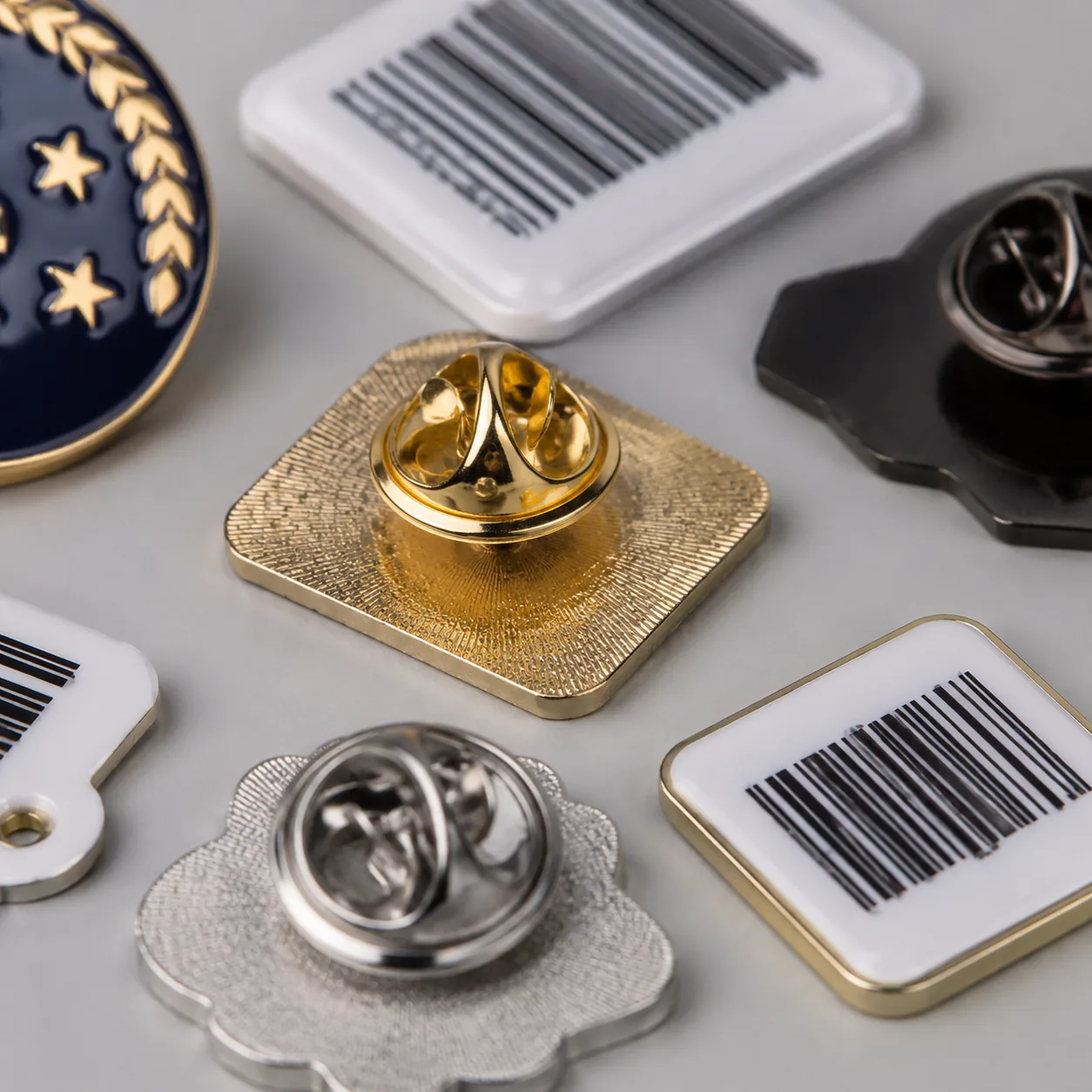
Why Retail-Ready Orders Fail After Production Passes
A promo product can pass plating, color and dimensional inspection and still fail at receiving. The common failure point is not the pin, coin or patch itself; it is the label system around it. Warehouses reject cartons when the barcode scans as the wrong SKU, inner packs are unmarked, carton quantities do not match the ASN, or country-of-origin text is missing from the sellable unit. For a 5,000-piece enamel pin order, domestic relabeling can cost USD 0.12 to 0.35 per unit once a 3PL must open cartons, sort variants, apply new stickers and update counts. That rework can exceed the original factory packing cost.
Retail-ready control applies beyond supermarket channels. Museum shops, sports clubs, subscription boxes, online marketplaces, event merchandisers and promotional-product distributors all need the same basics: one sellable unit, one correct SKU, one approved barcode, clear origin marking, correct warning text and stable carton counts. If a shipment has three finishes, two backing cards or two attachment types, each commercial variant needs its own controlled line in the packing specification. A handwritten note on an inner carton is not a label system.
At ZheCraft, barcode and carton labeling are treated as production specifications, not final-hour decoration. Pins, brooches, challenge coins, metal keychains, patches, fridge magnets and lanyards should have label files approved before mass packing. Changing barcode placement after 10,000 units are bagged usually adds 3 to 6 working days because workers must reopen, sort, scan-check, relabel and reseal units before cartons can be rebuilt.
Build the SKU Map Before Artwork Release
The first control point is defining what the buyer will scan and sell. One SKU may be one pin on a backing card, a pair of pins in one polybag, a three-patch set, a coin in a capsule and box, or one lanyard with a badge holder. Many receiving failures start when the design team assigns one barcode per artwork while the retailer expects one barcode per bundled retail set. The factory cannot repair that logic during packing unless the SKU map is already approved.
For custom metal and textile promo items, zero mixing should be the standard within a retail SKU. A 30 mm hard-enamel pin in gold plating with a rubber clutch and the same pin with a butterfly clutch should be separate SKUs if the buyer tracks them separately. The front artwork may be identical, but the attachment, retail description, unit weight, pack quantity and barcode may differ. Treating those two items as interchangeable creates inventory errors even if the product is visually close.
A practical SKU map should include item name, artwork revision, size, material, finish, attachment, packaging type, barcode value, unit quantity, inner quantity, master carton quantity, net weight target and carton number sequence. For example: SKU KC-AN-045 is a 45 mm zinc alloy keychain, antique nickel finish, 25 mm split ring, 1 piece per OPP bag, 100 pieces per inner carton, 500 pieces per master carton, Code 128 carton label and UPC-A unit label. This structure must be locked before labels or carton marks are printed.
| Product type | Typical sellable unit | Inner pack target | Master carton target | Carton weight guide |
|---|---|---|---|---|
| Enamel pin on card | 1 pin, card and clutch | 50 or 100 pcs | 500 to 1,000 pcs | Under 15 kg gross |
| Challenge coin | 1 coin in capsule, pouch or box | 25 or 50 pcs | 100 to 300 pcs | Under 18 kg gross |
| Metal keychain | 1 keychain in OPP bag or carded bag | 50 or 100 pcs | 300 to 800 pcs | Under 16 kg gross |
| Embroidered patch | 1 patch in bag or header card | 100 pcs | 1,000 to 2,000 pcs | Under 14 kg gross |
| Fridge magnet | 1 magnet in bag or on card | 50 or 100 pcs | 300 to 1,000 pcs | Under 15 kg gross |
| Lanyard | 1 folded lanyard in bag or sleeve | 50 pcs | 200 to 500 pcs | Under 13 kg gross |
Set Barcode Type, Size and Scan Grade
Most retail unit labels use UPC-A in North America or EAN-13 for many international retail channels. Code 128 is common for internal warehouse labels because it can encode SKU, PO, batch and carton IDs in a compact symbol. QR codes are useful for instructions, authentication or warranty registration, but they should not replace the retailer-required linear barcode unless the receiving system explicitly accepts QR scanning at checkout or inbound receiving.
Barcode artwork should be supplied as vector PDF, AI, EPS or 600 dpi monochrome PNG. For UPC-A or EAN-13 on backing cards, header cards or small retail stickers, a final printed width of 30 to 37 mm and a bar height of at least 20 mm is a safe working range. Maintain a minimum 3 mm quiet zone on both left and right sides; 5 mm is safer when the code sits near logos, borders or multilingual text. For Code 128 carton labels scanned from 300 to 600 mm away, 50 to 80 mm symbol width is more reliable than a compact 35 mm code.
Print contrast is more important than brand styling. Black bars on matte white stock remain the safest choice. Metallic ink, transparent labels, dark backing cards, pearlescent paper and gloss lamination can reduce first-scan rates. If the brand requires a colored backing card, place the barcode in a white knockout box with at least 5 mm clearance around the symbol. For high-volume retail orders, request barcode verification to ISO/IEC 15416 where available; a grade C or better is a practical minimum, while grade B is preferred for national retailers.
| Spec point | Recommended requirement | Avoid |
|---|---|---|
| UPC-A or EAN-13 size | 30 to 37 mm wide, 20 mm high minimum | 18 to 25 mm symbols on textured cards |
| Quiet zone | 3 mm minimum, 5 mm preferred | Text, borders or die-cuts near bars |
| File format | Vector or 600 dpi black-only raster | Low-resolution screenshots |
| Print contrast | Black on matte white | Foil, gloss or transparent stock |
| Verification | Scan 10 labels per SKU before packing | Approving from screen images only |
| Scan grade target | ISO/IEC 15416 grade C minimum where tested | Unverified resized artwork |
Match Label Material and Placement to the Product
The best label location is flat, visible, scannable and resistant to lifting during transit. For enamel pins and brooches on backing cards, the barcode is usually printed on the card back or applied as a 30 x 20 mm to 40 x 25 mm thermal-transfer sticker. Do not place the code over a pin post, brooch bar, rubber clutch bulge or folded card seam. Wrinkles and raised areas distort narrow bars and cause intermittent scanning failures.
For challenge coins, the unit barcode usually belongs on the paper box, velvet box sleeve or outer polybag, not on the coin capsule. A 40 x 25 mm label works on many coin boxes. Clear acrylic capsules are poor label surfaces because curved edges and handling oils cause corner lift. For coins above 50 mm diameter or 3.5 mm thickness, boxed labeling is cleaner, reduces handling scratches and gives space for country-of-origin text.
For lanyards, woven patches and embroidered badges, avoid sticking retail labels directly to fabric. Textile texture, loose fibers and merrowed edges reduce adhesion and make scanning uneven. Use an OPP bag, folded paper sleeve, header card or insert card instead. For fridge magnets, avoid covering the display face unless the label is designed to be removed cleanly. Strong magnets should be packed in paper inner cartons before master packing so units do not shift, attract metal shelves or damage neighboring printed cards.
Add Origin, Warning and Retail Text Early
A sellable unit often needs more than a barcode. Common label fields include item description, distributor or brand name, country of origin, material statement, age grading, choking warning, polybag suffocation warning, recycling marks and importer information where required. Requirements vary by destination and channel, so the buyer should supply approved compliance text. The factory can print and place the text accurately, but it should not invent legal wording for the importer.
Country-of-origin marking is usually printed as “Made in China” or “Product of China” on the backing card, bag label, box or carton label. For small pins and keychains, marking the product itself may be impractical because the reverse side is occupied by posts, clutches, backstamps or moving hardware. Unit packaging is normally the cleaner method, but the wording must be consistent across unit, inner carton and master carton. Do not allow a unit card to say one origin while the carton mark says another.
Polybags need their own specification. Consumer-facing OPP bags for small promo items are commonly 30 to 40 microns thick, while many retail programs prefer at least 38 microns, or 1.5 mil. Bags with an opening perimeter above about 380 mm may require a suffocation warning in some channels. A 60 x 80 mm pin bag may not have enough space for legible warning text, so the warning may need to move to the backing card, header card or retail box. For children’s products, confirm age grade, small-parts labeling and market-specific requirements before the factory starts packing.
- Assign a unique UPC, EAN or internal barcode to every sellable variant.
- Supply final label text in the destination language before sample approval.
- Specify country-of-origin wording for the unit, inner carton and master carton.
- Place warnings on the card, bag, box or insert where they remain legible.
- Use 7 to 8 pt minimum text for warnings when space allows; avoid relying on 5 pt text.
- Review any translation yourself instead of asking the factory to create compliance wording.
Price, MOQ and Lead Time by Label Method
Labeling cost depends on whether the code is variable, printed as part of the retail artwork or applied as a separate sticker. For stable SKUs above 1,000 pieces, printing the barcode directly on the backing card, insert or retail box is usually cleaner and cheaper in handling. For trial orders, mixed assortments or marketplace sellers that change codes often, thermal-transfer stickers are safer because the barcode can be updated without remaking cards.
As a working FOB range, small black-and-white barcode stickers for pins, patches, magnets and keychains add about USD 0.015 to 0.05 per unit when applied during normal packing. Custom printed backing cards usually add USD 0.04 to 0.18 per unit depending on size, paper weight, print sides, coating and die-cutting. A 55 x 85 mm, 300 gsm card with one-side full color and one-side black barcode often lands near USD 0.07 to 0.12 at 1,000 to 3,000 pieces. Header cards with hang holes or euro slots cost more because of die-cutting and folding.
Lead time should be included in the packing schedule. Thermal sticker setup can usually be added in 1 to 3 working days after barcode approval. Printed cards or sleeves normally need 4 to 8 working days for print, cutting and sample confirmation. If UPCs change after goods are packed, relabeling can add 2 to 6 working days and USD 0.03 to 0.12 per unit, depending on whether workers must reopen OPP bags, replace backing cards or rebuild carton counts.
| Label method | Typical MOQ | FOB add-on | Lead-time impact | Best use |
|---|---|---|---|---|
| Thermal barcode sticker | 300 to 500 pcs per SKU | USD 0.015 to 0.05 each | 1 to 3 days | Variable SKUs and small runs |
| Printed backing card | 500 to 1,000 pcs per design | USD 0.04 to 0.18 each | 4 to 8 days | Pins, magnets and patches |
| Printed box label | 300 to 500 pcs per SKU | USD 0.03 to 0.08 each | 1 to 4 days | Coins and premium keychains |
| Header card with hang hole | 1,000 pcs per design | USD 0.06 to 0.20 each | 4 to 8 days | Pegboard retail display |
| Inner carton label | No fixed MOQ if printed in-house | USD 0.01 to 0.03 each | Same day to 1 day | Receiving and count control |
| Master carton mark | No fixed MOQ | Included to USD 0.02 each | Same day to 1 day | Forwarder and 3PL routing |
Inspect Labels With Critical-Defect Rules
Label inspection should be written into the QC checklist. For most B2B promotional merchandise, AQL 2.5 for major defects and AQL 4.0 for minor defects is common for visual issues such as smudges, skewed placement or light print. Barcode identity errors need stricter handling. A wrong barcode, wrong SKU text, wrong country-of-origin statement or wrong carton quantity should be treated as a critical defect with zero acceptance in the inspected sample.
A first-article label check should happen before full packing. Scan 5 to 10 units per SKU, compare the output against the approved SKU map, confirm the human-readable number, check placement tolerance and verify that the unit count matches the inner carton label. At final inspection, scan samples from the beginning, middle and end of packed cartons. For mixed-SKU shipments, coverage by SKU matters more than a large random count from only one carton.
Physical tolerances should be measurable. Retail labels on cards or boxes should be within ±2 mm when placement affects appearance or scan access. Carton labels can usually allow ±10 mm provided the code is flat, visible and not wrapped around an edge. Labels should not cover hang holes, warning text, product windows, tamper seals, magnetic closures or opening flaps. Adhesion should survive light rubbing and 24 hours in a packed carton without curling corners.
- Scan barcode master files before printing and again after labels are printed.
- Approve one fully packed reference sample for each SKU and pack style.
- Classify wrong barcode, wrong SKU, wrong origin and wrong quantity as critical defects.
- Use AQL 2.5 major and 4.0 minor for print quality, smudges and placement issues.
- Photograph the unit label, inner label and master carton label before shipment.
- Keep scanned label results or screenshots with the inspection record.
Control Inner Carton and Master Carton Labels
A good carton label lets a warehouse receive goods without opening every box. At minimum, the master carton label should show buyer name or PO, SKU, item description, quantity, carton number, gross weight, net weight, carton dimensions and country of origin where required. A clear example is: PO 45821, SKU PIN-GOLD-030, enamel pin gold 30 mm, 500 pcs, carton 3 of 12, G.W. 12.5 kg, N.W. 11.2 kg, 38 x 28 x 24 cm, Made in China. If one carton contains multiple SKUs, mark it “Mixed SKU” and place an internal packing list on top.
Inner carton labels are especially useful for small items. A 1,000-piece pin order may be packed as ten inner cartons of 100 pieces, then loaded into two master cartons. Without inner labels, warehouse staff must open bags or count retail cards manually. For kitting, event merchandise and subscription boxes, inner labels prevent similar designs from being mixed during later assembly.
For export packing from Yiwu and similar production hubs, common master cartons for metal promo products range from 35 x 25 x 20 cm to 45 x 35 x 30 cm. Gross weight is usually kept below 15 kg for pins and keychains and below 18 kg for challenge coins. Heavier cartons may reduce freight cost per unit but increase corner crushing, drop damage and manual handling risk. If a retailer or 3PL has a maximum carton weight, carton dimension rule, SSCC label requirement or pallet routing guide, include it in the RFQ before quotation.
Approve One Controlled Packing File
Before mass packing, send the factory one controlled packing file that includes the SKU map, barcode files, unit packaging artwork, label placement drawings, inner quantities, master carton quantities, carton label template, AQL levels and critical-defect definitions. Do not split these instructions across old emails, chat screenshots and separate artwork folders. The label printer, packing line and final inspector need the same version of the truth.
Request a packed pre-production sample or, at minimum, clear photos of the first packed unit, inner carton and master carton. A photo can confirm placement and text, but it is not a reliable scan approval. Final approval should use printed samples, factory scan screenshots or third-party inspection records. If the goods are shipping to a retailer, marketplace warehouse or 3PL, compare the sample label against that routing guide before cartons are sealed.
For the next order, add a labeling section to the RFQ: barcode type, final code value, printed size, label stock, placement tolerance, origin text, warning text, unit count, inner count, carton count, maximum carton weight, AQL level and zero-acceptance rule for barcode mismatch. If you are sourcing pins, coins, patches, lanyards, magnets or keychains from ZheCraft, align the label plan with the real packing line before quotation. The cheapest time to fix a receiving problem is before anyone has packed 10,000 units.
Have a project? Send your artwork and target quantity and we’ll reply with a detailed quotation within 12 working hours.
Ready to get this made?
Send your sketch, target quantity and ship-date. Detailed quotation in 12 hours.



