Barcode and Label Specs for Custom Promo Product Shipments
Why label failures become paid-for rejects
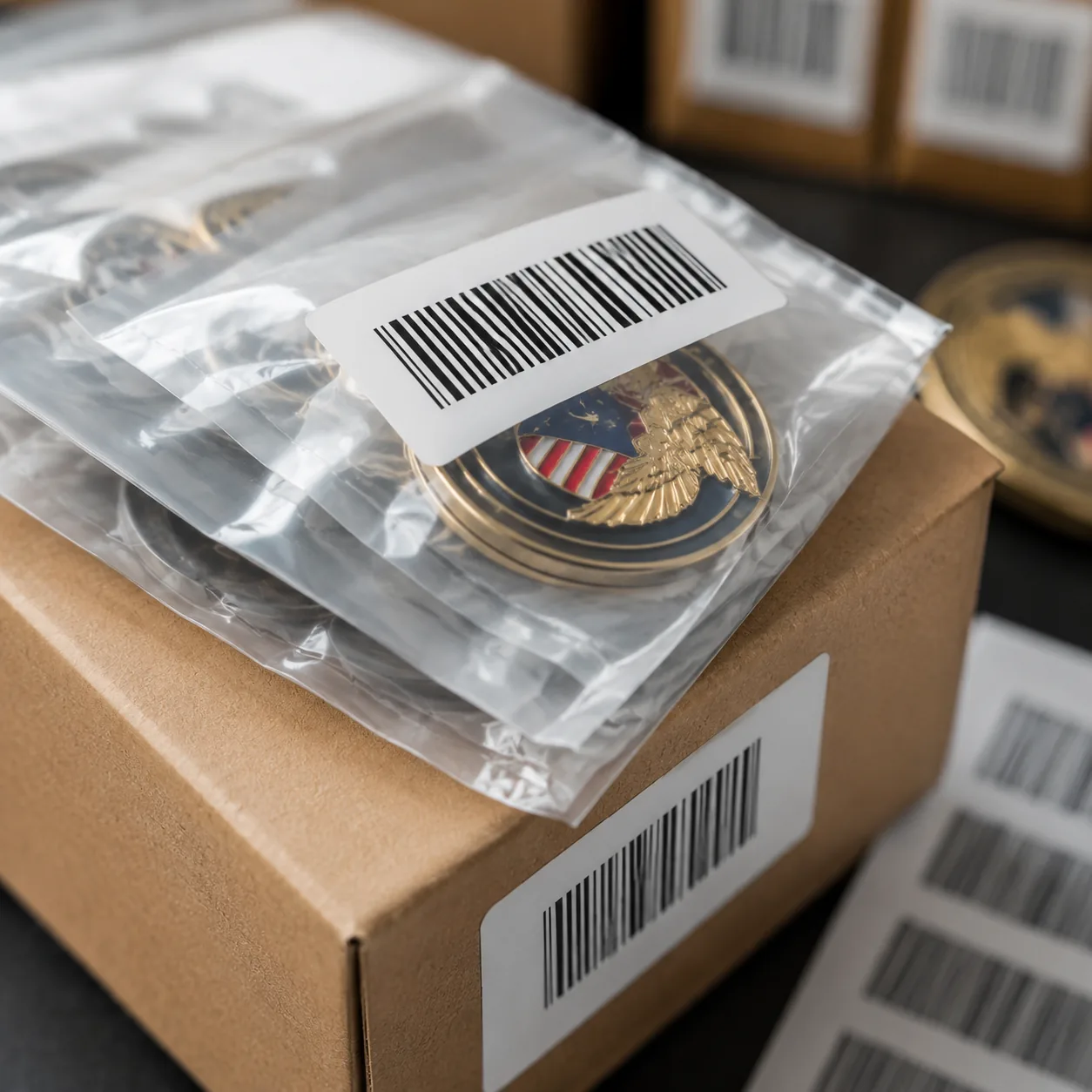
A shipment of enamel pins, challenge coins, keychains or patches can pass product inspection and still be refused at the receiving dock. The usual causes are not plating defects or color errors. They are operational failures: an unreadable UPC, a missing country-of-origin mark, a carton label that does not match the packing list, mixed SKUs packed without a carton map, or a retail sticker covering artwork that the buyer already approved.
These details must be handled as production specifications, not as warehouse administration. Once 20,000 units are sealed in OPP bags, backing cards, inner boxes and master cartons, correction is slow. In China, a realistic relabeling job for 5,000 to 30,000 small promo items typically adds 2 to 5 working days if labels are simple and all cartons are still at the factory. If inner packs must be opened, counted and rebagged by SKU, the delay can reach 7 working days and the labor charge can exceed the original label cost by 5 to 20 times.
The safest control point is before sample approval. Define the full label system: selling-unit barcode, inner-box label, master-carton label, pallet label if needed, and country-of-origin marking on the product or immediate packaging. At ZheCraft, barcode and carton-label checks are tied to final AQL inspection for pins, brooches, keychains, magnets, coins, patches and lanyards, so receiving requirements are verified before export cartons leave the packing line.
Define the scan level before packaging artwork
The first decision is where the code must scan. A retail UPC on each backing card is different from a Code 128 carton ID used by a 3PL. If the purchase order only says “add barcode,” a factory may place one label on the export carton while the retailer expects one scannable code on every selling unit.
For enamel pins and badges on backing cards, common unit labels are 25 x 15 mm, 30 x 20 mm and 40 x 25 mm. The smaller size is usable only when the data is short and the quiet zone is protected. For gift-boxed coins and keychains, 40 x 25 mm or 50 x 30 mm scans better because the box surface is flatter. For lanyards in individual OPP bags, 50 x 30 mm gives room for SKU, color, barcode, quantity and “Made in China” without crowding.
Do not place barcodes on curved metal keychain bodies, textured PVC patches, glitter surfaces, fabric folds or glossy foil areas. Scanners need a flat, matte, high-contrast field. If the item must look premium, put the code on the back of the backing card, the belly band, the bottom of a rigid box, or a removable rear label rather than on the decorated face.
| Label level | Practical size | Typical data | Specification to lock |
|---|---|---|---|
| Selling unit | 30 x 20 mm to 50 x 30 mm | UPC/EAN, SKU, origin mark | Placement within ±2 mm of approved layout |
| Inner box | 60 x 40 mm to 80 x 50 mm | SKU, variant, quantity, PO | Quantity variance 0 pieces unless buyer approves |
| Master carton | 100 x 70 mm to A6 | PO, SKU, carton count, weights, origin | One SKU per carton unless mixed-carton map is issued |
| Pallet | A5 or A4 | SSCC or pallet ID, PO, destination | Two adjacent sides, readable at 1 m |
Match barcode format to the channel
UPC-A and EAN-13 are the normal retail formats for selling units. Code 128 is better for warehouse SKUs, purchase orders, carton IDs, serial numbers and internal tracking because it handles alphanumeric data efficiently. QR codes are useful for warranty pages, authentication, event landing pages or reorder forms, but they should not replace a retailer-required UPC or EAN unless the receiving system confirms QR acceptance in writing.
For small promotional products, a reliable printed UPC-A or EAN-13 is usually 25 to 35 mm wide with a bar height of at least 18 to 22 mm. Code 128 can be smaller on unit packs when data is short, but carton receiving labels should use 50 to 80 mm width and 15 to 25 mm height so handheld scanners can read them from 50 to 100 cm. Quiet zones should be at least 3 mm on each side for unit labels and 5 mm for carton labels; crowding the quiet zone is a common reason for scan failure even when the bars look clean.
Print barcodes in 100% black on matte white stock. Avoid reverse-out codes, metallic ink, transparent labels, varnish over the code area, gradients behind the bars, and low-resolution raster artwork. For printed backing cards, specify vector barcode artwork or minimum 300 dpi output at final size. For sticker labels, thermal-transfer printing with resin or wax-resin ribbon is more durable than direct thermal labels for ocean freight and warehouse handling.
- Confirm whether the destination requires UPC-A, EAN-13, Code 128, QR code, GS1-128, SSCC, or a retailer-specific label.
- Supply barcode data as text plus verified vector artwork; do not rely only on a screenshot in the artwork file.
- Reserve quiet zones of at least 3 mm on unit labels and 5 mm on carton labels.
- Avoid metallic ink, gloss lamination, transparent stock, curved placement and textured surfaces under the code.
- Require unit-label scan tests at 15 to 30 cm and carton-label scan tests at 50 to 100 cm.
- Check the human-readable digits against the approved SKU list, not only the scanner beep.
Specify origin marking by product and packaging
For custom metal and textile promotional products made in China, buyers commonly require “Made in China” on the product, immediate retail packaging, or both. The correct location depends on destination regulations, retailer policy and how the unit is sold. A carton-only origin mark is often insufficient when the selling unit is separated from the master carton before retail or event distribution.
On enamel pins, medals and challenge coins, a backstamp can work when the reverse has a flat area. Practical letter height is 1.0 to 1.5 mm, with recessed or raised depth around 0.15 to 0.25 mm depending on mold and plating. On black nickel, antique bronze and heavily textured reverses, laser marking may give better contrast, but it must be checked on the production finish, not only on raw metal. For backing cards and printed labels, use at least 5 pt text, with 6 to 8 pt preferred for retail readability.
If the product is too small or the reverse is reserved for a logo, mark the immediate packaging. A 25 mm soft enamel pin on a 55 x 85 mm card can carry origin text on the card back without changing the pin mold. A zinc alloy keychain in an OPP bag can use a 30 x 20 mm rear label combining SKU, barcode and origin mark. For lanyards, origin can be printed on the header card, belly band or unit label rather than woven into the strap unless the buyer specifically requires permanent product marking.
| Marking location | Typical spec | Best fit | Risk to manage |
|---|---|---|---|
| Metal backstamp | 1.0 to 1.5 mm letters; 0.15 to 0.25 mm relief | Pins, coins, badges with flat reverse | May conflict with back logo or clutch hardware |
| Laser mark | 0.8 to 1.2 mm letters on flat metal | Dark plating, stainless steel, zinc alloy | Contrast varies by finish and needs sample approval |
| Backing card print | 5 to 8 pt black text | Pins, brooches, patches | Card must remain with item through sale |
| Bag or box label | 30 x 20 mm minimum | Keychains, magnets, lanyards | Front placement can reduce retail appearance |
Build carton labels for receiving, not decoration
A master carton label should let a warehouse receive the goods without opening the carton. At minimum, include buyer PO, supplier name if required, SKU, item description, color or variant, quantity, carton number, total carton count, gross weight, net weight, carton dimensions and country of origin. If a shipment contains multiple SKUs, each SKU needs its own carton sequence or an approved mixed-carton map showing exact quantities by carton number.
Small metal promo products are dense, so carton quantity and gross weight need control. Common export carton sizes are 35 x 25 x 25 cm, 40 x 30 x 30 cm and 45 x 35 x 35 cm. For hand-loaded cartons, keep gross weight below 15 kg when possible; for challenge coins and zinc alloy keychains, 10 to 12 kg is often safer. Pushing cartons to 20 kg may reduce carton count, but it increases rupture risk, corner compression damage and manual-handling complaints.
A 100 x 70 mm carton label is readable on small cartons, but A6 is safer for palletized receiving. Place labels on the long side, upper-right quadrant, at least 30 mm away from carton edges, straps and tape seams. Apply labels after carton sealing so tape does not cover bars or text. For palletized retail shipments, use two pallet labels on adjacent sides and keep the lowest barcode at least 400 mm above the floor where possible.
- Use one SKU per master carton unless the buyer approves a mixed-carton packing map.
- Print carton sequence as 1 of 24, 2 of 24 and continue without duplicate or skipped numbers.
- Match carton quantity exactly to the packing list, commercial invoice and inner-box labels.
- Keep barcode, human-readable SKU and carton number on the same label face.
- Set carton-label placement tolerance at ±10 mm and unit-label placement tolerance at ±2 mm.
- Photograph the first approved packed carton and use it as the line standard.
Choose label stock for freight conditions
A label can pass a photo check and fail after four weeks in ocean freight. Humidity, abrasion, carton dust, compression and temperature swings can lift edges or smear print. For export cartons, avoid direct-thermal labels intended for short domestic delivery. Use thermal-transfer labels or coated paper labels with a permanent adhesive rated for corrugated cartons.
For unit packaging, 70 to 80 gsm matte white paper labels are usually adequate for backing cards and gift boxes. OPP bags need stronger adhesive because polypropylene has low surface energy and releases weak labels easily. For long storage, outdoor event kits, cooler exposure or moisture-prone distribution, PP or PET synthetic labels are more stable than paper, though they cost more and may look less premium.
Adhesive choice affects both scan reliability and retail appearance. Permanent adhesive is good for carton control and warehouse labels, but it can tear paper gift boxes or leave residue on tins and acrylic cases. Removable adhesive is cleaner for temporary retail information, but it should pass a peel test after 24 hours and 72 hours on the actual packaging material.
| Label material | Typical FOB impact | Best application | Failure mode if misused |
|---|---|---|---|
| Matte paper, permanent adhesive | $0.005 to $0.015 per label | Backing cards, paper boxes, cartons | Tears on removal and may mark gift packs |
| Coated paper, strong adhesive | $0.010 to $0.025 per label | OPP bags and export cartons | Can look industrial on retail packaging |
| PP or PET synthetic | $0.030 to $0.080 per label | Moisture-prone or long-storage shipments | Higher cost and less paper-like finish |
| Removable adhesive | $0.020 to $0.060 per label | Premium tins, acrylic boxes, temporary data | May lift from OPP bags or rough cartons |
Inspect labels with AQL and scan evidence
Visual review is not enough. A barcode that looks sharp can still fail because the quiet zone is too small, the magnification is wrong, or the data does not match the SKU. During pre-shipment inspection, specify scan testing by SKU and by packaging level. For normal promotional-product orders, use ANSI/ASQ Z1.4 general inspection level II, AQL 2.5 for major defects and AQL 4.0 for minor defects. Treat wrong barcode, missing barcode, unscannable code, wrong SKU label and missing origin mark as major defects. For retailer programs, many buyers set label-data errors as zero-tolerance critical defects.
For orders below 3,000 pieces, scan 100% of master carton labels and randomly scan unit labels across every SKU and packaging format. For 3,000 to 30,000 pieces, use the AQL sample size as the baseline, then increase sampling for any SKU with a first failure. For multi-SKU orders, scan at least one unit from every SKU, every carton-label format and every inner-box label format. If any barcode fails, quarantine the affected SKU or carton range until root cause is found.
The inspection file should include photos of each label type, scan screenshots or scanner confirmation, final carton dimensions, gross weight, net weight and packing list. Write measurable tolerances into the PO: unit-label placement ±2 mm, carton-label placement ±10 mm, barcode digits exactly matching the approved file, carton count exactly matching the packing list, and master-carton quantity variance of 0 pieces unless the buyer approves a short or over carton.
Lock cost, lead time and pilot packing early
Barcode control is inexpensive when it is designed before packing. A unit sticker usually adds $0.005 to $0.080 FOB per piece depending on size, material, adhesive and print method. A printed barcode on a backing card may add no separate label cost, but it requires clean artwork setup, barcode verification and prepress control. MOQ is usually low for standard thermal-transfer labels, often 500 to 1,000 labels per size, while custom printed packaging may require 1,000 to 3,000 cards or boxes depending on supplier and finish.
Late correction is where cost rises. Relabeling 10,000 sealed pins may require opening cartons, removing inner bundles, applying labels, recounting, resealing, updating carton marks and rechecking weights. A simple carton relabel may cost $80 to $300 in labor on a small order and add 1 to 3 working days. Unit-pack relabeling across several SKUs can add 3 to 7 working days, especially when each label must be matched to a color, size or retailer SKU.
Plan label lead time in the production calendar. Standard sticker-label preparation usually takes 1 to 2 working days after barcode data and placement are approved. Printed backing cards usually add 5 to 8 working days. Rigid boxes add 10 to 18 working days. Custom lanyard sleeves, belly bands or header cards usually add 7 to 12 working days. These are not post-inspection tasks; they must be approved before mass packing starts.
| Order situation | Planned cost | Late correction cost | Typical schedule impact |
|---|---|---|---|
| Barcode built into sample artwork | Low setup cost | None if scan test passes | 0 to 1 day |
| Sticker labels approved before packing | $0.005 to $0.080 per unit | Low | 1 to 2 days |
| Master cartons relabeled after packing | Label plus warehouse labor | Moderate | 1 to 3 days |
| Unit packs reopened and relabeled | Labor-heavy recount and repack | High | 3 to 7 days |
Before issuing the PO, send a label specification sheet with the artwork and RFQ. Include barcode type, barcode data, label size, material, adhesive, placement drawings, country-of-origin wording, carton-label template, SKU list, carton quantity rules and scan-test method. If goods ship to a retailer, marketplace warehouse, 3PL or event venue, request that destination’s label guide before production begins.
For ZheCraft orders, the practical next step is a pilot pack: one finished selling unit, one inner box if used, one master carton label, the carton mark, gross weight and scan-test evidence. Approving this small set before full packing prevents correctly manufactured products from becoming warehouse exceptions.
Have a project? Send your artwork and target quantity and we’ll reply with a detailed quotation within 12 working hours.
Ready to get this made?
Send your sketch, target quantity and ship-date. Detailed quotation in 12 hours.



