Barcode and Label Specs for Custom Promo Giveaways
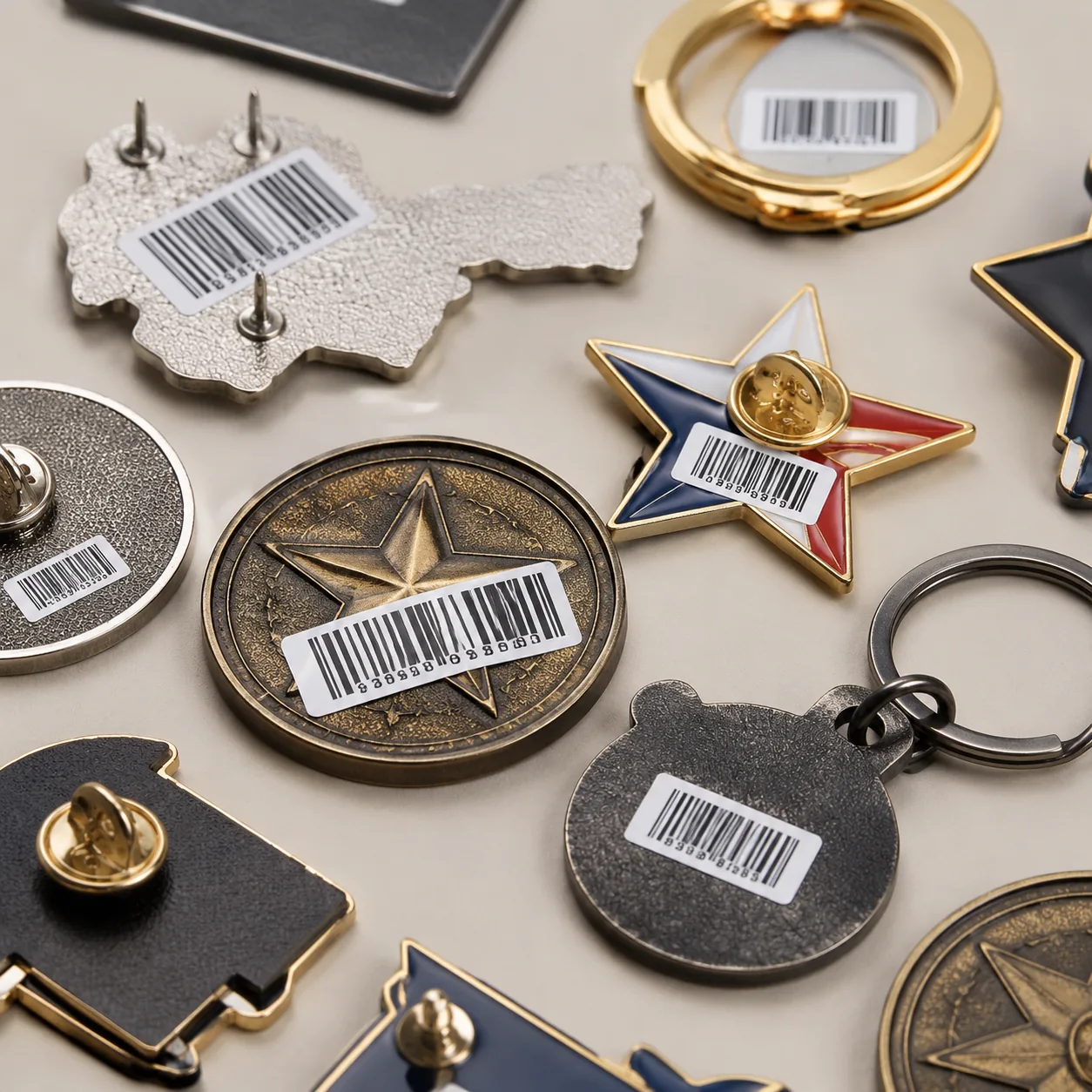
Receiving failures start with small label gaps
A custom enamel pin, challenge coin, keychain, patch or lanyard can pass product inspection and still be rejected at the receiving dock. The usual failures are practical rather than dramatic: a UPC printed below scannable size, a carton label covered by tape, a mixed-SKU carton without a carton-level contents list, or a suffocation warning missing from a polybag. Retail DCs, 3PL warehouses and event fulfillment teams usually treat these as non-conforming goods even when the product itself is correct.
Promotional products make labeling harder because the factory is often packing many small, similar items with different artwork, languages, dates or destination codes. A 25 mm lapel pin, a 50 mm woven patch and a 90 mm die-struck coin may belong to the same campaign, but they need different bag sizes, label positions, carton counts and scan distances. If the purchase order says only “standard export packing,” the supplier has to guess the rules of your downstream warehouse.
For export orders, label approval should be separated from artwork approval. Artwork approval confirms the item can be manufactured; label approval confirms it can be received, counted, scanned and routed. This is especially important when goods ship directly from China to a retailer distribution center, Amazon-style fulfillment warehouse, franchise network or multi-city event site instead of first entering the buyer’s own warehouse.
Define the packing level before quotation
Before asking for a final price, decide whether each SKU needs no unit label, a unit barcode, a backing card barcode, an inner-carton label, a master-carton label or a full kitting label. The decision affects label stock, carton size, labor speed, inspection time and export paperwork. A pin packed loose in 100-piece bags is not the same job as the same pin individually bagged, UPC-labeled, scan-checked and sorted into destination cartons.
For custom metal giveaways, barcode-labeled unit packing is most efficient from 500 pieces per SKU upward. It can be done at 300 pieces per SKU, but the setup cost is spread across fewer units. Below 200 pieces per SKU, the main risk is not label cost; it is cross-labeling during changeover. If an order has 20 badge designs at 100 pieces each, quote it as a multi-SKU handling job, not as bulk packing with labels added at the end.
| Packing level | Typical use | Minimum practical spec | Typical FOB cost impact |
|---|---|---|---|
| No unit label | Internal gifts, event handouts opened before use | Carton mark plus inner-bag count label | Base price |
| Unit barcode label | Retail, 3PL pick-and-pack, inventory receiving | 30 x 20 mm to 50 x 30 mm label; UPC/EAN width at least 30 mm | +0.03 to +0.08 USD per piece |
| Backing card barcode | Pins, brooches, patches, magnets on display card | Barcode panel at least 35 x 20 mm; 300 gsm card common | +0.06 to +0.18 USD per piece |
| Inner carton label | Store packs, language sorting, team allocation | 70 x 40 mm to 100 x 60 mm; SKU and quantity visible | +0.20 to +0.60 USD per inner carton |
| Master carton label | Distributor, retailer DC or 3PL receiving | 100 x 75 mm minimum; A6 preferred for export cartons | +0.30 to +0.90 USD per carton |
| Full kit label | Multi-item gift sets, event packs, destination cartons | 60 x 40 mm to 100 x 70 mm; kit SKU plus contents reference | +0.15 to +0.60 USD per set |
MOQ tiers should be stated by SKU, not only by total order quantity. A 10,000-piece order with one barcode is a simple packing run; a 10,000-piece order split across 50 barcodes is a sorting and verification project. For most promo items, allow 1 to 2 additional packing days for 500 to 5,000 labeled units, 3 to 5 days for 5,000 to 20,000 units and 5 to 8 days when there are more than 30 SKU or destination combinations.
Use barcode formats that scan on small packs
UPC-A and EAN-13 remain the safest formats for retail point-of-sale because they are widely supported and readable when printed correctly. For unit labels on pins, keychains, magnets and patches, specify a minimum barcode symbol width of 30 mm for UPC-A or EAN-13 and a quiet zone of at least 2.5 mm on both left and right sides. On backing cards, a 35 to 40 mm symbol width gives better scan reliability after cards rub against each other in transit.
Code 128 is better for internal SKUs, lot codes, order numbers and alphanumeric strings. It can be compact, but do not compress it below 25 mm width for handheld warehouse scanners unless your data string is very short and the buyer has tested it. For carton labels, use a larger Code 128 symbol where possible; 50 to 80 mm width is easier to scan from 300 to 600 mm away on a busy receiving line.
QR codes are useful for product registration, serial verification, instruction pages and campaign landing pages, but they should not replace a retail barcode unless the receiving system explicitly accepts QR data. On packaging labels, 10 x 10 mm QR codes can work in controlled conditions, but 15 x 15 mm is a safer warehouse minimum. If the code is laser engraved on a coin, badge or keychain, use a flat, non-textured area with strong contrast. A practical minimum is 12 x 12 mm for a short URL and 15 x 15 mm for longer encoded data.
Avoid printing barcodes over metallic ink, dark artwork, holographic film or heavy texture. For thermal transfer labels, specify 203 dpi as a minimum and 300 dpi where the barcode is small or dense. If the buyer requires barcode verification, request ANSI/ISO grade C or better at final size; grade B is preferable for retail programs where labels will be handled repeatedly before scanning.
Specify label stock, adhesive and durability
The lowest-priced label is not the lowest-cost option if it falls off, curls, smears or darkens before receiving. For indoor OPP polybags, a 60 to 80 gsm coated paper label with permanent acrylic adhesive is usually sufficient. For premium presentation or humid routes, white PP or PET labels in the 50 to 75 micron range resist tearing and moisture better than paper. For export cartons, thermal transfer labels are more durable than direct thermal labels during ocean freight and warehouse abrasion.
Direct thermal labels are acceptable for short domestic fulfillment, but they can darken when exposed to heat above about 50°C or strong sunlight. For cartons leaving China by sea or rail, specify thermal transfer printing with wax-resin ribbon or preprinted coated stock. A carton label should remain readable after 30 to 45 days in transit and after normal handling abrasion.
Adhesive choice depends on the label carrier. Do not apply barcode labels directly to woven lanyards, embroidered patches or lint-heavy fabrics unless the label is temporary and not used for final receiving. Fibers reduce contact area and labels lift at the edges. Use a polybag, hang tag, header card or backing card instead. For OPP bags, confirm adhesion after 24 hours; a practical tolerance is no edge lift above 1 mm at room temperature.
| Surface | Recommended label method | Control point to specify | Avoid when |
|---|---|---|---|
| Clear OPP or CPP bag | Coated paper, PP or PET pressure-sensitive label | No edge lift above 1 mm after 24 hours; label placed on flat area | Bag is dusty, oily or heavily wrinkled |
| Backing card | Direct print or coated paper barcode label | Barcode grade C minimum; quiet zone not interrupted by artwork | Dark artwork or varnish sits behind barcode |
| Export carton | Thermal transfer label, A6 or 100 x 75 mm | Readable after 20 hand-rub cycles; not placed across tape or seam | Long sea freight with direct thermal stock |
| Metal product | Laser QR, etched code or durable printed sticker | Code position within ±0.5 mm if engraved; flat area required | Curved, mirror-plated or textured surface |
| Fabric item | Hang tag, header card or polybag label | Barcode not attached directly to fibers | Loose label on lint-heavy textile surface |
Make carton labels useful at the dock
A good carton label answers five questions without opening the box: what SKU is inside, how many pieces are inside, which purchase order it belongs to, which carton number it is and where it should go. For B2B promotional shipments, include product name, SKU, PO number, barcode or carton ID, quantity, gross weight, net weight, carton dimensions and carton sequence such as “CTN 3 of 12.” If the carton contains mixed SKUs, mark “MIXED SKU” clearly and include a printed contents list inside the carton plus one pouch copy outside.
Carton label size should match scan distance and carton size. A6, about 105 x 148 mm, is preferred for master cartons. A 100 x 75 mm label is workable on smaller cartons under roughly 40 x 30 x 25 cm. Place labels on one flat side, not across seams, straps, corners, stretch film or clear tape. If the buyer uses pallet receiving, place one label on the long side and one on the short side so the ID remains visible after palletizing.
For small heavy metal goods, carton strength matters as much as label format. Pins, coins and keychains concentrate weight in compact cartons, so 5-ply corrugated board is usually safer than light 3-ply board for export. Keep courier cartons under 15 kg gross weight and sea-freight cartons under 18 kg unless the buyer approves otherwise. A common enamel pin carton is 36 x 26 x 20 cm with 1,000 to 2,000 pieces depending on backing cards and bags. Challenge coins are heavier; 300 to 500 pieces per carton is more realistic for 45 to 50 mm coins in PVC pouches.
Control label accuracy on the packing line
Label control should be built into the production traveler, not handled as a late warehouse note. Each SKU needs a locked packing file showing artwork name, SKU code, barcode number, product description, packing method, pieces per inner bag, pieces per inner carton, pieces per master carton and destination code if applicable. When any field changes, the revision date should change and old label files should be removed from the packing table.
The biggest risk is cross-labeling similar items. This happens when two designs share the same size, plating and attachment but carry different slogans, languages, dates or store destinations. The simplest prevention is line clearance: finish one SKU, remove remaining labels and products from the table, record the balance, then release the next SKU. For orders with many versions, use one printed SKU matrix at the packing station and one retained approved sample per SKU.
Inspection should treat label defects differently from minor cosmetic defects. Many promotional product inspections use AQL 2.5 for major defects and AQL 4.0 for minor defects, but wrong barcode, wrong SKU, unreadable barcode, missing warning label and wrong carton count should be treated as critical defects with zero acceptance in the sample. For scannability, a practical control is 100% scan testing on the first 50 units per SKU, then random scan checks every 200 to 300 units or at each label roll change.
- Approve a PDF label proof with real barcode data, not a placeholder symbol.
- Specify barcode format, symbol size, quiet zone, human-readable number and label position.
- Require one packed photo per SKU showing front, back, unit label and carton label.
- Use line clearance between SKUs and remove obsolete labels from the packing table.
- For mixed cartons, require a carton-level contents list with SKU quantities.
- Use carton sequence numbers such as CTN 1/8, CTN 2/8 and avoid duplicate numbers.
- Match the final packing list to carton labels before balance payment or shipment release.
Plan realistic cost and lead-time impact
Labeling is usually inexpensive per piece, but it can slow packing more than buyers expect. Bulk-packed enamel pins may be packed at several thousand pieces per worker per day. Individually bagged and barcode-labeled pins often fall to 800 to 1,500 pieces per worker per day depending on backing cards, label position and scan checks. Multi-SKU work adds changeover time, and that time is often more important than the label material cost.
As a planning range, simple unit barcode labeling adds 1 to 3 production days for up to 5,000 pieces when labels are approved before mass packing starts. Orders from 10,000 to 30,000 pieces usually need 3 to 6 additional days. Orders with store sorting, destination cartons or more than 30 SKU combinations can need 5 to 10 additional days. If label files arrive after goods are finished, expect idle inventory and a new packing slot rather than immediate shipment.
FOB cost depends on the carrier and the number of handling steps. A custom enamel pin in an OPP bag with one barcode label commonly adds 0.03 to 0.08 USD per piece. A pin or patch on a printed backing card with a barcode panel and hang hole typically adds 0.08 to 0.20 USD per piece depending on card size, paper weight and printing. Full kitting with multiple items, destination labels, scan checks and carton sorting can add 0.15 to 0.60 USD per set before special pallet or retailer routing requirements.
Some label requirements also change carton cube. A 50 x 30 mm label on a 60 x 80 mm bag may cover too much of the product and force a larger bag. A backing card can improve retail presentation, but it increases paper cost, carton volume and freightable weight. These changes should be visible in the quotation so the buyer can compare bulk packing, bag labeling and carded retail packing on a landed-cost basis.
Avoid over-specifying simple giveaways
Not every promotional giveaway needs retail-grade labeling. If 2,000 pins are being opened and handed out at a conference registration desk, individual UPC labels may add cost without improving control. A master-carton label, inner-bag count label and simple packing list may be enough, especially when staff will open all cartons before distribution.
Over-specification creates its own problems. A large barcode label on a tiny bag can hide the product, wrinkle at the edge or reduce scan reliability because it curves around the pack. For a 25 mm lapel pin in a 60 x 80 mm OPP bag, a 50 x 30 mm label is usually too dominant. If presentation matters, use a backing card with a dedicated barcode panel instead of forcing a large bag label.
Another common mistake is changing SKU names after barcode approval. Warehouses may not care whether the factory calls an item “gold badge” or “anniversary pin,” but receiving systems often match exact SKU strings. Freeze SKU, barcode, carton quantity and destination code before packing. Treat later changes like artwork changes: revise the document, confirm the version and recheck first packed units before mass packing continues.
Build the label spec into the PO
Start by mapping the receiving route, not just the factory shipment. Goods going to a buyer’s office need different labels from goods going directly to a retailer DC, 3PL warehouse, franchise network or event city warehouse. Ask the receiving party for its label manual before the factory quotes final packing, because retailer routing guides may specify barcode format, label placement, carton weight limits and even pallet label layout.
Then send the supplier a packing specification with barcode files, SKU table, unit label position, carton label fields, carton quantity limits and inspection expectations. For custom pins, brooches, keychains, fridge magnets, challenge coins, patches and lanyards, this should be part of the production worksheet before packing materials are ordered. The best time to catch a label mistake is when 20 pieces are packed, not when 20 cartons are sealed.
- Prepare one SKU table with barcode number, product name, artwork version, destination and order quantity.
- Decide whether each label belongs on the unit bag, backing card, hang tag, inner carton or master carton.
- Set carton limits, usually 15 kg gross weight for courier and 18 kg for sea freight unless approved.
- Request first-article packed photos and scan confirmation before full packing.
- Require AQL treatment for label defects, with wrong barcode and wrong SKU treated as critical.
- Keep one retained packed sample per SKU for reorder, dispute and claim comparison.
Have a project? Send your artwork and target quantity and we’ll reply with a detailed quotation within 12 working hours.
Ready to get this made?
Send your sketch, target quantity and ship-date. Detailed quotation in 12 hours.



