Barcode and Carton Label Specs for Custom Promo Products
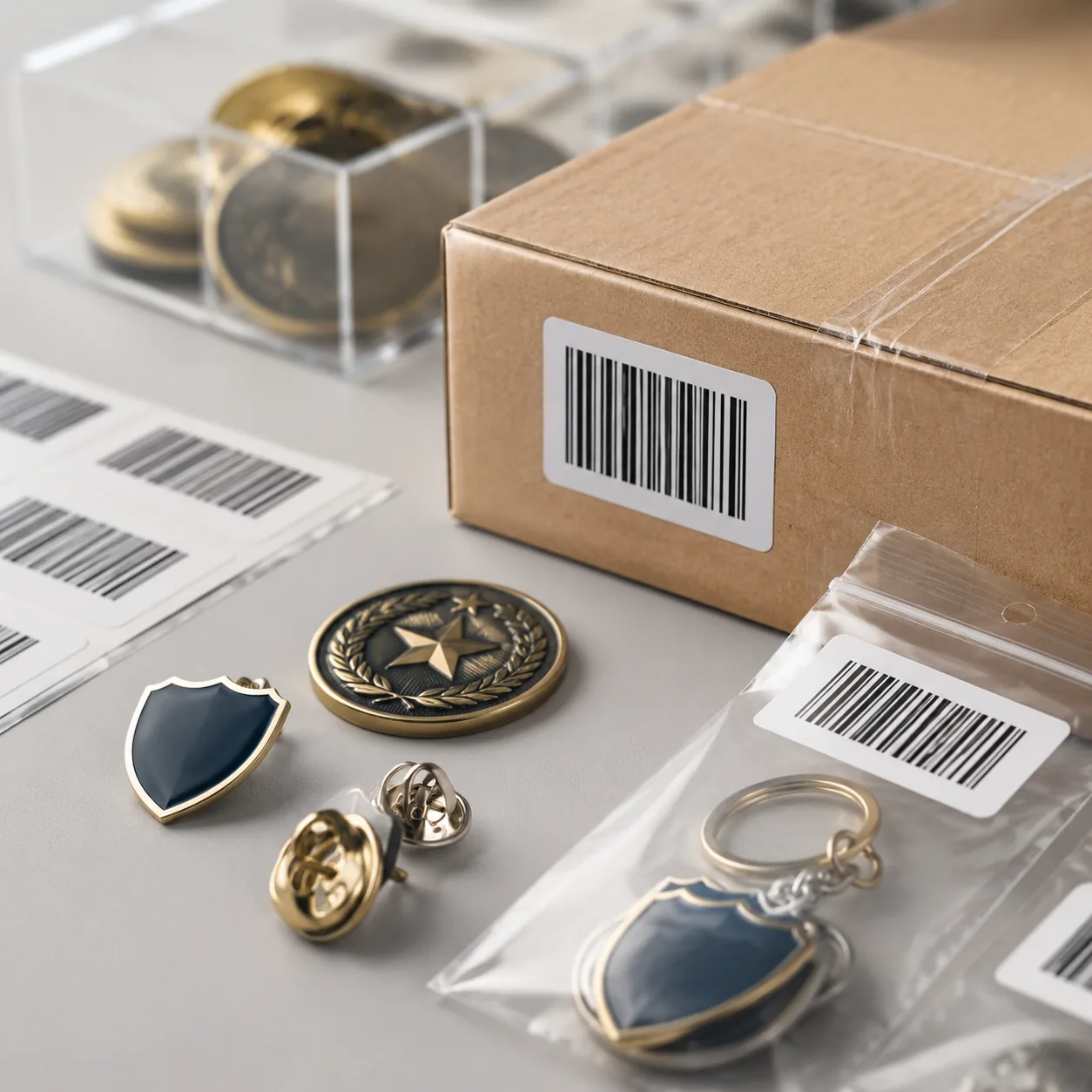
Why Good Products Still Fail Receiving
A custom pin, coin, patch, keychain, magnet, or lanyard order can pass visual inspection and still be rejected at the warehouse door. The failure is usually not plating, enamel color, embroidery density, or attachment strength. It is unreadable barcodes, missing carton marks, mixed SKUs in one inner box, inconsistent carton counts, or labels placed under tape where scanners cannot reach them.
Retailers, 3PLs, Amazon-style fulfillment centers, and event logistics teams commonly charge USD 0.15 to USD 0.60 per unit for relabeling. Manual sorting is often billed at USD 25 to USD 55 per labor hour, and rush correction can delay receiving by 2 to 7 days. On low-cost promotional products, those charges can exceed the cost of the backing card, polybag, or inner carton.
Labeling should be treated as a production specification, not as a file sent after packing starts. The factory needs barcode type, label size, print method, SKU logic, carton-mark layout, inner-pack quantity, placement tolerance, and inspection criteria before mass packing. This guide focuses on physical labeling specs for small promotional products and complements, but does not replace, the buyer’s retailer routing guide.
Build the Label Hierarchy Before Artwork Approval
Most labeling mistakes start when product artwork is approved before the logistics structure is defined. A simple enamel pin order may need a unit barcode on the backing card, an inner-box label for 100 pieces, and a master-carton label for 1,000 pieces. A campaign kit may also need set codes, colorway codes, event dates, warehouse destination codes, and carton sequence numbers.
Use one SKU for each sellable or inventory-controlled unit, not for a broad product family. If 5,000 keychains are split across five colors, avoid carton notes such as “blue style” or “red style.” Use clear codes such as KC-2026-BLU, KC-2026-RED, and KC-2026-BLK, then define the exact quantity per polybag, inner box, and export carton. If a retail set contains three items packed together, the set needs its own SKU even if each component also has an internal item code.
Unit-level labeling is not always necessary. For giveaways handed out in bulk from cartons, inner-box and master-carton labels are usually enough. Unit labels add cost, handling time, and adhesive risk on velvet pouches, matte backing cards, kraft sleeves, and rubber clutch bags. Unit barcodes make sense when each piece will be sold, inventoried, kitted, returned, or distributed across multiple locations.
| Packing Level | Typical Data Required | Common Label Size | Factory Control Point |
|---|---|---|---|
| Unit pack | SKU, barcode, product name, color, country if required | 35 x 20 mm to 50 x 25 mm | Check placement on backing card or polybag before mass application |
| Inner box | SKU, description, quantity, PO, batch date | 60 x 40 mm to 80 x 50 mm | Keep one SKU per inner box unless buyer approves mixed packing |
| Master carton | PO, SKU, quantity, CTN no., GW/NW, dimensions, barcode | 100 x 100 mm or 100 x 150 mm | Apply on one long side and one short side for pallet visibility |
| Mixed carton | Mixed-carton warning, SKU list, inner-box breakdown | 100 x 150 mm minimum | Use only when routing guide allows mixed cartons |
Choose Barcode Symbology and Minimum Size
UPC-A and EAN-13 are standard for retail point-of-sale use. Code 128 is widely used for internal SKUs, carton IDs, batch codes, and alphanumeric item numbers because it handles letters, numbers, hyphens, and compact strings. QR codes are useful for consumer links or internal traceability, but they should not replace a required linear barcode unless the receiving system confirms 2D scanning.
For unit packaging, a practical barcode area is 30 to 38 mm wide and 10 to 14 mm high for UPC-A, EAN-13, or short Code 128 data. For carton receiving, use a main barcode at least 60 mm wide and 20 mm high on a 100 x 70 mm or larger label. Keep quiet zones clear: minimum 3 mm on both sides for unit labels and 6 mm for carton labels. Do not place text, borders, hang holes, or die-cut edges inside the quiet zone.
Avoid shrinking a barcode to rescue a crowded backing-card design. A 20 mm wide EAN-13 may scan at a desk but fail under warehouse lighting, through a wrinkled OPP bag, or after glossy lamination adds reflection. For thermal-transfer black-on-white labels, target ANSI/ISO barcode grade B or better where verification is available. For offset-printed backing cards, grade C may be accepted only if the retailer permits it and the production sample scans reliably.
| Use Case | Recommended Code | Minimum Printed Size | Technical Note |
|---|---|---|---|
| Retail unit sale | UPC-A or EAN-13 | 30 x 12 mm | Buyer supplies valid GS1-linked number; factory should not invent UPCs |
| Internal SKU tracking | Code 128 | 32 x 10 mm | Works well for item-color codes such as PIN-2045-NVY |
| Carton receiving | Code 128 | 60 x 20 mm | Use on 100 x 70 mm or larger carton label with 6 mm quiet zones |
| Consumer link | QR code | 18 x 18 mm | Test after printing and lamination; avoid curved or wrinkled surfaces |
| Very small card | Short Code 128 | 25 x 8 mm | Use only after scanner test on production material |
Specify Label Material, Adhesive, and Placement
Label stock must match the packaging surface. Promotional products may use OPP bags, kraft boxes, velvet pouches, paper backing cards, PVC sleeves, PET clamshells, and corrugated export cartons. For master cartons, 70 to 80 gsm thermal-transfer paper with permanent adhesive is usually sufficient. For OPP bags and PVC sleeves, specify acrylic permanent adhesive and test lift after 24 hours because low-cost labels often peel from smooth plastic.
For unit labels on backing cards, define a clear label zone before the card artwork is finalized. Common enamel pin card sizes are 55 x 85 mm, 60 x 90 mm, and 70 x 100 mm. Leave at least 35 x 18 mm on the back for a unit barcode and 45 x 25 mm if the label must include product name, SKU, and country-of-origin text. Keep labels away from hang holes, safety warnings, legal marks, product photos, and punched attachment points.
Placement tolerance should be measurable. For unit cards and polybags, use ±2 mm from the approved position. For inner boxes, use ±3 mm. For master cartons, ±5 mm is normally acceptable as long as the barcode remains flat, visible, and away from tape seams. On cartons, keep the label at least 30 mm from edges and crushed corners. Do not apply critical labels across sealing tape because tape replacement during customs or inspection can remove the barcode.
- Confirm every label size in millimeters, not only by artwork scale.
- State adhesive type: permanent, removable, acrylic, hot-melt, or freezer-grade if required.
- Define placement from fixed edges, such as 10 mm from top and 8 mm from right.
- Require black print on white or very light background for scan-critical labels.
- Keep labels off seams, pouch folds, zipper areas, carton tape, and curved packaging.
- Approve photos of labeled units, inner boxes, and sealed cartons before mass packing.
Control Inner Packs and Mixed-SKU Risk
Small custom products are easy to mix because one carton can hold hundreds or thousands of pieces. A 25 mm soft enamel pin on a backing card may pack 100 pieces per inner box and 1,000 to 2,000 pieces per export carton. A 50 mm die-struck challenge coin in a PVC pouch may pack 25 to 50 pieces per inner box and 300 to 500 pieces per carton, depending on thickness, plating, capsule use, and gross weight limit.
If the receiving warehouse expects one SKU per carton, do not allow mixed cartons for leftover quantities. The last carton should be underfilled and labeled correctly. If mixed cartons are unavoidable, require a bright “MIXED SKU” label, an external packing list, and separate labeled inner boxes for each SKU. The factory should never pack loose mixed colors into one carton unless the buyer accepts manual sorting at destination.
For distributor orders, inner boxes of 50, 100, or 250 pieces are typical, depending on item weight and packaging bulk. Each inner box should show SKU, item description, color or variant, quantity, PO number, batch date, and destination if there are multiple warehouses. This usually adds USD 0.02 to USD 0.08 per unit for pins and keychains, but it reduces receiving disputes and makes partial releases easier.
| Product | Typical Inner Pack | Typical Export Carton | Reduce Quantity When |
|---|---|---|---|
| Enamel pins on cards | 50 to 100 pcs | 1,000 to 2,000 pcs | Premium thick cards, epoxy coating, fragile attachments, heavy clutches |
| Metal keychains | 50 pcs | 500 to 1,000 pcs | Large charms, gift boxes, anti-scratch pouches, bottle openers |
| Challenge coins | 25 to 50 pcs | 300 to 500 pcs | 4 mm thickness, 3D relief, capsules, antique plating protection |
| Woven or embroidered patches | 100 to 250 pcs | 2,000 to 5,000 pcs | Hook backing, merrowed edge bulk, individual retail bags |
| Lanyards | 50 to 100 pcs | 500 to 1,000 pcs | Bulky buckles, safety breakaways, card holders, metal hooks |
Write Carton Marks Warehouses Can Use
A usable carton mark is readable from one meter away and gives receiving staff enough information to process the carton without opening it. Minimum fields should include buyer code or company name, PO number, SKU, product description, color or variant, quantity, carton number, total cartons, gross weight, net weight, and carton dimensions. Carton sequence should be written as CTN 3/12, not as a handwritten “3” without context.
For export cartons, 100 x 100 mm and 100 x 150 mm labels are common. Secondary text should be at least 10 pt, while SKU, PO, and carton number should be 18 to 24 pt. If cartons will be palletized, apply the main carton mark on one long side and one short side. For high-volume retail distribution, add a scannable carton ID using Code 128 and keep the human-readable SKU directly under the barcode.
Carton strength and label accuracy are linked because crushed cartons damage labels. For metal products, use 5-ply corrugated cartons when gross weight exceeds 12 kg. Keep gross weight below 18 kg where possible; many buyers prefer 15 kg or lower for manual handling. Pins, patches, magnets, and lanyards can usually meet that limit. Challenge coins may require smaller cartons to stay below 15 to 18 kg.
Inspect Labels with AQL and Scan Checks
Label inspection should be part of the pre-shipment inspection plan, not a casual warehouse photo check. For promotional products, a practical default is AQL 2.5 for major defects and AQL 4.0 for minor defects under General Inspection Level II, unless the buyer’s routing guide is stricter. Wrong SKU, missing barcode, unreadable barcode, wrong quantity, missing carton label, or mixed product in a single-SKU carton should be classified as major defects.
Before mass packing, request photos of the first five labeled units per SKU, one labeled inner box, and one sealed master carton. The photos should show label placement, barcode clarity, carton-mark layout, carton number, and actual packed quantity. For orders above 10 SKUs, require a packing matrix with SKU, barcode data, quantity per inner, quantity per carton, carton count, mixed-carton status, and destination warehouse.
Scan checks must use printed production labels, not only PDF proofs. A label can look perfect on screen and fail after thermal ribbon density, lamination glare, ink spread, or low-resolution printing changes the bars. Equally important, the scanned data must match the buyer’s system. A barcode that scans cleanly to the wrong SKU creates hidden inventory errors that are harder to fix than a label that does not scan at all.
- Classify wrong SKU labels, unreadable barcodes, and missing carton labels as major defects.
- Set unit label placement tolerance at ±2 mm and carton label tolerance at ±5 mm unless otherwise agreed.
- Scan production labels after printing, after application, and again on sealed cartons where possible.
- Check carton counts against the PO, packing matrix, and final packing list.
- Open at least one carton per SKU during inspection when carton sealing rules allow it.
- Retain one labeled unit and one carton-label photo for reorder reference.
Cost, MOQ, Lead Time, and RFQ Data
Basic carton labels are inexpensive: usually USD 0.03 to USD 0.08 per master carton for standard adhesive labels. Unit barcode sticker application commonly adds USD 0.015 to USD 0.05 per piece, depending on order volume, label size, surface, and whether the label must be aligned to a tight visual position. Custom printed backing cards with barcode data typically add USD 0.04 to USD 0.18 per piece at 1,000 to 5,000 units, with lower unit cost at 10,000 pieces and higher cost for many SKU changes.
Typical MOQ for thermal unit labels is low, often 500 to 1,000 labels per SKU, but small runs may carry a setup charge of USD 15 to USD 45 per SKU. Offset-printed backing cards are usually more efficient at 1,000 pieces per design or higher. Variable-data printing, where every card or carton has a unique serial code, needs separate quotation because it requires data control, proofing, and often 3 to 5 extra production days.
Lead time impact is usually 1 to 3 days for standard unit and carton labels, 3 to 6 days for printed backing cards, and 5 to 8 days if barcode data changes after packaging materials are printed. Late SKU changes are the main delay driver. If the buyer revises product names, color codes, or barcode numbers after packing starts, the factory must stop, quarantine affected labels, reconcile data, and reprint before continuing.
For an RFQ, send one spreadsheet with SKU, product name, barcode data, barcode type, unit pack quantity, inner pack quantity, carton quantity, destination, and mixed-carton permission. Attach label artwork as vector PDF or high-resolution black-on-white files. State whether the factory should use thermal-transfer labels, printed backing cards, or carton stickers. With complete data at quotation stage, the factory can price packaging accurately, protect the shipping schedule, and prevent the receiving team from becoming the final assembly line.
Have a project? Send your artwork and target quantity and we’ll reply with a detailed quotation within 12 working hours.
Ready to get this made?
Send your sketch, target quantity and ship-date. Detailed quotation in 12 hours.



