Backstamp Specs for Custom Pins, Coins and Badges
Why the back fails after the front is approved
A common late-stage failure is not the visible artwork. It is the rear mark: a copyright line that fills with plating, a country-of-origin label that loses legibility after polishing, or a sponsor logo that telegraphs through the front face on thin metal. By the time this is caught, the die may already be cut, which leaves only three options: accept a weak mark, pay for rework, or move the shipment date.
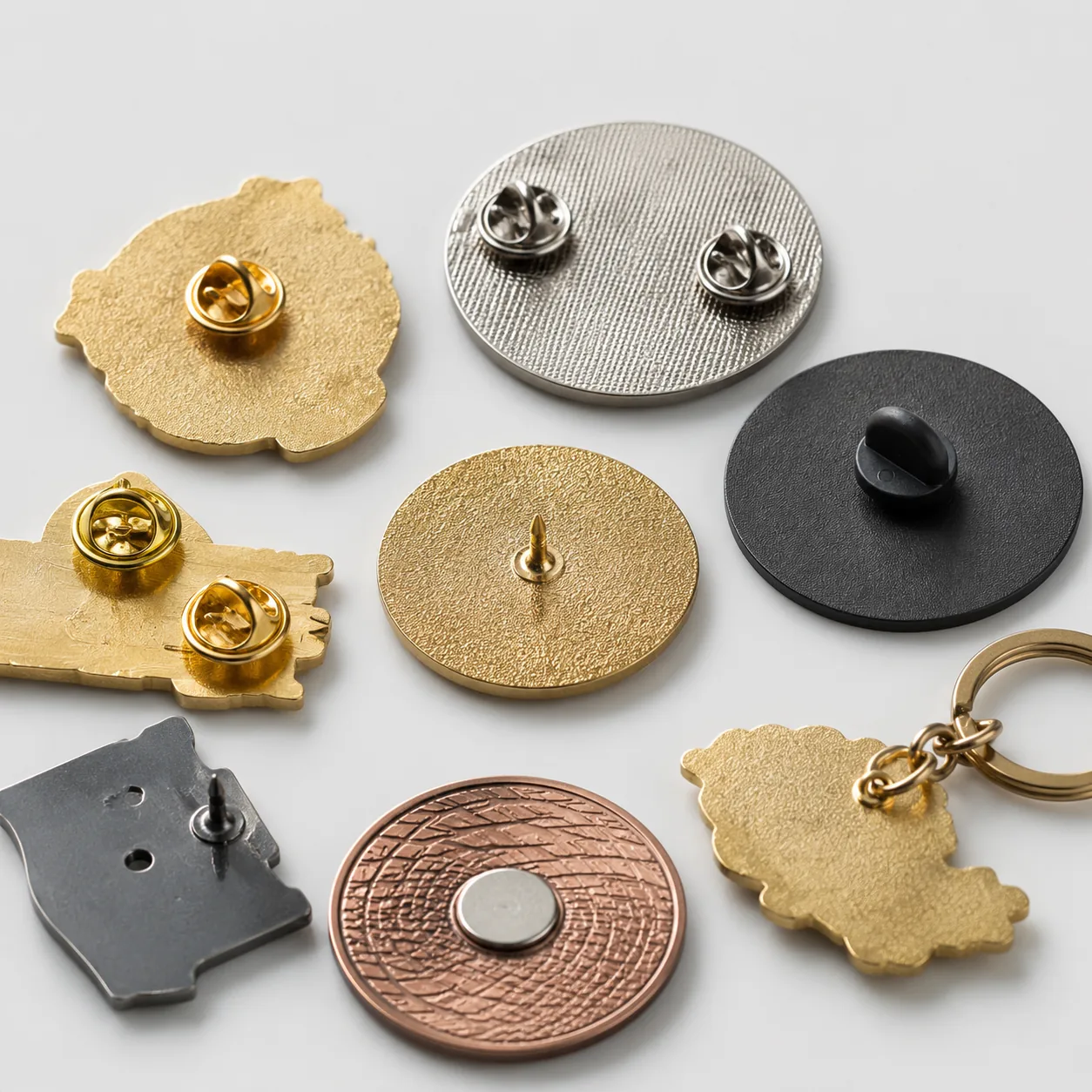
Backstamps look simple in a PDF, but they are shaped by metal thickness, plating build-up, polishing pressure, enamel cavity depth, and the amount of flat area left around posts, magnets, and hinges. For international B2B orders in retail, licensing, museums, events, and corporate gifts, the rear mark should be specified with the same discipline as the front artwork.
At ZheCraft, we treat backstamp details as production specs, not decoration notes. For most custom enamel pins, badges, and coins, the safe starting point is to define the marking method, minimum character size, relief depth, placement tolerance, plating system, and inspection standard before sample tooling starts.
Choose the marking method before you ask for a quote
There are four practical ways to add information on the back: stamped relief, cast relief, laser engraving, and printed ink. Stamped or cast relief is best for fixed text such as brand names, copyright lines, country-of-origin labels, and edition marks. Laser engraving is better for variable data such as serial numbers, batch codes, dates, and short QR identifiers.
Printed ink is usually the weakest option for metal pins or coins. It can work on flat, low-wear promotional items or on an epoxy-coated back, but it is more vulnerable to rubbing, alcohol wipes, pocket abrasion, and shipping contact. If the item will be handled daily, choose raised, recessed, or laser-marked metal instead.
| Method | Best use | Minimum practical spec | Typical MOQ | FOB impact | When not to choose it |
|---|---|---|---|---|---|
| Stamped recessed or raised | Fixed logos, copyright, country labels | 0.35 mm stroke, 1.8 mm text height, 0.15 to 0.25 mm depth | 100 pcs for pins, 300 pcs for some badge programs | Usually included in tooling; new rear die adds about 25 to 80 USD | Very small text, variable numbers, or products thinner than 1.2 mm |
| Cast relief | 3D coins, thick badges, sculpted backs | 0.45 mm stroke, 2.2 mm text height, 0.25 to 0.50 mm relief | 50 to 100 pcs for coins, 100 to 300 pcs for badges | Usually included in the mold; mold changes add about 60 to 150 USD | Sharp legal text or tiny trademark lines |
| Laser engraving | Serial numbers, QR labels, batch codes | 0.20 mm line, 1.2 mm text on smooth plating | 100 pcs+, often with setup on each SKU | 0.03 to 0.12 USD per piece depending on data | Rough sandblast areas, deep black nickel, heavy curves |
| Pad or screen print | Promotional copy on flat backs | 0.25 mm line, 1.5 mm text, clear coat preferred | 500 pcs+ to be economical | 0.02 to 0.08 USD per color per piece | Keychains, coins in pockets, alcohol-cleaned items |
Size the text for plating, polishing, and real-world viewing
Backmarks must be designed larger than they look on screen. Decorative plating and polishing soften edges, especially on fine counters in letters like A, B, R, O, and e. On a typical iron or zinc piece, copper underplating is often 5 to 8 microns, nickel 3 to 5 microns, and decorative gold, silver, black nickel, or antique top layers are commonly in the 0.03 to 0.12 micron range for flash finishes. The total build is small, but it is enough to close tight letter spaces if the artwork is undersized.
For stamped enamel pins from 20 to 35 mm, use at least 1.8 mm letter height for recessed text and 2.0 mm for raised text. Stroke width should be no thinner than 0.35 mm, with 0.45 mm preferred for antique finishes because oxidation and wiping reduce contrast. For challenge coins from 38 to 50 mm, 2.2 to 2.8 mm letter height is safer, especially if the back includes a textured field or radial pattern.
Avoid placing a backstamp directly behind large front enamel pools or thin cutout bridges. On a 1.2 to 1.5 mm pin, a deep rear stamp can telegraph as a faint shadow on the front if it sits under a polished face. Our normal tolerance is plus or minus 0.15 mm for stamped relief depth and plus or minus 0.20 mm for rear mark placement. Thin or openwork designs may need looser control, especially when the front and back are not fully symmetrical.
Match the backstamp to the base material and thickness
Iron is the most common base for stamped soft enamel and hard enamel pins because it gives crisp relief at low cost. It is usually used at 1.2 to 1.8 mm thickness for standard pins, with FOB pricing around 0.45 to 1.20 USD for 25 to 35 mm pieces depending on color count, plating, and attachment. It handles rear stamping well, but very deep marks can distort thin front areas if the layout is crowded.
Zinc alloy is better for cast badges, 3D coins, oversized pins, irregular openwork, and pieces above 45 mm. It allows thicker sections, often 2.0 to 4.0 mm for badges and 3.0 to 5.0 mm for coins, and it integrates back logos cleanly into the mold. The trade-off is that tiny legal text is usually less crisp than stamped iron unless the mark is enlarged.
Brass is useful for premium coins and badges that need clean engraving and better corrosion resistance, but it is not always economical for large giveaways. MOQ is typically 100 to 300 pieces, with FOB pricing often 15 to 35 percent higher than comparable iron or zinc alloy items. Stainless steel works well for flat laser-marked tags and keychains, but it is not ideal for enamel-filled die-struck designs with complex color separation.
- Use iron for crisp stamped text on 20 to 40 mm pins when the back is mostly flat.
- Use zinc alloy for 3D coins, thick badges, and irregular shapes where molded relief is acceptable.
- Use brass when premium weight, engraving quality, and corrosion resistance matter more than unit price.
- Use stainless steel for flat laser-marked tags, not detailed enamel pins with many raised metal lines.
- Avoid deep rear stamping on products thinner than 1.2 mm unless the front has enough structural support.
Place the mark around hardware, magnets, and safety rules
Backstamp placement has to work around the functional hardware. A butterfly clutch post normally needs a solder or rivet area of 4.5 to 5.5 mm diameter, while deluxe clutch posts may need more clearance. For brooch pins, the hinge and catch often occupy 18 to 32 mm of length, so rear text should stay at least 2.0 mm away from the hardware footprint.
For fridge magnets and magnetic badges, the magnet recess changes the available marking zone. A common round neodymium magnet is 8 by 2 mm, 10 by 2 mm, or 12 by 2 mm, and the recess wall should usually keep 1.0 to 1.5 mm of metal thickness around the pocket. Do not place required legal text inside a glued magnet area because it will be hidden and can weaken adhesive contact.
For child-safe items, rear marks should not create sharp raised burrs or snagging points. We normally specify an edge radius of at least 0.2 mm on raised back logos and inspect for sharpness during finishing. If the product is intended for children, discuss attachment type, small-parts risk, and nickel-release requirements separately instead of assuming the backstamp solves compliance.
Write legal, brand, and country marks with no ambiguity
Do not send vague notes such as add copyright on back or put made in China small. The factory needs exact text, capitalization, symbols, placement, orientation, and whether the mark is raised, recessed, or laser engraved. If a licensor requires a fixed sequence such as copyright owner, year, trademark symbol, and manufacturer code, include it in the RFQ and on the technical artwork.
Country-of-origin marking is often required for import, retail, or marketplace programs, but the wording and visibility expectations depend on destination and product type. A practical rear mark is MADE IN CHINA at 1.8 mm text height minimum for pins and 2.2 mm for coins. If packaging also carries origin information, the product mark may still be needed when the item can be separated from the carton or sleeve.
For QR codes on backs, be conservative. A laser QR below 8 by 8 mm can scan in an office but fail after plating glare, curvature, plastic bags, and phone autofocus are added. For reliable scanning on metal, use 10 by 10 mm minimum, a 1.0 mm quiet zone, high-contrast laser on matte nickel or stainless, and verify with at least three common phone models before mass production.
Build inspection, pricing, and lead time into the purchase order
Backstamp quality should be inspected with objective criteria before shipment. For standard promotional orders, AQL 2.5 for major defects and AQL 4.0 for minor defects is typical. For licensed retail, gift-with-purchase, or collector coins, buyers often use AQL 1.5 major and 2.5 minor, with 100 percent check for serial numbers or variable QR codes.
Define what counts as a major defect. Examples include missing legal text, wrong country-of-origin, unreadable brand name at 30 cm viewing distance, duplicate serial numbers, QR codes that fail scanning, backstamp rotated more than 5 degrees from the agreed orientation, or rear relief showing through the front face. Minor defects can include light polishing haze, small plating shade variation, or slight relief softening that does not affect readability.
Price and schedule are most efficient when the backstamp is decided early. If the rear mark is included before tooling, it is often part of the same die or mold cost. For a 25 to 35 mm enamel pin, normal tooling is commonly 30 to 90 USD depending on size and complexity, while a revised rear die after sample approval can add 25 to 80 USD and 2 to 4 extra days. For challenge coins, mold costs are higher because of size, depth, and 2D or 3D relief; a 45 mm coin mold may cost about 80 to 180 USD, and changing a rear logo after approval can require partial or full mold rework.
Typical production lead time is 12 to 18 days for simple pins, 15 to 25 days for coins, and 3 to 7 additional days if laser serialization, QR testing, or special antique finishing is required. MOQ usually does not change because of a fixed backstamp: 100 pieces for enamel pins and keychains, 50 to 100 pieces for challenge coins, and 300 to 500 pieces when special printing, packaging, or variable codes are involved. Unit cost impact is normally zero for fixed stamped marks included in tooling, 0.03 to 0.12 USD for laser work, and 0.02 to 0.08 USD per printed color.
Send a backstamp-ready RFQ
Before requesting quotes, decide whether the rear mark is functional, legal, branding, anti-counterfeit, or decorative. That decision controls the marking method and the inspection level. A decorative logo can tolerate softer edges, but legal origin text and licensed copyright lines need measurable readability criteria.
Send the supplier a back artwork layer at actual size, not only a front view. Include product size, material preference, thickness, plating finish, attachment position, exact rear text, minimum letter height, relief type, relief depth, placement tolerance, and inspection standard. If you are not sure whether the mark will fit, ask for a factory DFM review before sample payment rather than after the die is cut.
- Confirm product size, thickness, and base material before placing the rear mark.
- Specify raised, recessed, laser, or printed marking instead of saying logo on back.
- Keep text at 1.8 mm minimum on pins and 2.2 mm minimum on coins unless the factory approves otherwise.
- Leave at least 2.0 mm clearance from posts, brooch hardware, magnet recesses, and edges.
- Set AQL level, readability criteria, and QR or serial-number checking rules in the purchase order.
- Approve a golden sample photo set before mass production, especially for licensed or retail orders.
Have a project? Send your artwork and target quantity and we’ll reply with a detailed quotation within 12 working hours.
Ready to get this made?
Send your sketch, target quantity and ship-date. Detailed quotation in 12 hours.



