Artwork Revision Control for Custom Promo Orders
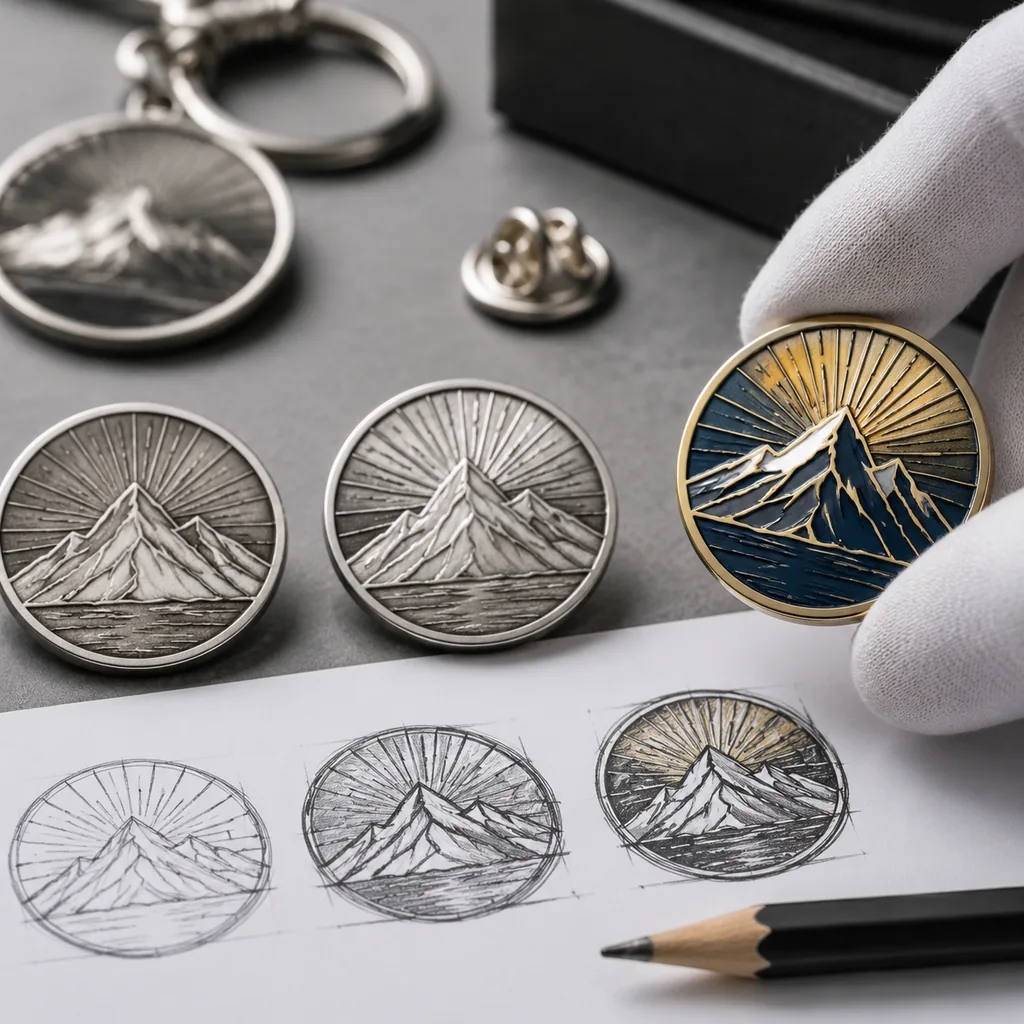
Why approved samples still ship with wrong artwork
Wrong-artwork claims usually come from uncontrolled inputs, not deliberate supplier shortcuts. A buyer sends logo_v3.ai with the RFQ, marketing later emails logo_final_new.pdf, a sales rep approves a WeChat screenshot, and production still cuts the mold from the first vector file. By the time the error is visible, the die may be engraved, enamel mixed, lanyard film output, backing cards printed, or cartons labeled.
Custom pins, challenge coins, keychains, magnets, woven patches, PVC patches and lanyards all turn artwork into process instructions. One change can affect CAD, mold engraving, plating, enamel filling, UV printing, sublimation, sewing, packing and inspection. Moving a 4 mm backstamp, changing Pantone 186 C to 200 C, or shifting a lanyard logo repeat by 8 mm can create scrap rather than a simple file update.
A realistic schedule impact is 1 to 2 working days for a proof-only change, 3 to 7 working days for a revised pre-production sample, and 5 to 12 working days if a mold, screen, sublimation file, woven program or printed card must be remade. ZheCraft treats approved artwork as a controlled production input: one frozen master file, one revision code, and written confirmation of price, tooling and lead-time impact before any post-approval change enters production.
Freeze the production proof before tooling
The freeze point should be the signed production proof, not the first quotation sketch. A usable proof shows front view, back view, size in millimeters, material, finish, color references, attachment, packing, barcode or carton marks, and measurable tolerances. If those details are split across emails, chat messages and old PDFs, the factory is being asked to manufacture from an incomplete instruction set.
For die-struck enamel pins, freeze outline size, metal line width, recessed color areas, cutouts, backstamp, pin post position, thickness and plating. For challenge coins, freeze diameter, thickness, edge style, 2D or 3D relief, dual-side artwork, numbering, enamel areas and antique finish. For lanyards, freeze width, total length, logo repeat, print method, clip, safety breakaway, buckle, stitching color and packing method.
| Item to freeze | Typical spec to state | Why it matters |
|---|---|---|
| Overall size | 25.0 mm pin +/-0.3 mm; 50.0 mm coin +/-0.5 mm; 20 mm lanyard width +/-1.0 mm | Controls tooling, perceived value, backing card fit and carton quantity |
| Metal line width | 0.20 mm minimum raised metal for soft enamel; 0.30 mm preferred around large color fills | Prevents broken enamel dams, color bleed and weak detail |
| Plating finish | Nickel, brass, black nickel, copper, antique gold or matte gold; decorative flash commonly 0.03-0.10 micron over base plating | Avoids finish mismatch between sample, reorder and mass production |
| Color reference | Pantone Solid Coated code, thread card number, PVC chip or approved physical sample | Prevents screen-color arguments and wrong material matching |
| Attachment | Single clutch 6-8 mm below top edge; double clutch for pins over 35 mm; brooch bar centered +/-1.0 mm | Controls rotation, sagging, wear comfort and complaint rate |
| Packing | Individual OPP, backing card, retail box or bulk tray; inner quantity and master carton count | Controls labor cost, barcode placement, carton marks and receiving checks |
Use revision codes that cannot be misread
Words such as final, latest, approved and new become useless after several email threads and internal handoffs. Use a revision code that includes project code, product type, size, revision number and date. A clean file name is BRD24_pin_30mm_rev03_2026-03-18.ai. The matching proof should carry the same number, such as BRD24_pin_30mm_rev03_2026-03-18_proof.pdf.
Campaigns with several SKUs need separate item codes, not one shared logo file. Use BRD24_coin_50mm_rev02, BRD24_lanyard_20mm_rev04 and BRD24_patch_75mm_rev01. Only the latest numbered revision approved in writing can enter tooling or mass production. Screenshots are useful for discussion, but not for production release unless they show the exact item code, revision number and approval date.
- Keep one master vector file per item: AI, EPS, CDR or editable PDF.
- Convert fonts to outlines before approval to prevent substitution at the factory.
- Keep placed bitmap images at 300 dpi minimum for printed cards, sublimated lanyards and inserts.
- Delete unused logos, hidden layers, old colorways and alternate layouts before release.
- Put Pantone, thread, PVC or print references beside each color area on the proof.
- Require the quotation, PI and production proof to show the same item code and revision number.
Classify changes by cost and lead-time risk
A small visual edit is not always a small production edit. Moving a lanyard logo 1 mm before film output may take one proof cycle. Widening a 0.15 mm enamel dam to 0.25 mm after the pin die is cut can require a new mold. The deciding question is whether the change affects tooling, plating setup, mixed enamel, print film, sewing fixtures, printed packaging, carton labels or inspection criteria.
Before sample approval, normal artwork corrections are usually included in development. After sample approval, even a minor change can reset the sampling queue by 3 to 7 working days. After mass production starts, the buyer may also pay for scrapped parts, reworked packing, reprinted cards or expedited freight.
| Change request | Low impact before tooling | High impact after release |
|---|---|---|
| Correct typo on backing card | 0-1 day if cards are not printed | 2-5 days plus card reprint; often USD 25-80 setup for small runs |
| Change enamel Pantone code | 1-2 days for proof update | 2-4 days if enamel is mixed or filled; scrap may apply |
| Adjust pin outline shape | 1-2 days CAD update | New mold, typically USD 25-120 and 3-7 working days |
| Change 50 mm coin relief | 2-3 days CAD or 3D file update | New CNC or die work, often USD 80-300 and 5-10 working days |
| Move clutch or magnet position | 1 day proof update | May require mold insert, soldering jig or adhesive fixture change |
| Switch lanyard from screen print to sublimation | Quote revision and art rebuild | Adds about USD 0.08-0.25 per piece at 500 pcs; new print file needed |
| Add barcode labels after packing approval | Packing quote revision | 1-3 days for label proof, printing and repacking labor |
Keep approval evidence inspection can use
Approval evidence must be clear enough for receiving, finance or a dispute reviewer to understand without reading the full email history. The minimum approval pack is the signed production proof, approved sample photos or sealed golden sample, quotation, purchase order, packing instruction, change log and inspection standard. For repeat orders, keep the previous mass-production sample as well as the pre-production sample because it reflects real plating, filling, sewing and packing conditions.
For metal items, useful photos include front view, back view, side thickness, attachment close-up, plating close-up and packed view. Include a ruler or caliper in at least one image for pins over 35 mm, coins over 45 mm, medals over 60 mm and patches over 70 mm. For lanyards, photograph full length, width, logo repeat, clip, breakaway, buckle, sewing and heat-cut ends.
State the AQL before production. A common promotional-goods standard is General Inspection Level II, AQL 2.5 for major defects and AQL 4.0 for minor defects. Critical defects should have 0 acceptance. Critical defects include wrong logo, unsafe sharp edges, broken pin posts, loose magnets, missing specified child-safety breakaway, and incorrect barcode that could block receiving.
- Signed production proof with item code, revision number and date.
- Approved pre-production sample photo set or sealed golden sample.
- Purchase order listing quantity, unit price, Incoterm, delivery date and approved revision.
- AQL standard with major, minor and critical defect definitions.
- Packing specification showing inner pack, master carton count, gross weight target and carton mark.
- Change log listing every approved revision after quotation, with cost and lead-time impact.
Control mixed promo sets with one matrix
Mixed promo sets are where revision errors multiply. A campaign may include a 30 mm enamel pin, a 50 mm challenge coin, a 60 mm fridge magnet, a 75 mm woven patch, a PVC keychain and a 20 mm polyester lanyard. The brand team sees one artwork system; the factory sees different materials, tolerances, processes and lead times.
Use a master matrix instead of scattered instructions. List every SKU, revision number, size, material, finish, color reference, attachment, packing method, MOQ, FOB price range, tooling charge and production lead time. This prevents the common failure where the pin uses the new logo while the coin, patch or backing card still uses the previous version.
| Product | Practical MOQ | Typical FOB range | Normal lead time after approval | Revision risk |
|---|---|---|---|---|
| Soft enamel pin, 25-35 mm | 100 pcs/design | USD 0.45-1.20 at 500 pcs | 12-18 days | Old logo in mold, wrong plating, weak metal lines |
| Challenge coin, 45-60 mm | 100-300 pcs/design | USD 1.20-3.80 at 300 pcs | 18-25 days | Relief mismatch, wrong edge style, back artwork not updated |
| Woven patch, 60-90 mm | 100 pcs/design | USD 0.35-1.10 at 500 pcs | 10-18 days | Small text lost in thread conversion |
| PVC patch or keychain | 100-300 pcs/design | USD 0.70-2.20 at 300 pcs | 15-22 days | Mold color separation changes logo detail |
| Polyester lanyard, 15-25 mm | 100-500 pcs/design | USD 0.35-1.10 at 500 pcs | 10-16 days | Logo repeat misaligned at seam or buckle |
| Printed backing card | 300-500 pcs/version | USD 0.04-0.18 at 1,000 pcs | 5-10 days | Old URL, barcode, legal line or sponsor logo |
Write normal tolerances into the same matrix: enamel pin size +/-0.3 mm and thickness +/-0.2 mm; challenge coin diameter +/-0.5 mm and thickness +/-0.3 mm; woven patch size +/-1.0 mm and border +/-0.5 mm; PVC patch size +/-0.8 mm and thickness +/-0.3 mm; lanyard length +/-10 mm. These figures give inspection a measurable basis instead of a subjective argument.
Set commercial rules for post-approval changes
A supplier should not charge for every proof correction, but buyers should expect cost and schedule impact after approval milestones. For straightforward enamel pins, a 500-piece FOB price often falls around USD 0.45-1.20 per piece depending on size, plating, colors, epoxy, backing card and attachment. A mold remake after approval can cost more than the unit-price saving negotiated during sourcing.
For challenge coins, a 50 mm zinc alloy or iron coin may range from USD 1.20-3.80 FOB at 300 pieces depending on thickness, enamel count, plating and 2D or 3D relief. A late relief change can affect CNC engraving or die machining and add 5 to 10 working days. For lanyards, changing from one-color screen print to dye sublimation may add USD 0.08-0.25 per piece at 500 pieces, but it is often correct for gradients, photos or full-color artwork.
The best commercial term is not no change fees. It is transparent change control. Ask the factory to classify each change as proof only, sample only, tooling, material, production queue, packing or shipping impact. The reply should state revised unit price, tooling charge, sample lead time, mass-production lead time and whether previous work becomes scrap.
- Before quotation: revisions are normally free unless CAD cleanup or logo rebuilding is complex.
- Before tooling: proof changes should usually take 1-2 working days.
- After tooling: geometry, relief, text depth or backstamp changes usually trigger tooling remake cost.
- After sample approval: a revised physical sample usually adds 3-7 working days.
- After mass production starts: scrap cost applies to completed pieces, printed cards or labeled cartons.
- After packing starts: expect repacking labor, new labels, carton replacement and possible freight delay.
PO release checklist for artwork control
Before issuing the purchase order, send one approval package and require the supplier to reply with the exact revision number they will produce. Do not release production from a message that says looks good without naming the item code, file name, date, quantity, finish and packing method. If timing is urgent, freeze fewer options instead of rushing undecided details into tooling.
For repeat programs, ask the factory to store the golden sample, mold number, plating finish, color references, attachment spec, packing photo and carton mark under one reorder code. Confirm tooling storage terms and whether polishing, mold maintenance or color re-approval is needed after 12 to 24 months. This matters for annual events, franchise merchandise and distributor programs where the buyer may change but the product must remain consistent.
- Create one item code per product and one revision number per artwork file.
- Approve only a PDF proof that matches the editable master file.
- Define inspection before production, including AQL 2.5 major, AQL 4.0 minor and 0 critical unless your standard differs.
- Keep a physical golden sample where color, plating, weight, relief or hand feel matters.
- Require written price and lead-time confirmation for every post-approval change.
- Do not release deposit, tooling approval or mass-production approval until the frozen proof is complete.
A one-page revision-control checklist attached to every RFQ and PO prevents most wrong-artwork claims. ZheCraft can work directly from that buyer file, or convert scattered artwork, Pantone notes, packaging comments and MOQ targets into a controlled production proof before sampling.
Have a project? Send your artwork and target quantity and we’ll reply with a detailed quotation within 12 working hours.
Ready to get this made?
Send your sketch, target quantity and ship-date. Detailed quotation in 12 hours.



