Artwork File Prep for Custom Metal Giveaways
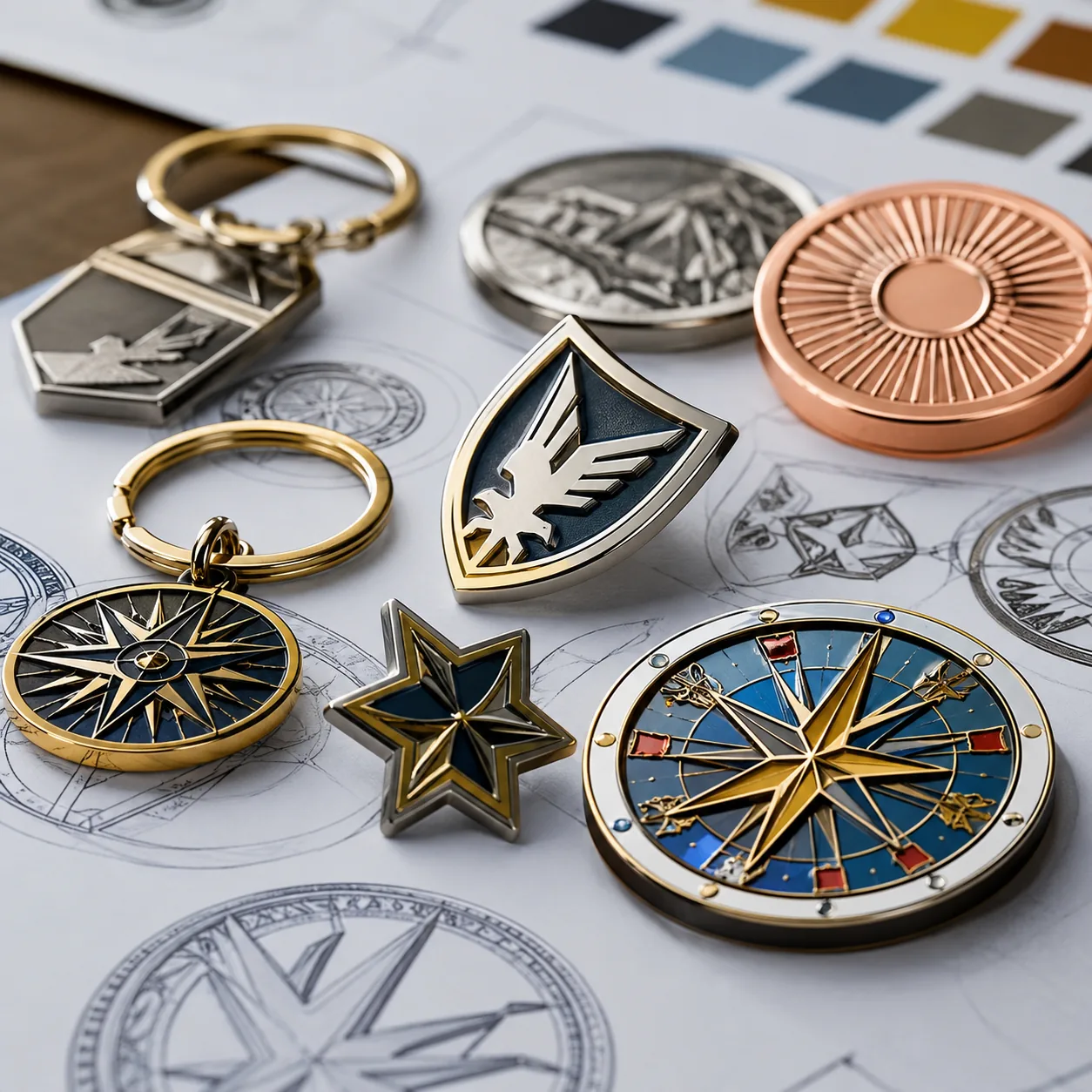
Why artwork prep causes most delays
Most custom metal giveaway projects do not fail on plating, tooling, or production capacity. They stall because the artwork file is not usable as a manufacturing reference. A buyer may send a low-resolution logo, a web image, or a PDF that looks clean on screen but lacks vector paths, named layers, and measurable linework. The factory then has to redraw, confirm dimensions, and sometimes correct design intent before any quoting or sampling can begin.
For international buyers, this matters because every extra clarification round adds days and often changes the quote. A simple pin or badge can move from a 10-14 day sample cycle to 15-20 days if the artwork needs reconstruction. More complex items like challenge coins, multi-layer keychains, or patches with stitched text can lose a full week if line thickness, color separations, or cutout geometry are unclear. The cheapest way to reduce cost is to make the first file technically complete.
What a factory actually needs
A production-ready file is not just a pretty image. It is a set of instructions that allows the maker to define metal borders, recessed areas, enamel fills, plating breaks, and cutting paths without guessing. At minimum, the design should be supplied as editable vector artwork in AI, EPS, or PDF with text converted to outlines and all linked images embedded. For pinned products, we also need the finished size, intended metal line thickness, Pantone references if color matching matters, and notes on whether the design should be soft enamel, hard enamel, printed, or mixed-process.
ZheCraft typically reviews artwork against the manufacturing method before we quote. That means checking whether a 20 mm lapel pin has enough room for a 0.25 mm recessed line, whether a 35 mm coin can support 3D relief without losing facial detail, or whether a 25 mm keychain has enough internal space for split-ring hardware. If the buyer leaves those decisions open, the factory has to assume a safe spec, and the product may look technically correct but visually different from the brand brief.
File formats and tolerances
Different product types need different levels of precision. Pins and badges usually tolerate a little simplification because small enamel areas can be visually adjusted during tooling, but challenge coins and engraved items need sharper line control because depth and texture are part of the design. Patches and lanyards are even more dependent on file discipline: thread count, stitch direction, and weave resolution can expose every weak edge in the source art. The practical rule is that the smaller and more detailed the item, the less forgiveness there is for raster art or ambiguous strokes.
The table below shows the file standards buyers should target before requesting a quote or sample. These are the specifications that most reliably prevent redraws, but they should be matched to the product type and decoration method rather than copied blindly across every item.
| Item type | Preferred file standard | Key tolerance or spec | Common risk if ignored |
|---|---|---|---|
| Enamel pin | Vector AI or EPS; text outlined | Minimum practical line width 0.20-0.25 mm | Lost details and broken enamel cells |
| Challenge coin | Vector AI with defined relief notes | Readable features at 0.30-0.40 mm depth/edge control | Soft faces, muddy textures, poor 3D translation |
| Keychain | Vector PDF or AI with hardware callouts | Cutout gaps and holes sized to 0.40-0.60 mm minimum | Weak joints or clip interference |
| Patch | Vector art plus stitch notes | Fine text generally needs 1.5-2.0 mm cap height | Unreadable lettering and thread crowding |
| Lanyard | Vector art in repeat layout | Clear repeat length and print-safe margins | Broken pattern seam or off-center logos |
The proofing checklist buyers should use
Before you send artwork to a supplier, run a simple internal check. Ask whether the file shows the exact finished shape, not just the logo. Confirm whether all stroke widths are intentional or just screen-view defaults. Make sure every color is identified if the order depends on brand matching, and confirm whether the item needs front-only decoration or a backstamp, serial number, or print on both sides.
If the factory has to infer the design intent, approval becomes slower and riskier. For example, a buyer may think a tiny gap in a logo is decorative, while the engineer may treat it as an accidental opening and close it during cleanup. That can change the product geometry, especially on stamped or cast metal pieces where thin areas can collapse in tooling. The best files make it difficult to misunderstand the brand intent.
- Provide editable vector artwork, not only a screenshot or raster logo
- Outline fonts and remove hidden layers, masks, and stray points
- State finished size in millimeters, not only in pixels
- Label every Pantone or print color if color accuracy matters
- Mark cut lines, holes, cutouts, and any moving parts
- Specify whether the art should be mirrored for the back side
- Include a reference photo only as secondary guidance, not as the main file
Common file problems and factory impact
The most expensive artwork mistakes are usually not obvious. Low-resolution files can appear acceptable on a laptop but fail when enlarged for tooling. Tiny text may be readable in a presentation deck but become illegible when the metal edge consumes available space. Overlapping shapes, inconsistent stroke widths, and unclosed paths can also force manual redraws, which raises cost and creates a second point where human interpretation can drift from the original design.
A good supplier will flag these issues early, but the buyer still pays in time. Redraw fees are often modest, sometimes free for a simple cleanup, but the hidden cost is delay and approval churn. On a standard promotional pin or keychain, an extra round of corrections can add 2-4 days; on a multi-item promo set where multiple products must share one visual system, the delay can be longer because each component has to be aligned to the same art source. That is why file discipline matters even when the unit price is low.
When to redraw, simplify, or split the design
Not every design should be manufactured exactly as submitted. Very fine gradients, photographic shading, and dense text blocks often need to be simplified for metal production. If a logo includes hairline details that fall below 0.20 mm, those details may disappear in soft enamel, blur in printing, or collapse during casting. In that case, the correct move is not to force the artwork through, but to redraw the graphic for the chosen process.
Sometimes the right answer is to split one design into two production methods. For example, a sharp logo outline can be stamped or die-struck, while interior color is handled by soft enamel or printing. Another common approach is to remove tiny taglines from the front and move them to the backstamp or backing card. This keeps the front visually clean while preserving brand information somewhere the buyer can still use it.
Comparison of art preparation approaches
The preparation method should match the order complexity. A simple single-color badge does not need the same art-control depth as a full series of branded promo items. Buyers who understand this can shorten sampling time and reduce the odds of rework. The comparison below is a practical planning guide, not a rigid rule, but it shows why different file standards produce very different outcomes in factory review.
| Preparation approach | Best for | Benefits | Trade-offs |
|---|---|---|---|
| Basic logo file cleanup | Simple pins or keychains | Fastest start, lower prep effort | Higher risk of redraw and small-detail loss |
| Fully engineered vector pack | Coins, badges, complex pins | Best control over size, lines, and cutouts | Needs more buyer time upfront |
| Product-specific art set | Promo bundles with multiple items | Keeps one brand consistent across SKUs | More files to manage and approve |
| Factory-assisted redraw | Legacy logos or rough source art | Useful when source art is incomplete | Adds coordination time and approval steps |
What to send before quoting or sampling
The smartest buyers do not send a single artwork file and wait. They send a small spec pack that lets the factory quote accurately the first time. That pack should include the editable art file, finished dimensions, intended product type, plating direction if relevant, attachment or hardware preference, and any must-keep brand elements. If the project is part of a campaign, include the order quantity range and target delivery date so the supplier can decide whether the design is feasible at the requested speed.
For ZheCraft, the best RFQs usually include both the artwork and a short manufacturing note. Even a brief note like hard enamel, 30 mm, nickel plating, matte gold, one logo color to match Pantone 186 C, back with butterfly clutch gives the engineering team enough information to check feasibility and suggest adjustments early. That is far better than asking for a price on a file that still needs interpretation.
What to do next
If you are preparing a custom pin, coin, badge, keychain, patch, or lanyard order, audit the artwork before you ask for pricing. Check file format, text outlines, finished size, minimum line widths, color callouts, and whether the design needs simplification for the chosen process. If any part is unclear, fix it before the quote stage, because that is where most avoidable delays start.
If you want, use a one-page submission pack for your next project: source artwork, finished size, product type, color references, hardware needs, and target quantity. That gives the factory enough information to judge manufacturability, estimate lead time, and reduce revision loops. For mixed promo programs, it is also the easiest way to keep all items visually consistent without forcing every product to share the same technical limits.
Have a project? Send your artwork and target quantity and we’ll reply with a detailed quotation within 12 working hours.
Ready to get this made?
Send your sketch, target quantity and ship-date. Detailed quotation in 12 hours.



